
A stablecoin launch needs six workstreams: 1:1 reserves, mint and burn controls, compliance, audited contracts, banking, and liquidity. Under the GENIUS Act, effective January 18, 2027, reserves must be liquid dollar assets. A Troniex build takes 4-8 weeks and costs $15,000 to $45,000+. Licensing and banking set the real launch date.
To launch a stablecoin, an issuer needs six things in place: reserves, mint and burn controls, compliance, smart contracts, banking, and liquidity. Miss one and the coin either never goes live or fails its first redemption wave.
Three decisions set your cost and timeline before anyone writes code. Where you issue. What backs the coin. Whether you build or use a platform.
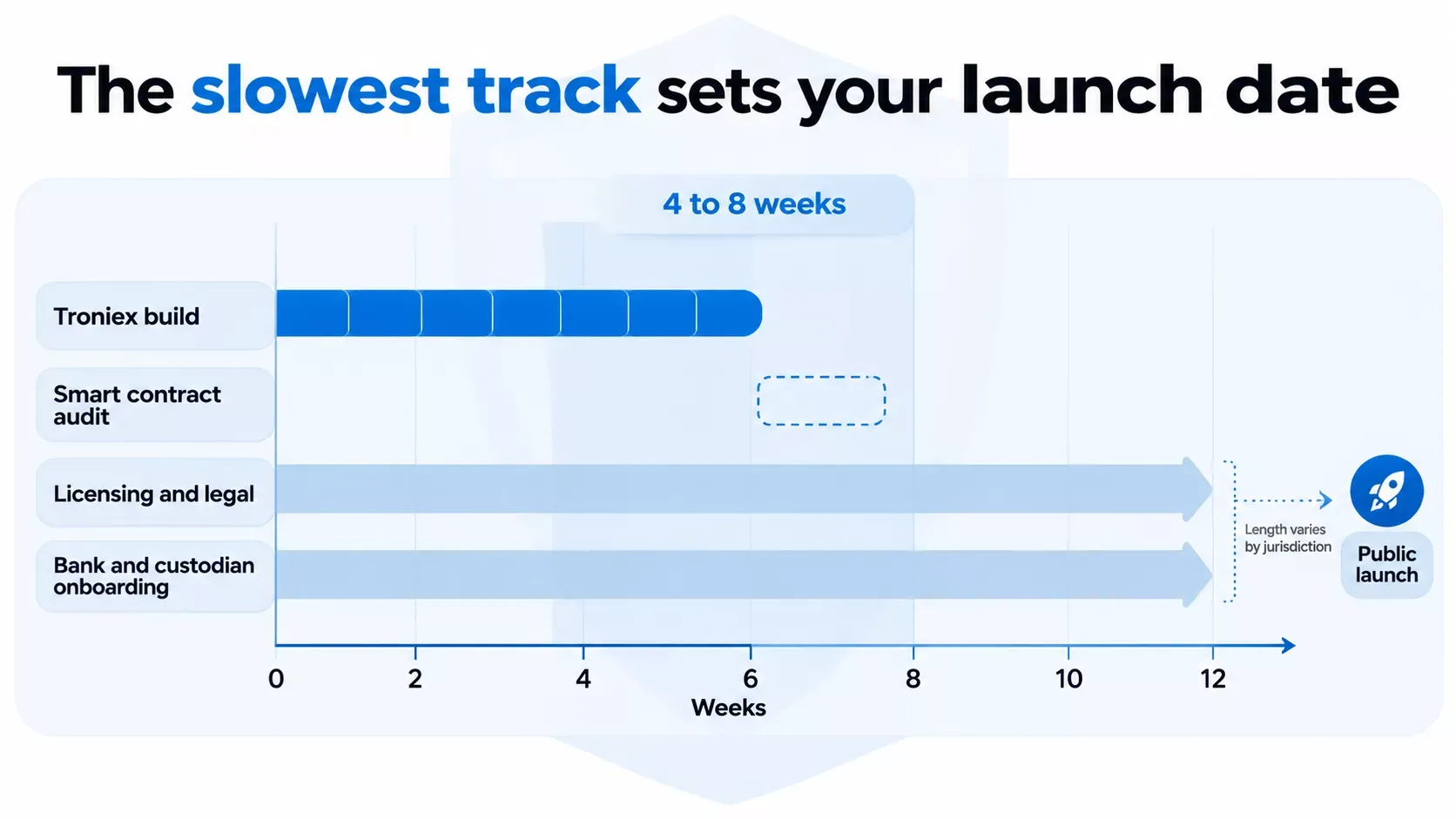
A Troniex stablecoin build runs 4-8 weeks and costs $15,000 to $45,000+. Licensing and bank onboarding run on their own clock, and that clock is often longer than the build. If you want the build handled end to end, see our stablecoin development company page.
Every token in circulation needs a matching reserve asset.
Key Takeaways
- Fiat-backed is the clearest path for a first launch. It fits the reserve models in both the GENIUS Act and MiCA.
- Reserves must equal tokens in circulation and stay segregated. Reconcile them daily, not only in the monthly report.
- Split mint, pause, and upgrade powers across separate keys. Add multisig approval and a daily mint cap.
- Par redemption under a published policy is a legal requirement in the US and the EU.
- The GENIUS Act and the OCC rule take effect January 18, 2027. After that date, issuing without permitted issuer status is unlawful in the US.
- A Troniex build takes 4-8 weeks and costs $15,000 to $45,000+. Audits, licensing, banking, and liquidity cost extra.
- Launch in phases with a low mint cap, and write a depeg runbook before mainnet.
How to Launch a Stablecoin: The 6 Core Workstreams
Launching a stablecoin means setting up six workstreams: a reserve structure that backs every token 1:1, mint and burn controls, a compliance program, audited smart contracts, banking and custody partners, and launch liquidity. The issuer owns reserves and licensing. The engineering team owns contracts and the mint and redeem backend.
|
Workstream |
Owner |
Where it sits |
|---|---|---|
|
Reserve structure and custody |
Issuer, bank or custodian |
Outside the build, client-dependent |
|
Mint and burn controls |
Engineering |
Inside the 4-8 week build |
|
Compliance program and tooling |
Issuer, counsel, engineering |
Tooling inside the build, licensing outside |
|
Smart contracts and audit |
Engineering, audit firm |
Contracts inside the build, audit outside |
|
Banking and fiat rails |
Issuer, bank |
Outside the build, client-dependent |
|
Liquidity and listings |
Issuer, market maker |
After mainnet |
The split matters for planning. Engineering finishes in weeks. Banks and regulators set the pace for everything else, so start those conversations on day one.
How to Create a Stablecoin: Choose the Backing Model and Issuer Entity
Two choices come first. The backing model decides how the peg holds. The issuer entity decides which regulator you answer to.
Fiat-Backed, Crypto-Collateralized, and Algorithmic Stablecoins
|
Model |
How the peg holds |
Regulatory fit |
Best for |
|---|---|---|---|
|
Fiat-backed |
1:1 reserves in cash and short-term Treasuries, redeemable at par |
Built for the GENIUS Act and MiCA |
Payments, remittance, treasury products |
|
Crypto-collateralized |
Overcollateralized on-chain assets, liquidated when collateral drops |
Does not fit the 1:1 reserve model of regulated payment stablecoins |
DeFi-native protocols |
|
Algorithmic |
Code adjusts supply to hold the price |
Does not fit the reserve-backed model both regimes require |
Experiments only |
Terra's UST, an algorithmic design, collapsed in May 2022. For a first launch, pick fiat-backed. It has the clearest legal path and the simplest mint and redeem logic.
Pick the Right Issuing Entity
Your entity type follows the market you sell into.
- United States: A permitted payment stablecoin issuer. The GENIUS Act recognizes three paths: a subsidiary of an insured depository institution, a federal qualified issuer, or a state qualified issuer. From January 18, 2027, issuing a payment stablecoin without that status is unlawful.
- European Union: An authorized credit institution or e-money institution issues e-money tokens under MiCA.
- Singapore: The Monetary Authority of Singapore (MAS) regulates single-currency stablecoins.
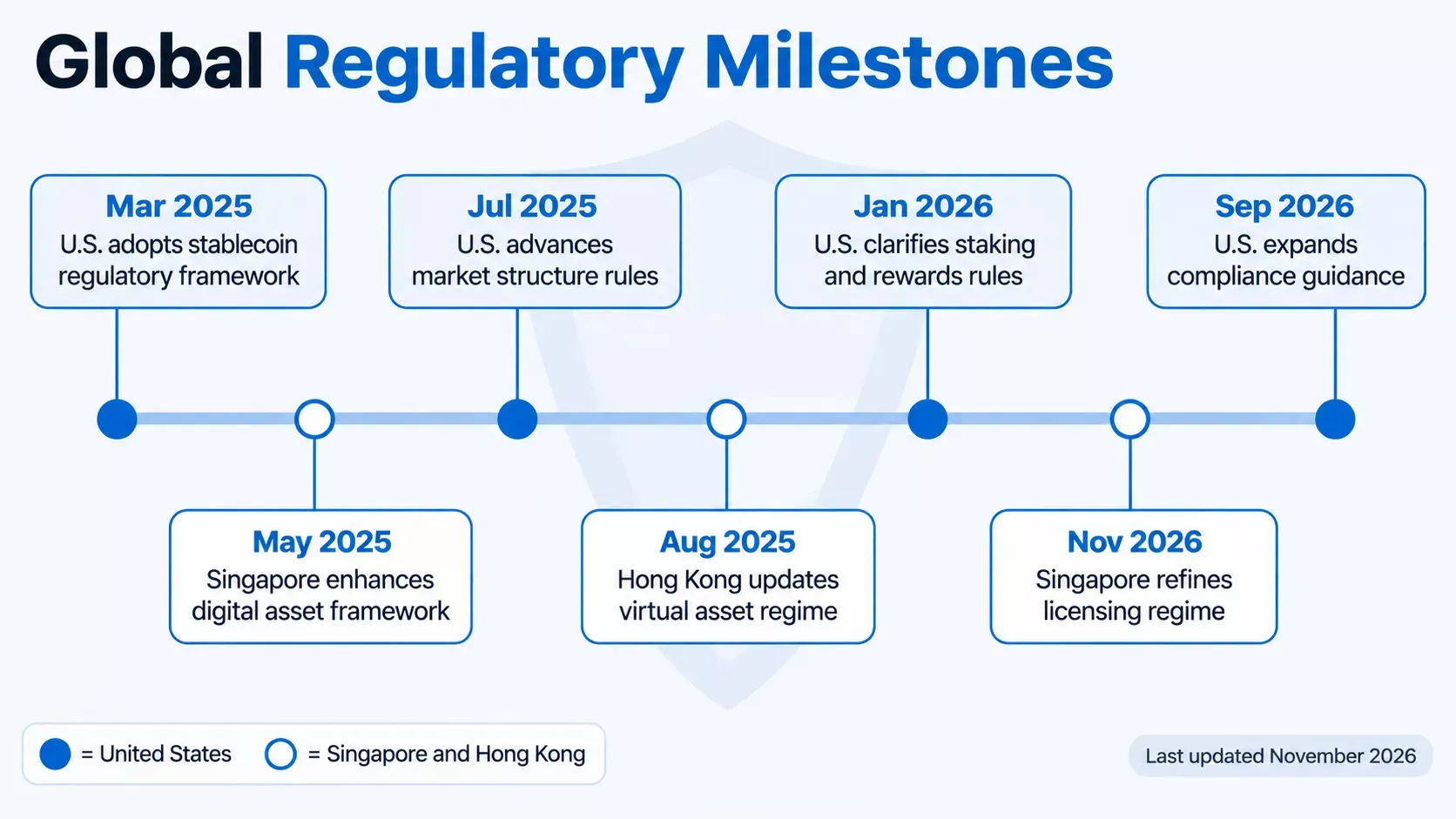
- Hong Kong: The Hong Kong Monetary Authority (HKMA) licenses fiat-referenced stablecoin issuers under the Stablecoins Ordinance. The first licenses went out in April 2026.
Most teams pick one primary regime and add others after launch. Jurisdiction details are in the compliance section below.

Ready to Launch Your Own Stablecoin? Build It with Troniex Technologies
Best for the middle of the article and the conclusion. Captures readers with active development intent.
Talk To Our ExpertsStablecoin Reserve Requirements: Assets, Custody, and Attestation
Reserves are the product. Every other workstream exists to keep one promise: a token redeems for one dollar. Regulators write most of their rules around that promise.
What Assets Stablecoin Reserves Must Hold
A fiat-backed stablecoin is backed by reserve assets worth at least as much as the tokens in circulation. Those assets are cash, bank deposits, short-term US Treasuries, or similar liquid holdings, kept in segregated accounts at a qualified custodian. Holders redeem tokens for dollars at par.
Under the GENIUS Act, eligible reserves include:
- US currency and funds held at a Federal Reserve Bank
- Demand deposits at insured depository institutions
- Treasury bills, notes, or bonds with 93 days or less to maturity
- Repurchase and reverse repurchase agreements backed by Treasuries
- Other similarly liquid, federally backed assets approved by the primary regulator
Corporate debt and equities are not on the list. The Act bars issuers from pledging, rehypothecating, or reusing reserves except for narrow operational purposes. Reserves stay segregated from operating funds.
In an insolvency, token holders hold a priority claim on the reserve assets. The Act also bars issuers from paying interest or yield to holders for holding or using the coin.
Reserve Rules by Jurisdiction
|
Rule |
United States (GENIUS Act) |
European Union (MiCA, e-money tokens) |
|---|---|---|
|
Backing ratio |
1:1 |
1:1 |
|
Asset types |
Fed funds and insured deposits, Treasuries up to 93 days, Treasury-backed repo, other approved liquid federal assets |
Highly liquid instruments in the same currency, with at least 30% in separate accounts at credit institutions (Article 54) |
|
Custody |
Segregated, bankruptcy-remote, qualified custodian |
Segregated, protected from issuer insolvency |
|
Reporting |
Monthly public reserve disclosure, examined by a registered accounting firm, certified by the CEO and CFO |
Ongoing reserve reporting to the supervisor under MiCA |
|
Redemption |
Par redemption under a published policy |
Par redemption at any time |
Singapore's MAS framework, finalized in 2023, requires reserves of at least 100% of par value, held in cash, cash equivalents, or short-term sovereign debt of three months or less. Issuers return par value within 5 business days when holders redeem directly with them.
Hong Kong also requires full backing and par redemption. Check current terms with MAS and the HKMA before you finalize the reserve design.
Daily Reserve Reconciliation Process
Monthly reports satisfy regulators. A daily check protects you. The process takes five steps:
- Pull bank and custodian balances at a fixed time each day.
- Read circulating supply from the token contract on every chain you issue on.
- Calculate variance: reserves minus total supply across chains.
- Compare variance against two limits: a floor of zero (any shortfall) and a ceiling on surplus, so excess funds don't sit unplanned in the reserve account.
- Log the result and require sign-off from two named people.
A shortfall triggers an automatic mint pause and an alert to the compliance lead. Build the pause into the contract's pauser role so it doesn't depend on someone reading email.
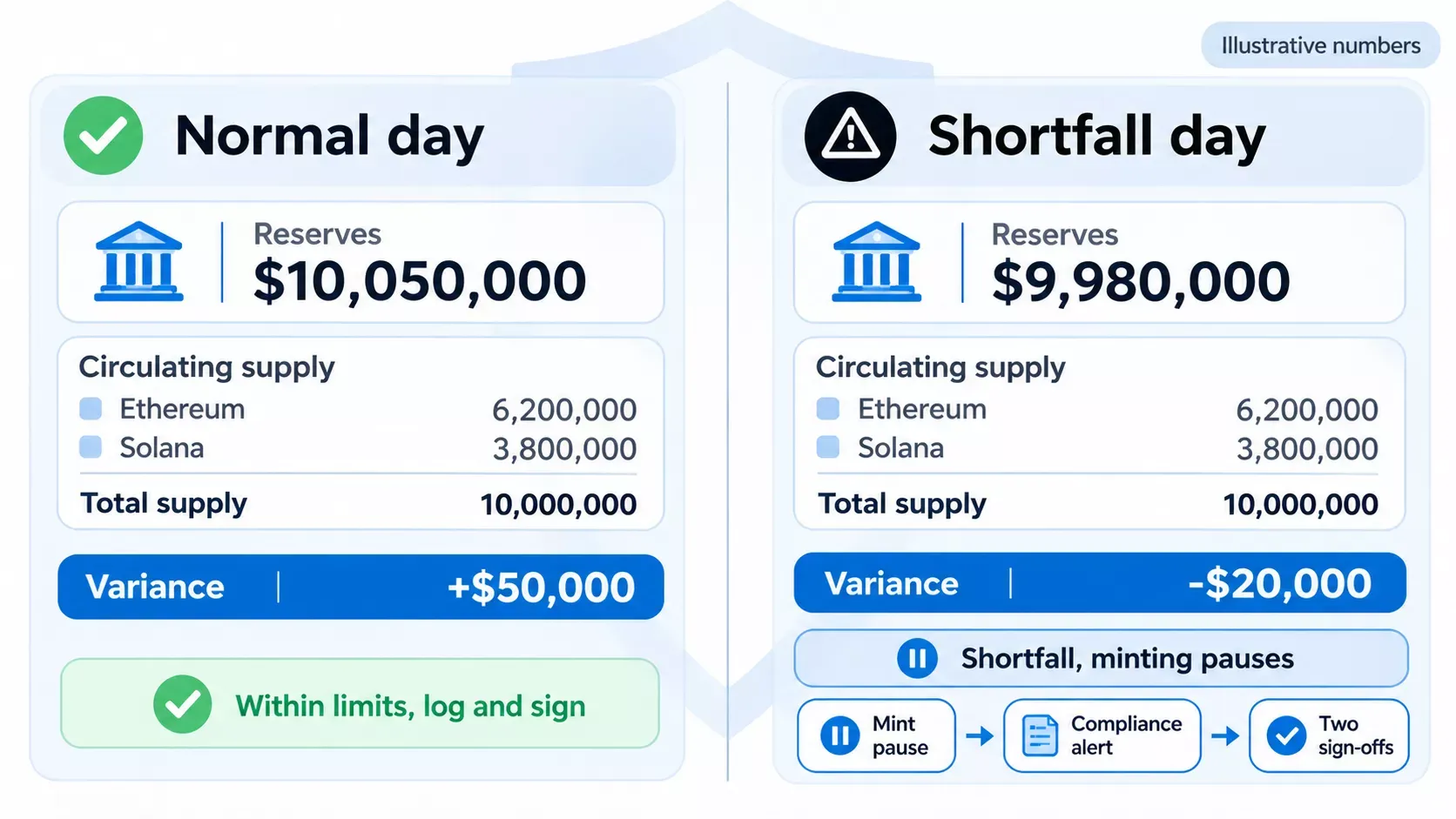
A shortfall of any size pauses minting until two people sign off.
Attestation, Audit, and Proof of Reserves
Attestation and audit are different products. An attestation is an accountant's report on reserves at a point in time. An audit is a deeper review of controls and financials. The GENIUS Act requires a monthly reserve report, examined by a registered public accounting firm and certified by the CEO and CFO.
Plan for that cadence from the first month. Issuers above $50 billion that are not SEC reporting companies also publish audited annual financial statements.
A public attestation page should show:
Reserve balance by asset class
Circulating supply by chain
The as-of date
The accounting firm's report
Proof of reserves is an optional layer. An on-chain oracle publishes reserve data next to the token's supply so holders see coverage in real time. It adds trust for DeFi integrations. It does not replace the monthly accountant report.
Stablecoin Minting and Redemption: How the Lifecycle Works
Minting creates tokens against deposits. Redemption destroys tokens and releases dollars. The loop is simple on paper. Most launch failures sit in the handoffs between bank, backend, and chain.
The Stablecoin Mint Flow
A stablecoin gets minted when an approved customer deposits fiat into the reserve account, the deposit clears, and an authorized minter signs a transaction that creates the same number of tokens on-chain. The contract adds the tokens to the customer's wallet and raises total supply by that amount.
The steps:
- Onboarding and KYC. The customer passes identity and sanctions checks before any deposit.
- Fiat deposit. The customer sends a wire or bank transfer to the reserve account.
- Deposit confirmation. The backend matches the incoming funds to the customer. Wires confirm the same day. ACH takes longer.
- Mint request. The system creates a request for the confirmed amount.
- Approval. One approver signs small requests. Two approvers sign requests above a set threshold.
- On-chain mint. The minter role calls the mint function. The daily mint cap is checked in the contract.
- Wallet receipt. Tokens land in the customer's allowlisted wallet.
The Stablecoin Redemption Flow
Redemption runs the loop in reverse:
- The customer submits a redemption request from a verified wallet.
- The customer sends tokens to the redemption address.
- The burner role burns the tokens on-chain.
- The backend confirms the burn and releases fiat from the reserve.
- The bank sends funds under your published redemption SLA.
Publish the SLA and meet it. Par redemption is the legal core of the product under both the GENIUS Act and MiCA. The GENIUS Act requires a public redemption policy that covers timely redemption and fees. A redemption queue that slips past your stated window is the fastest way to lose trust.
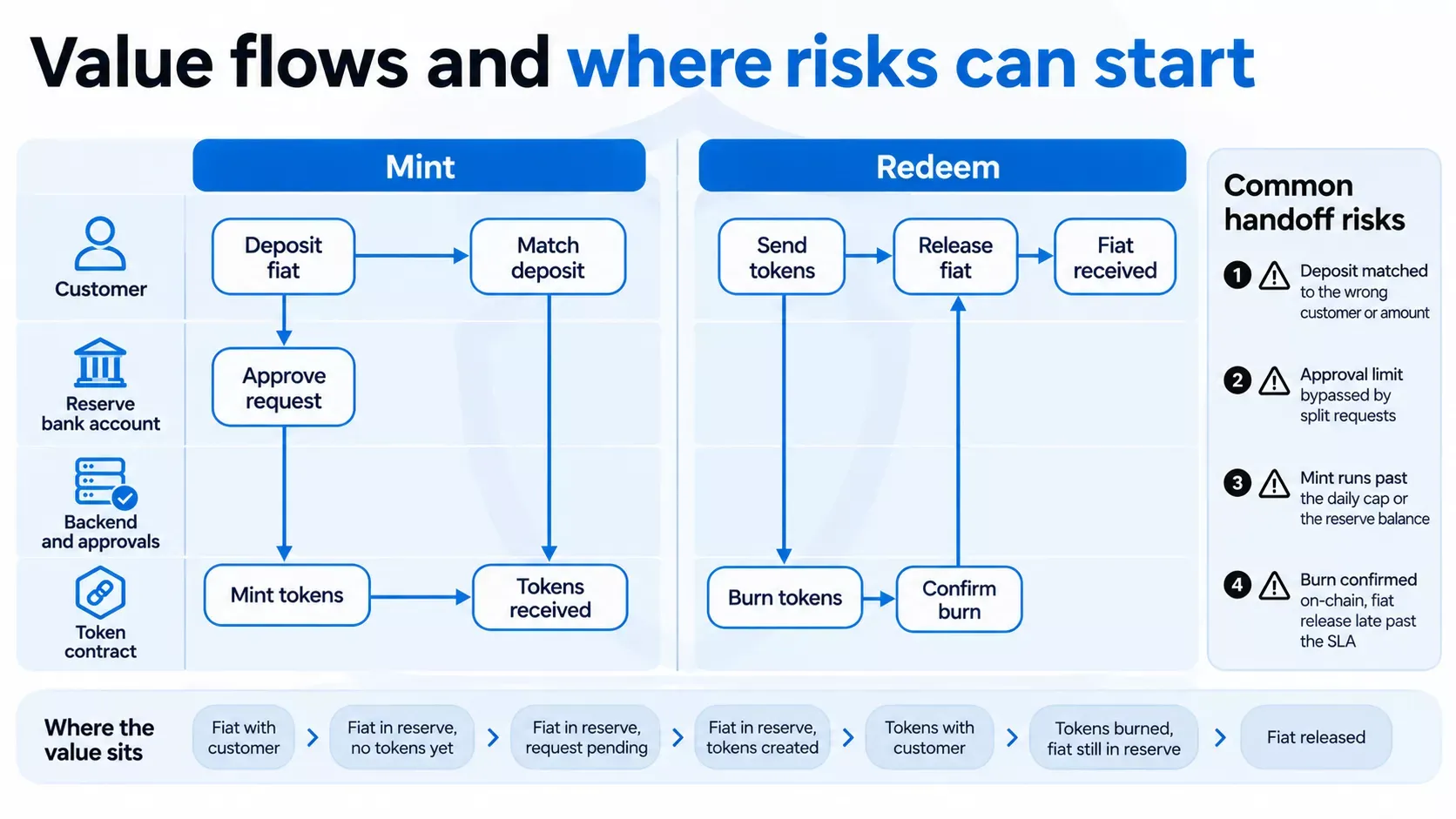
Most launch problems start at a handoff between bank, backend, and chain.
Smart Contract Controls and Role Separation
Split the powers. One key should never mint, pause, and upgrade.
|
Role |
Permission |
Typical holder |
Control |
|---|---|---|---|
|
Minter |
Create tokens within the daily cap |
Backend service key |
Multisig approval above a set threshold |
|
Burner |
Destroy tokens at redemption |
Backend service key |
Limited to the redemption address |
|
Pauser |
Halt transfers and minting |
Compliance lead and one engineer |
2-of-3 multisig |
|
Blacklister |
Freeze addresses on lawful order |
Compliance team |
Logged, two-person approval |
|
Upgrader |
Change contract logic |
Governance multisig |
3-of-5 with a 48-hour timelock |
These are common starting values. Set thresholds from your risk model and test them before mainnet. Add a daily mint cap and a short delay on large mints so a compromised key hits a wall.
The GENIUS Act also requires issuers to keep the technical ability to freeze, seize, or burn tokens on a lawful order. The pauser and blacklister roles carry that duty. For contract architecture detail, read our crypto token tech stack guide.
Best Blockchain for a Stablecoin Launch
Pick the chain where your users and liquidity already sit. Score each option on fees, custody support, exchange and wallet listings, and compliance tooling.
|
Chain |
Strength |
Trade-off to weigh |
|---|---|---|
|
Ethereum |
Deepest liquidity, widest custody and exchange support |
Higher fees at peak load |
|
Solana |
Low fees, fast finality, strong payments activity |
Different tooling from EVM chains |
|
Tron |
Heavy stablecoin transfer volume, low fees |
Narrower DeFi ecosystem |
|
Base |
Low fees, Coinbase ecosystem access |
Younger ecosystem |
|
Polygon |
Low fees, EVM tooling |
Smaller liquidity than Ethereum mainnet |
The table reflects general ecosystem positioning in November 2026. Launch on one chain first. Add chains after the reconciliation process handles one supply total cleanly.
Stablecoin Compliance by Jurisdiction: GENIUS Act, MiCA, and More
Compliance sets your launch date more than engineering does. Rules also moved in 2026, so date every claim you rely on.
This section is general information, not legal advice. Confirm each point with counsel in your issuing jurisdiction.
US and Asian milestones in date order. MiCA is covered in the section below.
United States: GENIUS Act Requirements
The GENIUS Act sets federal rules for payment stablecoin issuers. It covers reserve backing, redemption, reporting, and the ability to freeze tokens on lawful order. It also bars issuers from paying interest or yield to holders for holding or using the coin.
Rulemaking status as of November 19, 2026:
- The OCC issued its final rule on October 21, 2026 (Bulletin 2026-50). It creates 12 CFR Part 15 and covers permitted activities, reserve assets, redemption, risk management, audits, and reporting.
- The rule and the Act take effect January 18, 2027. After that date, issuing a payment stablecoin without permitted issuer status is unlawful.
- From July 18, 2028, digital asset service providers are barred from dealing in non-compliant stablecoins.
- The Federal Reserve proposed reserve limits and capital standards in September 2026.
- Treasury, FinCEN, and OFAC have proposed anti-money laundering, sanctions, and customer identification rules. None were final as of this date.
Sources: OCC final rule summary and Federal Reserve proposal coverage.
European Union: MiCA E-Money Token Rules
MiCA treats a stablecoin pegged to one official currency as an e-money token. Only an authorized credit institution or e-money institution issues one. Article 54 of MiCA requires at least 30% of funds received to sit in separate accounts at credit institutions, with the rest in highly liquid instruments in the same currency. Tokens classed as significant face a higher deposit share. Holders redeem at par at any time under Article 49. The EU register of authorized issuers lists current authorizations.
Singapore and Hong Kong Stablecoin Licensing
Singapore's MAS finalized its framework for single-currency stablecoins pegged to the Singapore dollar or a G10 currency in 2023. It sets the reserve and redemption rules described above.
Hong Kong's Stablecoins Ordinance took effect on August 1, 2025 and requires an HKMA license for issuers of fiat-referenced stablecoins. The HKMA issued its first licenses on April 10, 2026, to HSBC and Anchorpoint Financial, a joint venture involving Standard Chartered. Both are authorized to issue Hong Kong dollar stablecoins.
|
Jurisdiction |
Regulator |
Issuer path |
Status |
|---|---|---|---|
|
United States |
OCC, Federal Reserve, Treasury |
Permitted payment stablecoin issuer |
OCC final rule October 21, 2026, Act effective January 18, 2027 |
|
European Union |
National authorities, EBA |
Credit or e-money institution |
In force, authorizations issued |
|
Singapore |
MAS |
Issuer under the MAS stablecoin framework |
Framework finalized in 2023 |
|
Hong Kong |
HKMA |
Licensed issuer under the Stablecoins Ordinance |
In force since August 1, 2025, first licenses April 2026 |
Day-One Compliance Stack: KYC, AML, and Sanctions Screening
Build these controls before the first mint:
|
Control |
Driver |
Tool category |
|---|---|---|
|
KYC onboarding |
AML and customer due diligence rules |
Identity verification provider |
|
Sanctions screening |
OFAC and equivalent lists |
Screening API |
|
Transaction monitoring |
AML program requirements |
Blockchain analytics |
|
Travel rule messaging |
FATF travel rule |
Travel rule network |
|
Freeze, seize, and burn |
Lawful order duty |
Pauser and blacklister roles |
|
Record keeping |
AML record retention |
Audit log store |
Wire these into the mint flow so a failed check blocks the mint. A manual review step after the fact leaves a gap that regulators notice. For more on monitoring, read our crypto payment gateway compliance guide and our piece on AI-powered stablecoin development.
Stablecoin Development Cost and Timeline: $15,000 to $45,000+ in 4-8 Weeks
A stablecoin build with Troniex costs $15,000 to $45,000+ and takes 4-8 weeks. That covers smart contracts, the mint and redeem backend, compliance tooling, and integrations. Audits, licensing, legal fees, and bank onboarding cost extra and depend on your jurisdiction.
What Drives Stablecoin Development Cost
The "+" in the range comes from scope. These factors move the price:
- Number of chains at launch
- Custodial or non-custodial mint flow
- KYC, AML, and analytics vendor integrations
- Admin dashboard scope, from basic controls to full reporting
- Fiat rails and banking API connections
- Multi-asset or multi-currency support
Launch Costs Outside the Build
Budget separately for:
- Smart contract audit, ideally from two firms
- Legal and licensing fees
- Bank and custodian onboarding
- Initial liquidity
- Ongoing attestation or audit fees
Quotes for these vary by jurisdiction and firm, so get them in writing early.
Get a Custom Stablecoin Development Cost and Project Estimate
Best immediately after the cost and timeline section. Targets readers evaluating vendors and budgets.
Request A ProposalStablecoin Launch Timeline by Phase
The build runs 4-8 weeks, depending on scope.
|
Phase |
What ships |
Client supplies |
|---|---|---|
|
Discovery and architecture |
Reserve flow, role matrix, chain choice |
Issuer entity, banking partner, target markets |
|
Contract build |
Token contract with mint, burn, pause, and freeze controls |
Role holders, multisig signers |
|
Backend build |
Mint and redeem services, reconciliation job |
Bank API access, custodian details |
|
Compliance tooling |
KYC, sanctions, and monitoring integrations |
Vendor accounts, policy documents |
|
Testnet and audit handoff |
Testnet release, test reports, audit-ready code |
Audit firm engagement |
|
Mainnet deployment |
Production contracts and monitoring |
Final sign-off |
|
Licensing and bank onboarding |
Runs in parallel |
Client and counsel; length varies by jurisdiction |
Other guides quote 3 to 24 months for a stablecoin launch. Those ranges often bundle legal approvals and banking with the build. Separating them gives you a build date you control and a regulatory date you plan around.
The build finishes first. Licensing and banking decide when you go live.
Planning a build? Get a scoped quote for your stablecoin build.
How to Launch a Stablecoin in Phases: Mint Caps, Liquidity, and Stress Tests
Don't open at full scale. Phase the launch and raise limits as controls prove out.
Phase 1: Allowlisted mainnet. Set a low mint cap. Allow only vetted wallets. Run a full redemption test with internal funds. Exit when mint, burn, reconciliation, and fiat release all match for several consecutive days.
Phase 2: Partner pilot. Raise the cap. Onboard a small group of partners. Measure real settlement times against your stated SLA. Exit when redemptions meet the SLA at the new volume.
Phase 3: Public launch. Open to the market. Seed liquidity on exchanges and DEXs. Connect on and off ramps through a stablecoin payment gateway. Exit when depth holds the peg through ordinary trading swings.
On liquidity, Brale's 2024 guide described 20K-50K as often enough for the first phase of a program, using venues such as Uniswap v3 on EVM chains and Orca on Solana. That figure is a March 2024 data point, so size your own pools from your target depth.
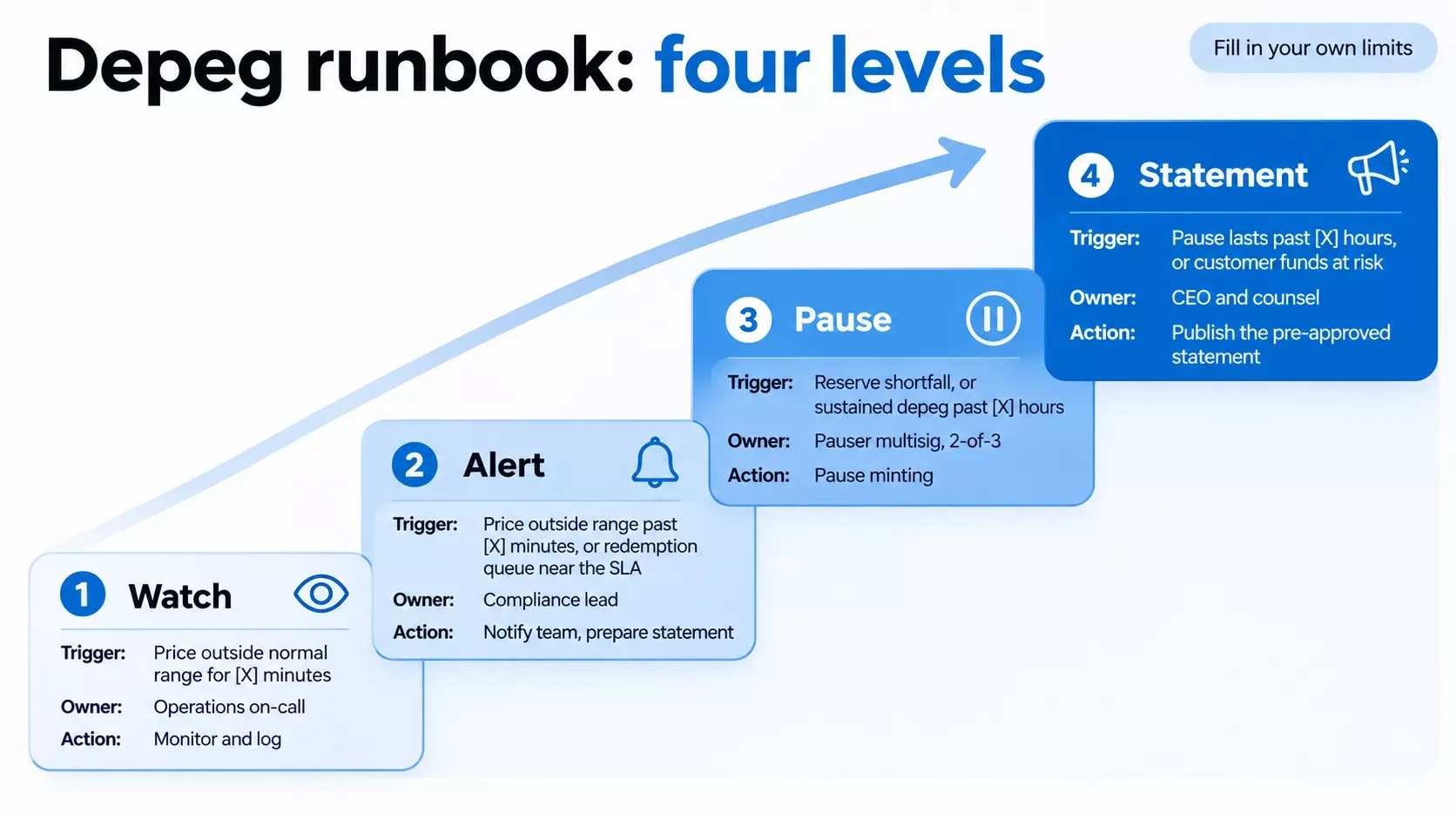
Write a depeg runbook before launch. It names the triggers (price band, redemption queue length, reserve variance), who holds pause authority, and a short public statement ready to send.
Set every bracketed limit before launch and test the ladder once. For a step-by-step list, use our stablecoin platform launch checklist.
Custom Stablecoin Development vs Issuance Platform: Which to Choose
You have three routes: build custom, use a white-label issuer, or use an issuance platform. Each trades control against speed.
|
Route |
Control |
Speed |
Compliance burden |
Fit |
|---|---|---|---|---|
|
Custom build |
Full control of contracts, roles, and chains |
Weeks to build, plus licensing |
Issuer carries it |
Teams with custom logic or multi-chain plans |
|
White-label issuer |
Limited to the partner's template |
Fast |
Largely on the partner's license |
Brands that want a branded coin quickly |
|
Issuance platform |
Moderate, set by the platform's API |
Fast |
Shared |
Product teams adding a coin to an existing app |
Platforms worth evaluating:
- Paxos: A regulated stablecoin issuer.
- Coinbase custom stablecoins: Custom issuance for businesses.
- Brale: Stablecoin issuance with an API and exchange listings.
- Bridge: A Stripe company with issuance and payments infrastructure.
Check current terms with each provider before you decide.
Troniex builds custom stablecoin platforms with role-separated contracts, reconciliation tooling, compliance integrations, and multi-chain support. If your coin needs its own mint rules, reserve workflow, or chain mix, a custom build gives you that control. See our stablecoin development company service.
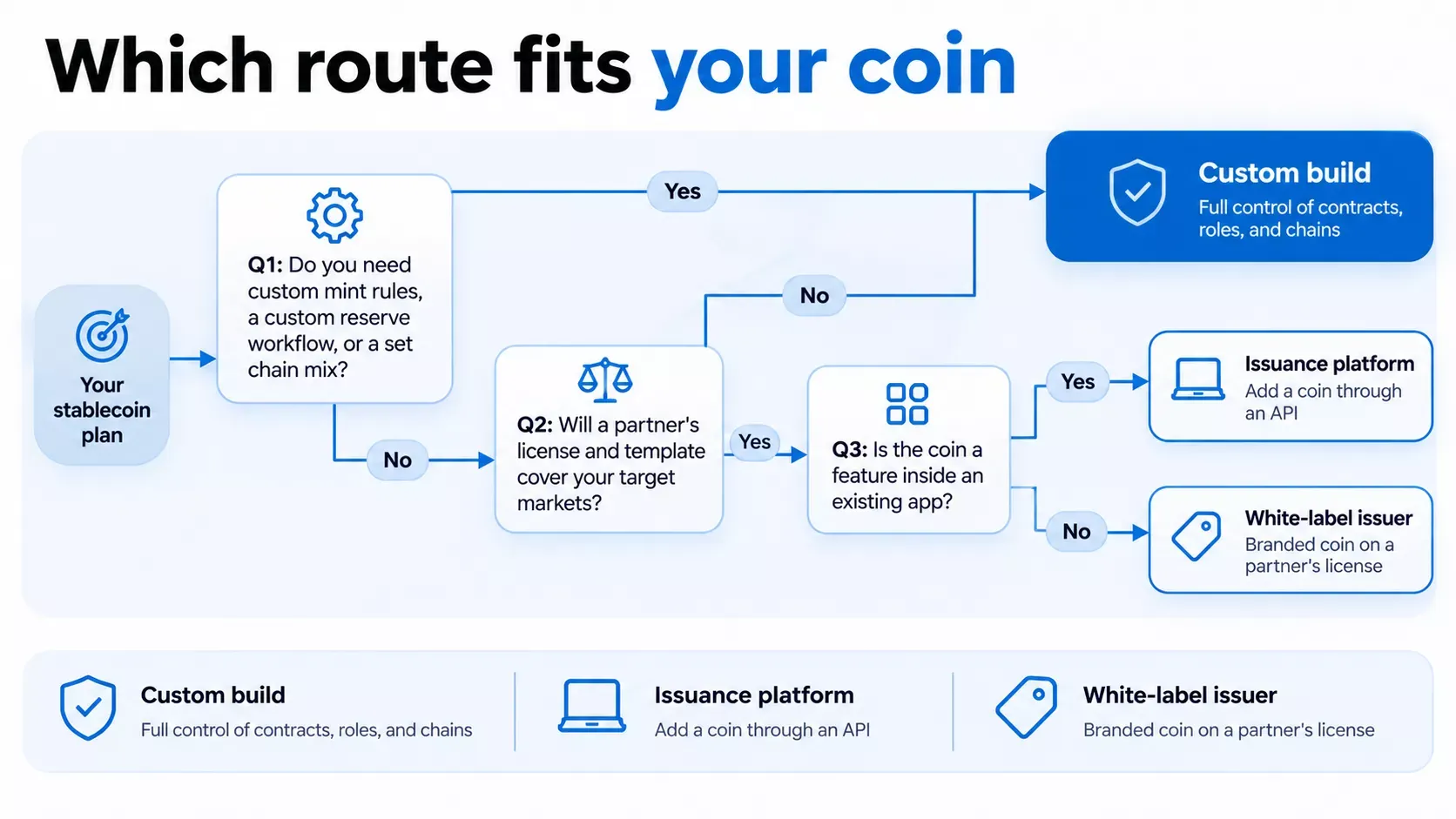
Pick a platform when speed and bundled licensing matter most and your token needs no custom logic. Pick custom when control over contracts and reserves is the product.
Common Stablecoin Launch Mistakes to Avoid
- Mixing reserves with operating funds. Fix: separate, bankruptcy-remote accounts from day one.
- A single-key minter. Fix: multisig approval above a threshold and a daily mint cap.
- No redemption SLA. Fix: publish one and test it before public launch.
- Licensing after launch. Fix: start counsel and regulator conversations during discovery.
- Thin day-one liquidity. Fix: line up a market maker and fund pools before the public phase.
Build a Compliant Stablecoin Platform with Enterprise-Grade Security
Best after the compliance and smart contract sections. Targets technically informed enterprise buyers.
Contact UsConclusion: Start With Reserves, Banking, and Licensing
Launching a stablecoin is a sequencing problem. Engineering finishes in 4-8 weeks. Reserves, banking, and licensing decide the rest, so start them first.
Pick a fiat-backed design, choose your issuing jurisdiction, and open conversations with a bank and counsel before the first line of contract code ships. Build the controls regulators ask about: segregated reserves, daily reconciliation, split key roles, and a published redemption policy. Then launch in phases, with a low mint cap and a tested depeg runbook.
The GENIUS Act takes effect January 18, 2027, and the OCC rule is already final. Teams that want a US-regulated coin have a clear date to plan against. Troniex builds the contracts, mint and redeem backend, and compliance tooling for that plan. Book a stablecoin architecture call to scope yours.