A wrong call on the chain, token standard, or contract design breaks the token before launch. The chain decides which wallets and exchanges accept it. The contract design decides who mints, freezes, or upgrades supply. The audit scope follows both.
We've delivered 150+ blockchain projects, including token launches on Ethereum, BNB Chain, Polygon, and Solana. This guide walks through each layer of the stack, names the option to pick in each case, and lists the tools that hold up in production. If you want a team to build it, see our crypto token development company page.
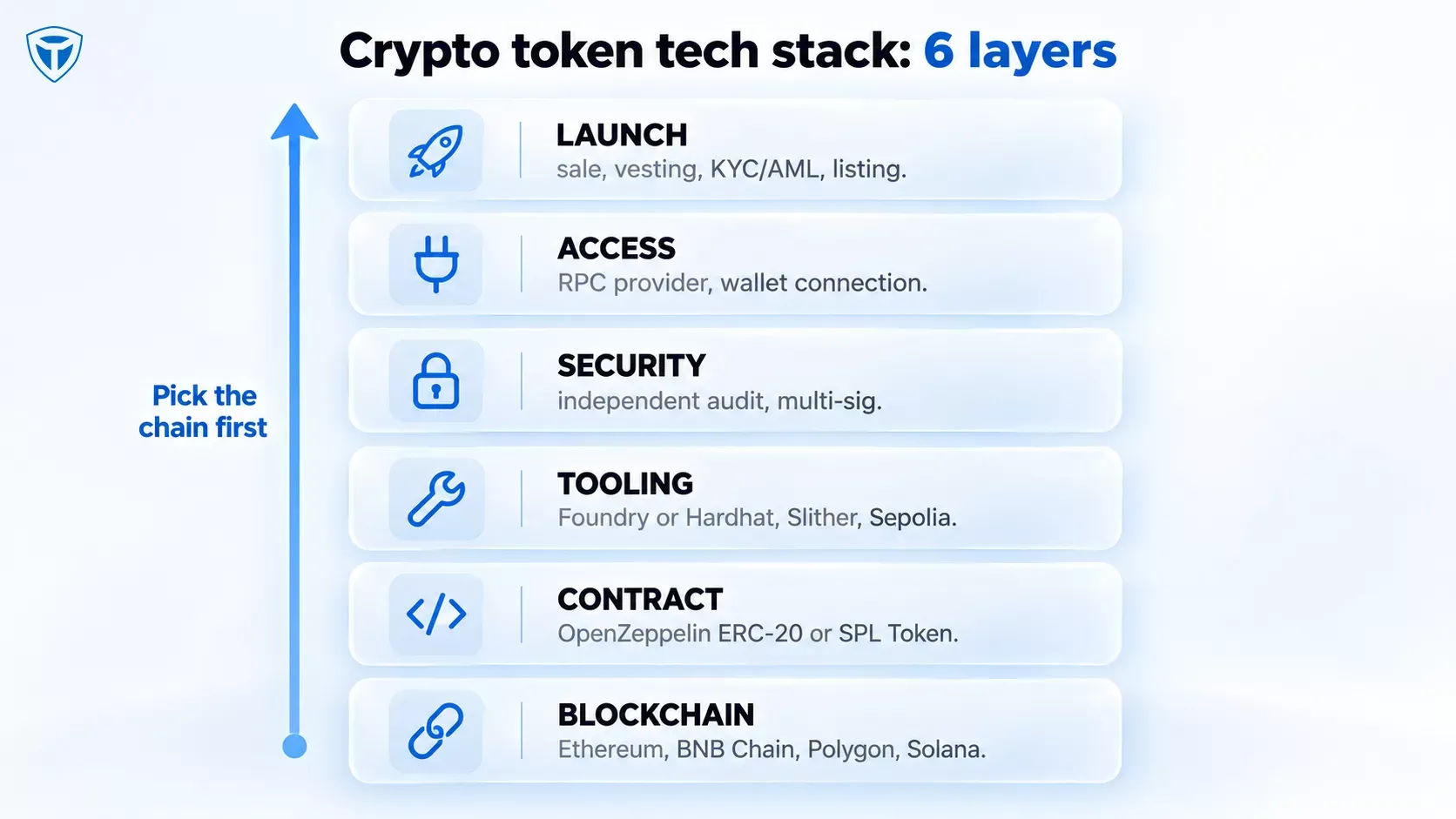
- Pick the chain first. It sets the token standard, the contract language, and the audit scope.
- Use Ethereum for exchange reach, BNB Chain or Polygon for lower fees, Solana for the lightest build. EVM chains share one toolchain.
- Extend OpenZeppelin contracts. Don't write token logic from scratch. Every extra extension adds audit scope and gas cost.
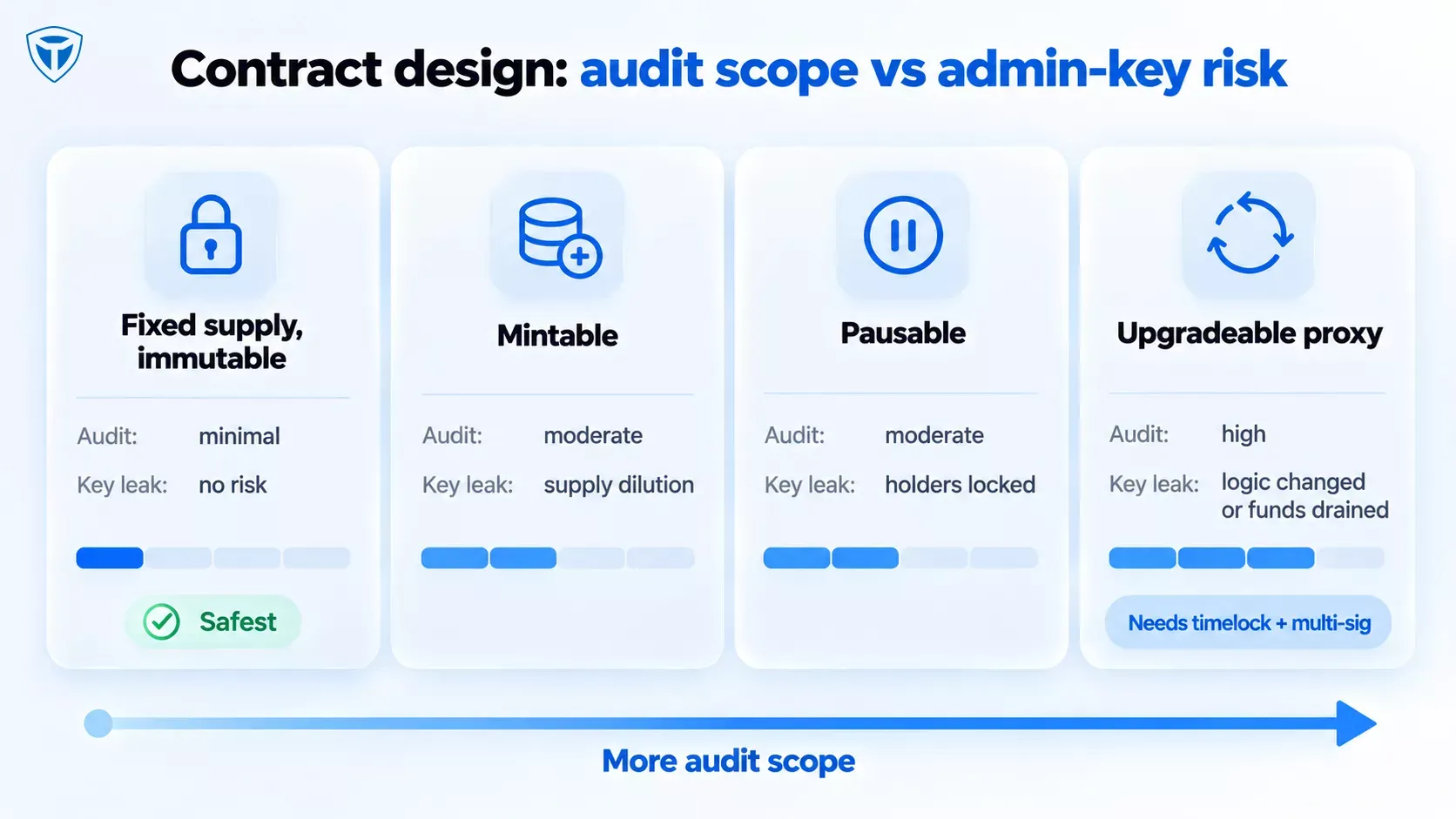
- Fixed supply with no admin keys is the safest design. Add mint, pause, or upgrade rights only when the product needs them.
- Hire an independent auditor and put admin roles in a multi-signature wallet. Exchanges and investors check both before they list or buy.
- Plan the launch layer early. Sale contracts, vesting, KYC/AML, liquidity, and exchange listing take longer than the token itself.

Scope Your Token Stack Before You Write A Line Of Code
Share your target holders, exchanges, and budget. We map the chain, token standard, contract design, and audit scope for your launch.
Talk to Our ExpertsWhat A Crypto Token Tech Stack Includes: 6 Layers
A token is a contract on an existing blockchain. You don't build the chain, the consensus layer, or the nodes. That makes a token stack shorter than a chain stack. It runs from the blockchain layer up through the contract, tools, audit, and launch.
- Blockchain layer: Ethereum, BNB Chain, Polygon, Solana, or Tron. This choice locks your token standard and contract language.
- Contract layer: smart contract code, libraries, token standard, and mint/burn logic. Written in Solidity (EVM) or configured through the SPL Token program (Solana).
- Tooling layer: compiler, test framework, static analyzer, testnet, and block explorer for verification.
- Security layer: independent code audit, admin key management, and multi-signature wallets.
- Access layer: RPC provider, wallet connection (MetaMask, Trust Wallet), and holder dashboard.
- Launch layer: token sale and vesting contracts, KYC/AML backend, liquidity setup and exchange listing.
Best Blockchain And Token Standard For Your Crypto Token
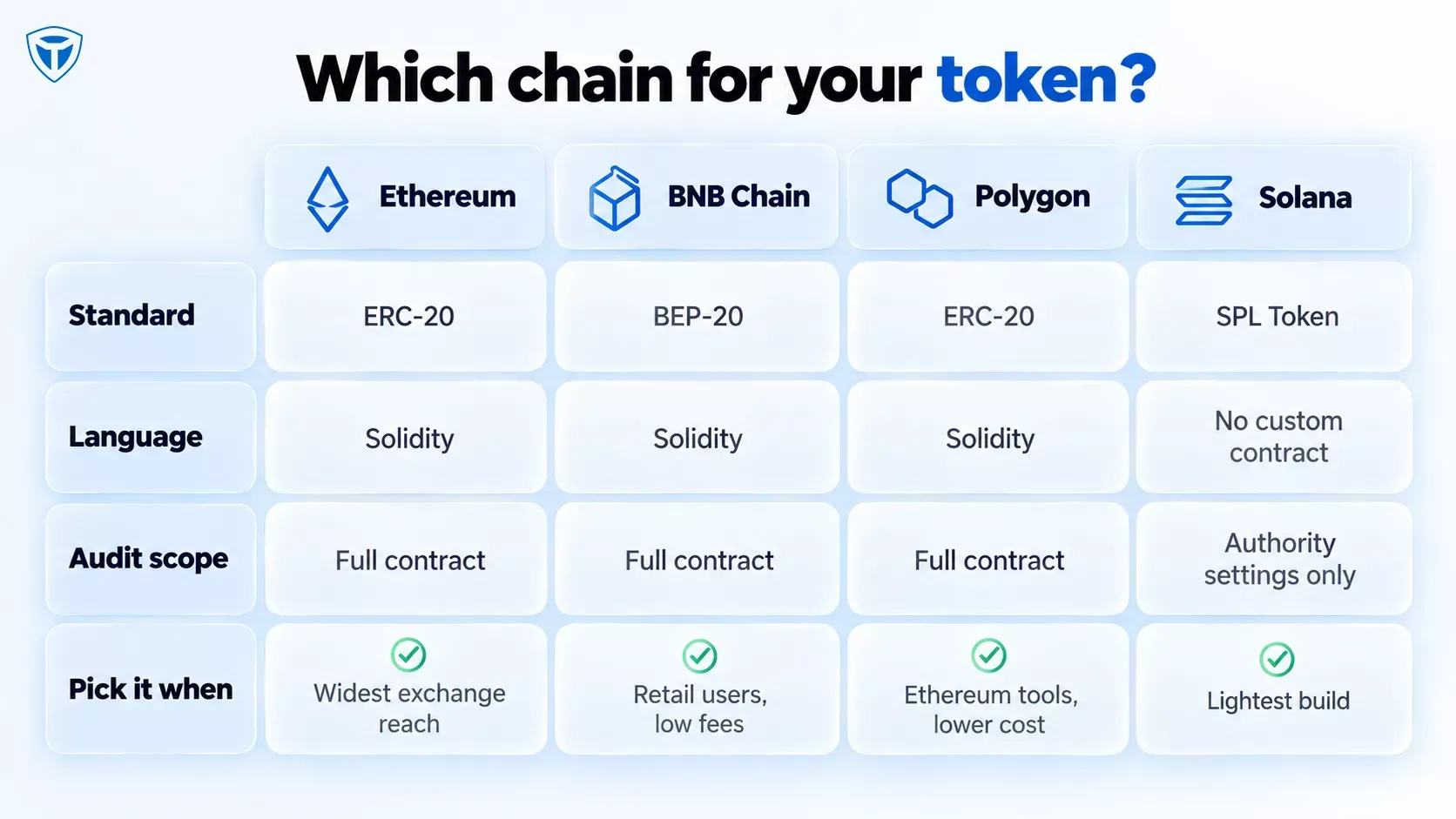
Pick the chain where your holders and exchanges already are.
|
Chain |
Standard |
Contract language |
Audit scope |
Pick it when |
|---|---|---|---|---|
|
Ethereum |
ERC-20 |
Solidity |
Full contract |
Exchange and wallet reach matter most |
|
BNB Chain |
BEP-20 |
Solidity |
Full contract |
You target retail users and low fees |
|
Polygon |
ERC-20 |
Solidity |
Full contract |
You want Ethereum tooling at lower cost |
|
Solana |
SPL Token / Token-2022 |
None for basic tokens |
Authority settings, plus any extension or hook program |
You want the fastest, lightest build |
Ethereum gives the widest exchange and wallet support at the highest deploy and transfer fees. ERC-20 is the standard, backed by a decade of production use and the audited OpenZeppelin ERC-20 contracts.
An ERC-20 transfer uses 45,000 to 65,000 gas. Cost equals gas used times gas price times the ETH price. At 2 gwei and ETH at $3,000, a 55,000-gas transfer costs about $0.33, and congestion multiplies that. Check the live Etherscan gas tracker before you set a budget.
BNB Chain and Polygon charge a fraction of Ethereum's fees for the same kind of transfer while keeping the EVM toolchain. Both use Solidity and the same tools. Read the BNB Smart Chain docs and the Polygon docs for current fee and finality figures.
Solana is fast and cheap per transfer. It uses the SPL Token program, which holds all token logic in one program you don't write. You configure supply, decimals, and mint authority. You still review those settings and any extension program you attach, so the audit scope is small, not zero. See the Solana token docs.
Compare the two EVM token standards in our post on the difference between ERC-20 and BEP-20.
EVM chains and their standards
ERC-20 is the Ethereum standard. It defines approve, transfer, transferFrom, and balance queries. Every wallet that speaks Ethereum speaks ERC-20, and most exchanges list ERC-20 tokens first.
BEP-20 mirrors ERC-20 in function and lives on BNB Chain. A holder's BEP-20 token has no value on Ethereum, so your docs and marketing must name the chain you launched on. Our BEP-20 token development company page covers builds on BNB Chain.
Polygon runs the EVM, so an ERC-20 contract deploys there unchanged. You get the Ethereum standard with lower fees and faster confirmation. See our guide to Polygon token development for deployment steps.
Solana and non-EVM chains
Solana uses the SPL Token program. You don't implement a standard. You configure a program. You set the mint authority (who creates new tokens), the freeze authority (who freezes accounts), the decimals, and the metadata. The program handles transfers, balances, and supply limits.
Token-2022 extends SPL with transfer fees, transfer hooks, confidential transfers, and a permanent delegate. Use SPL for a basic token. Use Token-2022 when the token needs logic on transfer. Read the Token Extensions overview before you pick extensions, because each one changes wallet and exchange support.
TRC-20 on Tron mirrors ERC-20 and suits stablecoin-heavy payment flows. This guide covers EVM chains and Solana. If your holders sit on Tron, see our TRC-20 token development company page.
Smart Contract Language And Libraries For Token Development
Use Solidity on EVM chains with OpenZeppelin Contracts as the base. Solana tokens use the SPL Token program, so you write no custom contract. Pick the chain first, because it sets the language and the audit scope.
Solidity with OpenZeppelin
OpenZeppelin Contracts is a set of audited base contracts for token logic, access control, and upgrades. You extend its ERC20 contract and add only what the token needs.
Standard extensions:
- Burnable: holders burn their own tokens. Use
ERC20Burnable. - Pausable: an admin pauses all transfers. Use
ERC20Pausable. - Capped supply: a hard cap set at creation. Use
ERC20Capped. - Permit: approvals by signature, so holders skip a separate approve transaction. Use
ERC20Permit. - Votes: token-weighted governance. Use
ERC20Votes.
Add only the extensions you need. Each one adds audit scope and gas cost. For custom contracts built and audited end to end, our smart contract development services team handles Solidity and Rust.
We're also an ERC-20 token development company with 4+ years in blockchain and AI.
Rust and the SPL Token program on Solana
On Solana, you create a mint account and set the mint authority, the freeze authority, and the metadata (name, symbol, decimals). The SPL Token program does the rest. For burn taxes, transfer hooks, or delegation, attach Token-2022 extensions. Hooks run as separate programs, and those programs need their own audit.
Fixed supply or mintable, upgradeable or immutable
|
Contract type |
What holders verify |
Audit scope |
Risk if the admin key leaks |
|---|---|---|---|
|
Fixed supply, immutable |
Supply is locked at deploy. No admin keys. |
Minimal. The token contract only. |
None. No admin keys exist. |
|
Mintable, immutable |
Supply grows. Admin mints. No upgrade path. |
Moderate. Mint logic and access control. |
A stolen key mints tokens and dilutes supply. |
|
Pausable, immutable |
Admin pauses all transfers. No upgrade path. |
Moderate. Pause logic. |
A stolen key locks every holder. |
|
Upgradeable proxy |
Admin ships new logic at the same token address. |
High. Proxy pattern, initialization and every future upgrade path. |
A stolen key changes contract logic or drains funds. Needs a timelock. |
Fixed supply is the easiest to audit and the safest for holders. If the token needs no minting, burning, or pausing, lock the supply and renounce admin roles after deploy.
Smart Contract Testing Tools: Foundry, Hardhat, and Slither
You need a contract library (OpenZeppelin), a test framework (Foundry or Hardhat), a static analyzer (Slither), a testnet, and a block explorer for source verification. Run an independent audit before mainnet.
Foundry or Hardhat
Foundry is a Solidity-native framework written in Rust. You write tests in Solidity, get built-in fuzzing, and run the suite fast. Hardhat is JavaScript-based. Pick it if your team knows TypeScript better than Solidity or needs a specific plugin. For most token projects, either works. Pick the one your team already knows.
Static analysis, testnet and verification
Run Slither on every commit. It catches reentrancy, access control gaps, and other common flaws in seconds, and it's free.
Deploy to Sepolia before mainnet. Confirm the deployment, run test transfers, and verify the source on Sepolia Etherscan. Read the Ethereum testnet list for current options. For BNB Chain, use the BNB Testnet faucet. For Polygon, use Amoy. For Solana, use devnet with the Solana faucet.
After testing, publish the verified source on the mainnet explorer. Holders and auditors then read the code and confirm it matches the bytecode on chain.
Follow the full deployment flow in our step-by-step guide to create an ERC-20 token on Ethereum.
Token Smart Contract Audit, Admin Keys, and Multi-Sig Security
Before mainnet: independent audit
An independent audit firm reviews your contract, runs automated tools, fuzzes it with random inputs, and stress-tests the deployment. Expect 1 to 4 weeks depending on complexity. We run code audits and stress tests on every token project we deliver.
Don't claim an audit you didn't buy. Internal testing and peer review are not an audit. Investors treat an unaudited token as high-risk. Independent firms include Trail of Bits, OpenZeppelin, and ConsenSys Diligence.
Admin keys and multi-signature wallets
Never hold an admin key in a single private key. Use a Safe multi-signature wallet and require 2 of 3 signers or more for every admin action. On Solana, use Squads.
Give the mint, pause, and upgrade roles to separate wallets with different signer sets. A leaked key then exposes one function, not the whole token. OpenZeppelin's access control guide shows how to split roles.
Add a timelock to upgradeable tokens. A 24 to 48 hour delay gives holders time to read an upgrade and exit before it runs. The OpenZeppelin Upgrades docs cover proxy patterns and upgrade safety checks.
After deploy
- Publish the verified contract source on the block explorer.
- Write a security statement that lists what each admin role still does (mint, pause, upgrade).
- If the token no longer needs minting, call
renounceRoleon the minter role. - Document the multi-signature wallet addresses and the upgrade timelock.
Publishing this up front heads off FUD and supports exchange listing reviews.
Get Your Token Contract Built, Tested, And Audit-Ready
We build on OpenZeppelin, test with Foundry and Slither, and hand off to an independent auditor. Every project gets 100% QA and stress testing.
Get a QuoteWallet Connection and RPC Providers For Token Apps
RPC provider or your own node
Your app needs an RPC endpoint to send transactions and read balances. Use a provider such as Alchemy or Infura for most projects. They're cheap, reliable and run the nodes for you. Run your own node only at millions of requests per day, where the fixed cost pays off. For a token launch, a provider is far simpler.
Wallet connection
On the web, use wagmi and viem for wallet connection. Together they handle MetaMask, Ledger, Coinbase Wallet and WalletConnect. MetaMask and Trust Wallet are the wallets most holders already use. For Solana apps, use Wallet Adapter.
Token Launch Layer: Sale, Vesting, KYC/AML And Exchange Listing
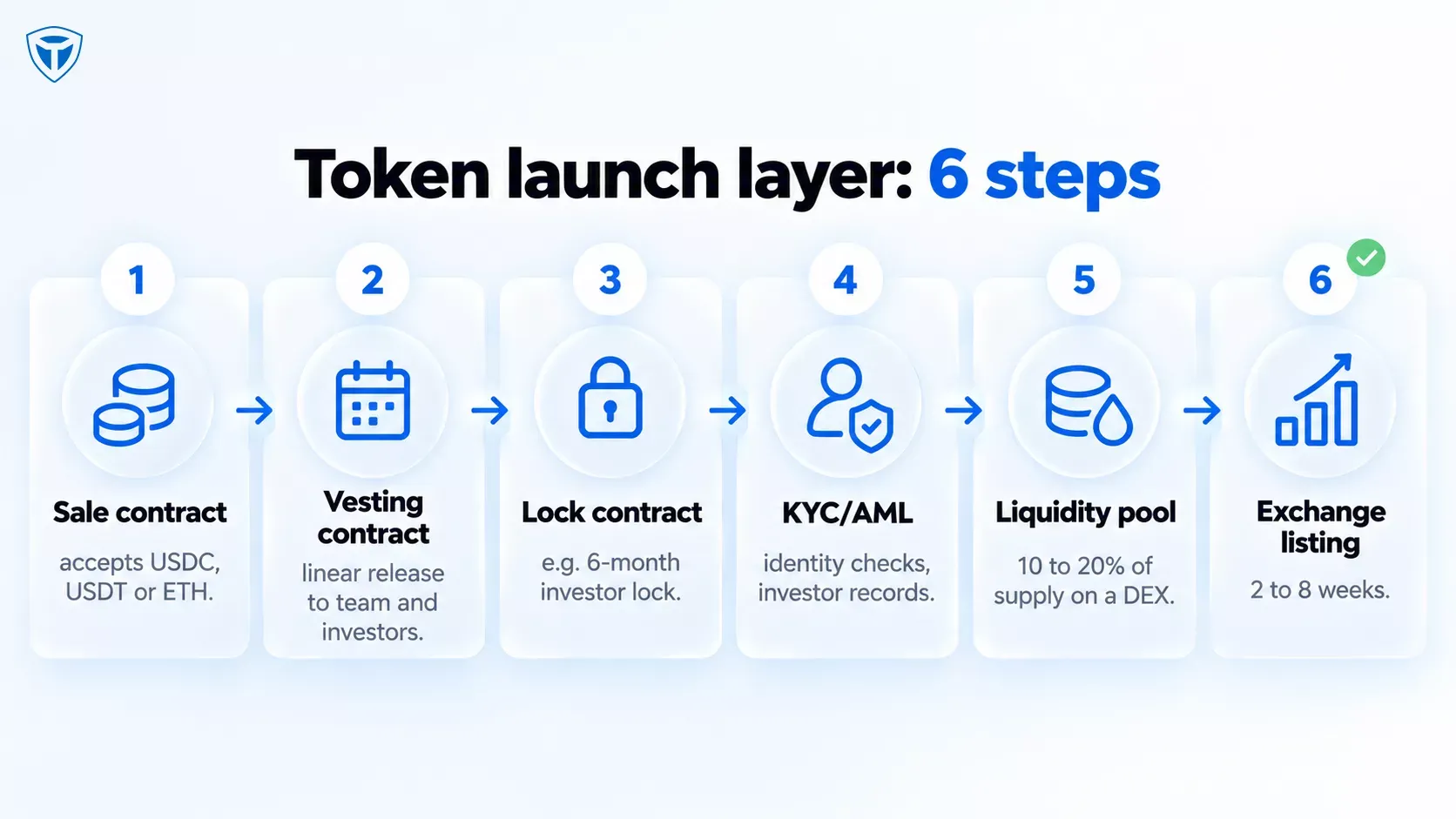
Token sale and vesting contracts
Three components make up the sale side:
- Sale contract: holds the token, accepts payment (USDC, USDT or ETH), calculates tokens owed and sends them to the buyer.
- Vesting contract: allocates tokens to the team, investors and treasury and releases them linearly over months or years. It stops team dumping.
- Lock contract: locks tokens for a fixed period before transfer. Use it when an investor wants a 6-month lock.
Our ICO development services team builds, audits and deploys all three in 2 to 4 weeks. For launchpad-style sales, read our guide to IDO token launchpad development.
KYC/AML and the backend
A token sale needs identity checks and investor records.
- Identity verification: use a KYC provider (Onfido, Veriff, IDology) to verify name, address and ID documents.
- Investor records: store approved addresses, purchase amounts and vesting schedules in a database.
- Payment intake: accept stablecoins (USDC, USDT) or fiat by bank transfer. Payment processing adds 2 to 4 weeks and legal review. Talk to a lawyer about your jurisdiction.
KYC/AML is mandatory if you sell to institutions or take fiat. Most exchanges require it before listing.
Liquidity and exchange listing
After the sale, you need liquidity and a listing.
- Liquidity pool: seed a pool with 10% to 20% of total supply on a DEX such as Uniswap, PancakeSwap or Raydium, paired with USDC or USDT.
- Exchange listing: apply to centralized exchanges such as Binance, Bybit or Kraken. Listing takes 2 to 8 weeks. Our token listing services cover the application and vetting workflow.
Crypto Token Development Cost By Stack Layer
Token cost depends on four layers: the chain, contract complexity, audit scope and the launch layer around it.
|
Layer |
Cost driver |
Budget effect |
|---|---|---|
|
Blockchain |
Ethereum, BNB Chain or Solana |
Ethereum adds deploy and transfer cost. Solana has no contract deploy cost for a basic token. |
|
Contract |
Fixed supply, mintable, pausable or upgradeable |
Fixed supply is cheapest. Upgradeable with multi-sig adds audit scope. |
|
Audit |
Size and complexity |
Basic token: $5K to $20K. Complex with vesting: $20K to $50K. |
|
Launch layer |
Sale portal, KYC/AML, DEX liquidity, exchange listing |
Sale and KYC: $10K to $30K. Exchange listing: $10K to $100K by exchange tier. |
A fixed-supply token with a simple audit and no sale layer sits at the low end. An upgradeable, mintable token with vesting, full KYC/AML and a Tier-1 listing sits at the high end. For line-item pricing, see how much it costs to create an ERC-20 token.
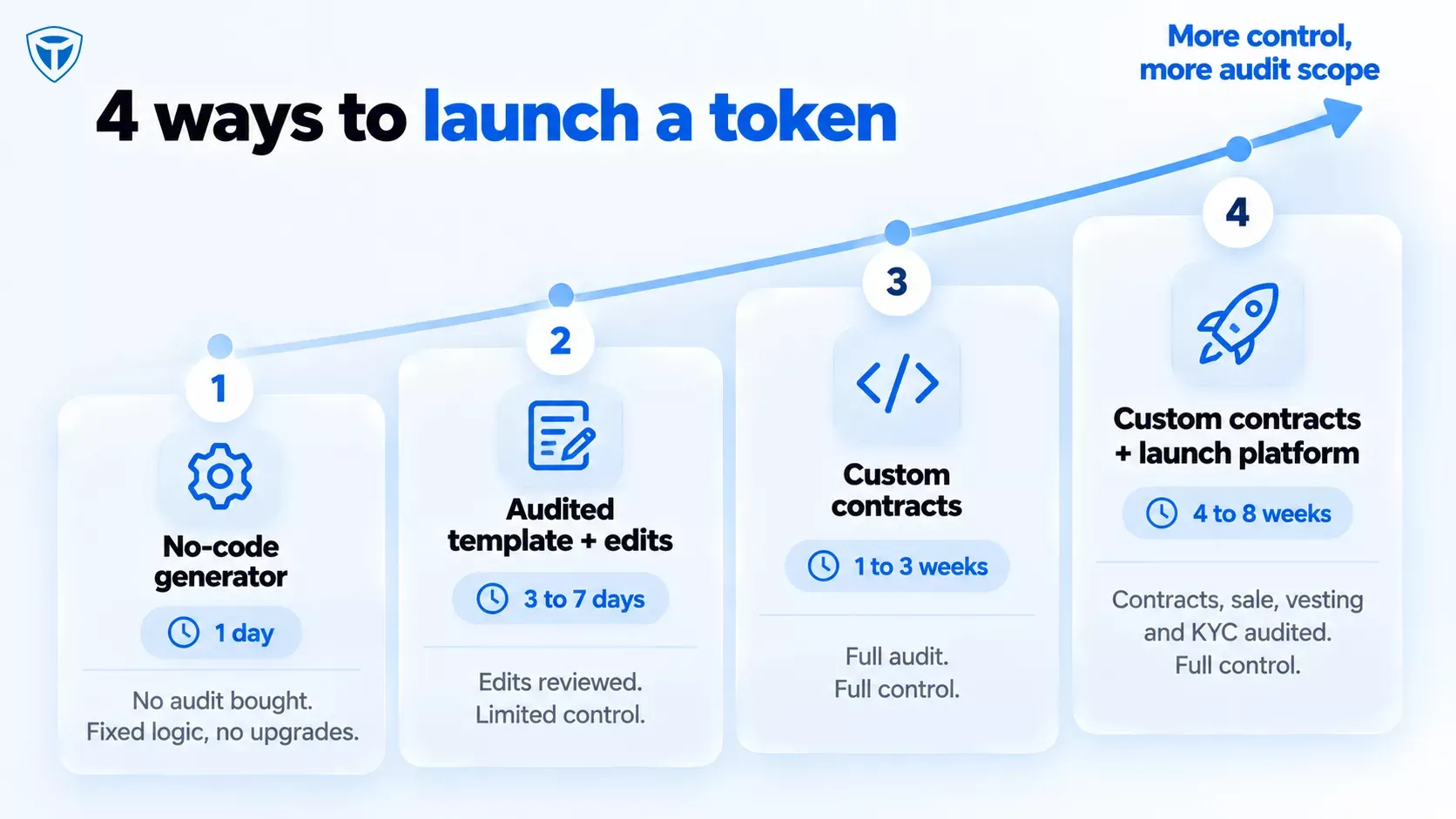
Token Generator Vs Audited Template Vs Custom Smart Contracts
|
Choice |
Time to launch |
Audit scope |
Control over tokenomics |
Upgrade freedom |
|---|---|---|---|---|
|
No-code generator |
1 day |
None bought. The generator deploys stock OpenZeppelin code. |
Limited to presets. |
None. Logic is fixed once live. |
|
Audited template + edits |
3 to 7 days |
Moderate. Your edits get reviewed. The base is already audited. |
Moderate. |
Limited to the template pattern. |
|
Custom contracts |
1 to 3 weeks |
High. All custom code is audited. |
Full. |
Full. |
|
Custom contracts + launch platform |
4 to 8 weeks |
High. Contracts, sale, vesting and KYC platform are audited. |
Full. |
Full. |
We've built tokens on all four paths, and the time estimates come from those projects. For a different stack, read our post on the tech stack to build a crypto exchange.
Best Crypto Token Development Tools Per Layer
|
Layer |
Default pick |
Pick the alternative when |
|---|---|---|
|
Blockchain |
Ethereum |
Fees matter more than exchange support (BNB Chain or Polygon). You want the lightest setup and smallest audit (Solana). |
|
Contract |
OpenZeppelin ERC20 |
You need burning, pausing or vesting. Extend OpenZeppelin for each. Don't write token logic from scratch. |
|
Test framework |
Foundry |
Your team knows JavaScript better than Solidity (Hardhat). |
|
Static analysis |
Slither |
Your chain is Solana. Slither doesn't read Rust, so use fuzzing (Trident) and a Solana-specialist audit. |
|
Testnet |
Sepolia (Ethereum), BNB Testnet, Solana devnet |
You deploy on Polygon (Amoy) or a layer 2 (Arbitrum Sepolia, Optimism Sepolia). |
|
Audit |
Independent firm (Trail of Bits, OpenZeppelin, ConsenSys Diligence) |
No alternative. Always hire independent review. |
|
Admin keys |
Safe (multi-sig) |
Your chain is Solana (Squads). |
|
Wallet connection |
wagmi + viem |
Your app needs Solana wallets (Wallet Adapter). |
|
RPC provider |
Alchemy or Infura |
Traffic passes 1M requests a day (run your own node). |
Ready To Launch Your Crypto Token?
The right stack avoids rebuild costs, audit delays and failed exchange listings. Book a free 30-minute strategic consultation to scope your token, choose the chain and contract design and plan the launch layer.
Talk to Our Experts