PHP to Next.js Migration Services for Fintech and Exchange Platforms
Modernize your legacy PHP platform without rebuilding your entire application from scratch.
Modernize legacy PHP applications into high-performance Next.js platforms through a structured, phased migration, no total rebuild required. Upgrade your frontend or full stack seamlessly while safeguarding existing architecture, integrations, and core business logic.

Every Big Win Starts With One Small Step Make Yours!
Great achievements don’t happen overnight. Take your first step today and let success follow.
4+Years of Expertise
Pioneering blockchain andAi since day one

99.6%Client Satisfaction
Where ambition meetsexecution—every time.

100%Quality Assurance
Code audited,stress-tested, future-proofed.

150+Projects Delivered
From seed-stage startupsto enterprise ecosystems.

Why Migrate Your PHP Application to Next.js?
PHP has powered business applications, financial platforms, and content-driven websites for years. However, as applications grow, maintaining older PHP architectures can become increasingly challenging. Legacy templates, tightly coupled frontend and backend logic, inconsistent APIs, and outdated dependencies can make it harder to introduce new features and support evolving customer expectations.
Migrating to Next.js provides an opportunity to modernize the frontend architecture while reviewing how your application handles data, authentication, integrations, and business logic.
Key Reasons to Consider PHP to Next.js Migration
Migrating from PHP to Next.js helps modernize your web application with improved performance, scalability, and a better user experience. It also enables faster development, seamless API integration, and access to a modern React-based ecosystem.
Modernize the frontend architecture
Replace traditional PHP-rendered templates with reusable React components and a modern Next.js application structure. This creates a more flexible foundation for developing and maintaining user interfaces.
Improve application experience
Next.js supports server-side rendering, static generation, and other rendering strategies. These capabilities can help deliver appropriate performance and rendering behavior across different application pages.
Simplify frontend development
A component-based architecture makes it easier to maintain shared interface elements, introduce new functionality, and manage complex application screens.
Build a more flexible API architecture
Separating frontend and backend responsibilities allows the Next.js application to communicate with existing PHP services or newly developed APIs.
Prepare for future modernization
A phased migration creates opportunities to improve individual application components without requiring every part of the existing system to change simultaneously.
Planning to Modernize Your PHP Application?
Evaluate your existing architecture and explore a structured PHP to Next.js migration strategy that preserves critical business functionality, integrations, and data.
Is Next.js Migration Right for Your Platform?
A migration is worth evaluating when:Your existing PHP application is difficult to maintain.
Frontend changes require extensive modifications to backend code.
Your application needs more flexible and interactive interfaces.
Your development team faces difficulties maintaining older templates and dependencies.
You are planning new features that require a modern frontend architecture.
Not every PHP application needs a complete migration. If the existing platform is stable and meets business requirements, selective modernization may be more practical.
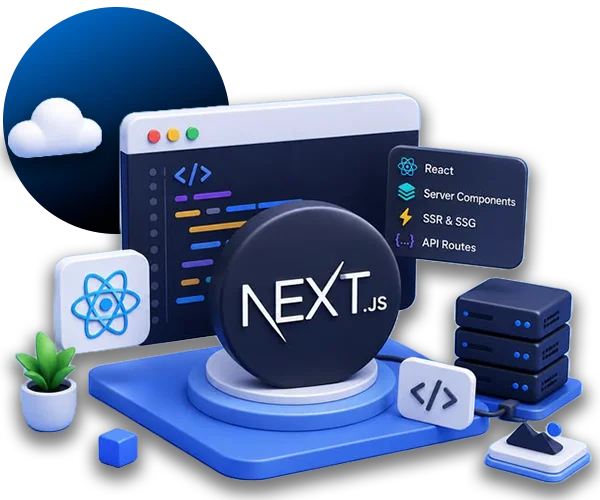
What Does a PHP to Next.js Migration Include?
The migration scope depends on your existing application architecture and modernization goals. While some businesses only need a PHP frontend replacement, others may require updates to backend services, APIs, authentication, and integrations. Troniex evaluates your requirements to define a clear migration scope focused on the components that need modernization.
PHP frontend to Next.js migration
This approach replaces the existing PHP presentation layer with a Next.js frontend while retaining compatible backend functionality.
The migration may include:- ★ Converting PHP templates into React components.
- ★ Rebuilding application pages using Next.js.
- ★ Connecting the new frontend to existing PHP APIs or backend endpoints.
- ★ Implementing routing and navigation.
- ★ Recreating forms, dashboards and interactive interfaces.
- ★ Reviewing rendering and caching requirements.
Best suited for: Businesses that want to modernize their frontend without replacing a functioning PHP backend.
PHP full-stack modernization
For applications that require broader architectural changes, selected backend components can also be migrated.
The scope may include:- ★ Rebuilding the frontend using Next.js.
- ★ Porting selected PHP business logic to Node.js services.
- ★ Developing or restructuring REST APIs.
- ★ Modernizing authentication and session management.
- ★ Reviewing database access and query handling.
- ★ Reconnecting payment providers and third-party integrations.
- ★ Separating background jobs and long-running processes.
Best suited for: Businesses planning broader application modernization or requiring a more flexible service architecture.
What Changes and What Stays?
| Application component | Migration approach | Retention considerations |
|---|---|---|
| Frontend | PHP templates converted into React and Next.js components | Existing content and page requirements |
| Backend | Retain PHP services or migrate selected logic to Node.js | Existing business rules |
| Database | Keep the existing database where compatible | Existing records and schema |
| Authentication | Review and adapt login and session handling | Existing accounts and credentials |
| APIs | Retain, extend, or restructure API endpoints | Existing integrations where compatible |
| URLs | Preserve existing paths or implement redirects | Existing indexed URLs |
| Background processes | Retain or move to separate workers | Existing job behavior |
The database does not necessarily need to be replaced during a frontend migration. Keeping the existing data layer can reduce the scope of the initial release. For broader modernization, database changes should be assessed separately so that schema modifications do not introduce unnecessary migration risk.
Our PHP to Next.js Migration Process
A successful migration requires more than converting PHP templates into React components. The existing application must be understood, tested, and migrated in a way that preserves its required functionality. Our proposed migration methodology uses an incremental approach, allowing the existing application and new implementation to coexist while individual components are validated.
The exact phases and deliverables will be finalized according to the confirmed Troniex delivery process and project scope.
We begin by understanding how the current PHP application works.
Activities include:- Reviewing the existing PHP framework and application structure.
- Identifying routes, templates and page dependencies.
- Reviewing APIs and third-party integrations.
- Assessing database access patterns.
- Identifying authentication and session dependencies.
- Evaluating existing infrastructure and deployment requirements.
Deliverable: Application assessment, route inventory and preliminary migration scope.
Legacy applications often contain undocumented business rules and functionality that may not be obvious from the code. Before rebuilding components, we identify the behavior that the new implementation must preserve.
Activities include:- Reviewing important user journeys.
- Identifying critical business logic.
- Documenting existing application behavior.
- Developing characterization and regression tests.
- Identifying areas requiring additional validation.
Deliverable: Functional requirements and test coverage plan.
We define the target architecture based on the application requirements.
Activities include:- Designing the Next.js frontend structure.
- Defining API communication between frontend and backend.
- Deciding which PHP services should remain.
- Identifying backend components suitable for Node.js migration.
- Reviewing authentication and authorization requirements.
- Planning database connectivity and integration dependencies.
Deliverable: Proposed architecture, migration roadmap and implementation plan.
Before migrating the entire application, we identify a suitable route group or application module for an initial implementation. The pilot helps validate the proposed architecture, frontend integration, and testing approach.
Activities include:- Selecting a representative application component.
- Implementing the component using Next.js.
- Connecting it to the required backend services.
- Testing functionality and integration behavior.
- Reviewing performance and user experience.
Deliverable: Pilot implementation and findings for subsequent migration phases.
Once the migration approach is validated, implementation proceeds in manageable groups.
Activities include:- Rebuilding remaining application routes.
- Migrating selected backend functionality where required.
- Integrating existing databases and external services.
- Implementing authentication and session handling.
- Conducting functional and regression testing.
- Reviewing application performance and security requirements.
Deliverable: Migrated and tested application components.
The new application is prepared for production deployment.
Activities include:- Reviewing deployment readiness.
- Validating application routes and integrations.
- Verifying redirects and canonical URLs.
- Planning traffic transitions.
- Monitoring migrated functionality.
- Maintaining an agreed recovery procedure.
Deliverable: Production cutover and validation plan.
Following deployment, the migrated application is reviewed against the agreed requirements.
Activities may include:- Reviewing production behavior.
- Resolving identified migration issues.
- Reviewing application performance.
- Documenting the updated architecture.
- Providing repository and technical handover.
- Discussing ongoing maintenance and support requirements.
Deliverable: Migration documentation and agreed handover materials.
Ready to Plan Your PHP to Next.js Migration?
Start with a technical assessment of your existing application. Identify migration dependencies, define the target architecture, and build a phased roadmap for implementation.
Fintech and Cryptocurrency Exchange Migration Safeguards
Migrating a fintech or cryptocurrency exchange platform requires careful attention to financial functionality, authentication, integrations, and application availability. A frontend migration may appear straightforward, but changes to how application components communicate can affect critical user journeys.

Financial transaction integrity
Balance calculations, transaction histories, fee structures, and order-related functionality must retain their intended behavior. Our proposed approach includes documenting existing business rules, developing regression tests, and validating critical financial workflows before switching the corresponding components.

Authentication and session management
Login functionality, user permissions, and session handling must be reviewed when replacing the frontend or modifying backend services. The migration plan should account for existing authentication mechanisms, session compatibility, and authorization requirements.

Trading and exchange functionality
Exchange applications often involve order management, market data, trading interfaces, and real-time updates. Migrating the frontend to Next.js should preserve seamless communication with existing exchange services, while keeping matching engines and other latency-sensitive processes within dedicated backend services to ensure performance, reliability, and scalability.

Payment and third-party integrations
Payment gateways, wallet providers, market data feeds, and external APIs can introduce dependencies that affect the migration schedule. Each integration should be reviewed for authentication requirements, API compatibility, sandbox testing, and error handling.

Audit trails and application logs
Financial platforms may require consistent application logs and transaction-related records. The migration should assess whether existing logging and audit mechanisms need adaptation and validate that required records remain available.

Controlled deployment and release planning
A large-scale migration should not automatically require a single production cutover. Where the application architecture permits, components can be introduced incrementally with agreed validation and recovery procedures.
Our objective is to make modernization a controlled engineering project rather than an unnecessary disruption to your business operations.
SEO-Safe PHP to Next.js Migration
Migrating your website from PHP to Next.js should not compromise your existing search visibility or organic traffic. Troniex follows a structured SEO migration approach to preserve URL structures, metadata, redirects, internal links, and indexing signals throughout the transition.
Preserve Existing URL Structures
Retaining existing URLs wherever possible helps maintain search engine recognition and user accessibility. When URL changes are necessary, we implement relevant permanent redirects to guide users and search engines to the correct destinations.
Audit Existing SEO Elements
Before migration, we review your existing PHP website to identify important SEO elements and dependencies. This includes indexable URLs, page metadata, canonical tags, internal links, redirect chains, sitemap entries, and legacy PHP URLs.
Implement a Strategic Redirect Plan
We create a structured redirect map that connects existing URLs to their corresponding Next.js pages. This helps prevent broken links, unnecessary redirect chains, and traffic loss caused by irrelevant URL redirections.
Maintain Metadata and Canonical Signals
We preserve essential on-page and technical SEO elements during migration, including page titles, meta descriptions, canonical URLs, heading structures, structured data, internal links, and robots directives.
Select the Right Rendering Strategy
Next.js offers multiple rendering options to support different content and indexing requirements. We select the appropriate approach based on content updates, personalization, caching, and performance needs, using server-side rendering, static generation, or incremental static regeneration where suitable.
Validate SEO Before and After Launch
We perform technical SEO checks before deployment and monitor website performance after launch. This includes validating redirects, metadata, canonical tags, XML sitemaps, robots.txt, page rendering, indexability, and organic search performance.
Our objective is to make modernization a controlled engineering project rather than an unnecessary disruption to your business operations.
Our Trusted
Client Testimonial

Our partnership with Troniex has been fantastic. Their team is professional, committed, and always supportive. Their quality work and reliability helped us launch our project on time. I truly appreciate their support.
Project: Casino - Poker
Alex
Partner, Brevin
We are excited to work with Troniex on another project! My colleagues and I were impressed by their professionalism, attention to detail, and the support they provided during our project. Thank you guys for being with us
Project: Fibitpro
Nilesh
Sr. Consultant, Fibitpro
You guys really deserved my trust! I recommend Troniex, who need a perfect partner to setup a business. Mr. Saravanan and Mr. Rajasekar are highly motivated and talented, helped me to launch my business effortlessly.
Project: Poker Bet
James Mathew
Software Architect
I'm truly grateful to Troniex Technologies for bringing my business idea to life. Their expertise and attention to detail made the whole process smooth. I highly recommend their team to anyone looking for reliable support.
Project: Apex21
Arnold
Apex Crypto Academy
Code,Deploy,Dominate!
Future Proof Technology, Stacked for Your SUCCESS!
 HTML5 & CSS3
 React Js
 Angular Js
 Vue Js
 Next Js
 Java
 Python
 Node Js
 PHP
 C/C++
 Rails
 SQL
 Mongo DB
 Kafka
 Nginx
 Apache
 Heroku
 CloudFlare
 AWS
 TensorFlow
 Docker
 Kubernetes
 Jenkins
 Kotlin
 Trade Giant
 React Native
 Flutter
 Wordpress
 Magento
 Shopify
 Drupal
 Hyperledger
 GO
 Rust
 Solidity
Why Choose Troniex Technologies for PHP to Next.js Migration?
Choosing the right migration partner requires more than technical knowledge of PHP and Next.js. Your engineering team should understand existing application architectures, identify critical dependencies, and plan modernization without adding unnecessary complexity. Troniex Technologies brings fintech and cryptocurrency development experience, including expertise in exchange platforms and related application technologies.
Experience with fintech and exchange applications
Financial platforms involve more than standard frontend functionality. They may include complex user journeys, account management, APIs, transaction workflows and third-party service dependencies. Experience with these application requirements is relevant when planning modernization.
Frontend and backend engineering capabilities
A PHP migration may involve frontend replacement, backend restructuring or both. The migration scope should be based on your existing architecture rather than assuming that every component needs to be rewritten.
Structured testing and quality assurance
Application behavior must be validated as components are migrated. Troniex's published QA and engineering claims should be supported by the actual testing, code review, and release practices used for the engagement.
Scalable application architecture
Next.js and an appropriate API architecture provide a foundation for developing and maintaining modern application interfaces. The architecture should also account for backend services, data access, integrations, and application-specific performance requirements.
Ongoing technical support
Migration does not end with deployment. Documentation, knowledge transfer, and clearly agreed post-launch support arrangements help your team maintain the updated application.
PHP to Next.js Migration Cost and Timeline
The cost and duration of a PHP to Next.js migration depend on the complexity of the existing application and the scope of modernization.Replacing a PHP frontend while retaining an existing backend is generally a different undertaking from migrating frontend, backend logic, authentication and integrations together.
Factors that influence migration cost
| Factor | How it affects project scope |
|---|---|
| Codebase size | More routes, templates and application components require additional implementation work |
| PHP framework and dependencies | Older frameworks and tightly coupled code may require additional assessment |
| Frontend complexity | Interactive dashboards and complex user journeys require more frontend development |
| Backend migration | Porting PHP business logic to Node.js increases the migration scope |
| Database architecture | Complex schemas and query dependencies require additional analysis |
| Third-party integrations | Each payment provider, API and external feed introduces integration and testing requirements |
| Authentication and security | Existing login, permissions and session mechanisms require compatibility assessment |
| Testing requirements | Limited existing test coverage increases characterization and regression testing work |
| Infrastructure | Hosting, deployment and environment changes may add implementation work |
How do we estimate the migration timeline?
We begin by reviewing the existing application and identifying the components that need to be migrated.
1. Number and complexity of application routes.
2. Existing PHP framework and architecture.
3. Frontend-only or full-stack migration requirements.
4. Database and integration dependencies.
5. Required testing and validation.
6. Deployment and handover requirements.