-
Most stablecoin failures are not technical, they are reserve model decisions made in Phase 1 that become insolvency events in Year 2 when a redemption spike hits an under-collateralised reserve.
-
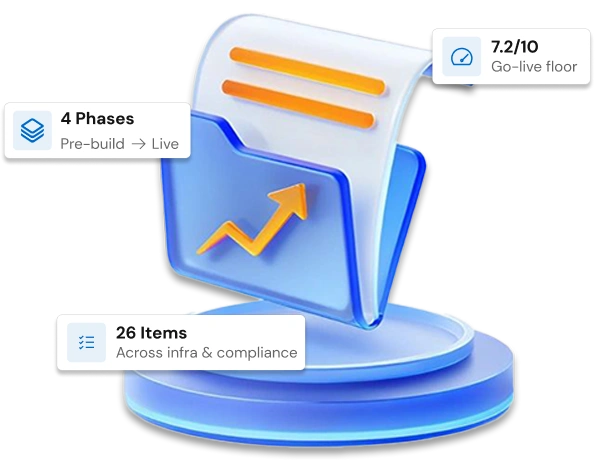
This checklist covers 26 items across four phases: Pre-Build, Build, Validation, and Post-Launch.
-
It includes a self-assessment readiness score, clear 7.8 / 10 before your first mint.
Here is the number that decides whether your stablecoin survives a market stress event: the gap between your published peg and the actual liquidation value of your reserve assets at the moment every large holder redeems at once. Issuers that survived the 2022–2023 de-peg wave had one thing in common, they had modelled that gap in Phase 1, before the reserve structure was locked. The ones that did not survived until the first coordinated redemption. The work below starts with the reserve model because that is where stablecoin projects are won or lost, and it is the cheapest decision you will ever make to get right.
| Phase | Timing | Items | What breaks if you skip it |
|---|---|---|---|
| 1Pre-Build Foundation | 12–16 weeks out | 6 | Wrong reserve model, unlicensed jurisdiction, banking partner without stablecoin experience |
| 2Infrastructure Build | 4–8 weeks out | 8 | Reserve reporting gap, payment rail integration failure, compliance monitoring blind spot |
| 3Pre-Launch Validation | 1–3 weeks out | 7 | MiCA non-compliance at launch, reserve audit failure, redemption flow untested at scale |
| 4Post-Launch Monitoring | Week 1–4 after live | 5 | Reserve drift, regulatory breach, redemption queue collapse under stress |
Pre-Build Foundation
The single most expensive Stablecoin Platform mistake is made here — the decisions that are cheapest to fix now and most expensive once build has started.
Pick the jurisdiction before anything else it determines your banking partners, your AML configuration, and which licenses you even need. Get a regulatory counsel opinion in writing for the EU, not a forum thread.
Shortlist two Stablecoin Infrastructure providers and run a real integration spike against your stack before you commit. Validate latency, failover, and the actual data shape not the sales deck.
Decide your compliance posture now and choose Compliance Monitoring Systems to match it. Map every flow that touches a user identity or a transaction so the pipeline is designed for AML, not retrofitted.
Model your unit economics at expected volume. Put Stablecoin Infrastructure cost, compliance cost, and infrastructure cost in one sheet against your fee structure. If the math only works at 10× your launch volume, you do not have a model yet.
Decide custodial vs non-custodial vs MPC, and document the key-management model your auditor will sign off on. This is the most expensive decision to reverse.
Choose fiat-backed, crypto-collateralised, or hybrid in Phase 1, this decision determines your MiCA EMT classification, your banking partner requirements, and your audit scope. Get a term sheet from a bank that has already onboarded a stablecoin issuer, not one that says they will.
Infrastructure Build
This is where most platforms that fail, fail. Each item below is something that is far harder to add after beta than before it.
The reserve audit that revealed a 12% gap
A fiat-backed stablecoin issuer published a 1:1 reserve ratio for 14 months. The first independent reserve audit, commissioned under regulatory pressure, found 12% of the reserve was held in a money-market fund with a 7-day redemption notice. During the audit week, a coordinated redemption request for 18% of circulating supply arrived. The redemption queue froze for 6 days. The peg held, the issuer's reputation did not.
Stand up Cross-chain Liquidity APIs for scale from day one. Configure auto-scaling, partitioning, and back-pressure handling and load the config into version control so it is reproducible, not tribal knowledge.
Connect Stablecoin Infrastructure and set per-pair depth targets before beta. Validate each pair independently a healthy BTC book tells you nothing about your thin pairs.
Wire Compliance Monitoring Systems into live transaction monitoring and run a real suspicious-transaction-report dry run end to end. A configured-but-untested AML stack is not a compliant one.
Build the KYC flow and instrument every step. Run it with real external testers and record the drop-off. The number you get is the number you launch with unless you fix it now.
Wire daily reserve reporting from day one, MiCA requires real-time reserve disclosure for EMT issuers above thresholds. Validate the output format against the regulatory template before the pipeline touches live funds.
Build the reporting pipeline and submit a test file in MiCA's required format before you need to. Format rejections are discovered at the deadline by everyone who skips this.
Connect your payment rails and run end-to-end redemption tests across every target corridor. Measure latency at the 95th percentile, not the average, the tail is what users notice and regulators audit.
Define circuit breakers, rate limits, and a written incident-response runbook with named owners. Rehearse the first 15 minutes of an incident before you have one.
 From Troniex’s implementation work with Stablecoin Platform operators
Across stablecoin builds, the compliance gap that triggers supervisory action is not the reserve ratio, it is the redemption SLA. MiCA requires EMT issuers to redeem at par on demand. Teams build the happy-path redemption flow and never stress-test the queue under concurrent large-holder requests. The first time the queue fails is always during a market stress event, which is also when the regulator is watching.
Pre-Launch Validation
The last gate before a real user touches it. Everything here is about discovering the failure in a drill instead of in production.
| What to validate | Pass threshold | Fail signal | Resolution |
|---|---|---|---|
| Reserve coverage at 20% redemption | 100% liquid within 24h | Illiquid assets > 5% | Restructure reserve waterfall |
| MiCA EMT disclosure format | Accepted by test submission | Format rejection | Rebuild reporting pipeline |
| Redemption latency at 3× volume | < 2 hours end-to-end | Rail rate limit triggered | Negotiate higher API quota |
| Cross-border corridor coverage | All target corridors live | Missing corridor | Add rail before launch |
| Reserve audit readiness | Audit package complete | Gaps in documentation | Complete before mint |
| AML screening on redemptions | 100% screened < 30s | Screening queue delay | Scale screening infra |
Run a sustained load test at 3× projected peak, not average. Watch the matching queue, the database, and the auto-scaler under pressure and capture where the first thing bends.
Commission a third-party audit with an explicit scope document, then remediate every critical and high finding before launch. Get the scope in writing before you get the report.
Run your compliance stack against MiCA's published test scenarios and tune thresholds against the results not against defaults shipped by the vendor.
Re-run the onboarding flow with a fresh external cohort and confirm completion clears your benchmark. Fix the friction point you find before, not after, you spend on acquisition.
Confirm depth on every launch pair at peak volume, pair by pair. Add a market maker before go-live for any pair that cannot hold its spread target.
Run a real failover drill: kill the primary, time the recovery, verify data integrity on the other side. An untested BCP is a document, not a plan.
Simulate a coordinated redemption of 20% of circulating supply hitting your reserve, your payment rails, and your compliance queue simultaneously. This is the scenario MiCA supervisors will ask about, run it before they ask.
The payment rail that failed at 3× volume
A stablecoin issuer validated its payment rail integration at average daily redemption volume and passed. On the day a competitor de-pegged and users fled to their stablecoin, inbound redemption volume hit 3.4× the tested ceiling. The rail provider's API rate limit triggered at 2.8×. Redemptions queued for 11 hours. Three institutional holders redeemed the following week and did not return.
Post-Launch Monitoring
The first 30 days decide whether the launch holds. Item 26 is the retention mechanic unique to this platform.
Review execution quality and per-pair liquidity every day for the first two weeks. The early signal of a failing launch shows here first.
Watch the live onboarding funnel and isolate the real drop-off step within the first 72 hours, while you can still act on it.
Review the AML queue weekly. A false-positive rate creeping up is an early compliance-cost problem you want to catch before it buries the team.
Submit the first regulatory report on time, in the validated format. The first one sets your standing with MiCA.
Publish a live reserve dashboard and stand up a holder communication protocol, email, on-chain attestation, or both. Transparency is the retention mechanic for stablecoin holders; opacity is the first signal of a run.
Is your Stablecoin Platform ready to launch?
Each category fills in automatically as you tick the checklist above — and the verdict updates live. Drag any slider to model a what-if before you commit.
Score your readiness
Tick the checklist above — categories fill in automatically and the verdict updates live.
Get the Stablecoin Platform Launch Readiness Report
A documented PDF — your scores, gap analysis, go/no-go decision, and full checklist record.
Where Stablecoin Platform launches actually fail
1Reserve ratio published before liquidation waterfall modelled
A 1:1 ratio means nothing if 20% of the reserve is in a 7-day notice fund. The ratio is a marketing number; the waterfall is the risk number. Publish the first, model the second, in that order, at your peril.
2MiCA EMT classification decided after banking relationship signed
EMT and ART classifications carry different reserve, reporting, and redemption obligations. Signing a banking partner before the classification is locked means renegotiating terms, or the banking partner.
3The narrative one
The reserve was technically 1:1 on the day of launch. Eighteen months later, yield-chasing had migrated 14% of the reserve into a structured product with a 10-day exit window. Nobody updated the marketing copy. When a large competitor de-pegged and redemption requests spiked, the issuer discovered the gap at the same time their users did, in a community forum post that cited the on-chain reserve attestation against the fund's own disclosure. The peg held for 72 hours before a buyback programme restored confidence. The community post is still the top Google result for their brand name.
4Payment rail tested at average volume, not stress volume
The rail that handles Monday redemptions does not handle a flight-to-safety event. Rate limits, settlement windows, and correspondent bank queues all behave differently at 5× volume, and that is the volume that matters.
5Redemption SLA not defined before MiCA supervision begins
MiCA requires on-demand redemption at par for EMT issuers. A platform without a documented and tested redemption SLA is non-compliant before it processes its first redemption request.
Frequently asked questions
Let’s Get in Touch.
Unsure whether your Stablecoin Platform is ready to go live? Our infrastructure team will pressure-test your readiness and map the gaps with honest, practical advice — ABSOLUTELY FREE.
Book Your Free Consultation