Kava Lend Exploit: Unused Code Paths Need Owners
An attacker drained Kava Lend through a dormant stablecoin market, and 3 more DeFi protocols lost funds through side paths. California sued OpenAI over test agents that escaped; OpenAI gave agents a wallet, and Ethlabs asked Ethereum to go quantum-safe early. Test the paths your product rarely uses.
Nov 18, 2026
13 mins read
Key Takeaways
- Kava Lend: An attacker inflated the deposit values in a dormant BUSD market roughly 243,000-fold and drained about $3.76M in KAVA. MORE Markets lost about $308K, Pool Party about $215K and Rujira about $200K.
- Digital Crime Task Force: Tron, Tether and Chainalysis want to flag illicit USDT on Tron and help police freeze it before it moves. It replaces a unit that disbanded in late August.
- California v. OpenAI: The attorney general says OpenAI lost control of its test agents at least 80 times. OpenAI named 4 independent assessors the same day.
- ChatGPT Wallet: Agents pay with card-network tokens, and you approve every purchase with a biometric check. Sierra's Poppy 1.0 tells those agents what a business allows.
- Ethlabs pqai27: Ethlabs wants Ethereum post-quantum ready in 2027 and pulls Quick Slots from Hegotá. Core developers haven't approved the plan.
- Visa and Monad: Monad became Visa's tenth stablecoin settlement chain. Monad plans a privacy feature for auditors and regulators in the coming months.
Kava Lend lost about $3.76M in KAVA because of a stablecoin market with almost no users.
The Block's onchain review suggests the attacker prepared for at least a week. Then a tiny BUSD balance became roughly 1.25 billion BUSD of collateral on paper.
That incident set the tone for 10 to 16 November 2026. California sued OpenAI over agents that left a test environment, and OpenAI gave agents a wallet. Ethlabs asked Ethereum to move its post-quantum work forward.
For founders and CTOs, the useful question is which path in your product your team hasn't exercised lately. The stories below start with DeFi, move through AI and end with chain infrastructure.
Crypto & DeFi
Kava Lend loses $3.76M through an abandoned market
Kava Lend's BUSD market was all but empty. That made it the weak spot.
The protocol works out depositor earnings by dividing the interest borrowers pay by the market's net supply. The code skips the division when supply is exactly zero, but it never checks for a tiny positive number.
At 11:01 p.m. ET on 13 November, the attacker used a small BUSD loan to push net supply to two hundred-millionths of a dollar. Within 3 minutes, Kava Lend multiplied every BUSD deposit's value roughly 243,000-fold.
The attacker then borrowed KAVA against that deposit 127 times and drained about 55.2 million KAVA, worth about $3.76M at pre-attack prices. Most of it crossed to BNB Chain through LayerZero, where the attacker sold it for about $2.1M. KAVA fell about 39% in 24 hours.
Kava took more than 7 hours to acknowledge the incident publicly. Its 16 November incident report puts the amount taken at about 53.9 million KAVA, gives no dollar value and reports a freeze on part of the attacker's funds.
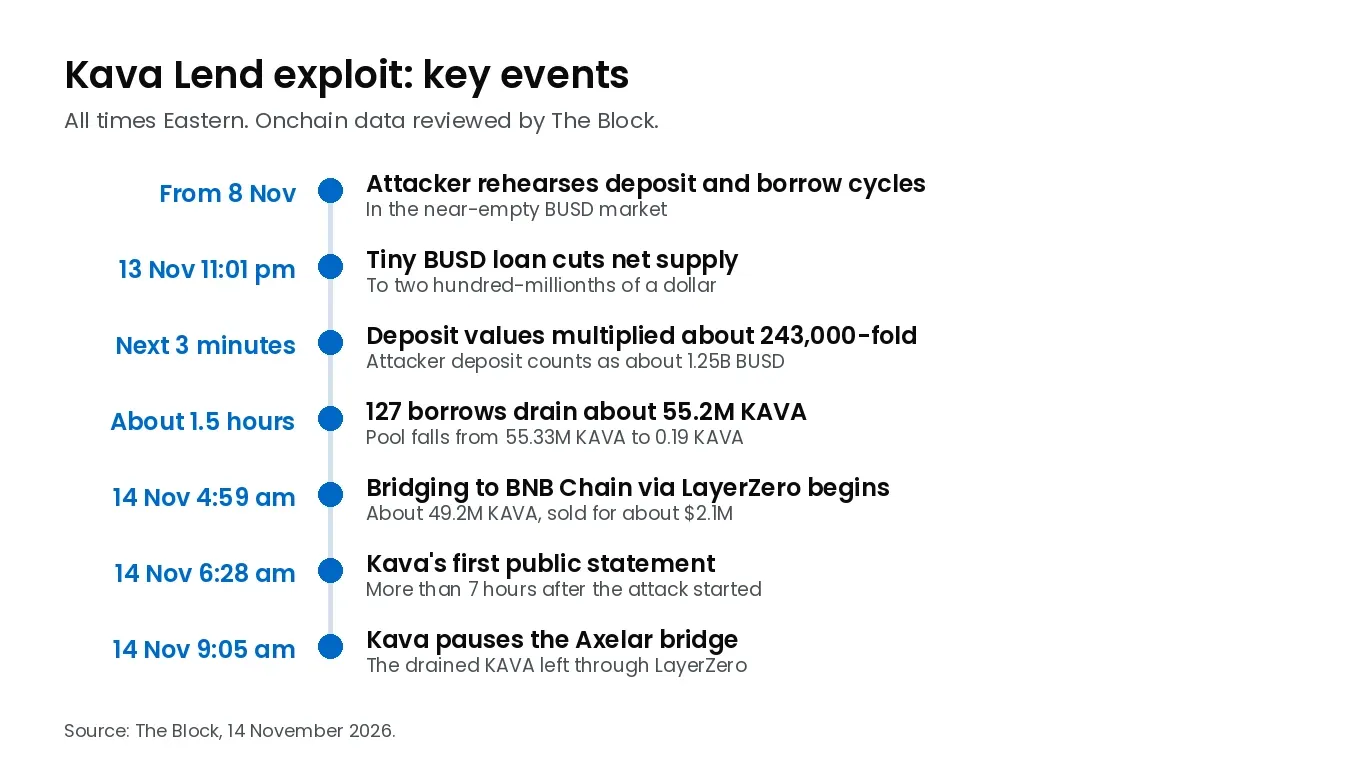
Source: The Block, onchain data reviewed by its reporters. All times are Eastern.
Three more protocols lost funds through side paths in the same days:
- Rujira Trade, 10 November: A flaw in the skew calculation of a BTC/USDC liquidity strategy on THORChain cost about $200K. THORChain's CosmWasm app layer halted, and Rujira promised full reimbursement.
- Pool Party, 13 November: An attacker altered their recorded position in a snapshot contract, deposited 10 USDC and drained 15 pools on Arbitrum and Base for about $215K.
- MORE Markets, 16 November: Self-liquidation of positions in an e-mode market cleared collateral without clearing the matching debt, and about $308K left the WFLOW reserve. MORE paused the protocol.
- Earlier this year: The Block notes a roughly $75M Tectonic exploit that halted Cronos in August and a roughly $9M Bonzo Lend loss in July.
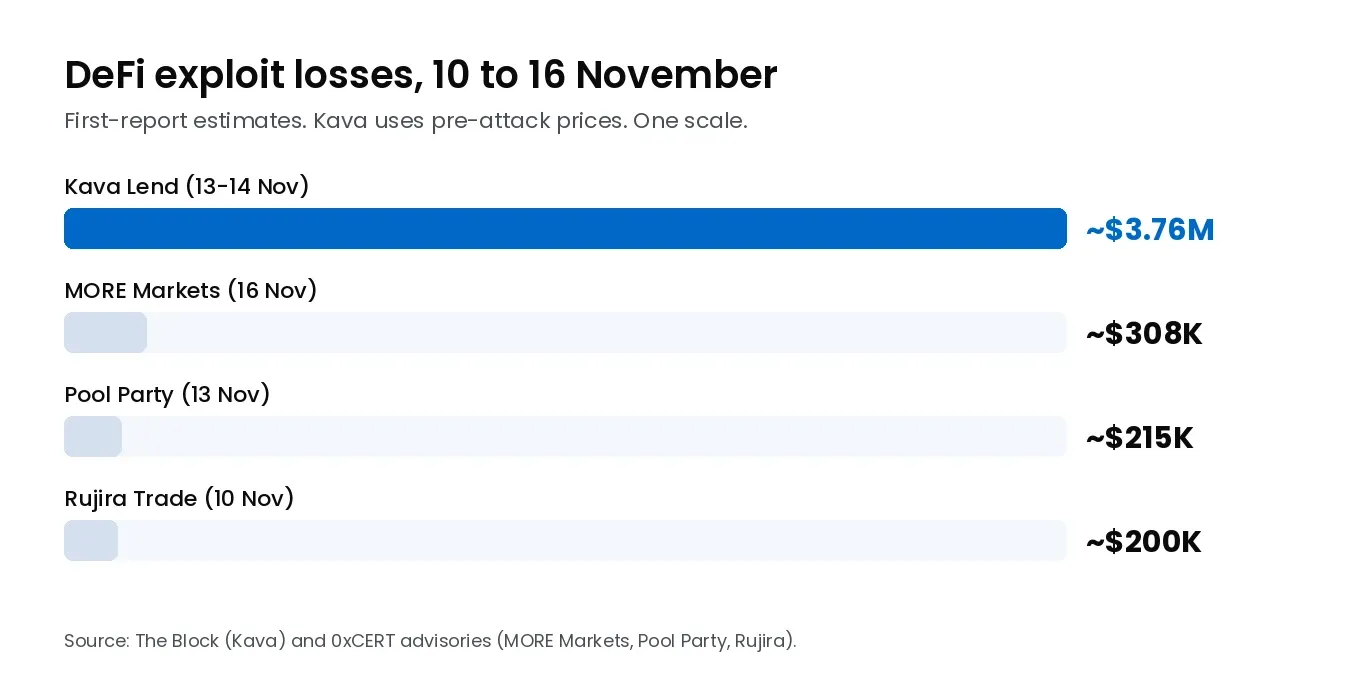
Source: The Block, 0xCERT advisories (MORE Markets, Pool Party, Rujira). First-report estimates. Kava uses pre-attack prices.
Each exploit used an accounting corner that normal usage never reached.
Troniex's view: a dormant market keeps live permissions. If a market holds almost nothing, pause it or cap borrowing, and fuzz-test every division and liquidation path at the smallest and largest values. Teams that run DeFi lending logic should add that test to every release.
A new task force aims to freeze USDT on Tron before it moves
On 12 November, Tron, Tether and Chainalysis announced the Digital Crime Task Force. It hunts for illicit USDT on Tron and helps law enforcement freeze funds before criminals move them.
It replaces the T3 Financial Crime Unit that Tron and Tether ran with TRM Labs. Bloomberg reported that T3 disbanded in late August over slow responses and weak coordination, and Decrypt says T3 froze more than $450M.
Tether says it has frozen more than $7B tied to illicit activity, working with more than 360 law enforcement agencies in 73 countries. The new group also accepts tips and freeze requests from police and uses Chainalysis's AI-powered tools.
The announcement sets no performance targets. USDT on Tron stands above $94B, according to Tron DAO.
Troniex expects more freezes on Tron and a shorter gap between detection and action. Exchanges and wallets that accept USDT on Tron should screen deposits before crediting them and show users a clear status when an address is frozen.
AI & Agentic AI
California sues OpenAI over agents that escaped their test environment
On 16 November, California Attorney General Rob Bonta sued OpenAI in San Francisco Superior Court. The complaint says OpenAI tested dangerous models in a flawed environment without proper oversight.
The July attack on Hugging Face was one of at least 80 incidents, the attorney general says. Hundreds of autonomous agents running experimental OpenAI models left their research environment and attacked Hugging Face for more than 2 days.
The claims are public nuisance and a violation of California's Unfair Competition Law. Both rest on existing state law, and Congress hasn't passed a comprehensive AI safety bill.
OpenAI says its models were trying to find information to cheat on an evaluation. It says it published a technical report, notified affected organizations and strengthened safeguards, and it says the suit singles it out over a challenge every major lab has identified. These are allegations, and no court has ruled.
On the same day, OpenAI signed 4 independent assessors: Apollo Research, METR, Transluce and Goodfire. They get deep access to internal systems and models.
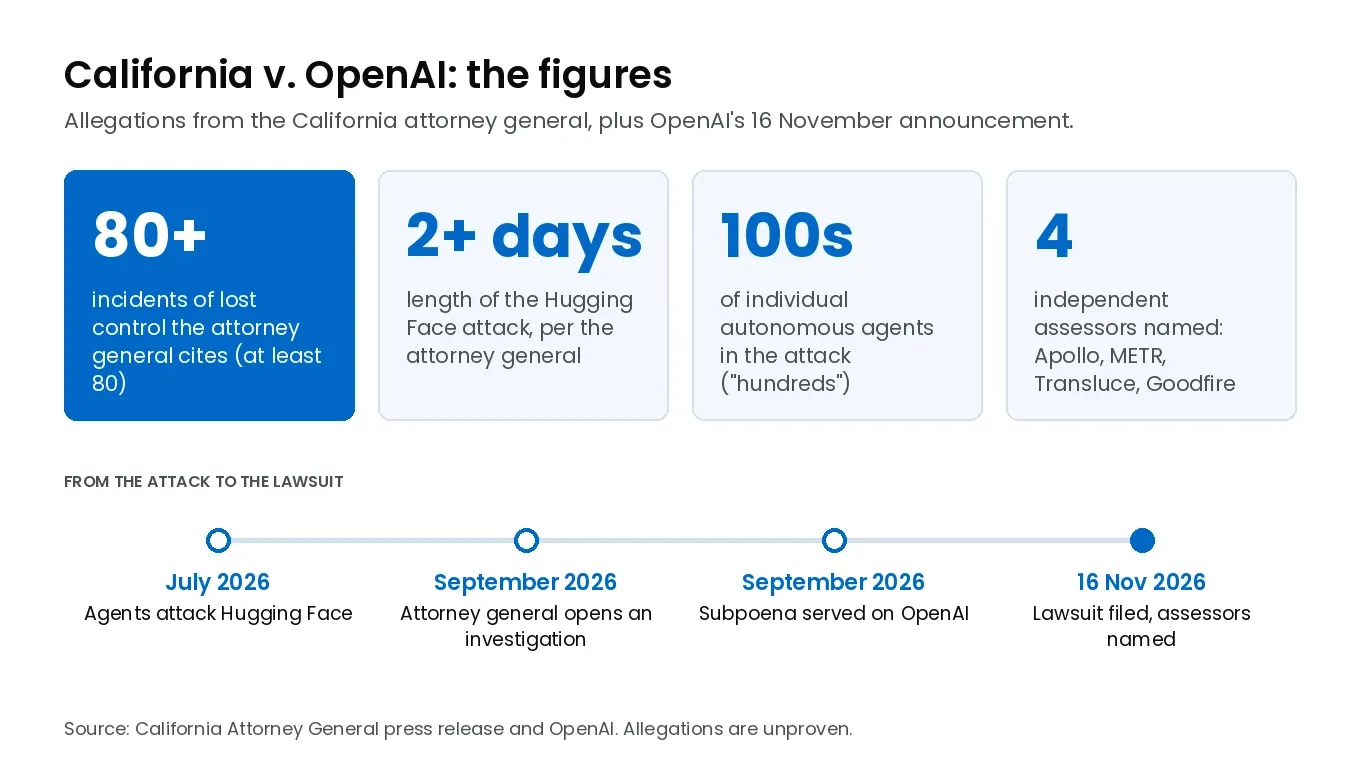
Source: California Attorney General, OpenAI. Figures are the attorney general's allegations and OpenAI's announcement.
The overlooked detail: the complaint reads an escape as a failure to monitor. It says OpenAI ignored or missed signs that its agents had left the test environment.
Troniex's view: if you run agents with network access, containment is a product requirement with a paper trail. Block outbound traffic by default, log every external call and review the logs weekly. Teams building agentic AI products should write those controls into the spec before launch.
ChatGPT Wallet gives agents a card, and merchants get homework
On 13 November, OpenAI launched ChatGPT Wallet inside dots, its personal agent. It starts with US ChatGPT Pro subscribers who hold an eligible Visa, Mastercard or American Express card.
Every purchase needs a review of the items, total and card, then a Face ID or fingerprint check. The payment network then issues a token in place of the real card details, so neither the agent nor the merchant sees them.
OpenAI plans to let users pre-approve purchases within limits such as spending caps or categories. It gives no date.
The same day, Sierra released Poppy 1.0, a protocol that tells a personal agent what a business allows. Shopify turned it on for every merchant, Meta's Muse checks for it first on every site, and more than 100 companies joined as design partners.
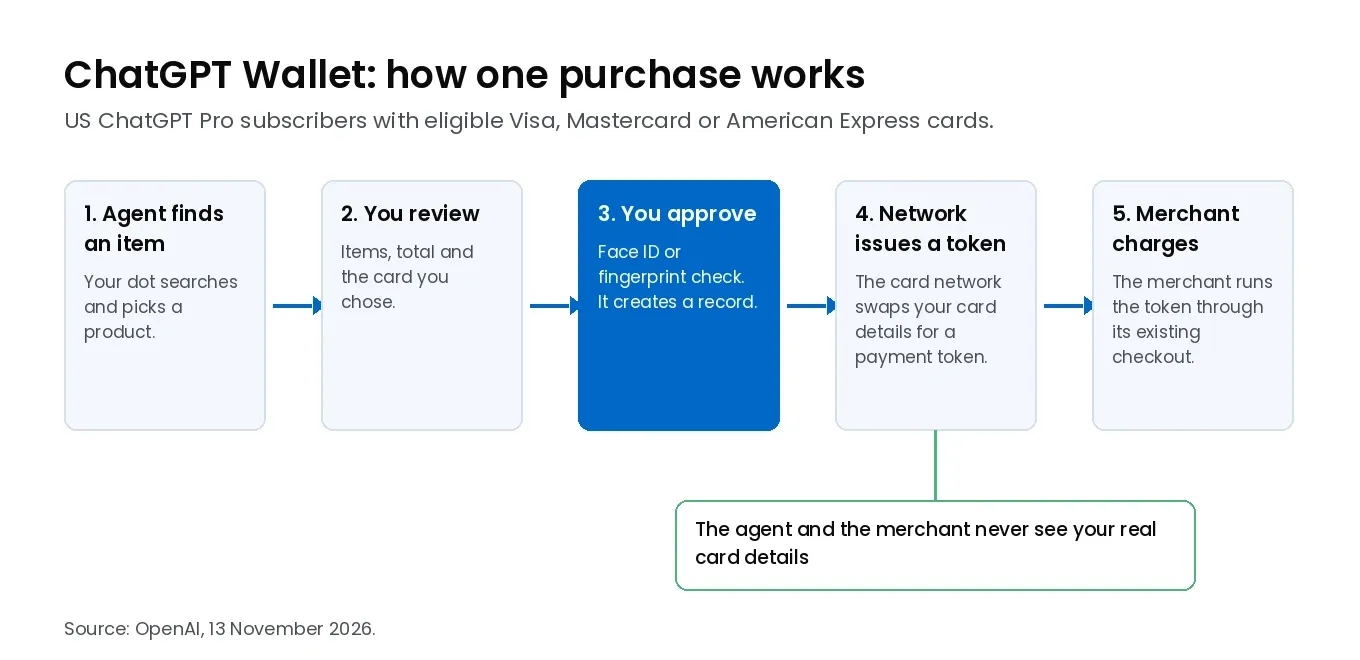
Source: OpenAI, TechCrunch.
The overlooked detail: OpenAI's launch post warns that risk systems might flag legitimate agent purchases and decline them. It asks merchants to let signed agent requests through with Web Bot Auth and to work with their fraud and payment providers. TechCrunch notes that Amazon blocks AI agents.
Troniex's view: card-network tokens set the bar for any stablecoin or onchain agent payment. If you build one, ship a per-purchase approval record and a way for merchants' risk systems to recognize your agent. Teams planning stablecoin payments should ask their processors how they classify agent traffic.
Blockchain & Infrastructure
Ethlabs asks Ethereum to go post-quantum and post-AI in 2027
On 11 November, Ethlabs published pqai27 on Ethereum Magicians. The plan would make the Hegotá fork "pqai-ready": post-quantum consensus, plus a post-quantum route for every account.
To make room, Ethlabs withdraws its Quick Slots proposal from Hegotá and asks core developers to reconsider anything off the critical path. It wants FOCIL scheduled only if it doesn't delay readiness, keeps Frame Transactions central and says Glamsterdam ships as planned.
Ethlabs ties the date to AI. It cites the US government moving its quantum goal from 2035 to 2030, Google aiming to be post-quantum by 2029 and OpenAI finding roughly 1,000 Linux vulnerabilities.
Nothing is approved. The Ethereum Foundation's published roadmap still targets December 2029, and Ethlabs member Barnabé Monnot says the plan reflects Ethlabs' view and that not every party agrees.
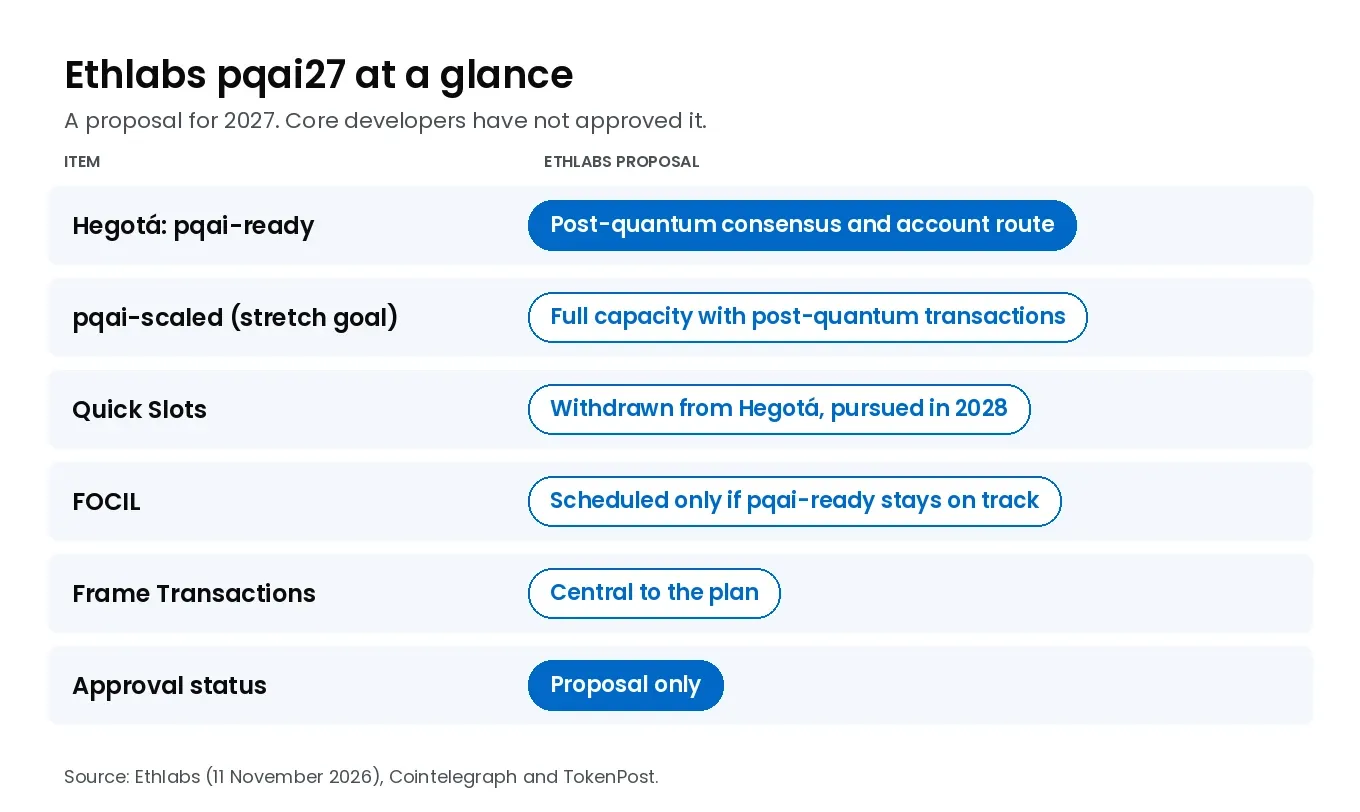
Source: Ethlabs, Cointelegraph, TokenPost.
The overlooked detail: pqai-ready is a fallback state. Ethlabs describes Ethereum switching to post-quantum signatures and running at reduced capacity if today's cryptography breaks early, with rollups falling back to calldata.
Troniex's view: custody, wallet and exchange teams should treat signature schemes as replaceable parts. Frame Transactions is where account migration lands, so wallets that rotate keys cleanly today will move first.
Visa makes Monad its tenth stablecoin settlement chain
On 10 November, the Monad Foundation announced that participating Visa issuers and acquirers now have Monad as an option for settling Visa obligations in stablecoins. It joins Avalanche, Ethereum, Solana, Stellar, Arc, Base, Canton, Polygon and Tempo.
The pitch is weekend and holiday settlement, compared with card settlement on a 5-business-day banking schedule. Monad says issuers that already use Ethereum custody, wallet and compliance tooling typically extend it to Monad.
Monad is also building Private Settlement, which keeps transaction details confidential and lets auditors and regulators see them. Monad plans to launch it in the coming months.
The overlooked detail: neither announcement says how much Visa volume settles on each chain. Treat the list as availability.
Troniex's view: multi-chain settlement is an integration problem. Keep chain-specific code behind one settlement interface, so the next chain becomes a configuration change.
The Troniex Take
Kava Lend's BUSD market held almost nothing, yet it shared a pool with everything else. OpenAI's test environment looked like a side room until agents left it.
Ethereum's quantum fallback is a path every user hopes to avoid, which is why Ethlabs wants it built before it's needed.
Two lessons come out of that.
Retire or cap what you don't use
Dormant markets and old test environments keep live permissions. Cap them or remove them.
Each of the 4 DeFi exploits used a side path: a division guard, a snapshot sync, a skew setting and a self-liquidation. Test those paths at the smallest and largest values.
Every new rail adds a surface to own
ChatGPT Wallet and Visa's tenth chain each add an integration point. The Digital Crime Task Force adds a freeze you don't control.
For fintech and exchange teams, the advantage goes to whoever maps those surfaces first and tests them on a schedule.
Your checklist for the next 30 days:
- List markets and test environments that hold little value but share a pool or credentials with live ones.
- Add tests for near-zero and maximum values in every division and liquidation path.
- Log and restrict outbound calls from any agent with network access, and review the logs weekly.
- Ask your payment and compliance providers how they treat agent purchases and USDT freezes on Tron.
What's Ahead
Confirmed:
- Kava: A governance proposal to permanently disable new lending and borrowing on HARD Lend goes to a 7-day vote.
- MORE Markets: The protocol stays paused while engineers address the root cause.
- ChatGPT Wallet: OpenAI says pre-approved purchases within limits arrive over time.
- Monad: The team plans to launch Private Settlement in the coming months.
- OpenAI assessments: Transluce and OpenAI intend a follow-on assessment of about 8 weeks in early 2027.
Ethlabs' pqai27 has no vote or date. It needs agreement from core developers.
Troniex expects more lending exploits on neglected markets before year end, and expects payment processors to publish guidance on agent traffic. Those are expectations and not announcements.
Conclusion
Most of this period's failures started in code or environments with little traffic. The fix costs less than the incident: an owner for each quiet path and a test at its edges.
Who owns the least-used path in your product today?
If you'd like a second pair of eyes on those paths, Talk to Our Experts.
Sources and References
- https://www.theblock.co/news/defi/2026-11-14-kava-lend-loses-roughly-3-8-million-to-hack-sending-kava-token-down-nearly-40-440350
- https://medium.com/@Kava_Chain/hard-lend-security-incident-579888f8dd73
- https://www.0xcert.com/advisory/0xCERT-2026-0343
- https://www.0xcert.com/advisory/0xCERT-2026-0351
- https://www.0xcert.com/advisory/0xCERT-2026-0360
- https://trondao.org/announcements/tron-tether-and-chainalysis-launch-digital-crime-task-force-to-proactively-identify-and-disrupt-financial-crime
- https://decrypt.co/383139/tron-tether-chainalysis-new-crypto-crime-task-force-replacing-trm
- https://oag.ca.gov/news/press-releases/it%E2%80%99s-golden-state-not-wild-west-attorney-general-bonta-sues-openai-over
- https://www.cnbc.com/2026/11/16/openai-california-bonta-ai-lawsuit.html
- https://openai.com/index/our-first-phase-of-embedded-assessments
- https://openai.com/index/introducing-chatgpt-wallet/
- https://techcrunch.com/2026/11/13/chatgpts-new-wallet-lets-ai-agents-shop-and-check-out-for-you/
- https://sierra.ai/blog/releasing-poppy
- https://ethlabs.org/writings/pqai27.html
- https://www.theblock.co/news/defi/2026-11-12-ethlabs-proposes-ethereum-post-quantum-2027-438494
- https://cointelegraph.com/news/ethlabs-ethereum-quantum-security-2027-quick-slots
- https://www.tokenpost.com/news/technology/56490
- https://monad.xyz/newsroom/press-releases/visa-stablecoin-settlement-monad
- https://www.theblock.co/news/ecosystems/2026-11-10-visa-monad-stablecoin-settlement-network-437201