
Ethereum Pauses Glamsterdam After Auditors Find Contracts It Would Break
Ethereum paused Glamsterdam after audits found contracts it would break. Plus Base 200ms blocks, Kraken and AAVE, MEXC, GPT-6 Cyber.
Nov 12, 2026
14 mins read
Ethereum paused its Glamsterdam testnet fork after auditors found live contracts that the new gas rules would break, a day after Base moved to 200ms blocks. Kraken’s parent bought AAVE, FinCEN cut off MEXC, Greece taxed DeFi income and OpenAI shipped GPT-6 Cyber. Chain rules are now part of your contract spec.
Key Takeaways
- Ethereum Glamsterdam: Core developers paused the Hoodi test fork. ChainSecurity found live contracts that depend on gas behavior that EIP-8037 and EIP-8038 change.
- Base Denim: Base now makes a block every 200ms, 10 times faster than before. Contracts that count blocks as time see those timers shrink to a tenth.
- Kraken and Aave: Kraken’s parent Payward and its clients bought AAVE on the secondary market. Payward cites $33B in Aave net deposits.
- MEXC cut-off: FinCEN ordered US financial institutions to stop moving funds for MEXC Global. Treasury cites at least $16B in illicit flows.
- Greece: A 15% levy on staking, lending and DeFi liquidity income starts 1 January 2027, next to a 10% gains tax.
- GPT-6 Cyber: OpenAI’s model built working exploits for 948 Linux kernel flaws. Its predecessor managed 166 in the same test setup.
- Cheaper agents: Meta priced Muse Ember at $0.10 per million input tokens and $0.50 per million output tokens.
Ethereum’s core developers confirmed on 6 November that Glamsterdam stays paused on the Hoodi testnet. An audit found that the gas changes would break contracts that are already live, and immutable contracts cannot be patched.
A day earlier, Base had done the opposite. It moved to a block every 200ms on 5 November, and any contract that counts blocks as time now runs ten times faster than its author intended.
This edition covers 3 to 10 November 2026. The common thread is chain rules changing under deployed code. Founders and CTOs also get Kraken’s AAVE purchase, the FinCEN order against MEXC, Greece’s DeFi tax, OpenAI’s GPT-6 Cyber and a cheaper way to run agents.
Crypto & DeFi
Kraken’s parent buys AAVE and moves closer to onchain lending
On 5 November, Payward, the parent company of Kraken, said an affiliated fund and its asset management clients bought an undisclosed amount of AAVE on the secondary market. Payward says more purchases are possible.
Payward cites $33B in net deposits and $11B in active loans for Aave. It bought on the open market and not from Aave directly, which a person familiar with the deal told CoinDesk is a signal of alignment.
The deal changed shape along the way. CoinDesk reported talks in June that covered 250,000 AAVE and a 15% equity stake in Aave Group at a $385M valuation. This week’s announcement mentions tokens only.
Why it matters: an exchange group now treats a lending protocol’s governance token as a client product. That puts DeFi exposure inside a regulated platform’s custody and reporting systems.
The amount is undisclosed, so the size of the bet is unknown. The structure is the story.
Troniex sees the build implication in the ledger. An exchange that offers onchain lending exposure needs one view of customer balances across its own books and DeFi lending positions, with reconciliation that runs daily.
FinCEN cuts MEXC off from US financial institutions
On 6 November, FinCEN ordered US financial institutions to stop transmitting funds to or from MEXC Global. The order uses section 9714(a) of the Combating Russian Money Laundering Act and takes effect 30 days after Federal Register publication.
Treasury says MEXC Global facilitated at least $16B in illicit transactions over the five years to May 2026. Of that total, nearly $1.5B is tied to Russian sanctions evasion, including $232M in direct transactions with sanctioned entities.
Treasury adds that the exchange was still processing transactions with Garantex and its successor Grinex as recently as June 2026. As of September 2026 it handled more than $1B in daily transactions and held about $5B in reserves.
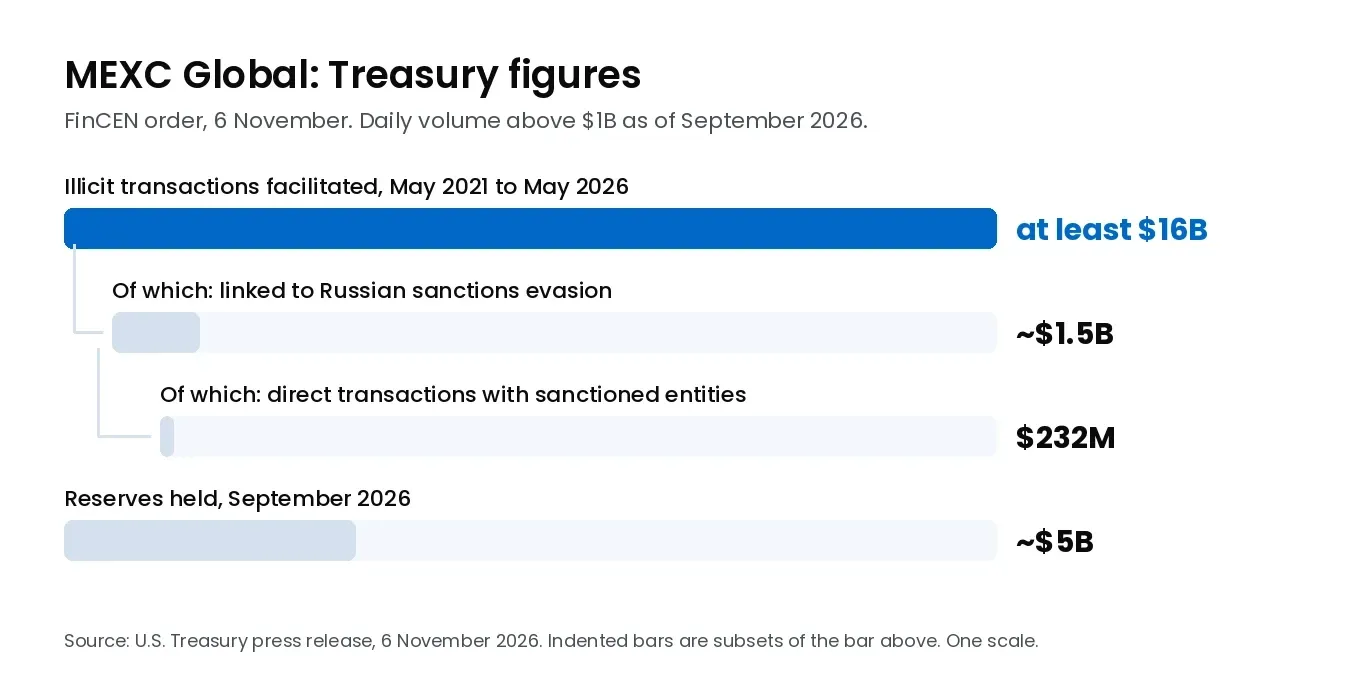
Bar chart of MEXC Global figures from Treasury: at least $16B in illicit flows, of which nearly $1.5B is Russia-linked, including $232M in direct sanctioned-entity transactions, plus about $5B in reserves
Source: U.S. Department of the Treasury, FinCEN. Illicit flows cover the five years to May 2026. Reserves are as of September 2026.
The order works at the banking layer. Any US bank, payment processor or broker-dealer that touches MEXC flows must stop once it takes effect.
Troniex’s reading: counterparties carry the next question. Exchanges and OTC desks that settle with MEXC-linked accounts or wallets need a written policy before the effective date. Transaction monitoring should tag exposure to named exchanges, and screening lists need an owner who watches FinCEN orders.
Greece taxes DeFi income at 15%
Greece’s parliament approved a crypto tax framework that starts 1 January 2027. The rules cover four points:
- Gains: 10% on annual net crypto gains above €500. Once gains cross the threshold, the whole gain is taxable.
- DeFi income: 15% on staking, crypto lending and DeFi liquidity returns, treated as interest income.
- Losses: Losses above €500 carry forward for 5 years.
- Past gains: 12 months to declare them without late-filing penalties. Tax is due within 60 days of declaration.
The tax also applies when crypto pays for goods or services.
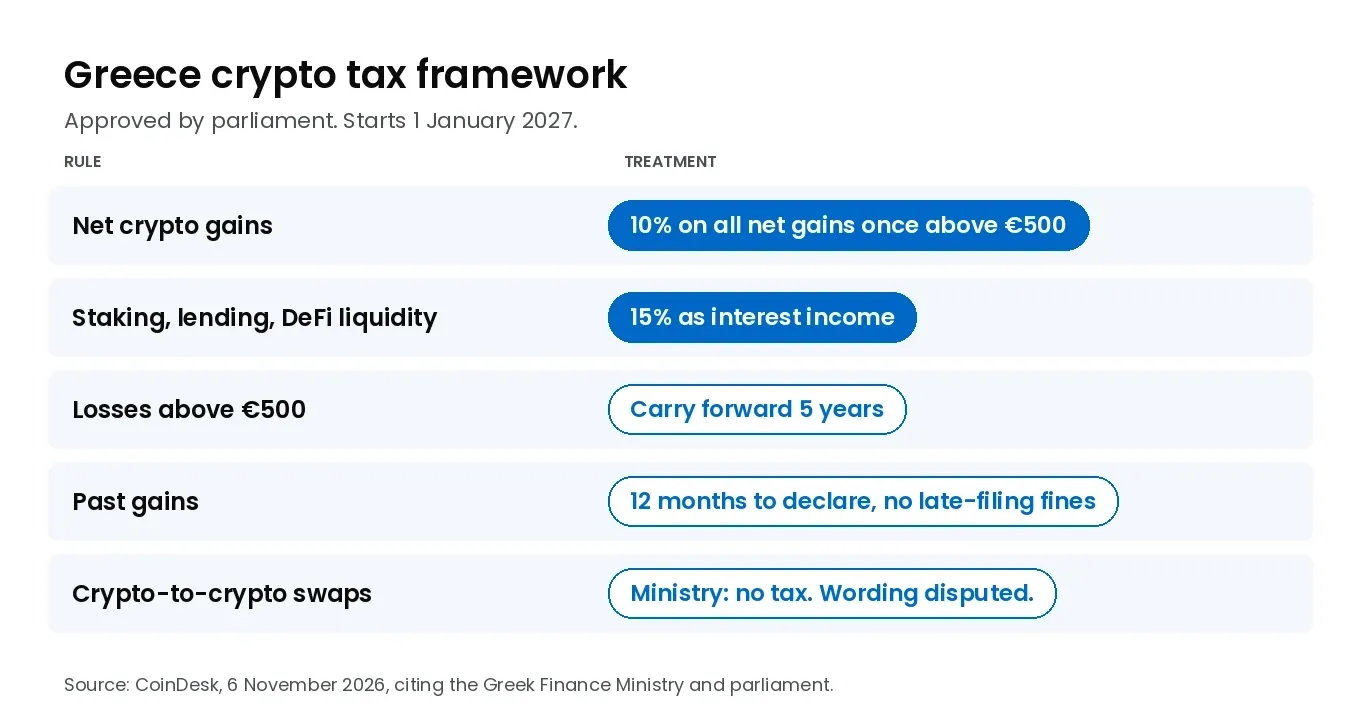
Table of Greece’s crypto tax rules: 10% on all net gains once above 500 euros, 15% on staking, lending and DeFi liquidity income, 5-year loss carry-forward, 12-month declaration window, effective 1 January 2027
Source: CoinDesk, Greek Finance Ministry as reported.
Greece names DeFi liquidity returns explicitly. A user who provides liquidity now has an income event to report.
The Finance Ministry says swapping one crypto for another will not trigger tax. Parliament’s Scientific Service warned that the bill’s wording leaves room to tax those trades. Treat that as unsettled until secondary rules arrive.
Troniex sees a data job here. Exchanges and wallets with Greek users need lot-level cost basis and a yield-income ledger before January.
AI & Agentic AI
OpenAI’s GPT-6 Cyber turns exploit development into a model task
On 5 November, OpenAI introduced GPT-6 Cyber, a model trained to find and validate exploitable vulnerabilities while staying inside the scope a researcher sets.
OpenAI reports 48.5% on ExploitGym, up from 32.1% for GPT-5.6 Cyber. Its researchers built working exploits for 948 Linux kernel vulnerabilities, more than 5 times the 166 that GPT-5.6 Sol exploited in the same test setup. They also produced evidence for 81 previously unknown high-severity Firefox vulnerabilities, as classified by Mozilla.
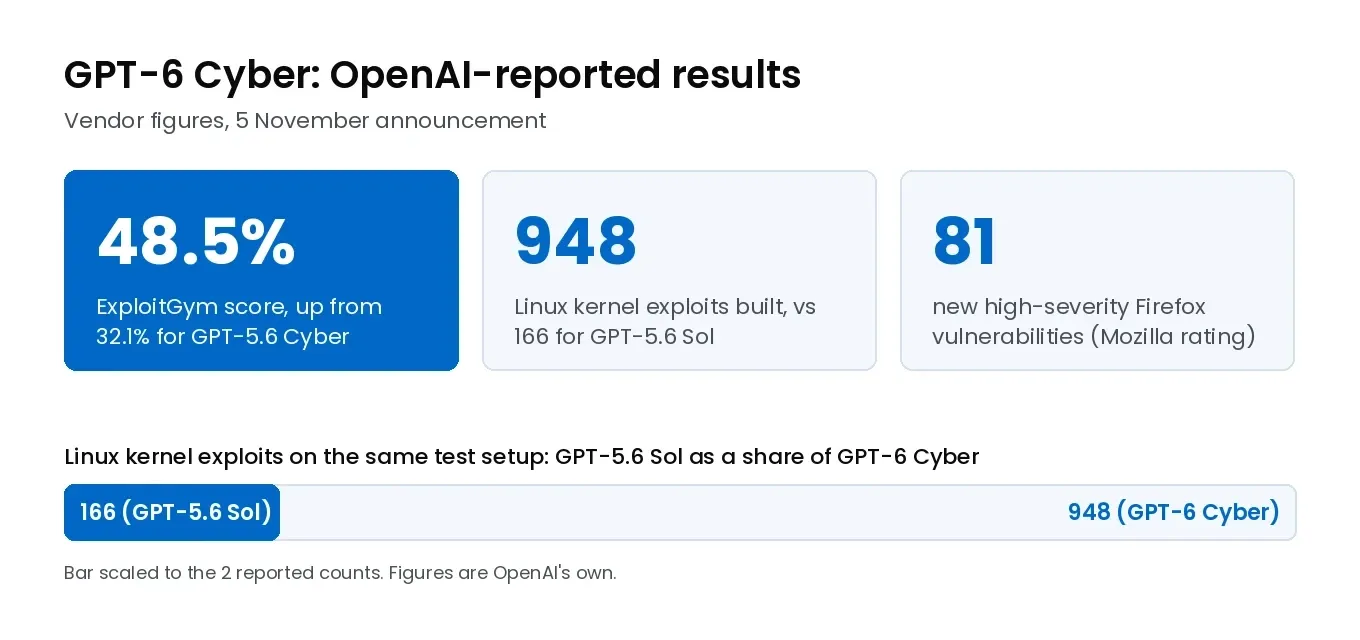
KPI chart of OpenAI-reported GPT-6 Cyber results: 48.5% ExploitGym, 948 Linux kernel exploits versus 166 for GPT-5.6 Sol, 81 Firefox high-severity vulnerabilities
Source: OpenAI. Figures are OpenAI’s own and not independently replicated.
Access starts with select approved Daybreak Red customers through the API and Codex, with wider access promised. OpenAI rates the model Critical for cybersecurity under its Preparedness Framework, up from High.
The announcement covers Linux, Firefox and web applications. It does not name smart contracts. Troniex reads the same capability class as relevant to Solidity and exchange back ends.
Dragos, which tested cyber-permissive models on a mock power plant range, put the risk plainly. Rob T. Lee, its Chief AI Officer, said “the skill floor is dropping for the reconnaissance and vulnerability research needed before an attack.”
What this changes for builders: a single audit before launch covers a snapshot. Release pipelines need AI-assisted review on every contract change and dependency update, with human auditors on business logic and economic attacks.
Meta prices an agent worker model at a fraction of the cost
On 9 November, Meta released Muse Ember, its smallest and most efficient model. Meta built it for the work agents repeat all day: tool calls, coding subtasks, routing, extraction and long document parsing.
It costs $0.10 per million input tokens and $0.50 per million output tokens, with a 1M-token context window. Meta’s own comparison puts Muse Spark 1.3 at $1.25 and $4.25, and cost per Artificial Analysis task at $0.14 versus $2.39. That is about 17 times lower, for an Intelligence Index of 36 against 37.
Meta pitches a split: “Muse Wonder plans, Muse Ember handles the volume.” A large model sets the rules and a cheap one applies them across thousands of cases.
Why it matters: agents spend most of their tokens on many small steps, so the cost of one step decides whether an agent product has margin. Reconciliation checks and support triage are the obvious fits for fintech and exchange teams.
The scores are Meta’s and Artificial Analysis’s. Meta’s own table shows Claude Haiku 5.5 ahead on FrontierCode 2.0, 34.9% to 27.2%. A cheap worker fits routine steps, and hard engineering work still needs a stronger model.
Moonshot AI sold the other half on 5 November. Its Kimi Hosted Agents offer a managed runtime with isolated sandboxes, 140+ skills, 30+ plugins and 8 finance agent templates, and pitch it against months of building agent infrastructure in-house.
Troniex’s view: the build-or-buy decision moves from the model to the runtime. Price the full path per task, including retries and review time, before you commit.
Blockchain & Infrastructure
Ethereum pauses Glamsterdam after audits find contracts it would break
Ethereum’s next upgrade is stuck on the Hoodi testnet. Core developers postponed the 26 October activation on 22 October, and on 6 November the Ethereum Foundation explained why.
ChainSecurity found projects that rely on invariants that EIP-8037 and EIP-8038 break. The two proposals change how much gas Ethereum charges for certain operations and for state. Core developers will not fork Hoodi until the issues are resolved.
One example from ChainSecurity’s analysis: some contracts rely on a failed external call leaving too little gas for the next step. Under the new accounting that gas returns, so a contract records a permanent failure for an operation meant to stay retryable. The Foundation documents eight affected invariants in a public repository.
On 9 November the Foundation added an update. It has received four reports of deployed contracts that break under the proposed changes, and it is contacting those protocols.
It also says it takes seriously a concern that changes touching immutable contracts get too little scrutiny. Its developers are prototyping specification revisions.
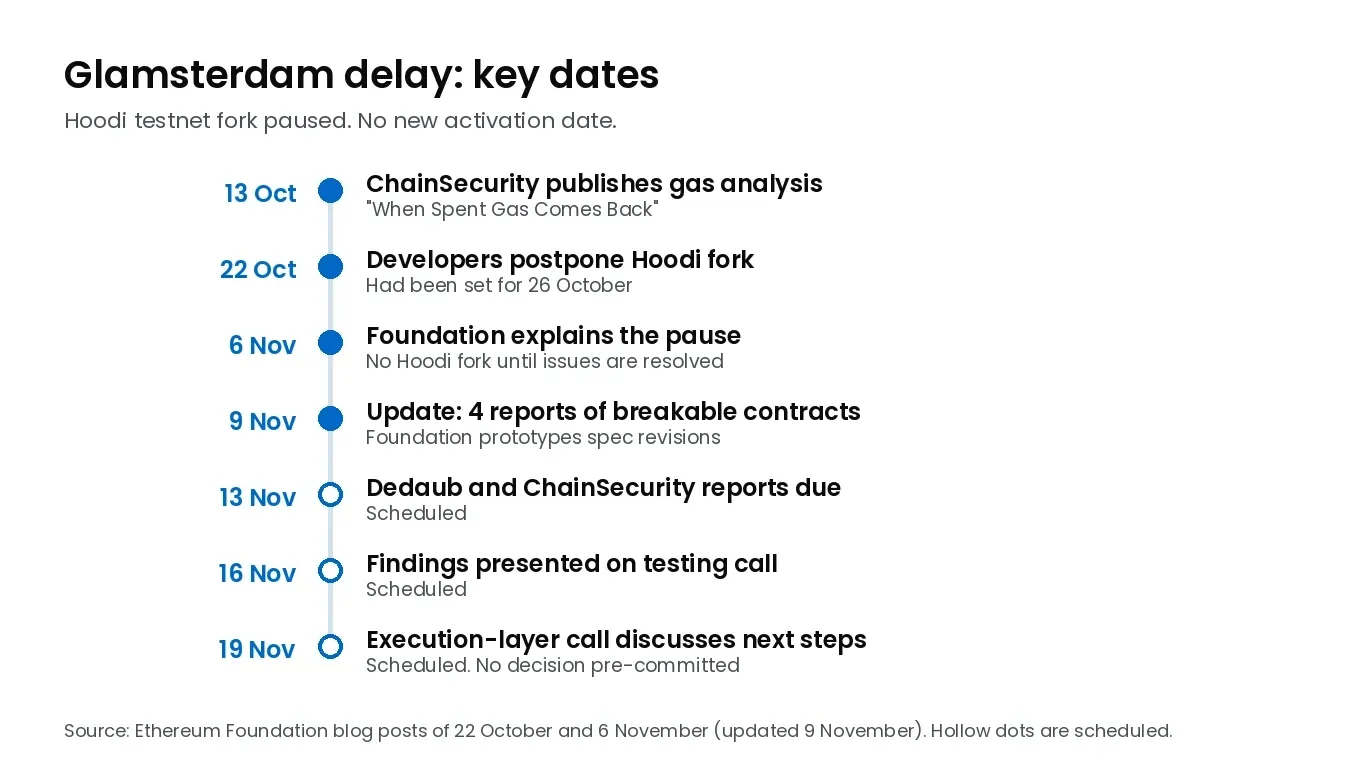
Timeline of the Glamsterdam delay: ChainSecurity analysis 13 October, Hoodi postponed 22 October, Foundation post 6 November, four reports 9 November, audit reports 13 November, calls 16 and 19 November
Source: Ethereum Foundation, Hoodi postponement notice, ChainSecurity blog. Hollow dots are scheduled dates.
The same upgrade carries enshrined proposer-builder separation (EIP-7732) and block-level access lists (EIP-7928), so the pause holds the whole package. No mainnet date exists.
The Foundation says it cannot check every project, including offchain code. The burden lands on app teams.
What this changes for builders: search your contracts for fixed gas budgets, gas stipends and retry logic that depends on out-of-gas failures. Add those findings to audit scope now, and test on Hoodi when a schedule returns.
Base and Zcash shorten block time and block-count logic feels it
Base’s Denim upgrade went live on mainnet on 5 November at 18:00 UTC. Base now makes a canonical block every 200ms, down from every 2 seconds. That is five per second, and it replaces Flashblocks.
Base says block.number now advances 10 times faster while block.timestamp still moves in whole seconds. Anything that treats a block count as a duration shrinks to a tenth:
- Timelocks, cooldowns and exit delays.
- Vesting and emission schedules.
- Per-block rate limits and governance voting delays.
- Fixed-cardinality TWAP oracles, which Base says now cover roughly half as much wall-clock history.
Base added a BaseTime predeploy for millisecond time. Flashblocks streams stopped returning data at activation, so apps must move to canonical block subscriptions. Mainnet nodes need base/base v1.5.1 or later.
A 200ms block is not final. Base says it becomes safe when its batch posts to Ethereum and final when Ethereum finalizes that batch.
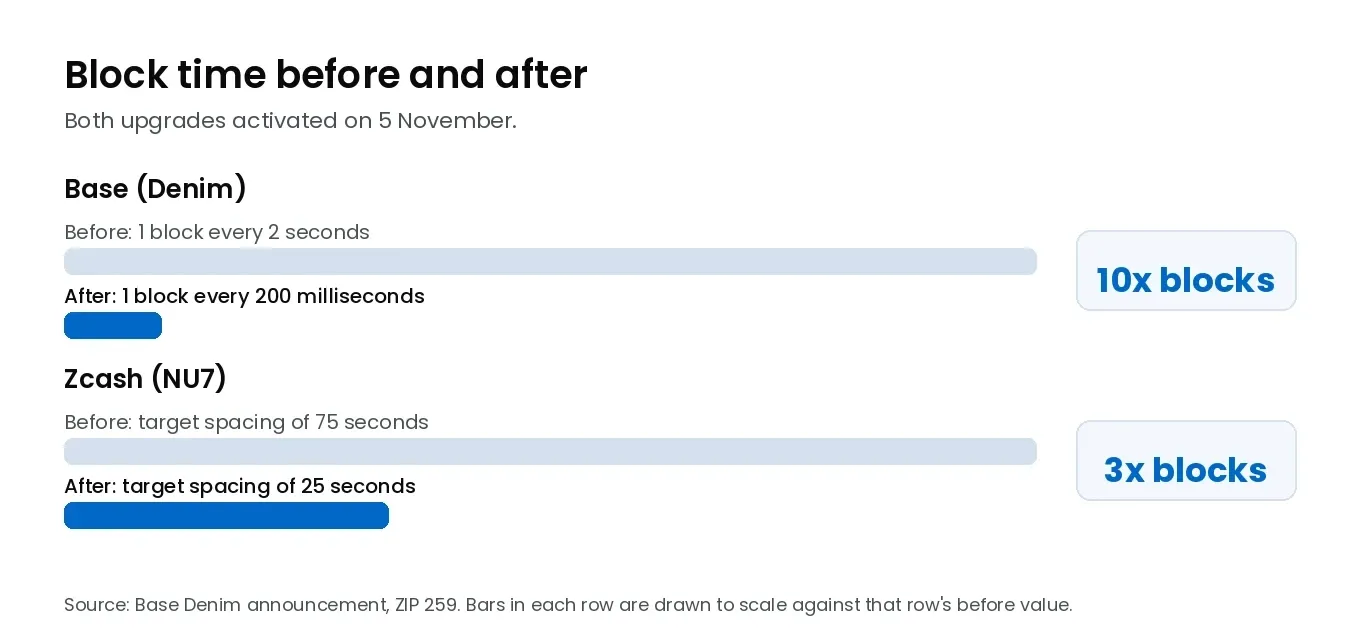
Before and after chart: Base block interval 2 seconds to 200 milliseconds, Zcash target block spacing 75 seconds to 25 seconds
Source: Base, ZIP 259. Bars within each row are drawn to scale.
Zcash made a similar move. Its NU7 upgrade activated on 5 November at block 3,543,405 and cut the target block spacing from 75 seconds to 25 seconds. Block subsidies scale down by the same factor so issuance holds steady.
NU7 also removes 60% of transaction fees from circulation into a public reserve, set for gradual reissue from block 8,939,664, expected in 2031. Version 4 transactions are now invalid, so ZEC left in the Sprout pool, about 12,224 ZEC according to The Block, is unspendable.
Troniex’s perspective: both upgrades repeat the Glamsterdam lesson. A faster block changes what a block-count timer means. Store durations as timestamps and treat chain parameters as versioned inputs.
The Troniex Take
A protocol team changes a number, and deployed code keeps trusting the old one. That failure mode ran through the infrastructure news this reporting period.
Glamsterdam rewrites gas accounting. Denim and NU7 shorten block time, and NU7 also retires version 4 transactions.
Two observations follow.
Chain parameters are part of your contract spec
Gas costs and block counts are inputs your code depends on, and protocol teams revise them. Teams that keep an assumptions register absorb each change in a sprint.
GPT-6 Cyber raises the pace of the other side. OpenAI’s 948 Linux exploits against 166 for the prior model show how fast model-assisted exploit work is scaling. Troniex’s view is that continuous review replaces the one-time audit for any contract that has upgrade paths or integrations.
Regulated platforms are absorbing DeFi
Kraken’s parent buys into Aave and Greece taxes DeFi liquidity income. At the other end, FinCEN cuts an exchange off at the bank.
Each one pulls onchain activity into systems that need clean data on who holds what and where funds came from.
For exchange and fintech founders, reporting and counterparty screening are product features that decide which markets you reach.
What to do this month:
- List every contract with fixed gas amounts, block-count timers or pending-state reads.
- Re-run tests on Hoodi once a schedule returns and on Base Sepolia now.
- Add AI-assisted review to the release pipeline for contract changes.
- Confirm your reporting produces lot-level cost basis and yield income per user, and that screening covers FinCEN orders.
What’s Ahead
Confirmed dates:
- 12 November: Ethereum’s consensus-layer call. EIP-8037 and EIP-8038 are not on the agenda.
- 13 November: Dedaub and ChainSecurity deliver and publish their reports.
- 16 November: The testing call, where the auditors and the Foundation present findings.
- 19 November: The execution-layer call discusses findings. The Foundation says no decision is pre-committed.
- 1 January 2027: Greece’s crypto tax framework starts.
30 days after Federal Register publication: FinCEN’s MEXC order takes effect.
OpenAI says it will widen GPT-6 Cyber access to all Daybreak Red customers soon, with no date given.
Troniex expects revised specifications for EIP-8037 and EIP-8038 on the 19 November table, since the Foundation is already prototyping them. That is an expectation and not an announcement.
Conclusion
Chains will keep changing their rules. Teams that write down which rules their contracts trust will absorb the next change in a sprint, and the rest will hear about it from an auditor or an attacker.
What number in your code would fail first if a protocol team changed it next month?
If you want an outside review of those assumptions, Talk to Our Experts.