
Binance's Signer Breach Puts Every Exchange's Trust Boundary on Notice
Attackers reached Binance's wallet-signing service through staff devices and an internal AI tool, with $6.34B in assets affected. The same week, Coinbase and Kraken opened to AI agents, DTCC switched on tokenized securities, and the CFTC cleared US equity perps. Custody controls and agent permissions are now product decisions.
Nov 06, 2026
9 mins read
- Binance signer breach: Attackers reached the wallet-signing service through staff devices and an internal AI tool. Assets affected: $6.34B. About $2.85B frozen or intercepted. Company funds replenished 98% of affected tokens.
- Mercado Bitcoin: About $38M lost across at least 10 chains on 2 November. Users covered. Second hot-wallet incident in 4 days.
- US equity perps: The CFTC cleared single-stock perps as security futures on dual-registered venues. No launch date named.
- AI agents on money rails: Coinbase and Kraken opened scoped agent access. Canadian banks RBC, TD, BMO and CIBC block personal AI agents from online banking.
- PhotonPay: $40M Series C funds an agent-ready execution layer on stablecoin and card rails (still in development).
- CrowdStrike: Shipped an AI kill switch and agreed to buy Fiddler AI (about $400M) and Dreadnode (about $95M).
- DTCC tokenization: Tokenization Service live. 34 securities. About 20 launch users. Tokens are 1:1 digital twins of DTC-held securities.
Attackers did not crack a cold vault at Binance. They instructed the signing service that moves hot-wallet funds, after months of access through staff laptops, a fake job interview, a tampered install, and an internal AI tool with production reach.
Binance's preliminary count of assets affected is $6.34B. About $2.85B is frozen or intercepted, and company funds have replenished 98% of affected tokens, according to Binance and secondary reporting.
This edition covers the reporting period 28 October to 3 November 2026. The bigger shift is clear: the people and tools that call a signer now sit inside the trust boundary, and so do AI agents that trade or pay.
Founders and CTOs will see what changed on agent access, tokenized collateral, and US equity perps, and where exchange builders ought to harden next.
Crypto & DeFi
Binance breach hits assets through the wallet-signing service
On 29 October, attackers used Binance's wallet-signing service to move assets from hot wallets on Ethereum and other chains. Binance's preliminary count of assets affected is $6.34B.
Co-CEO Richard Teng told CNBC on 3 November that the attack ran for about 4 months. In June, a wallet DevOps engineer installed a tampered Homebrew package while seeking an AI coding tool.
In September, fake recruiters planted malware in a second engineer's coding test. Internal AI tools then led them to the wallet-authorization system.
The FBI attributes the campaign to North Korea's TraderTraitor. Binance says company funds have replenished 98% of affected tokens, and about $2.85B is frozen or intercepted.
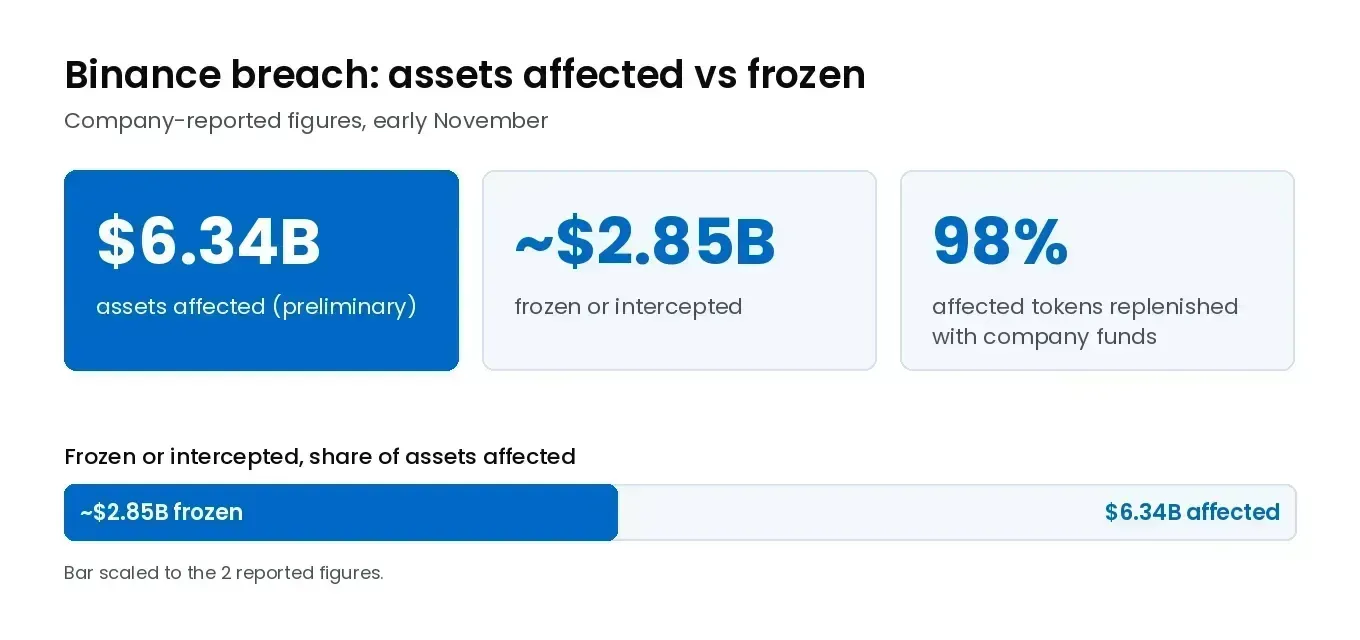
Source: TokenPost, CoinDesk, CNBC.
On Ethereum, EIP-7702 turned a hot wallet into an attacker-controlled sweeper (about 130 lines of code, per an analysis reported by Blockto).
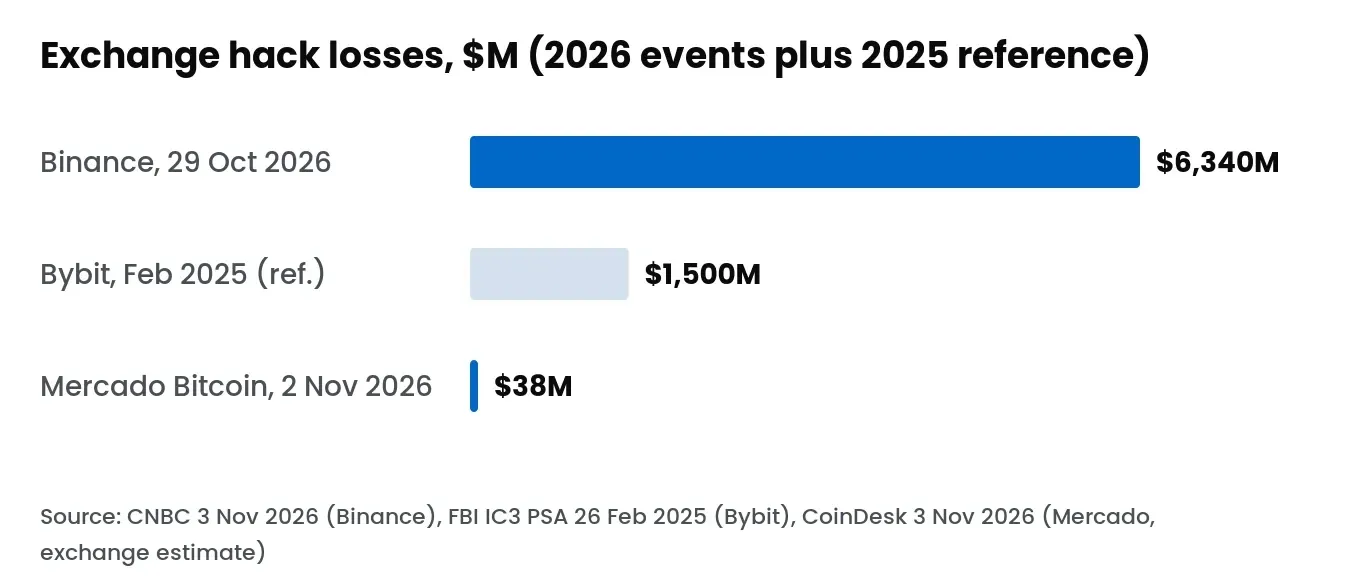
Bybit (Feb 2025) shown for scale. Sources: CNBC, FBI IC3, CoinDesk.
What this changes for builders: any internal caller that reaches a signer is now an attack surface, including AI coding tools treated as productivity software.
Troniex's reading is that reviews of centralized exchanges and wallet systems will start asking for an inventory of every tool with signing reach. Expect insurers and supervisors to ask for the same. Next, exchanges that leave EIP-7702-style delegation open by default invite a repeat path.
Mercado Bitcoin loses about $38M across 10 chains
On 2 November, Brazil's largest exchange paused deposits and withdrawals after drains on at least 10 chains. CoinDesk put losses near $38M, with about $11M frozen and a pledge that users are covered. Separately, BTCPay Server warned of drains on version 2.4.1 or older.
Two exchange incidents in 4 days both ran through hot wallets. The overlooked point: multi-chain hot wallets multiply blast radius when signing policy is shared.
Troniex sees hot-wallet caps, per-chain sweep schedules, and signing alerts as baseline in every crypto wallet build.
Prediction: operators that still share one signing path across chains will face the next insurer questionnaire first.
The CFTC clears single-stock perps for US exchanges
On 3 November, CFTC Chairman Michael Selig said the CFTC deems "Equity Perps" approved as security futures products. They list on venues registered with both the CFTC and the SEC. No exchange or launch date was named. CME Group's suit over the CFTC's 29 May approval of Kalshi's bitcoin perp remains pending.
A perp never expires. Funding payments between longs and shorts pull it toward the stock price. What changes: an offshore crypto product shape moves under dual US registration. The gap people miss is calendar mismatch: a 24/7 contract tracking a stock that trades 6.5 hours a day.
Our view, from perpetual exchange work and the perpetual launch checklist, is that funding, liquidation, and risk dashboards carry over from crypto. The team that solves weekend funding cleanly sets the standard venues copy.
AI & Agentic AI
Exchanges open to AI agents, Canadian banks shut them out
On 29 October, CBC reported that RBC, TD, BMO and CIBC are blocking personal AI agents from online banking.
On 2 November, Coinbase added an agent signup page for crypto and stock trades, with user-set limits (the service launched in June). On 3 November, Kraken co-CEO Arjun Sethi told The Logic that customers are free to let AI agents pull data or trade "all day long," within guardrails.
Agents connect via API or a Model Context Protocol (MCP) server, with scoped permissions: read data, trade inside a portfolio, stay under spending limits. Coinbase's docs bar agents from withdrawing to outside addresses. Access is revocable at any time.
Sethi named the open issue: liability when an agent goes rogue.
What changes: money access for agents is now a product feature on exchanges and a refusal on major Canadian banks. The missed piece is the audit trail.
Troniex builds AI agents, agentic systems, and trading bots. Exchanges need a permission layer: scoped API keys, agent-only sub-accounts, full action logs, and a kill switch per agent.
Our experts expect agent support to split exchanges into 2 tiers within a year, decided by that audit trail.
PhotonPay raises $40M for AI agents on stablecoin and card rails
On 30 October, Hong Kong's PhotonPay closed a $40M Series C led by Blockchain Capital. Company-reported figures: $65B annualized volume, 34 licenses, and 200,000+ business customers. Its "Financial OS" joins stablecoin wallets, fiat accounts, local clearing, and cards in 1 API.
The round funds an "agent-ready financial execution layer," with planned MCP support so agents read balances and pay inside business-set limits. That layer is still in development, with a live Mastercard demo in May 2026.
What changes: agent payments move from demos toward a funded execution stack on stablecoin and card rails. The overlooked build is the policy engine between an agent's request and the rail.
That fits Troniex stablecoin gateway and wallet work. Deterministic spending rules sold to every platform adding agents look like the durable product, ahead of another wallet UI.
CrowdStrike ships an AI kill switch and buys 2 agent-security startups
On 3 November, CrowdStrike launched an AI Kill Switch in Falcon Guardian: stop a rogue agent, block relaunch, cut network access, all logged. It also agreed to buy Fiddler AI for about $400M and Dreadnode for about $95M (WSJ via TechCrunch).
Buyers now treat a stop button as table stakes before approving agents in production. For custom AI in trading or payments, that off switch belongs in-app, next to the permission layer. Expect enterprise RFPs to list kill-switch and action-log requirements beside model choice.
Blockchain & Infrastructure
DTCC switches on tokenized securities
On 28 October, DTC launched the DTCC Tokenization Service (DTS). It tokenizes DTC-held securities (over $114 trillion in custody). The first batch covers 34 securities. About 20 firms signed on at launch, including JPMorgan Chase, Morgan Stanley, Bank of America, Citigroup and Fidelity.
Each token is a 1:1 digital twin: same CUSIP, rights and investor protections. Registered wallets swap tokens 24/7, and DTC tracks ownership in near real time. Tokenized stocks now have 2 models: DTCC's issuer-neutral twins inside existing plumbing, and third-party wrappers like the OKX and ICE plan, which 38 listed companies oppose (PANews, 29 Oct).
What changes: tokenization sits in core custody plumbing, ahead of retail wrappers. Collateral movement comes before retail trading.
Troniex offers asset tokenization and smart contract development. A direct DTS link needs DTC eligibility, a later opportunity. Brokers and asset managers that map which collateral they would post on-chain first will move faster when wallet allowlists open.
The Troniex Take
Three patterns define this reporting week.
First, the signer is the new attack surface. Binance lost funds through its signing service. Mercado Bitcoin's multi-chain drain landed days later. Inventory everything that reaches your signer, AI coding tools included, before you add agent order flow.
Second, AI agents get money access with limits, or they get blocked. Coinbase and Kraken ship scoped permissions. PhotonPay is funding the payment rail. CrowdStrike is selling the kill switch.
Canadian banks refuse. Define scopes, loss caps, and logs before customers arrive with agents of their own.
Third, institutional rails absorb crypto product shapes. DTCC's live tokens and CFTC equity perps pull collateral and derivatives into supervised plumbing. Risk engines will need to satisfy multiple regulators.
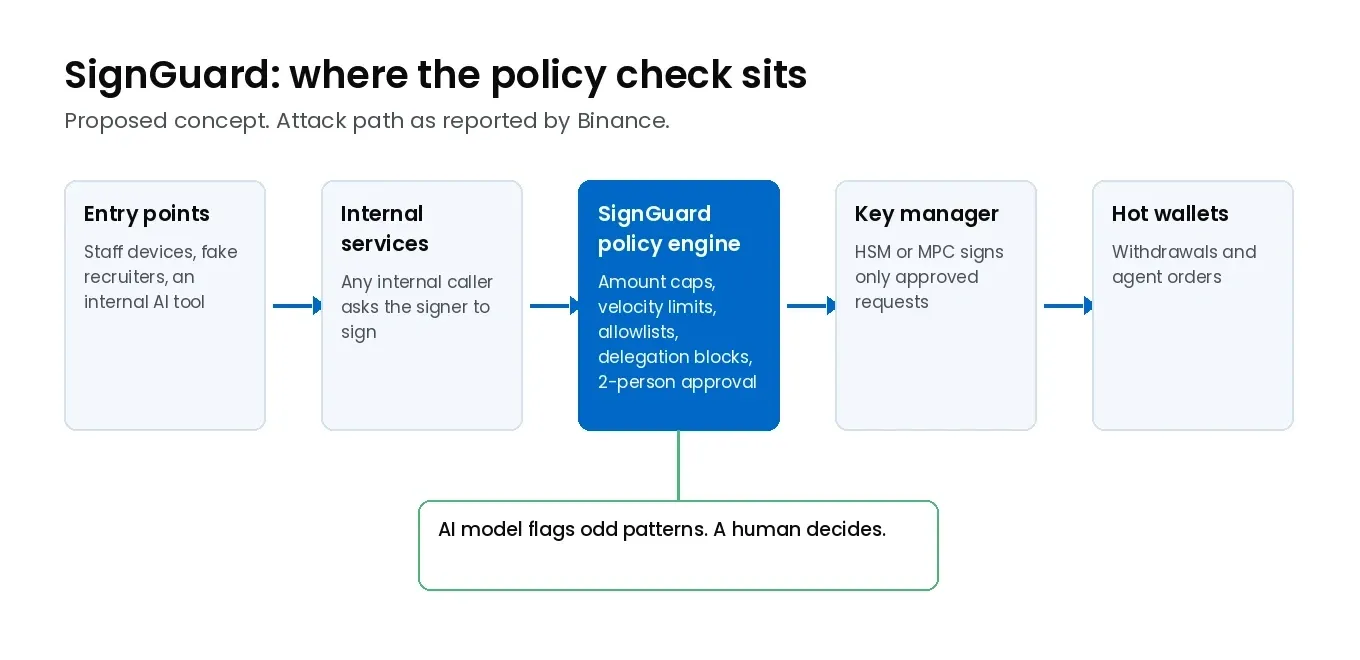
A signing-policy gateway between internal services and the key manager (HSM or MPC) matches the week: amount caps, velocity limits, destination allowlists, EIP-7702 blocked by default, 2-person approval above a threshold, and a kill switch per agent, wallet, or chain. An AI model flags odd patterns for a human and never approves.
What's Ahead
Watch for insurer and supervisor questionnaires that ask for a full inventory of tools with signing reach. That is an expectation, not a confirmed rule.
Watch for the first dual-registered venue to name an equity-perp launch date. Selig's statement approved the product class. No listing date is public.
Watch for agent permission layers and MCP endpoints to become table stakes on mid-sized exchanges that want the customers banks turn away.
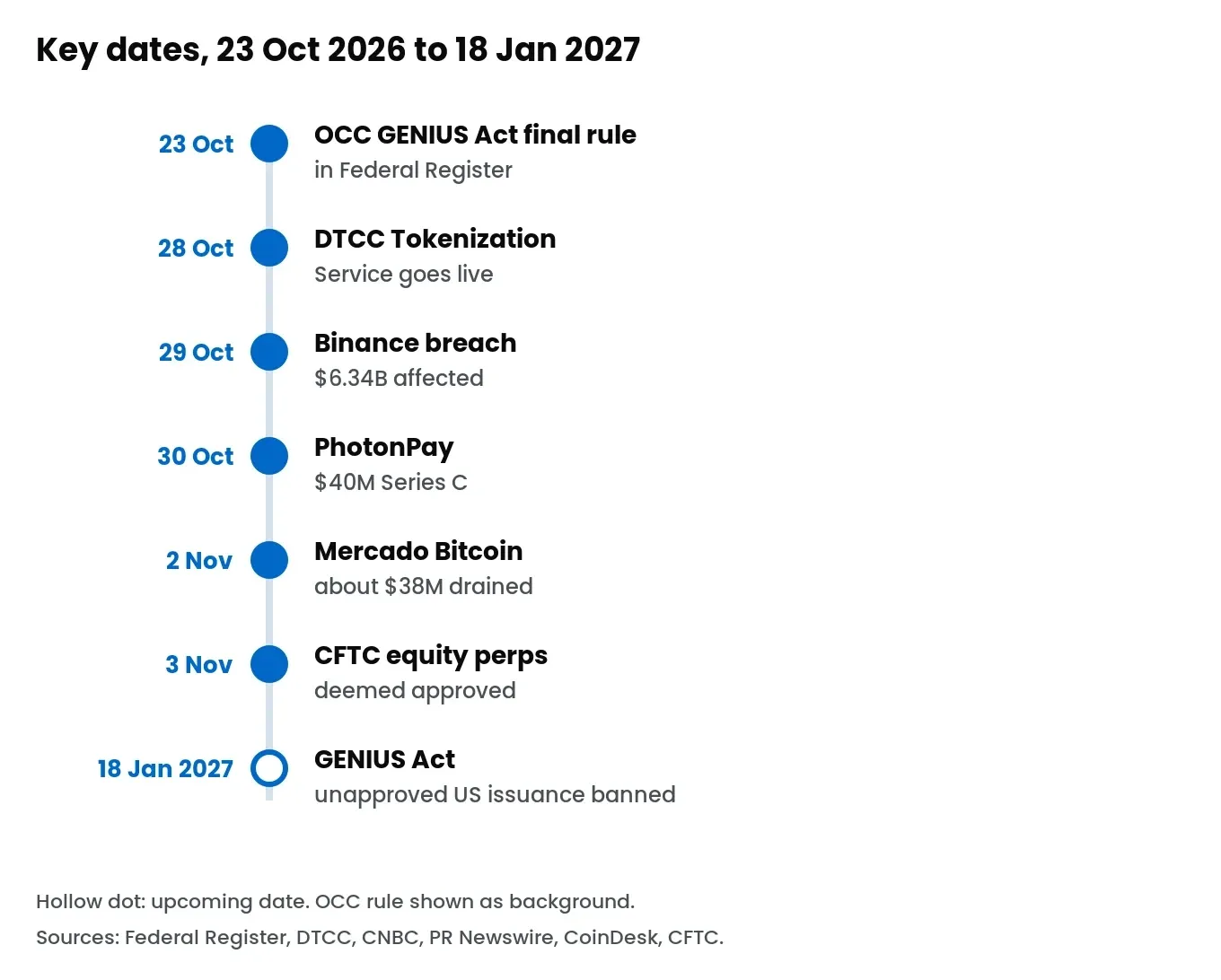
Also watch reserve, redemption, and allowlist controls harden in code as stablecoin rules advance. The OCC's GENIUS Act final rule from 23 October sets the background.
Issuing a US payment stablecoin without approval is a crime from 18 January 2027.
Conclusion
A tampered install and a fake job interview opened a path to $6.34B in assets at the world's largest exchange. Map what instructs your signer before you add agents.
Decide your agent policy now. Treat tokenized collateral and dual-registered equity perps as infrastructure you will meet in 2027, not as side experiments.
Which of your systems would you let an AI agent touch first?
If a wallet or exchange security review is on your list, Talk to Our Experts.