MT5 Trading Bot Development: How to Build, Test & Deploy a Custom EA in 2026
Learn how MT5 trading bot development works, from strategy design and MQL5 development to backtesting, risk management, optimization, and live deployment.
Sep 30, 2026
19 mins read
Automated trading has moved well beyond simple rule-based scripts. In 2026, traders, startups, brokers, prop firms, and trading businesses are increasingly looking at algorithmic systems that can analyze market data, execute predefined strategies, manage risk, and operate with minimal manual intervention.
The wider market reflects that shift. The global algorithmic trading market was valued at approximately $23.5 billion in 2025 and is estimated to reach $26.3 billion in 2026.
Grand View Research projects the market to reach $64.3 billion by 2033, representing a 13.6% compound annual growth rate from 2026 to 2033.
MetaTrader 5 remains one of the major platforms for this type of automation. Its ecosystem combines MQL5 development, MetaEditor, Expert Advisors, strategy testing, optimization, and automated execution.
More recently, MetaTrader 5 has also expanded its AI capabilities, including AI-assisted interaction with Expert Advisors and Strategy Tester workflows.
For businesses and traders, however, building an MT5 trading bot is about much more than generating a few lines of MQL5 code. A reliable system requires clear strategy specifications, execution logic, risk controls, testing, optimization, deployment, monitoring, and ongoing maintenance.
This guide explains how MT5 trading bot development works, what can be automated, how AI fits into the development process, how to test an Expert Advisor, and when a custom development approach makes more sense than a ready-made EA or no-code tool.
What Is an MT5 Trading Bot?
An MT5 trading bot is an automated software application that runs within MetaTrader 5 and follows predefined trading rules to analyze markets and, when authorized, execute or manage trades.
Most MT5 trading bots are built as expert advisors, commonly called EAs. Expert Advisors are applications developed using MetaQuotes Language 5, or MQL5.
An EA can be programmed to monitor market conditions, identify signals, calculate position sizes, place orders, modify positions, manage stop-loss and take-profit levels, and close trades according to predefined rules.
The important distinction is that an MT5 trading bot does not necessarily mean one particular strategy. The same platform can support trend-following, scalping, breakout, grid, mean-reversion, multi-symbol, signal-driven, and other automated approaches.
For simple strategies, MetaTrader 5 includes the MQL5 Wizard, which can generate an Expert Advisor by combining predefined signal, money-management, and trailing-stop components. For more sophisticated requirements, developers can build custom MQL5 logic.
This is why the term "MT5 trading bot development" can cover everything from a relatively simple EA to a complex automated trading system with multiple strategies, risk controls, external integrations, and monitoring.
How Does an MT5 Trading Bot Work?
A production-oriented MT5 trading bot can be viewed as a sequence of connected components:
Market Data → Strategy Engine → Signal Validation → Risk Management → Order Management → MT5/Broker Execution → Position Monitoring → Logging & Alerts
The market-data layer provides the information required by the strategy. The strategy engine evaluates that information against predefined conditions.
A signal-validation layer can then check whether the trade meets additional requirements such as spread, session, volatility, or market-state conditions.
Before an order is submitted, the risk engine can determine whether the trade is permitted and how much capital should be allocated.
The order-management layer handles execution, position updates, modifications, and trade-state tracking. After execution, monitoring and logging help identify errors, unexpected behavior, connection issues, or changes in market conditions.
This architecture matters because a trading strategy and a trading system are not the same thing.
A strategy describes when to trade. A production system also has to determine how to execute, how much to trade, what happens when execution fails, and how the system behaves after an interruption.
What Can an MT5 Trading Bot Automate?
A custom MT5 EA can automate many parts of a trading workflow, depending on the strategy and technical requirements.
Common automation functions include:
- Market-condition monitoring
- Entry and exit signals
- Stop-loss placement
- Take-profit management
- Trailing stops
- Position sizing
- Risk-per-trade calculations
- Maximum drawdown controls
- Daily loss limits
- Trading-session filters
- Spread filters
- Volatility filters
- Multi-symbol trading
- Portfolio-level rules
- Trade management
- Alerts and notifications
- Performance logging
For example, a scalping EA may require strict spread and execution controls, while a grid strategy may need more sophisticated exposure and drawdown management.
Businesses that require broader automated strategy infrastructure can also explore crypto trading bot development company services when their requirements extend beyond MT5 into multi-exchange or cryptocurrency automation.
The key is to design the automation around the actual trading requirements rather than treating every strategy as the same type of bot.

Build a Custom MT5 Trading Bot Around Your Strategy
Turn your trading rules into a custom MetaTrader 5 Expert Advisor designed around your entry, exit, position-sizing, and risk-management requirements. Share your strategy and discuss the technical scope with the Troniex Technologies team.
Talk To Our ExpertsTypes of MT5 Trading Bots
There is no universal MT5 trading bot because different strategies create different engineering requirements.
Trend-Following Trading Bots
Trend-following EAs attempt to identify directional market movement and enter trades according to predefined trend conditions.
They may use moving averages, momentum indicators, price-action rules, volatility filters, or combinations of multiple signals.
Scalping Trading Bots
Scalping bots typically operate over shorter timeframes and can place a larger number of trades.
Because execution conditions matter heavily, development may need to account for spreads, slippage, order latency, broker restrictions, and VPS performance.
Breakout Trading Bots
Breakout EAs identify price movements through predefined support, resistance, range, volatility, or session levels.
They may require additional filters to reduce false signals.
Grid Trading Bots
Grid systems place multiple orders around predefined price levels.
Their development requires careful consideration of position accumulation, grid spacing, exposure, volatility, and drawdown.
Businesses developing automated grid strategies can also review grid trading bot development for broader strategy and architecture considerations.
Mean-Reversion Bots
Mean-reversion systems attempt to identify situations where price has moved away from a predefined reference level and may revert.
The technical challenge is defining the conditions under which a deviation is considered actionable while controlling risk if the market continues moving in the same direction.
Multi-Symbol Trading Bots
A multi-symbol EA can analyze and potentially trade several instruments from one strategy framework.
This introduces additional requirements for market data handling, symbol-specific parameters, portfolio risk, and synchronization.
AI-Assisted Trading Bots
AI can support parts of an automated trading workflow, including code generation, research, signal analysis, parameter exploration, and development assistance.
However, AI-generated code should not automatically be treated as production-ready trading software.
How to Build an MT5 Trading Bot
Professional MT5 EA development usually starts before any code is written.
1. Define the Trading Strategy
The first step is to turn the trading idea into explicit rules.
Document:
- Entry conditions
- Exit conditions
- Stop-loss rules
- Take-profit rules
- Position sizing
- Maximum exposure
- Trading hours
- Instruments
- Indicators
- Market filters
- Risk limits
- Conditions for disabling the strategy
If a rule cannot be clearly explained, it will be difficult to implement and test consistently.
2. Convert the Strategy Into Technical Specifications
A developer then translates the trading rules into software requirements.
For example:
Enter long when condition A and condition B are true, provided the spread is below X, and daily loss remains below Y.
This is more useful than simply telling a developer to “build an RSI trading bot”
A clear specification reduces ambiguity and makes later testing much easier.
3. Design the EA Architecture
The next stage is deciding how the software should be organized.
A complex EA may separate:
- Signal generation
- Risk management
- Position sizing
- Execution
- Trade management
- Logging
- Configuration
- Error handling
Modular architecture also makes future strategy changes easier.
4. Develop the MQL5 Logic
MQL5 is MetaTrader 5's specialized programming language for creating expert advisors, indicators, scripts, and related trading applications.
Developers can use MetaEditor to write, compile, debug, and maintain the code.
For straightforward systems, the MQL5 Wizard may be sufficient. Custom strategies often require direct MQL5 development.
5. Add Risk Management
Risk management should not be treated as an optional feature.
Depending on the strategy, an EA may need:
- Maximum position size
- Risk-per-trade limits
- Maximum daily loss
- Maximum total exposure
- Maximum open positions
- Spread limits
- Stop-loss requirements
- Emergency shutdown conditions
- Trading-session restrictions
A strategy that performs well without clearly defined risk controls may still be unsuitable for live deployment.
6. Implement Execution and Error Handling
A bot also needs to handle what happens when the expected trade cannot be executed.
Possible scenarios include:
- Rejected orders
- Connection interruptions
- Unexpected spreads
- Insufficient margin
- Invalid stops
- Symbol restrictions
- Market closures
- Slippage
- Execution delays
The system should log important events and respond according to predefined rules rather than simply assuming every order will succeed.
Can AI Build an MT5 Trading Bot?
Yes, AI can assist significantly with MT5 trading bot development, but it does not remove the need for technical specification, code review, testing, and validation.
AI tools can help with:
- Generating initial MQL5 code
- Explaining MQL5 functions
- Converting strategy descriptions into code
- Debugging compilation errors
- Creating test cases
- Documenting code
- Exploring alternative implementations
- Assisting with optimization workflows
This area is becoming particularly relevant because MetaTrader 5 itself has expanded its AI capabilities. Recent platform updates introduced AI-assisted workflows for Expert Advisors, including preparing EAs for Strategy Tester runs and interacting with EAs, scripts, and indicators on charts.
That development changes the conversation around AI MT5 trading bots. The question is no longer simply whether AI can generate code. The more important question is whether the resulting system has been properly specified, reviewed, tested, and validated.
AI-Generated EA vs Custom MT5 EA Development
|
Factor |
AI-Assisted EA |
Custom EA Development |
|---|---|---|
|
Initial prototype |
Fast |
Structured |
|
Simple rule-based strategy |
Often suitable |
Suitable |
|
Complex strategy |
Requires review |
More controllable |
|
Risk architecture |
Must be explicitly specified |
Can be engineered directly |
|
Broker-specific requirements |
Requires validation |
Can be designed around requirements |
|
Error handling |
Requires verification |
Can be deliberately implemented |
|
External integrations |
Variable |
Customizable |
|
Monitoring |
Usually requires additional work |
Can be built into architecture |
|
Maintenance |
User-dependent |
Can be supported through development |
AI is therefore best viewed as a development accelerator rather than a substitute for engineering discipline.
How to Backtest an MT5 Trading Bot
Backtesting allows an Expert Advisor to be evaluated against historical market data before it is used in live trading.
MetaTrader 5 includes a strategy tester for testing and optimizing expert advisors across historical data. It supports multi-currency testing, visual testing, optimization, forward testing, and distributed testing.
A meaningful backtest should consider more than total profit.
Review metrics such as:
- Net profit
- Maximum drawdown
- Profit factor
- Number of trades
- Average trade
- Win rate
- Risk-adjusted performance
- Losing streaks
- Exposure
- Recovery behavior
Testing assumptions also matter.
For example, a strategy can look very different when spreads, commissions, slippage, and execution delays are realistically incorporated.
This is particularly important for scalping, arbitrage-style, and high-frequency strategies where small execution differences can materially affect results.
Turn Your MT5 EA Idea Into a Development Plan
Not sure whether your strategy is technically feasible? Start with the requirements. We can help define the strategy logic, required features, integrations, testing scope, and deployment requirements before development begins.
Request A ProposalHow to Avoid Overfitting an MT5 Trading Bot
One of the biggest mistakes in automated trading is optimizing a strategy so heavily against historical data that it performs well in the test but poorly on unseen data.
Suppose an EA has dozens of configurable parameters. If you repeatedly adjust those parameters until historical performance looks exceptional, you may be fitting the system to historical noise rather than identifying a robust trading relationship.
A more disciplined testing process can include:
In-Sample Testing
Use one portion of historical data for strategy development and optimization.
Out-of-Sample Testing
Reserve different data to evaluate whether the strategy generalizes beyond the development period.
Forward Testing
Run the strategy against a separate period that was not used for optimization.
Walk-Forward Testing
Repeatedly optimize on one historical window and evaluate the next period to examine how the strategy behaves as market conditions change.
Sensitivity Testing
Check whether small parameter changes produce similar behavior.
Stress Testing
Evaluate the system under less favorable assumptions, including wider spreads, additional slippage, delays, or adverse market conditions.
MetaTrader 5's Strategy Tester includes optimization and forward-testing functionality specifically designed to help developers evaluate expert advisors before live trading.
The objective should not be to discover the most impressive historical result. It should be to understand whether the strategy behaves consistently enough to justify further testing.
MT5 Trading Bot Security and Reliability
Trading software has a different risk profile from an ordinary application because errors can potentially lead directly to financial losses.
Security and reliability should therefore be considered during development rather than added at the end.
Important areas include:
- Source code protection
- Secure credentials
- Restricted permissions
- Input validation
- Order validation
- Risk limits
- Logging
- Error handling
- Emergency shutdown
- Access control
- Dependency management
- Version control
- Deployment controls
MetaTrader also warns users to be cautious about allowing unknown expert advisors to use DLL imports. That is a useful reminder that an EA should be treated as executable software, not simply as a harmless indicator.
For businesses building automated trading products, security should cover both the EA and the surrounding infrastructure.
How to Deploy an MT5 Trading Bot
Development does not end when the EA compiles successfully.
A sensible deployment process is:
Development → Backtesting → Optimization → Forward Testing → Demo Deployment → Production Deployment → Monitoring
Development Environment
Build and test the EA in a controlled environment.
Historical Testing
Evaluate the strategy against relevant historical data.
Forward Testing
Validate behavior against data that was not used during optimization.
Demo Deployment
Run the EA in a live-market but non-funded environment to identify operational issues.
VPS Deployment
If continuous operation is required, a VPS can keep the MetaTrader terminal and EA running without relying on a trader's personal computer.
Live Deployment
Only after the system has passed defined technical and risk checks should live deployment be considered.
Monitoring
Production systems should have visibility into:
- Active positions
- Order status
- Errors
- Connection state
- Margin
- Risk exposure
- Strategy status
- Unexpected behavior
Common MT5 Trading Bot Development Mistakes
- Coding Before Defining the Strategy: If the strategy is vague, the resulting software will be vague too.
- Treating a Backtest as Proof of Future Performance: Historical performance cannot guarantee future results.
- Ignoring Execution Conditions: A strategy can behave differently when spreads, slippage, latency, commissions, and broker rules change.
- Optimizing Too Aggressively: Too many optimization cycles can produce fragile parameters that fit historical data.
- Using AI-Generated Code Without Review: AI can produce syntactically valid code that does not correctly represent the intended strategy.
- Ignoring Failure Scenarios: Rejected orders, connection failures, unexpected market conditions, and restarts need defined responses.
- Treating Risk Management as an Afterthought: A profitable entry signal does not automatically make a complete trading system.
- Deploying Without Forward Testing: A successful backtest is only one stage of validation.
How Much Does MT5 Trading Bot Development Cost?
There is no responsible universal price for a custom MT5 trading bot.
The development cost depends on what the system needs to do.
A simple single-strategy EA with straightforward rules will generally require less engineering than a multi-symbol system with advanced risk controls, external API integrations, AI components, dashboards, or portfolio-level management.
Major cost factors include:
- Strategy complexity
- Number of instruments
- Number of strategies
- MQL5 development requirements
- External API integrations
- Risk-management complexity
- Dashboard requirements
- Testing requirements
- VPS and infrastructure
- Monitoring
- Security
- Maintenance
Businesses comparing development budgets should separate the cost of software development from infrastructure, broker costs, market data, ongoing maintenance, and trading capital.
For a broader breakdown of development, operating, and infrastructure expenses, see our guide to crypto trading bot cost when evaluating automated trading software budgets across different strategy types.
The important point is that a quote should be evaluated by scope rather than by price alone.
Should You Buy an MT5 EA, Use AI or Build a Custom Trading Bot?
The right approach depends on your requirements.
Buy an Existing EA
An existing EA may make sense when the strategy is standard, and customization requirements are limited.
Use an AI or No-Code Tool
AI and no-code tools can be useful for prototypes, experimentation, and simpler strategies.
Modify an Existing EA
Modification can be practical when an existing system already contains most of the required functionality.
Build a Custom MT5 EA
Custom development becomes more relevant when the strategy is proprietary, execution requirements are unusual, multiple systems must interact, or the business needs full control over the architecture.
How to Choose an MT5 Trading Bot Development Company
Choosing a development partner should involve more than asking whether the team can write MQL5.
Ask how the company approaches:
- Strategy documentation
- Architecture
- MQL5 development
- Risk management
- Backtesting
- Forward testing
- Broker compatibility
- Error handling
- Deployment
- VPS infrastructure
- Monitoring
- Source-code ownership
- Documentation
- Post-launch maintenance
A credible development process should also be transparent about limitations.
Be cautious of companies that guarantee specific trading returns without providing rigorous, independently verifiable evidence.
If your strategy is already implemented in another environment, ask whether the development team can translate it accurately rather than simply rewriting code syntax.
For example, businesses working with TradingView strategies may need TradingView bot development when moving from alerts and Pine Script toward a broader automated execution architecture.
Similarly, a business already operating an automated crypto strategy may need a different development architecture for crypto arbitrage bot development rather than attempting to force every strategy into the same MT5 model.
From Strategy to Production-Ready Automation
The biggest misconception about MT5 trading bot development is that the project ends when an EA starts placing trades.
A production-ready system is broader.
The development journey should look more like:
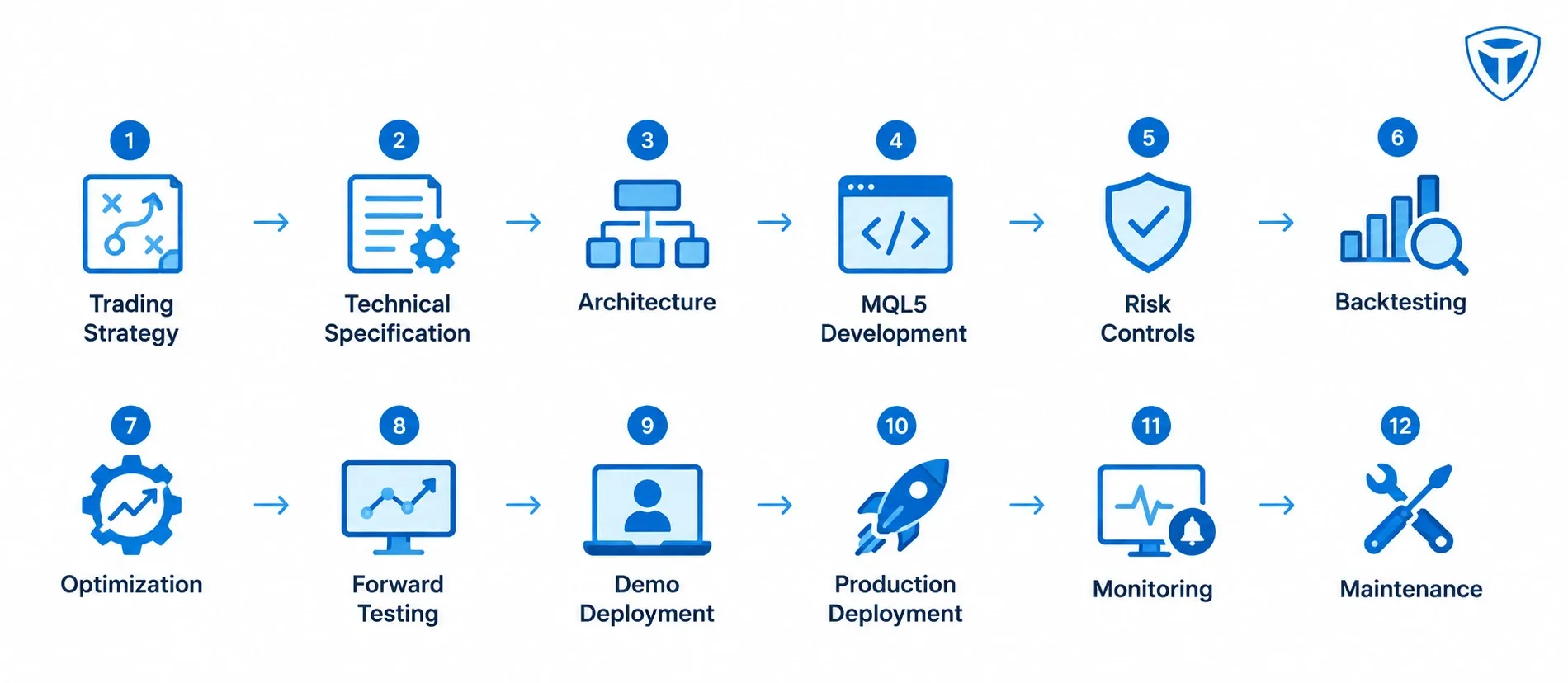
That process creates a clearer separation between the trading idea and the software responsible for implementing it.
For businesses building more advanced automated strategies, the same principles apply across different systems.
- A DCA trading bot development project may prioritize scheduled allocation and portfolio rules.
- A market-making bot requires an order book and inventory management.
- An AI trading bot may require data pipelines and model monitoring.
- A DeFi trading bot development project introduces blockchain transactions, smart contracts, wallet infrastructure, and on-chain execution.
The technology changes, but disciplined strategy specification, risk management, testing, and monitoring remain fundamental.
Why MT5 Trading Bot Development Is Becoming More AI-Driven
AI is likely to become an increasingly important part of the MT5 development workflow.
The most useful application is not necessarily asking an AI system to invent a profitable strategy. It is using AI to accelerate engineering tasks such as:
- Converting requirements into code
- Explaining MQL5
- Generating test cases
- Reviewing implementation logic
- Identifying potential edge cases
- Assisting with documentation
- Preparing testing workflows
- Analyzing test results
MetaTrader's own 2026 platform updates demonstrate that AI is moving closer to the development and testing workflow itself.
That creates a new development model:
Human Strategy → AI-Assisted Development → Technical Review → Automated Testing → Human Validation → Controlled Deployment
The human role remains important because trading requirements, risk tolerance, acceptance criteria, and production decisions cannot safely be reduced to code generation alone.
MT5 Trading Bot Development Checklist
Before deploying a custom EA, verify that you can answer “yes” to the following:
- Is the trading strategy written in precise rules?
- Are entry and exit conditions unambiguous?
- Is position sizing defined?
- Are maximum risk and exposure limits defined?
- Are broker execution conditions understood?
- Has the EA been tested using relevant historical data?
- Have realistic spread and transaction assumptions been considered?
- Has over-optimization been addressed?
- Has forward testing been completed?
- Have failure scenarios been tested?
- Are rejected orders handled correctly?
- Is logging available?
- Is the VPS or deployment environment stable?
- Are monitoring and alerts available?
- Is there an emergency shutdown mechanism?
- Is the source code documented and controlled?
- Is there a maintenance plan?
If several of these questions cannot be answered, the EA may still be a prototype rather than a production-ready trading system.
Start Your Custom MT5 Trading Bot Development Project
From strategy specification and MQL5 development to testing, optimization, and deployment, Troniex Technologies can help structure the development process around your specific automation requirements.
Contact UsFinal Thoughts
MT5 trading bot development is no longer simply about writing an Expert Advisor that can place an order. Modern automated trading systems need to connect strategy logic with execution, risk management, testing, deployment, monitoring, and maintenance.
AI-assisted development is speeding up prototyping, but it also makes proper validation more important because generated code still needs to represent the intended strategy correctly.
For a simple strategy, an existing EA or MQL5 Wizard may be enough. For a proprietary strategy, complex execution workflow, multi-symbol system, external integration, or commercial trading product, custom MT5 EA development provides much greater control over the implementation.
The strongest development process starts with the strategy, not the code:
Define → Architect → Develop → Test → Validate → Deploy → Monitor → Improve.
That is the foundation for building an MT5 trading bot that is not merely functional, but structured for real-world operation.