TradingView Bot Development: Build Custom Automated Trading Systems
Explore TradingView bot development for custom Pine Script strategies, alerts, webhooks, API integrations, risk controls, automated execution, testing, and scalable trading systems.
Sep 19, 2026
20 mins read
TradingView has become a widely used environment for technical analysis, chart-based strategy development, and market monitoring, while algorithmic trading continues to expand across financial markets. Grand View Research estimates that the global algorithmic trading market was worth $23.5 billion in 2025 and projects it to reach $26.3 billion in 2026, with a projected 13.6% CAGR through 2033.
TradingView bot development connects this growing automation demand with custom trading-system engineering. Instead of relying entirely on a ready-made bot, businesses can translate proprietary trading rules, indicators, and strategies into a structured automation workflow involving Pine Script, TradingView alerts, webhook or API communication, validation, risk controls, external broker or exchange integration, execution, and monitoring.
TradingView's current documentation distinguishes between strategy testing and live brokerage automation: Pine Script strategies can be backtested and forward-tested, while TradingView alerts can generate events, and webhooks can send HTTP POST requests to external applications.
TradingView currently states that automated strategy trading directly with a brokerage account is not available natively.
For businesses with proprietary strategies or specialized execution requirements, the opportunity is therefore not simply to "build a TradingView bot." It is to engineer a reliable system around TradingView's capabilities and the appropriate external execution infrastructure.
Quick Answer: What is TradingView bot development?
TradingView bot development is the process of converting TradingView indicators or trading strategies into an automated software workflow. A typical implementation combines Pine Script strategy logic, TradingView alerts, webhook/API communication, signal validation, risk management, external broker or exchange connectivity, execution controls, and ongoing monitoring.
What Is TradingView Bot Development?
TradingView bot development is more than writing a Pine Script indicator or configuring an alert. It involves designing the software components required to turn defined trading conditions into a controlled automation workflow.
TradingView provides Pine Script for creating proprietary indicators and strategies. Its documentation explains that strategies are specialized Pine Script scripts used to simulate trading behavior and analyze historical and real-time results.
TradingView Indicators vs Trading Strategies
An indicator primarily calculates and displays analytical information such as moving averages, RSI levels, volatility measurements, or market conditions. A strategy goes further by defining trading logic and simulated order behavior.
For example, an indicator might identify when RSI crosses a threshold. A strategy can define what should happen when that condition occurs, including an entry, exit, stop-loss, or take-profit rule.
That distinction matters when planning TradingView bot development services because the development requirement depends on whether the client already has executable strategy logic or only an analytical indicator.
TradingView Bot vs TradingView Automation System
The term "bot" can make the solution sound like a single application. In production environments, it is usually better understood as a connected system.
A typical architecture may include:
- TradingView chart and strategy
- Pine Script logic
- Alert configuration
- Webhook/API gateway
- Signal validation
- Risk engine
- Order management
- Broker or exchange integration
- Database and trade logs
- Monitoring and reporting
TradingView alerts can run from scripts and strategies, while webhook alerts can notify an external application through HTTP POST requests.
When Businesses Need Custom TradingView Bot Development
Custom development becomes relevant when a business needs:
- Proprietary strategy implementation
- Multi-market automation
- Custom entry and exit conditions
- Broker or exchange connectivity
- Portfolio-level controls
- Custom dashboards
- Advanced risk management
- Strategy-specific reporting
- Scalable infrastructure
- Ongoing maintenance and optimization
For businesses that need automation beyond TradingView-specific workflows, a crypto trading bot development company can build broader multi-strategy, exchange-connected trading infrastructure tailored to specific business requirements.
How Does a TradingView Automated Trading Bot Work?
A TradingView-based automated trading workflow generally separates strategy generation from external execution infrastructure.
The architecture can be represented as:
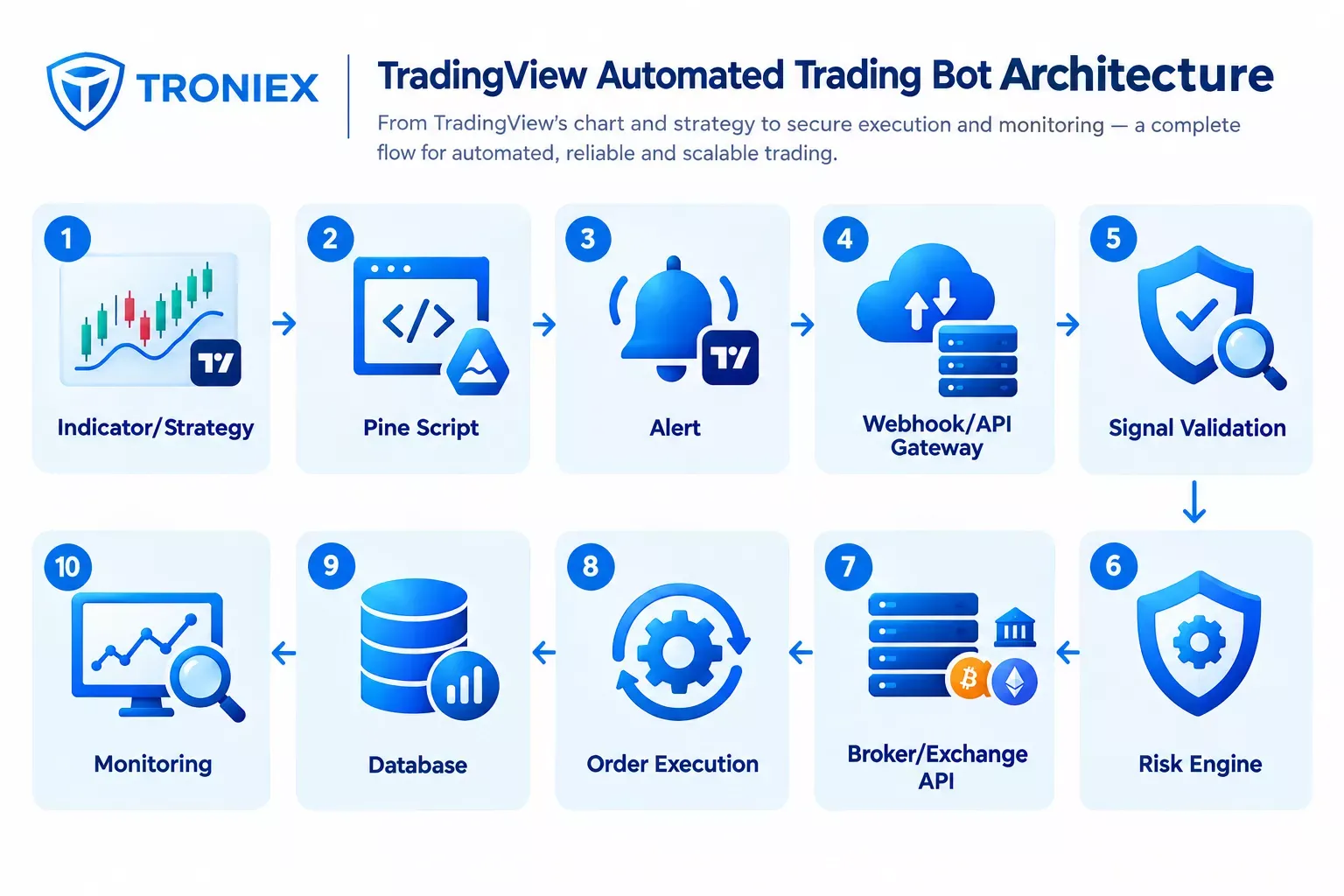
TradingView's current webhook documentation states that when an alert is triggered, TradingView can send an HTTP POST request to an external URL. Valid JSON alert messages are sent with an application/json content type.
TradingView also notes that webhook requests can fail, only ports 80 and 443 are accepted, and a remote server taking longer than three seconds can cause the request to be cancelled.
Signal Generation
The process begins with a trading condition. It might be an RSI crossover, moving-average relationship, breakout, volatility event, or a proprietary combination of indicators.
Alert and Webhook Delivery
Pine Script can expose alert events through functions such as alert() and, for indicators, alertcondition(). Strategies can also generate alerts based on order-fill events.
Signal Validation
The external system should not blindly execute every incoming message. It can validate the symbol, action, timestamp, strategy identifier, expected payload structure, account permissions, and other predefined conditions.
Risk and Order Management
Before an order reaches the execution venue, the system can apply position sizing, exposure limits, stop-loss rules, duplicate-signal protection, and other controls.
Broker or Exchange Execution
The validated instruction can then be routed through the appropriate broker or exchange integration, subject to that provider's API capabilities, account permissions, and applicable requirements.
TradingView Bot Trading Strategy Development
A successful automated system begins with a strategy that can be expressed as deterministic software logic.
TradingView bot trading strategy development converts a trader's methodology into clearly defined conditions that software can evaluate consistently.
Strategy Requirement Analysis
Before development begins, the strategy should be documented in operational terms:
- Entry conditions
- Exit conditions
- Indicators
- Timeframes
- Position sizing
- Stop-loss
- Take-profit
- Trailing rules
- Maximum open positions
- Trade frequency
- Market or session conditions
- Position reversal rules
- Exceptional conditions
For example, "enter when momentum is strong" is not sufficiently precise for software development. A technical specification might instead define a particular indicator relationship, timeframe, threshold, confirmation condition, and execution rule.
Converting Trading Rules Into Pine Script
Once the rules are defined, developers can translate them into Pine Script logic.
The objective is not merely to make the chart visually match a strategy idea. The objective is to create reproducible conditions that can be tested and evaluated.
TradingView identifies Pine Script as its programming language for creating proprietary indicators and strategies.
Strategy Optimization Without Overfitting
Optimization should not mean selecting the parameter combination that produces the most attractive historical result.
A robust development process examines whether a strategy remains reasonably consistent under different market conditions and parameter assumptions. Excessive optimization can create a system that fits historical data but performs poorly when conditions change.
Multi-Timeframe and Multi-Condition Strategies
More advanced strategies may combine multiple timeframes, confirmation indicators, volatility filters, market-session rules, and position-management conditions.
The development specification should define how those conditions interact before implementation begins.
Pine Script Trading Bot Development for Custom Strategies
Pine Script is central to many TradingView automation workflows because it allows developers to create custom indicators and strategies directly within the TradingView environment.
TradingView's documentation explains that Pine Script is its programming language for writing proprietary indicators and strategies.
Custom Pine Script Indicator Development
A business may already have a mathematical model or trading concept but lack a TradingView implementation. Custom indicator development can convert those requirements into chart-based calculations and visual signals.
Pine Script Strategy Development
A strategy can formalize entry, exit, and position-management logic for historical and forward testing.
TradingView's strategy documentation describes backtesting as recreating strategy behavior against historical data and forward testing as evaluating the strategy as real-time data updates.
TradingView Bot Script Development
A TradingView bot script may contain signal-generation logic, alert conditions, order-related strategy logic, or customized alert messages.
However, a script should not automatically be treated as a complete production trading system. Production automation normally requires additional infrastructure outside the charting layer.
Converting Existing Scripts Into Automated Workflows
Businesses with an existing Pine Script can assess:
- What the script currently calculates
- Whether its signals are deterministic
- What alert events are required
- What data must be transmitted
- Which validation rules are needed
- Which broker or exchange should receive the instruction
- What risk controls must operate externally
This approach can reduce redevelopment work when the existing script is technically suitable.

Get Custom Pine Script Trading Bot Development
Develop custom Pine Script indicators, strategies, alerts, and trading logic based on your documented methodology instead of adapting your requirements to a fixed bot platform.
Talk To Our ExpertsTradingView Trading Indicators and Strategies for Automation
TradingView supports a broad range of technical-analysis workflows, making indicators and strategies useful starting points for automated systems.
The important development distinction is that an analytical signal is not automatically a production execution workflow.
RSI, MACD, Moving Average and Momentum Strategies
Common strategy components include RSI, MACD, moving averages, momentum measurements, trend filters, and volatility conditions.
These can be combined into rule sets such as:
Indicator condition → confirmation → entry signal → risk validation → execution instruction
Breakout and Trend-Following Strategies
Breakout systems can define price or volatility conditions that trigger signals. Trend-following strategies can use moving averages, momentum, or other market-state filters.
Mean-Reversion Strategies
Mean-reversion logic may attempt to identify situations where price deviates from a defined reference level or statistical range.
Multi-Indicator Trading Strategies
Multiple indicators can be combined to reduce reliance on a single condition. The important development task is defining exactly how the signals interact.
Custom Proprietary Indicators
Businesses may also have proprietary indicators that are not available as standard TradingView scripts. Those indicators can become part of a custom development specification.
TradingView currently supports alerts associated with indicators and strategies, including alerts generated through Pine Script.
TradingView Webhook and API Integration Architecture
Webhook and API integration form the bridge between TradingView-generated events and an external automation system.
TradingView states that webhook alerts notify an external application by sending an HTTP POST request when an alert is triggered. It recommends secure, authenticated endpoints and warns against including passwords or login credentials in webhook URLs or message bodies.
TradingView Alert-to-Webhook Workflow
A typical workflow is:
Strategy Event → TradingView Alert → Webhook → API Gateway → Validation → Risk Checks → Order Management
The webhook should be treated as an input to the system rather than an unconditional instruction to execute.
JSON Signal Payloads
Structured JSON can communicate fields such as:
- Symbol
- Action
- Strategy ID
- Quantity
- Price
- Stop-loss
- Take-profit
- Timestamp
- Signal identifier
The exact payload should be designed around the receiving application's API requirements.
API Gateway and Authentication
The receiving infrastructure should authenticate requests, validate payloads, restrict permissions, and protect sensitive credentials.
Broker and Exchange API Integration
Different brokers and exchanges have different API models, order types, authentication requirements, rate limits, and execution behavior. Integration should therefore be treated as a dedicated engineering component.
Error Handling and Retry Logic
A production system should account for:
- Invalid payloads
- Duplicate signals
- Network failures
- API timeouts
- Rejected orders
- Partial fills
- Rate limits
- Service interruptions
- Position mismatches
TradingView notes that webhook requests can fail and that remote processing exceeding three seconds can result in cancellation.
That makes the external endpoint's design particularly important.
For businesses requiring automated execution across multiple exchanges, the same API and order-management architecture can be extended through crypto arbitrage bot development for strategy-specific multi-exchange workflows.
TradingView Automated Trading Bot Features
A custom TradingView automation system should be defined by its operational requirements rather than by a generic feature checklist.
|
Feature |
Purpose |
|---|---|
|
Custom strategy engine |
Implements proprietary trading rules |
|
Pine Script integration |
Develops TradingView indicators and strategies |
|
Alert management |
Creates actionable strategy events |
|
Webhook integration |
Transfers alert information to external infrastructure |
|
API integration |
Connects supported brokers or exchanges |
|
Signal validation |
Prevents invalid instructions from reaching execution |
|
Risk engine |
Controls trading exposure |
|
Position management |
Manages entries, exits, and open positions |
|
Stop-loss/TP |
Applies predefined protective conditions |
|
Trade logging |
Records system and execution events |
|
Monitoring |
Tracks system health and failures |
|
Analytics |
Measures strategy and execution performance |
|
Notifications |
Reports important events and exceptions |
The right feature set depends on the strategy, asset class, execution venue, number of users, and required level of automation.
For a single internal strategy, a lightweight architecture may be sufficient. A multi-user or multi-strategy platform may require dedicated authentication, databases, dashboards, monitoring services, role-based access controls, and infrastructure scaling.
TradingView Bot Risk Management and Security
Automation does not remove trading risk. It changes where risk is managed.
A production-oriented TradingView bot should therefore include controls that protect both the trading strategy and the software infrastructure.
Position Sizing
Position size should be determined according to the strategy and account-level constraints rather than allowing every signal to create an unrestricted order.
Stop-Loss and Take-Profit Rules
Protective conditions should be defined as part of the strategy specification and tested under realistic market assumptions.
Maximum Exposure Limits
The system can limit the amount of capital or exposure allocated to an individual asset, strategy, market, or portfolio.
Duplicate Signal Prevention
Repeated webhook events or retries should not unintentionally create duplicate positions. Unique signal identifiers and idempotent processing can help address this class of problem.
API Key and Credential Security
Credentials should never be placed casually into webhook messages. TradingView explicitly warns against sending passwords or login information through webhooks and recommends secure, authenticated endpoints and encryption.
Kill Switch and Emergency Controls
A production system can include mechanisms to pause new orders or disable strategy execution when abnormal behavior is detected.
Audit Logs and Monitoring
Logs should provide enough information to reconstruct what happened:
Signal received → validation result → risk decision → order request → broker/exchange response → final state
This creates a stronger operational foundation for troubleshooting and ongoing optimization.
Build a Custom TradingView Bot Around Your Strategy
Turn your existing trading rules, indicators, and Pine Script logic into a structured automation system with alerts, webhooks, risk controls, API integrations, and external trade execution.
Request A ProposalBacktesting and Forward Testing for TradingView Bots
Testing is one of the most important differences between a strategy concept and a deployable automation system.
TradingView describes backtesting as recreating strategy behavior using historical data and forward testing as evaluating strategy behavior as real-time chart data updates.
Historical Backtesting
Historical testing helps assess how a strategy would have behaved under past market conditions.
However, historical performance should not be treated as evidence that future performance will be the same.
Forward Testing
Forward testing evaluates how the strategy behaves as new market data becomes available.
This can reveal implementation issues that are less visible in historical simulations.
Paper Trading
Paper or simulated execution can help evaluate the external workflow without immediately committing live capital.
Walk-Forward Testing
Walk-forward testing can help evaluate whether parameters selected during one period remain useful during another period.
Slippage and Trading Fees
Backtests that ignore transaction costs, spreads, slippage, liquidity constraints, or execution latency may overstate practical performance.
Avoiding Look-Ahead Bias and Overfitting
Developers should ensure that future information is not inadvertently used to generate historical signals.
Overfitting is another concern: a strategy optimized too heavily against historical data can become less robust outside the development dataset.
Recommended Testing Workflow
Backtest → Robustness Check → Walk-Forward Test → Paper Trading → Controlled Deployment → Production Monitoring
This testing discipline helps transform TradingView strategy development into a more structured software-engineering process.
TradingView Bot Development Process
A structured development process reduces ambiguity between the trader, product owner, and engineering team.
Step 1: Strategy Discovery
Document the trading concept, target markets, timeframes, signals, risk rules, and desired automation behavior.
Step 2: Technical Specification
Convert the trading methodology into deterministic requirements that developers can implement and test.
Step 3: Pine Script Development
Build or adapt the indicator or strategy and establish the required alert behavior.
Step 4: Automation and API Integration
Develop the external signal-processing, validation, risk, and broker/exchange integration layer.
Step 5: Testing and Optimization
Test both strategy behavior and software behavior. Evaluate historical performance, forward behavior, execution conditions, error scenarios, and edge cases.
Step 6: Deployment
Move the tested system into the target environment with appropriate access controls, logging, monitoring, and operational procedures.
Step 7: Monitoring and Maintenance
Trading systems require ongoing maintenance because market conditions, APIs, infrastructure, dependencies, and strategy assumptions can change.
A development partner should therefore provide more than initial coding. The long-term system should have a defined process for monitoring, troubleshooting, updates, and controlled releases.
Custom TradingView Bot Development vs Ready-Made Trading Bots
Ready-made trading platforms can be useful when a trader's requirements fit the features and integrations already provided. Custom development becomes more relevant when the requirements themselves are a competitive advantage.
|
Factor |
Custom Development |
Ready-Made Bot |
|
Strategy customization |
High |
Usually constrained |
|
Source-code control |
Can be specified |
Usually unavailable |
|
Proprietary logic |
Supported |
Limited |
|
Custom API integration |
Flexible |
Depends on platform |
|
Risk engine |
Customizable |
Platform-defined |
|
UI/dashboard |
Custom |
Predefined |
|
Scalability |
Architecture-dependent |
Platform-dependent |
|
Maintenance |
Dedicated development |
Vendor-dependent |
|
Workflow ownership |
Can be tailored |
Provider-defined |
|
Business-specific controls |
Flexible |
Feature-dependent |
When Custom Development Makes Sense
Custom development is generally more relevant when a business needs:
- Proprietary strategy logic
- Unique execution workflows
- Specialized risk controls
- Multiple broker or exchange integrations
- Custom dashboards
- Multi-user functionality
- Source-code ownership
- Specific infrastructure requirements
- Long-term product scalability
The objective is not to claim that custom development is always necessary. It is to determine whether the business requirement is sufficiently specialized that a fixed platform may become restrictive.
TradingView Bot Development Cost and Timeline
There is no single responsible price for custom TradingView bot development because the scope can range from a Pine Script strategy implementation to a complete multi-user trading automation platform.
For businesses evaluating a broader automated trading solution beyond TradingView, reviewing crypto trading bot costs can help estimate how strategy complexity, exchange integrations, risk-management features, infrastructure, and ongoing maintenance may affect the overall development budget.
The major cost variables include:
|
Development factor |
Potential cost impact |
|---|---|
|
Strategy complexity |
Low → High |
|
Pine Script requirements |
Low → High |
|
Number of strategies |
Low → High |
|
Markets/assets |
Low → High |
|
Broker/exchange integrations |
Low → High |
|
Risk-management engine |
Low → High |
|
Dashboard |
Low → High |
|
Analytics |
Low → High |
|
Infrastructure |
Low → High |
|
Monitoring/maintenance |
Low → High |
What Increases TradingView Bot Development Cost?
Costs generally increase when a project requires multiple strategies, complex Pine Script logic, several execution venues, advanced portfolio controls, real-time dashboards, custom authentication, analytics, monitoring, or high availability.
A strategy that only needs TradingView-side development is fundamentally different from a production platform requiring multiple APIs, user accounts, databases, dashboards, and operational monitoring.
White Label vs Custom Development
A white-label solution can reduce initial development work when its architecture already satisfies the required business workflow.
Custom development provides greater control over strategy logic, product functionality, integrations, user experience, infrastructure, and future expansion.
Ongoing Maintenance and Optimization
Maintenance may include:
- API updates
- Pine Script updates
- Infrastructure monitoring
- Security patches
- Strategy modifications
- Performance optimization
- Bug fixes
- New exchange or broker integrations
- Reporting improvements
For businesses evaluating development vendors, the initial development quote should therefore be considered alongside the expected maintenance model.
Start Your Custom TradingView Bot Development Project
Have a strategy, Pine Script, indicator, or automation concept ready? Define the requirements, technical architecture, integrations, testing process, and deployment roadmap before development begins.
Contact UsHow to Choose a TradingView Automated Trading Bots Development Company
Choosing a TradingView Automated Trading Bots Development Company should involve more than checking whether a vendor can write Pine Script.
The development partner should understand the complete workflow from strategy specification through deployment and monitoring.
Pine Script and Trading Strategy Expertise
Ask whether the development team can translate trading rules into deterministic Pine Script logic and explain the difference between indicators, strategies, alerts, and external execution.
API and Webhook Integration Capability
A development partner should understand webhook payloads, API authentication, broker/exchange connectivity, validation, retries, failure handling, and execution reconciliation.
Security and Risk Controls
Ask how the system protects credentials, validates incoming signals, limits exposure, prevents duplicate instructions, and handles emergency shutdown requirements.
Testing and Deployment Process
A serious development process should include documented testing rather than moving directly from a strategy idea to live execution.
Ask how the team handles:
- Backtesting
- Forward testing
- Paper trading
- Slippage
- API failures
- Invalid signals
- Duplicate events
- Order rejection
- Monitoring
Post-Launch Monitoring and Maintenance
Trading infrastructure requires maintenance. Confirm whether the vendor provides monitoring, troubleshooting, upgrades, strategy changes, API maintenance, and infrastructure support.
Source Code and Intellectual Property
Before development begins, establish who owns:
- Pine Script
- Backend code
- Frontend/dashboard
- Integration code
- Documentation
- Deployment configuration
- Custom strategy implementation
Documentation and Technical Support
A production system should have sufficient documentation for architecture, configuration, integrations, security, deployment, and maintenance.
TradingView Bot Vendor Evaluation Checklist
Before selecting a development partner, ask:
- Can they convert strategy requirements into technical specifications?
- Do they have Pine Script expertise?
- Can they build external execution infrastructure?
- How are API credentials protected?
- How are duplicate signals handled?
- What testing methodology is used?
- How are broker or exchange API failures handled?
- Is source code delivered?
- What maintenance is included?
- Can the architecture scale?
- Can the team support additional strategies later?
- How are monitoring and incident handling managed?
The right vendor should be able to discuss both trading logic and software architecture. That combination is particularly important when the TradingView strategy becomes part of a larger commercial trading product.