Tech Stack To Build A Crypto Trading Bot In 2026: A Pick For Every Layer
A crypto trading bot needs a language for the execution engine (Python for most bots, Go or Rust for millisecond strategies), exchange connectivity through CCXT or native APIs, PostgreSQL and Redis for data, and a secrets manager holding trade-only API keys. Add a risk engine and monitoring before any live funds.
Oct 29, 2026
13 mins read
- Pick Python for most bots and move only the order path to Go or Rust when the strategy competes on milliseconds.
- Connect through CCXT for breadth or a native exchange SDK for exchange-specific order types and lower latency.
- Store orders and balances in PostgreSQL, live state in Redis, and ticks in a time-series database.
- Create trade-only API keys with withdrawals disabled, keep them in a secrets manager, and rotate them.
The tech stack for a crypto trading bot sets how fast orders reach the exchange and what a leaked credential can do. A slow language on a latency-bound strategy loses fills. A key with withdrawal rights loses the account.
We have built 150+ trading bots in the ecosystem.
If you'd rather hand the build to a team, our crypto trading bot development company page covers scope and process.

Get Expert Stack Guidance
Not sure which layer matters most for your strategy? Our engineers build trading bots every day and can recommend the right language, exchange connection, and hosting for your timeline.
Talk to Our ExpertsWhat A Crypto Trading Bot Tech Stack Covers
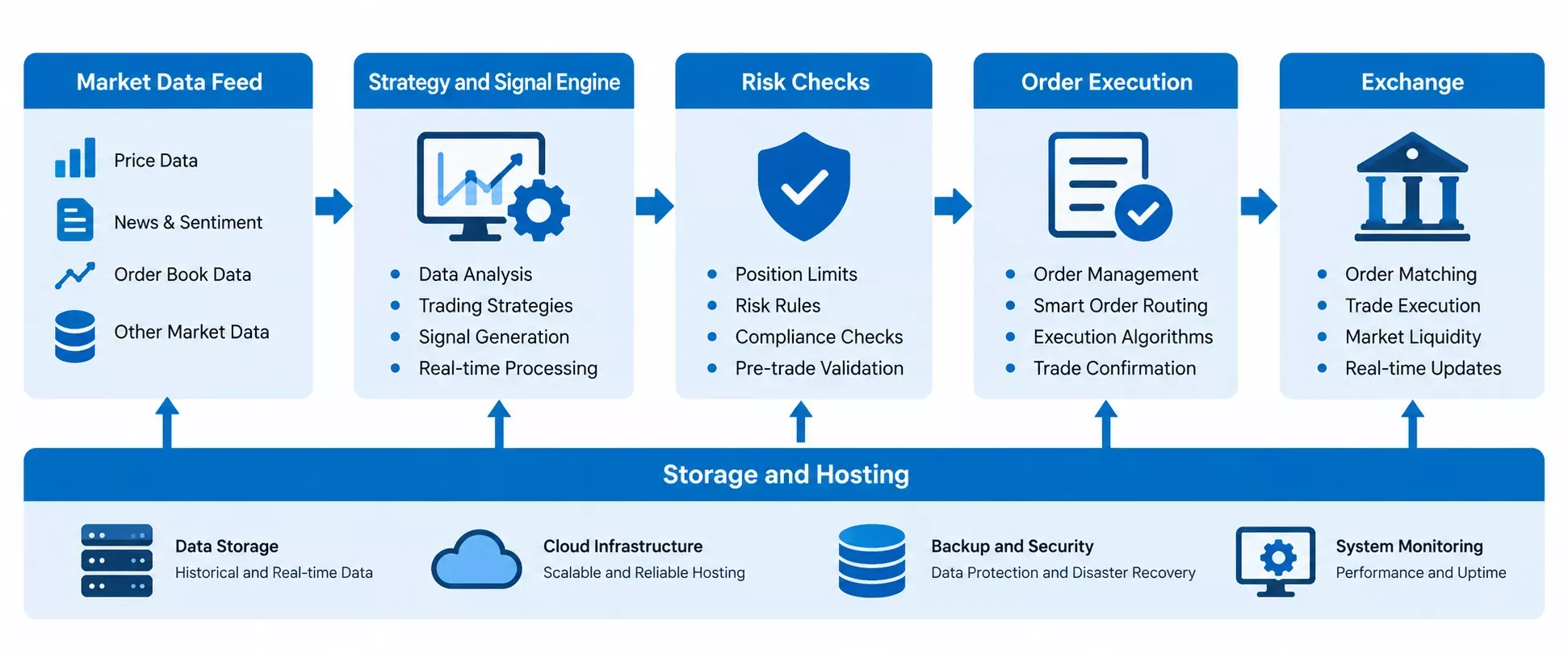
Data flows one way through a bot: market data in, orders out, with storage and hosting underneath. The right pick for each layer depends on one thing: how fast the strategy has to act.
- Market data and exchange connection: pulls prices and order books in and sends orders out.
- Strategy and signal engine: turns data into buy and sell decisions.
- Risk checks and order execution: blocks bad orders and tracks every fill.
- Storage and hosting: keeps state and history, and keeps the bot online.
The Stack Depends On The Bot Type
A DCA bot places a market buy once an hour. A market maker updates quotes many times a second. Those two bots share almost no infrastructure choices.
|
Bot type |
Latency need |
Default language |
Data feed |
Hosting |
|---|---|---|---|---|
|
DCA and grid bots |
Low: seconds are fine |
Python |
REST polling or one WebSocket stream |
Small VPS or container |
|
Arbitrage bots |
Medium to high: the spread closes fast |
Python, with Go for the order path |
WebSocket order books from every venue |
VPS in the exchange's region |
|
Market-making and HFT bots |
Highest: milliseconds decide fills |
Go or Rust |
Native WebSocket feeds with the full order book |
Server in the nearest region to the matching engine |
|
AI-assisted bots |
Set by the strategy it feeds |
Python |
Candles and order flow |
Container; add GPUs only if you train models yourself |
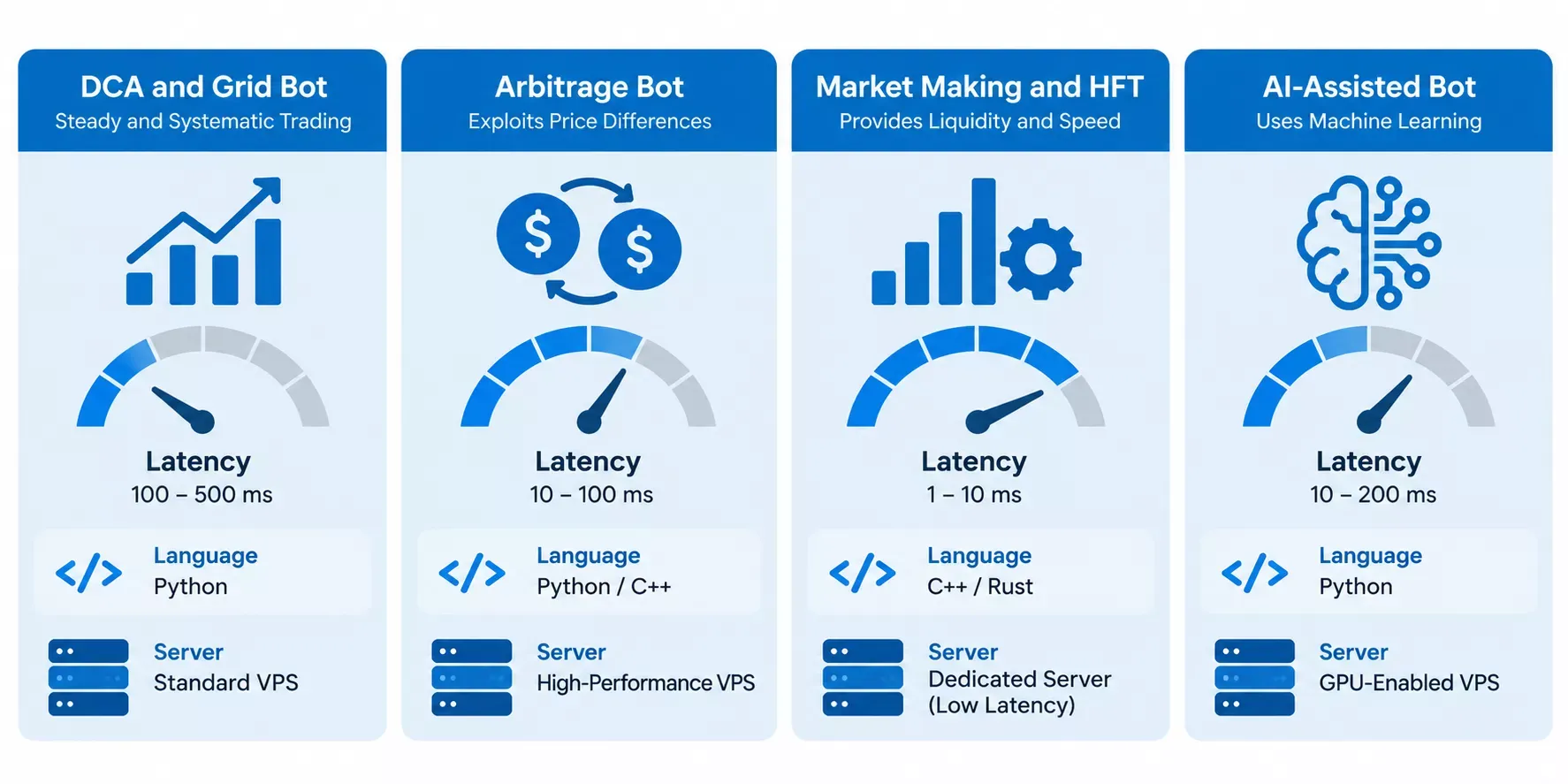
- DCA bots run on a scheduler and a REST client; our guide to DCA trading bot development covers the order logic.
- Arbitrage bots need live order books from every venue and a fast order path, which our crypto arbitrage bot development service builds.
Choosing A Language For The Execution Engine
Use Python for most bots: the ecosystem depth and asyncio handle many exchange connections concurrently. Move the order path to Go or Rust when the bot competes on milliseconds, as in market making and arbitrage between venues.
Python with asyncio
Python is fast enough for a crypto trading bot when the strategy acts in seconds or minutes. The network round trip to the exchange costs more time than the Python code that builds the order.
asyncio runs many WebSocket and REST calls on one thread, so one process can watch many markets. Python also has the widest library support: CCXT and pandas both run natively.
Go or Rust for the order path
Go and Rust pay off when the bot competes on milliseconds. Both compile to native binaries. Rust gives tight control over memory; Go gives fast build cycles and simple concurrency.
Keep strategy research in Python and port only the order path.
Our HFT trading bot development guide covers the latency-bound case.
TypeScript and Node.js
TypeScript fits when the bot shares types and code with a web dashboard. Node.js handles WebSocket streams well, and CCXT ships a JavaScript and TypeScript build.
Exchange Connectivity And Market Data
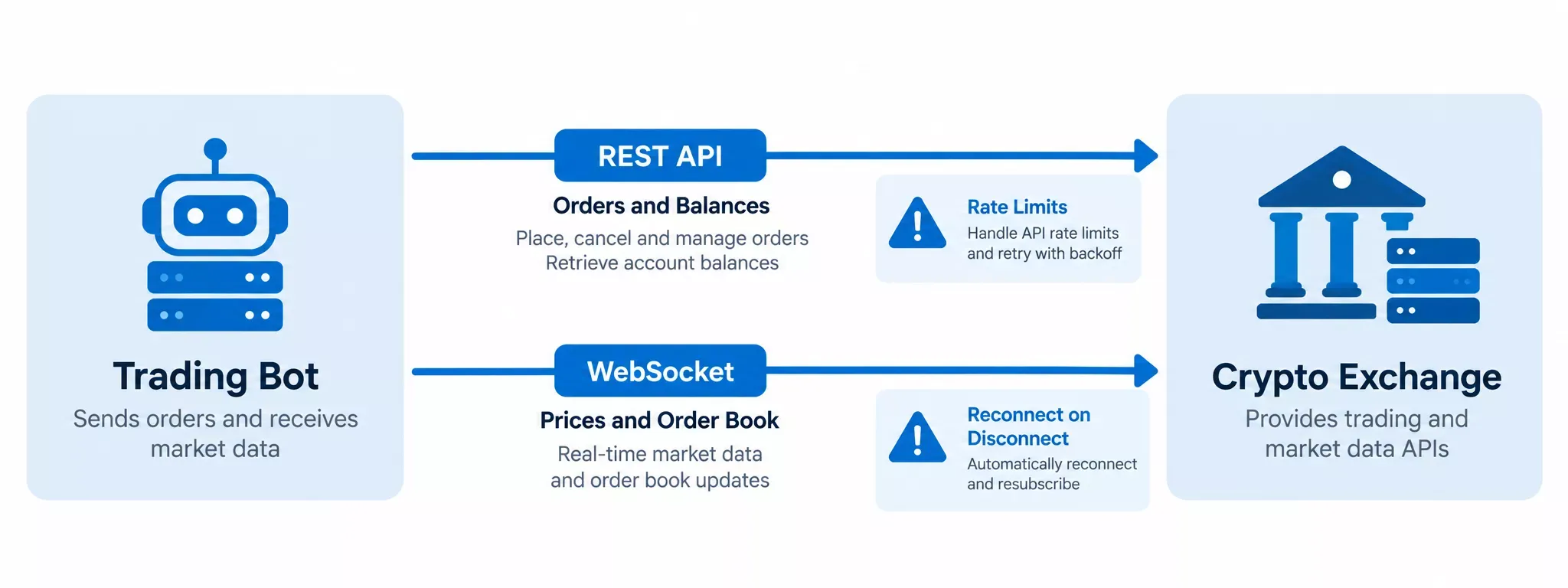
A bot connects to an exchange through its REST API for orders and account state, and through WebSocket streams for live prices and order books. A library such as CCXT wraps many exchanges behind one interface.
CCXT or native exchange SDKs
CCXT covers more than 100 exchanges through one unified interface and implements both REST and WebSocket. Native exchange APIs expose exchange-specific order types and can cut latency, at the price of one integration per venue.
-
Pick CCXT when the bot trades on several exchanges or you want to add venues quickly.
-
Pick the native SDK when you trade on one venue and need its specific order types or the lowest latency.
REST for orders, WebSocket for prices
Use REST for orders and balances. Use WebSocket for prices and order books, because polling REST for market data burns your rate limit. Two failure points need code from day one:
- Rate limits: exchanges reject requests over the limit and ban the IP after repeat violations, as Binance documents. Track request weight in the bot and back off early.
- Reconnects: connections drop. Binance's docs say a single connection is valid for a limited time and the server pings the client, so the bot must answer pings and expect disconnects. Resubscribe, then rebuild the order book from a fresh snapshot.
A bot that skips the snapshot after a reconnect trades on stale prices.
Strategy and Signal Layer
Rules-based strategies
Rules-based strategies turn indicators and thresholds into signals. Compute them from candle data with pandas or a technical analysis library.
Backtest your indicators before going live.
AI-assisted signals
Model libraries and LLM calls fit as one optional layer that outputs a signal. The risk engine still approves every trade.
Read for the model side.
Backtesting and paper trading
Backtest on historical candles with fee and slippage modeling. A backtest without fees overstates returns.
Backtrader is a common Python framework with old repository notes, so check release activity before you depend on it. A candle-replay loop that feeds stored historical data through your own engine is a safe alternative.
Run paper trading on the exchange's test environment before live funds. Match order types and rate limits to production.
Risk Engine And Order Execution
Place the risk engine between the strategy and the exchange client so no order skips it.
Pre-trade checks
- Position limit per market
- Maximum order size
- Daily loss stop that halts the bot
- Price-deviation guard that rejects orders far from the last trade
Order lifecycle
- Send idempotent client order IDs so a retry never double-fills.
- Check order status before any retry after a network error.
- Handle partial fills as their own order state.
- Reconcile local state against exchange balances on a schedule.
Database And Caching Layer
Use PostgreSQL for orders and balances, and Redis for the live order book and rate limits. Store tick and candle data in a separate time-series database.
Candle and tick storage
PostgreSQL with a time-series extension such as TimescaleDB handles candle data for one bot. Move to a dedicated time-series database when tick volume outgrows what one Postgres instance writes comfortably.
Multi-user case
Copy trading puts many user accounts behind one strategy, so order fan-out and per-user balances drive the schema.
Ready to Ship Your Trading Bot
You know the stack. Now the engineering starts: integrating libraries, renting infrastructure, and shipping before your first trade. We have delivered 150+ projects in blockchain and AI.
Get a Free Project ScopeAPI Keys And Custody
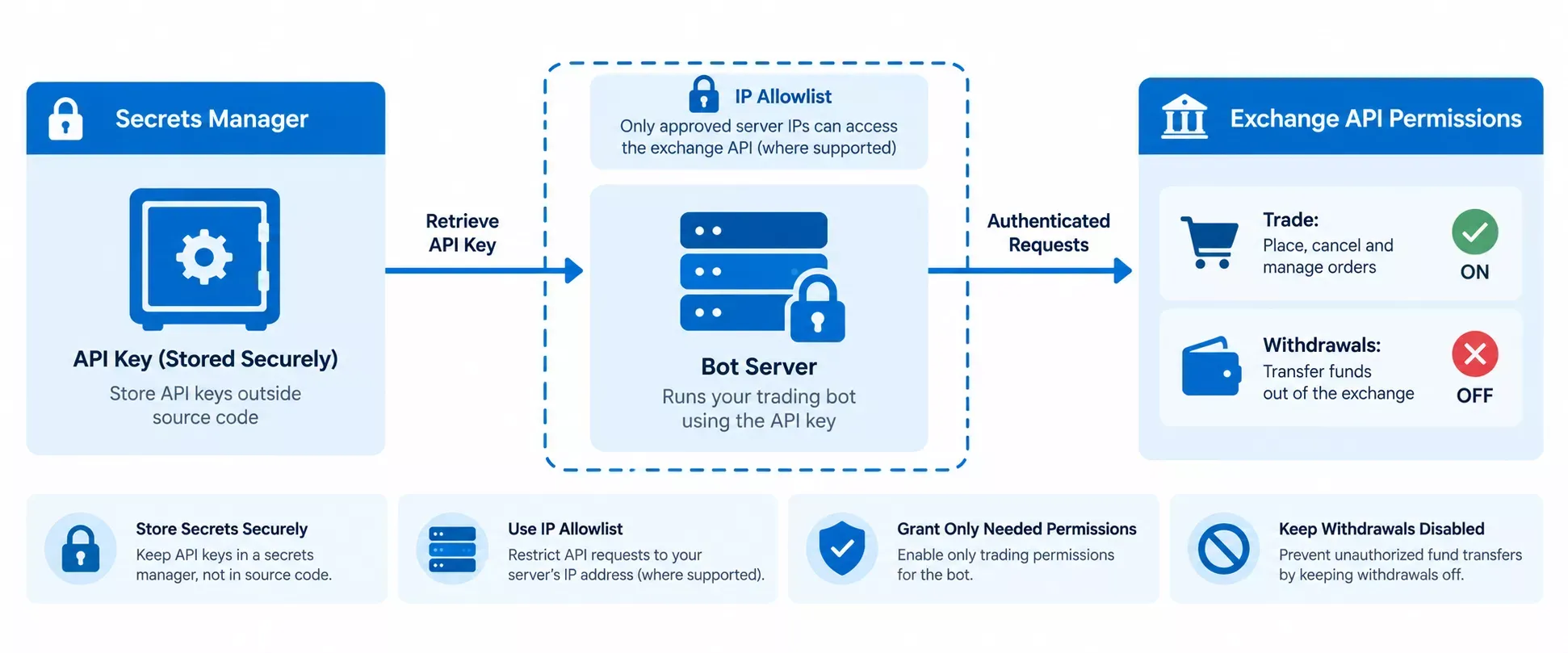
A trading bot holds credentials that move money. Treat key handling as part of the stack.
Exchange keys
- Grant trade permission only. Binance keys cannot trade until you enable it, so enable trading and nothing else.
- Leave withdrawals disabled in the exchange's key settings.
- Add an IP allowlist so only the bot server can use the key.
- Create one key per bot, so you can revoke one without stopping the rest.
Secrets storage
- Keep keys in a secrets manager or encrypted environment variables, never in source control.
- Rotate keys on a schedule and log key use, never key values.
How we test bot code
Every build we ship goes through 100% QA with code audits and stress testing.
Hosting and Monitoring
Docker and where to run
Package the bot in Docker so staging and production run the same image. Run a single bot on a VPS in the exchange's region to shorten the network path.
Move to Kubernetes when many bots run side by side.
Monitoring
- Heartbeat alert when the bot stops reporting
- Order-failure alert on every rejected or timed-out order
- Balance drift alert when local and exchange balances differ
- Log retention long enough to replay a bad trade
Dashboard and User Layer
Build this layer only if you serve other traders. Use React or Next.js for the dashboard and a per-user API key vault that encrypts each user's keys separately. Never send a stored key back to the browser.
Build Custom Or Buy A Ready-Made Bot
|
Option |
Control of strategy |
Key custody |
Time to launch |
Upkeep |
|---|---|---|---|---|
|
Open-source bot framework |
High: you edit the code |
Keys sit on your server |
Depends on your team |
You patch and monitor |
|
Ready-made bot subscription |
Low: preset strategies |
Keys sit with the vendor |
Shortest |
Vendor handles it |
|
White-label bot |
Medium: vendor strategies under your brand |
Set by contract |
Short |
Vendor maintains the core |
|
Custom build |
Full |
You decide |
Longest |
Your team or a partner |
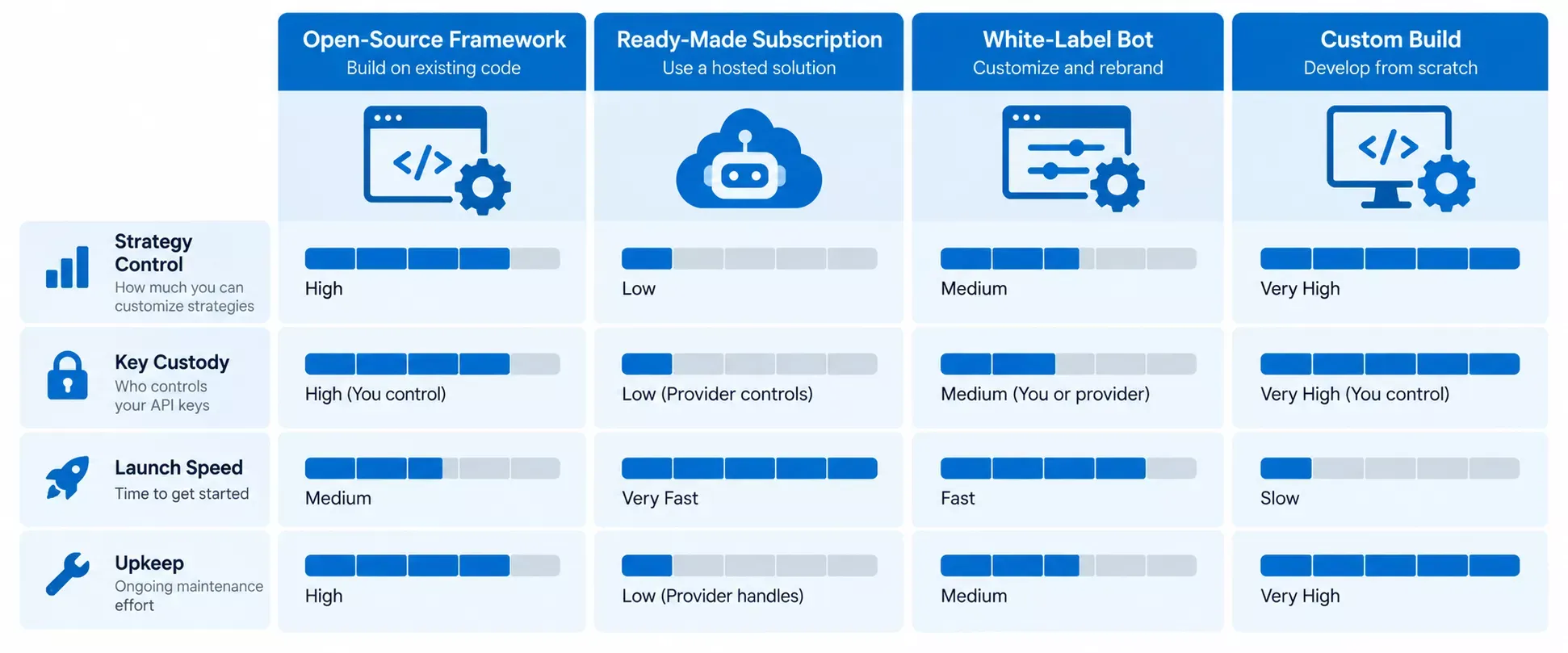
Build custom when the strategy is your edge or you need to hold the keys yourself. Buy a subscription when standard strategies are enough.
We have worked in blockchain and AI for 4+ years.
Our guide on how to build a custom crypto trading bot walks through the build path.
What Each Stack Choice Costs
Cost follows the layer decisions above.
|
Layer |
What drives cost |
Choice that raises it |
|---|---|---|
|
Language |
Engineering hours |
Go or Rust order path |
|
Exchange connectivity |
Integration count and upkeep |
One native SDK per venue |
|
Data |
Storage volume and feed fees |
Tick-level history, paid data feeds |
|
Strategy |
Research and testing time |
AI models, custom indicators |
|
Hosting |
Server count and proximity |
Nearest-region servers, Kubernetes clusters |
|
Security and QA |
Audit and test effort |
Multi-user key vault |
The cost depends on the layers you choose above.
Tools Per Layer
|
Layer |
Default pick |
Pick the alternative when |
|---|---|---|
|
Language |
Python with asyncio |
Go or Rust for the order path when milliseconds decide fills; TypeScript when you share code with a dashboard |
|
Exchange connection |
CCXT |
A native SDK for one venue's order types or lowest latency |
|
Market data |
WebSocket streams |
REST polling for slow strategies like DCA |
|
Strategy |
Rules with pandas |
A model or LLM call as an optional signal source |
|
Backtesting |
Candle-replay loop |
Backtrader once you confirm its release activity |
|
Risk and execution |
In-process risk module before the exchange client |
A shared risk module when many bots share one account |
|
Database |
PostgreSQL and Redis |
A time-series database when tick volume grows |
|
Keys |
Secrets manager |
Encrypted environment variables for a single small bot |
|
Hosting |
Docker on a VPS |
Kubernetes when many bots run side by side |
|
Dashboard |
React or Next.js |
Skip it when you serve no other traders |
Should I Build A Custom Bot Or Buy A Ready-Made One?
Build custom when the strategy is your edge, or you need control of key custody. Buy a ready-made bot when standard strategies are enough and speed to launch matters most.
Book a free 30-minute strategic consultation to scope your bot's stack and exchanges.
Talk to Our Experts We hold a 99.6% client satisfaction rate.