HFT Trading Bot Development: Building Ultra-Low Latency Trading Systems for Crypto, Forex & Institutional Markets
Develop custom HFT trading bots with advanced execution engines, AI analytics, risk management, and ultra-low latency infrastructure for maximum market performance.
Aug 07, 2026
11 mins read
Speed and automation are the hallmarks of the financial trading business. High-frequency trading (HFT) systems have grown beyond huge hedge funds to crypto exchanges and fintech firms that are investing in HFT trading bots. The global algorithmic trading sector is worth billions and is anticipated to rise as companies implement automated tools.
The emergence of digital assets and low-latency infrastructure is driving a demand for sophisticated trading systems capable of processing several market events per second.
As a leading crypto trading bot development company, Troniex Technologies provides institutional-grade HFT trading solutions for crypto exchanges, proprietary trading firms, and fintech startups.
Our technologies utilize sophisticated algorithms, AI-driven trading logic, and ultra-fast execution engines to help businesses capitalize on market opportunities while minimizing execution delays.
Whether you want to create a crypto HFT platform, deploy an advanced market-making solution, or build a custom trading system, our team delivers scalable, high-performance solutions designed for long-term success.
The Evolution of Modern Financial Markets Through HFT Trading Bot Development
Every second, financial markets produce a vast amount of data. Human traders are too slow to analyse and react to this information to capitalise on short-lived opportunities. HFT systems overcome this problem by automating the decision-making and execution processes.
What Is High-Frequency Trading?
High-frequency trading is a type of algorithmic trading that uses complex software to carry out a vast number of deals in milliseconds or microseconds. They are constantly monitoring market circumstances, seeking out trading opportunities, and executing trades without any human input.
How HFT Bots Make Thousands of Trades Per Second
An HFT trading bot is directly connected to market data sources and exchange APIs. Receives incoming information, analyses specified trading methods, and quickly places trades. That speed allows traders to capitalise on chances that disappear in milliseconds.
Why Speed Creates Market Advantage
In highly competitive markets, execution speed can directly impact profitability. Lower latency often results in better order fills, reduced slippage, and improved trade performance.
The Rise of Crypto HFT Trading
Cryptocurrency marketplaces are open 24/7, with significant pricing inefficiencies often existing between exchanges. This makes it the perfect environment.
How Does an HFT Trading Bot Actually Work?
When a business understands how an HFT bot works, it becomes easier to decide what to build.
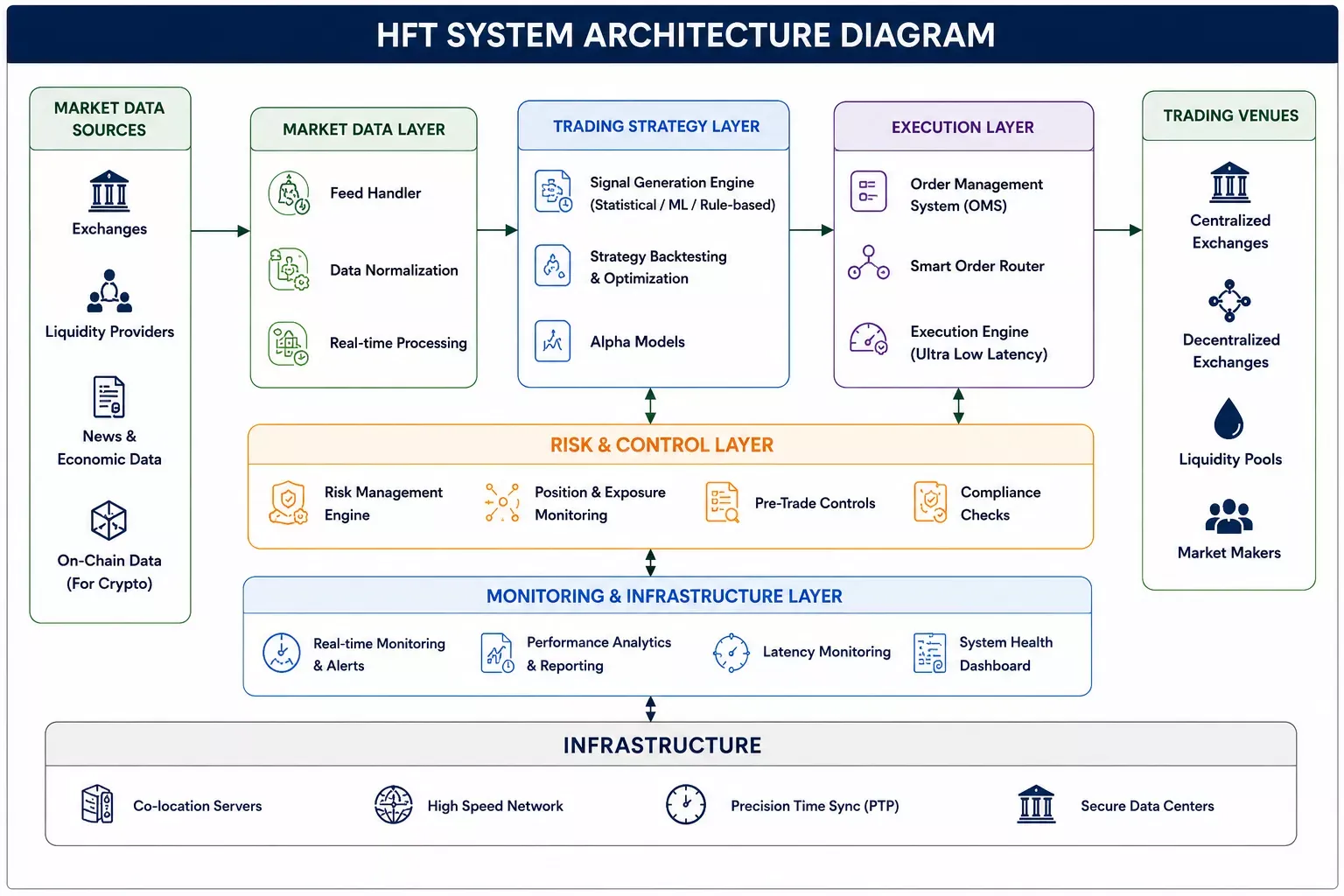
Market Data Collection Layer
The system aggregates market data in real time across various exchanges, including price changes, order book activity, trading volume, and liquidity metrics.
Real-Time Signal Creation
Advanced algorithms analyze incoming data streams and generate trading signals based on predefined rules or AI-driven models.
Automated Order Execution
When trading conditions meet strategy requirements, the execution engine instantly places buy or sell orders across connected exchanges.
Risk Control Instrument
Risk management modules monitor exposure, position sizing, stop-loss levels, and market volatility to limit excessive losses.
Trade Performance and Monitor Tracking
Complete dashboards provide insights into profitability, latency, execution quality, and overall strategy performance.
Core Components of an Institutional-Grade HFT Trading Bot
Successful HFT systems depend on robust architecture rather than trading strategies alone.
Market Data Feed Handlers
These modules aggregate and normalise market data from different exchanges with minimal processing latency.
OMS (Order Management System)
The OMS handles the entry, modification, cancellation and tracking of orders across trading venues.
Execution Engine
The execution engine acts as the core trading component responsible for delivering ultra-fast trade execution.
Smart Order Router
Smart routing technology finds the best exchange or liquidity source for each trade.
Risk Management Engine
Institutional-grade risk controls enable real-time monitoring of trading activity and automatic enforcement of pre-set limitations.
Monitoring and Alerting Layer
Watch out for latency spikes, infrastructure faults, and strategy abnormalities before they affect performance.
Accurate Time Synchronization
A proper timestamp is critical in high-frequency trading environments where even microsecond differences can affect execution outcomes.

Schedule a Free HFT Strategy Consultation
Discuss your trading goals with our specialists and discover the most effective architecture, infrastructure, and execution strategies for your business.
Talk To Our ExpertsWhich Trading Strategies Generate Profits in HFT Systems?
Different business objectives require different trading approaches.
Market Making Strategies
Market makers are bots that always post buy and sell prices and make money on the spread between the two. How Market Making Bots Work?
Order Book Imbalance Trading
HFT systems are also capable of predicting short-term price fluctuations based on the distribution of liquidity and order flow characteristics.
Event-Driven Trading
Bots’ capacity to respond in real time to economic statements, token listings, regulatory changes, and key market events.
Statistical Arbitrage
These tactics identify pricing discrepancies between correlated assets and capitalize on temporary inefficiencies.
Cross-Exchange Arbitrage
The bot simultaneously buys assets on one exchange and sells them on another where prices are higher.
Latency Arbitrage
Latency arbitrage leverages speed advantages to exploit delayed market information across trading venues.
Learn More: Crypto Arbitrage Bot Development Company
Crypto HFT Trading vs Traditional HFT: What Founders Need to Know
Many entrepreneurs assume all HFT systems operate similarly. In reality, crypto and traditional markets present unique challenges.
Centralized Exchange HFT
Accessible APIs, deep liquidity pools, and 24/7 trading options draw algorithmic traders to crypto exchanges.
Decentralized Exchange HFT
DEX environments require specialized strategies that account for blockchain confirmation times, gas fees, and liquidity fragmentation.
HFT in Forex Markets
Forex HFT focuses on currency pairs, macroeconomic events, and institutional liquidity providers.
HFT in Equity Markets
Stock market HFT relies heavily on co-location services, direct market access, and strict regulatory compliance.
Liquidity Challenges Across Markets
Every asset class presents different liquidity dynamics, requiring customized execution and risk-management approaches.
High-frequency trading firms often integrate portfolio hedging techniques to reduce market-wide exposure.
Tech Stack Required for HFT Trading Bot Development
Picking the correct tech stack directly impacts system performance.
Top Programming Languages for HFT
Depending on execution needs and strategy complexity, C++, Rust, Java, and Python are typically employed.
C++ vs Python for Low-Latency Trading
Python is faster to create and do analytics with; C++ is faster to run for latency-sensitive parts.
FIX Protocol Integration
The Financial Information Exchange (FIX) protocol remains a standard communication method within professional trading environments.
WebSocket Market Data Streams
WebSockets provide real-time market updates that support high-speed decision-making.
Database Technologies for Tick Data
Time-series databases and optimized storage solutions enable efficient processing of massive trading datasets.
Cloud vs Co-Located Infrastructure
Cloud environments give flexibility, while co-location delivers the lowest possible latency for institutional trading.
Ultra-Low Latency Infrastructure for HFT Success
The quality of infrastructure typically determines if an HFT strategy wins or loses.
Why Every Millisecond Matters
Execution delays can lead to missed opportunities, increased slippage, and reduced profitability.
Exchange Co-Location Services
Co-location places trading servers near exchange equipment to reduce network delays.
Techniques for Network Optimization
Dedicated connectivity, optimised routing, and efficient data processing result in a dramatic increase in execution speed.
Hardware Acceleration
Advanced hardware configurations help process market information faster and improve response times.
Trading Systems Based on FPGA
Field programmable gate arrays can offer excellent performance for latency-sensitive applications.
Latency Monitoring Tools
Ongoing monitoring ensures the infrastructure remains at peak performance as market conditions shift.
Get a Custom HFT Development Roadmap
Every trading operation is unique. Receive a personalized roadmap outlining technology, infrastructure, integrations, and estimated timelines.
Request A ProposalAI and Machine Learning in Modern HFT Trading Bots
The future of high-frequency trading is being transformed by artificial intelligence.
Predictive Analytics in the Market
Machine learning models identify hidden market patterns that traditional systems may overlook.
Reinforcement Learning for HFT
Adaptive algorithms are constantly improving decision-making based on real-world trading experience.
Market Regime Detection Models
AI systems can detect shifting market circumstances and automatically adjust trading behavior.
AI-Powered Order Execution
Intelligent execution engines optimize trade placement based on liquidity and market dynamics.
Adaptive Risk Management
Machine learning enhances risk assessment by analyzing evolving market conditions in real time.
Also Read: How to Build an AI Crypto Trading Bot
HFT Trading Bot Development Process: From Idea to Deployment
At Troniex Technologies, we use a structured development methodology that eliminates risk and shortens time-to-market.
Requirements Gathering
We identify business goals, target markets, asset classes, and strategic objectives.
Strategy Design
Trading logic is designed and optimized based on your operational requirements.
Infrastructure Planning
Our team architects a scalable, low-latency environment tailored to your trading needs.
API Integration
We integrate exchanges, liquidity providers, data feeds, and third-party services.
Backtesting
Historical data testing validates strategy performance before deployment.
Paper Trading
Simulated trading environments assist in honing algorithms without jeopardising funds.
Live Deployment
Following validation, the system is launched in production environments.
Continuous Optimization
Ongoing monitoring and optimization ensure long-term performance improvements.
Institutional firms often adopt advanced algorithmic trading solutions when strategies require automated decision-making, precise risk controls, and low-latency execution.
Common Challenges in HFT Trading Bot Development
Every advanced trading system must overcome technical and operational challenges.
Exchange Rate Limits
API restrictions can affect execution performance if not properly managed.
Slippage and Liquidity Issues
Market conditions may impact order execution quality during periods of high volatility.
Regulatory Compliance
Trading firms must comply with applicable financial regulations and exchange requirements.
Security Risks
Robust cybersecurity measures are essential for protecting assets and infrastructure.
Strategy Degradation
Trading strategies require continuous evaluation as market behavior evolves.
Market Volatility
Rapid market movements demand intelligent risk controls and adaptive execution systems.
Build vs Buy: Should You Develop an HFT Bot or Use Existing Software?
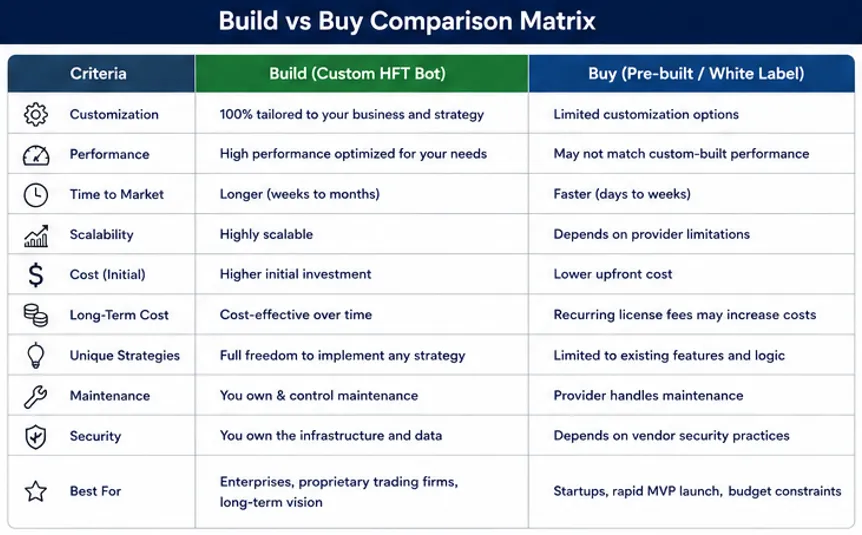
Businesses frequently ask whether they should build a custom solution or purchase an existing platform.
Open-Source HFT Bots
Open-source frameworks offer flexibility but often require extensive customization and maintenance.
White-Label Solutions
White-label platforms reduce development time but may limit scalability and differentiation.
Custom HFT Development
Custom-built systems provide complete control, superior flexibility, and long-term competitive advantages.
Cost vs Scalability Comparison
While custom development involves a higher initial investment, it typically delivers stronger performance and greater scalability over time.
How Much Does HFT Trading Bot Development Cost?
Development costs vary depending on project complexity, infrastructure requirements, and supported trading strategies.
Development Cost Factors
The cost is very much dependent on the complexity of the strategy, integrations and latency requirements.
Infrastructure Costs
Servers, data feeds, networking, monitoring systems, and co-location services contribute to overall expenses.
Exchange Connectivity Fees
Certain exchanges charge for premium market data and direct connectivity.
Team Composition Costs
Projects can require quantitative analysts, backend engineers, blockchain developers, DevOps specialists, and UI designers.
Ongoing Maintenance Expenses
Long-term budgeting should involve ongoing monitoring, updates, security improvements, and optimisation.
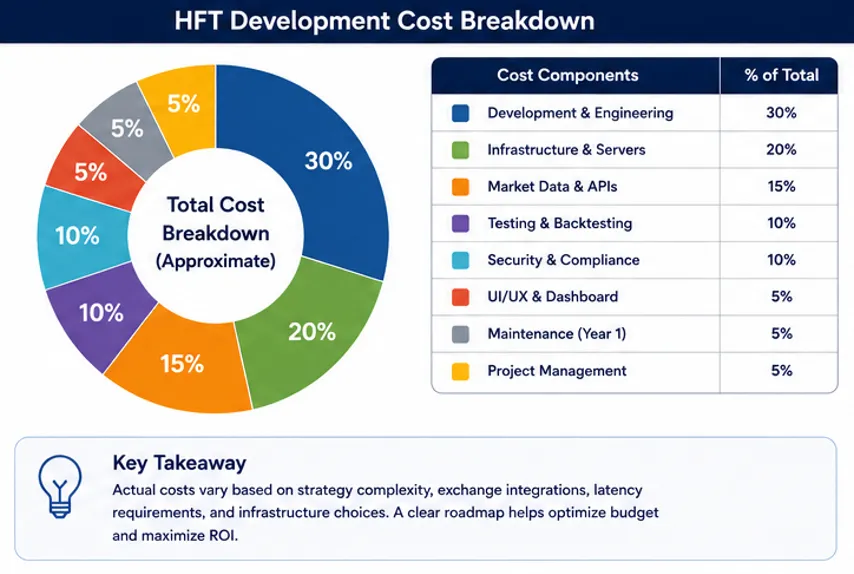
For startups, development costs may begin with a minimum viable product, while enterprise-grade systems often require larger infrastructure investments.
Future Trends Shaping HFT Trading Bot Development
The next generation of HFT systems will become increasingly intelligent and autonomous.
AI-Native Trading Systems
Artificial intelligence will play a larger role in signal generation and execution optimization.
Multi-Exchange Liquidity Aggregation
Future systems will seamlessly access liquidity across multiple trading venues.
Quantum Computing Research
Emerging research may eventually transform computational capabilities within financial markets.
DeFi HFT Opportunities
Decentralized finance continues to create new opportunities for automated trading strategies.
Autonomous Trading Agents
Self-learning systems capable of adapting to changing market environments are expected to become more prevalent.
Start Your HFT Trading Bot Development Project
Whether you're launching a startup or scaling an enterprise trading platform, our team can help transform your vision into reality.
Contact UsWhy Choose Troniex Technologies for HFT Trading Bot Development?
Troniex Technologies provides state-of-the-art trading infrastructure based on performance, reliability, and scalability.
Our development team has experience in blockchain development, algorithmic trading, exchange integration, AI development, and low-latency infrastructure engineering.
By partnering with us, you will receive:
- Custom HFT bot development
- Multi-exchange integration
- AI-powered trading capabilities
- Ultra-low latency architecture
- Advanced risk management systems
- Scalable cloud and co-location deployment
- Dedicated technical support
- Enterprise-grade security standards
Be it the launch of a new trading platform, scaling a crypto exchange, or creating institutional trading infrastructure, we have the technology basis to compete in today’s financial markets.