RSI Trading Bot Development: Strategies, Features, Cost & Development Guide
Explore RSI trading bot development, strategies, features, architecture, APIs, testing, security, cost, and how to choose the right development company.
Sep 15, 2026
17 mins read
The growth of algorithmic trading is creating greater demand for software that can monitor markets, evaluate predefined strategies, and execute trades without continuous manual intervention. The global automated crypto trading market is estimated at $25.3 billion in 2026, up from $22.2 billion in 2025, and Grand View Research projects it to reach $66.6 billion by 2033 at a 14.8% CAGR.
Within this market, RSI trading bots provide a focused approach to automated crypto trading. They use the Relative Strength Index (RSI) alongside configurable strategy rules, risk controls, and exchange connectivity to identify conditions and automate approved trade execution.
For businesses building proprietary trading infrastructure, RSI trading bot development involves much more than adding an RSI indicator to a dashboard. It requires strategy engineering, market-data processing, exchange API integration, order management, backtesting, security, monitoring, and scalable deployment.
Businesses evaluating RSI automation can work with a crypto trading bot development company to translate their trading logic into a scalable system with exchange connectivity, automated execution, testing, and risk controls.
What Is RSI Trading Bot Development?
RSI Trading Bot Development is the process of building automated trading software that calculates the Relative Strength Index, evaluates predefined strategy conditions, applies risk-management rules, and connects to cryptocurrency exchanges for automated order execution.
Unlike manual RSI trading, a bot can continuously monitor multiple markets and apply the same rules consistently. A custom implementation can also combine RSI with indicators such as MACD and EMA, multi-timeframe analysis, portfolio rules, and proprietary trading logic.
RSI and Automated Crypto Trading
RSI is a momentum oscillator commonly used to identify potential overbought or oversold conditions. In an automated system, its value becomes an input to programmable trading rules rather than a standalone prediction mechanism.
RSI Trading Bot vs Manual RSI Trading
A manual trader must monitor charts and decide when conditions are satisfied. An automated bot can evaluate predefined conditions continuously, validate risk parameters, and send orders according to programmed rules.
What Custom RSI Bot Development Includes
A production-grade implementation can include strategy engineering, exchange connectivity, execution management, dashboards, backtesting, paper trading, security controls, monitoring, and ongoing optimization.
How Does an RSI Trading Bot Work?
An RSI trading bot collects market data, calculates RSI values, evaluates strategy conditions, validates trading signals, checks risk limits, and sends approved orders through an exchange API.
A robust architecture separates market data, strategy logic, risk management, and execution rather than treating the bot as a single signal-generation script.
Market Data and RSI Calculation
The bot receives historical or real-time market data, such as OHLCV candles, and calculates RSI according to the configured period. The indicator engine can also process other technical indicators required by the strategy.
Strategy and Signal Validation
The strategy engine evaluates RSI conditions and additional rules. For example, a signal might require RSI to cross a threshold while price remains above an EMA or MACD confirms momentum.
Risk Engine and Order Management
A valid signal does not automatically become an order. The risk engine can evaluate position size, exposure, leverage, stop-loss levels, and account-level limits before order management prepares the trade.
Exchange Execution and Portfolio Monitoring
The order manager communicates with the exchange API, tracks order status, and reconciles fills. Portfolio monitoring then updates balances, open positions, performance data, and alerts.
This separation makes the architecture easier to test, monitor, and scale as additional strategies or exchanges are introduced.
RSI Trading Strategies for Automated Crypto Trading
An RSI bot does not have to rely on a single overbought/oversold rule. RSI can become one component of a broader algorithmic strategy, with the appropriate model depending on market conditions, liquidity, timeframe, execution costs, and risk tolerance.
RSI Overbought/Oversold Strategy
The traditional approach uses RSI thresholds to identify potential momentum extremes. Thresholds should remain configurable because market behavior can differ substantially across assets and timeframes.
RSI Divergence Strategy
An RSI divergence strategy compares price movement with RSI movement to identify situations where momentum may be behaving differently from price. Automated detection requires explicit rules for identifying swing points and confirming divergence.
RSI + MACD Strategy
MACD can provide additional momentum or trend confirmation before an RSI signal is accepted. This can reduce reliance on a single indicator, although additional conditions also require rigorous testing.
RSI + EMA Strategy
An EMA can establish broader directional context. For example, a strategy may evaluate long signals only when the price remains above a selected EMA while the RSI meets the defined entry condition.
Multi-Timeframe RSI Strategy
A multi-timeframe model can use a higher timeframe to establish market context and a lower timeframe to identify entries. This requires synchronization of data and clearly defined timeframe rules.
RSI Mean-Reversion Strategy
Mean-reversion systems attempt to capitalize on price movement back toward an established range. RSI can help identify momentum extremes, but these strategies can behave differently during persistent trends.
RSI Scalping Strategy
Scalping requires particular attention to execution latency, fees, slippage, liquidity, and position sizing. A backtest that ignores these factors can substantially overstate practical performance.
RSI Trend-Confirmation Strategy
Instead of treating RSI as the complete trading signal, the bot can use it as confirmation within a broader trend-following model.
No RSI strategy should be presented as universally profitable. Market regime, execution quality, fees, and risk controls materially affect real-world results.
How to Build a Custom Crypto RSI Trading Bot
Custom RSI trading bot development starts with defining the trading objective and ends with controlled production deployment. For businesses seeking crypto RSI trading bot development, the development process should connect strategy engineering with execution infrastructure rather than simply reproducing an indicator on a dashboard.
Define Requirements and Trading Objectives
The development team first establishes target exchanges, trading pairs, supported markets, execution frequency, user roles, strategy rules, and operational requirements.
Engineer the RSI Strategy
RSI periods, thresholds, entry and exit conditions, confirmation indicators, position sizing, and risk parameters are converted into explicit, testable rules.
Design the Trading Architecture
The architecture connects market-data ingestion, indicator calculation, strategy evaluation, signal validation, risk management, execution, databases, dashboards, and monitoring.
Integrate Exchanges and Develop the Bot
Exchange APIs and WebSockets provide market data, account information, and order-execution capabilities. Authentication, rate limits, retries, and error handling must be considered during development.
Test, Deploy, and Monitor
Backtesting, security testing, and paper trading should precede controlled production deployment. Once live, monitoring and operational alerts help identify execution errors, connectivity issues, and abnormal strategy behavior.
For businesses evaluating RSI trading bot development services, this complete lifecycle is more important than simply comparing feature lists.
If your strategy requires cross-exchange price differences rather than indicator-based signals, crypto arbitrage bot development provides a different automation model built around market-data synchronization, spread detection, and execution across exchanges.

Automate Your RSI Trading Strategy With Expert Development
Move beyond manual RSI signals with a purpose-built bot designed around your trading rules, preferred markets, execution requirements, and risk parameters.
Talk To Our ExpertsCore Features of an RSI Trading Bot Development Solution
A capable RSI Trading Bot Development Solution should provide configurable strategy logic while separating trading, risk, security, and monitoring functions.
Strategy and Market Intelligence Features
Core capabilities can include configurable RSI parameters, multi-timeframe analysis, multiple trading pairs, indicator combinations, signal validation, and strategy configuration.
Trading and Execution Features
A production bot can support multi-exchange connectivity, automated order execution, stop-loss, take-profit, position sizing, order management, and execution-status tracking.
Management and Analytics Features
A trading dashboard can provide portfolio monitoring, alerts, strategy backtesting, performance analytics, trade history, and administrative controls.
Security Features
API key protection, authentication, permission controls, encrypted credential storage, and audit logging should be incorporated into the system architecture.
The exact feature set should depend on the business model and trading requirements rather than following a generic checklist.
RSI Trading Bot Architecture and Technology Stack
Architecture is one of the biggest differences between a demonstration bot and production trading infrastructure.
A scalable RSI bot can be organized as:
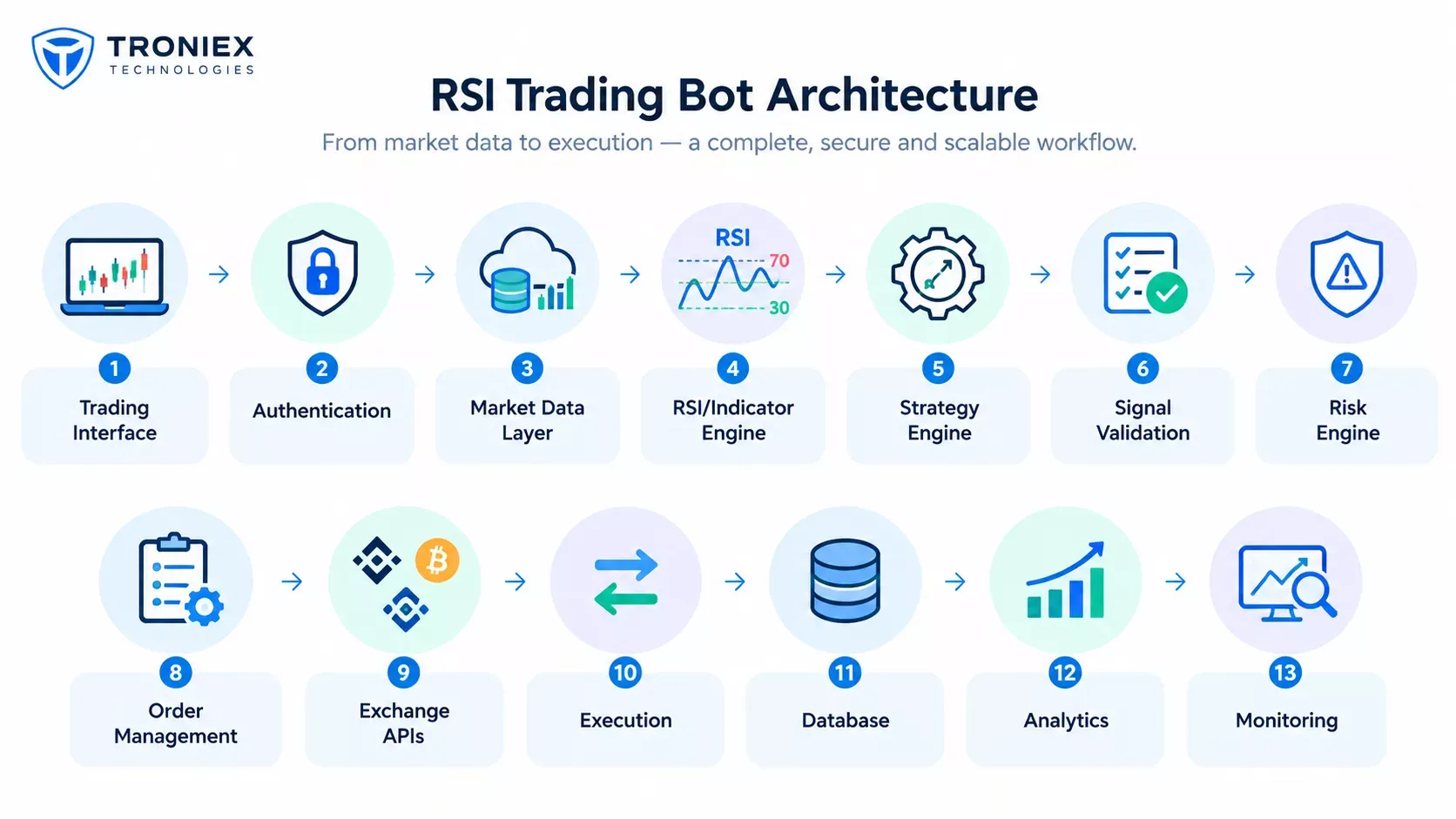
RSI Bot Architecture Layers
The market-data layer receives and normalizes exchange information. The indicator engine calculates RSI and supporting indicators. The strategy engine evaluates trading rules, while signal validation and the risk engine determine whether an opportunity can proceed to execution.
Separating these responsibilities makes individual components easier to test, replace, and scale.
Technology Stack for RSI Trading Bots
Depending on requirements, development can use Python or Node.js for application and strategy services, REST APIs and WebSockets for exchange communication, PostgreSQL for persistent records, and Redis for caching or low-latency workloads.
Cloud infrastructure, containerization, and centralized logging and monitoring can support scalable deployment.
Scalable and Fault-Tolerant Bot Infrastructure
Production systems should account for API failures, rate limits, connection interruptions, duplicate orders, service restarts, and unexpected market conditions. Retry logic, state reconciliation, monitoring, and controlled shutdown mechanisms help maintain operational integrity.
Crypto Exchange API Integration for RSI Trading Bots
Exchange integration connects the strategy engine to real market information and execution infrastructure. Depending on the business requirements, an RSI bot may integrate with exchanges such as Binance, Coinbase, Kraken, OKX, Bybit, and other supported platforms.
Market Data and WebSocket Integration
The bot can consume candle, ticker, order book, and trade data through exchange APIs. WebSockets can provide real-time streams where supported.
Authentication and Account Integration
Authenticated APIs provide account balances, positions, orders, and other information required for portfolio-aware trading. Credentials should be stored and handled using appropriate security controls.
Order Placement and Execution Management
The execution layer can submit supported market or limit orders, monitor order status, process fills, and reconcile the internal state with exchange records.
Rate Limits, Failover, and Error Handling
Exchange APIs impose operational constraints. A robust bot needs rate-limit handling, retry policies, connection recovery, and appropriate responses to rejected or partially executed orders.
Secure Exchange API Permissions
API credentials should follow the principle of least privilege. Withdrawal permissions should generally be disabled unless there is a compelling and specifically justified architectural requirement.
Backtesting, Optimization, and Paper Trading for RSI Bots
Backtesting should answer a more difficult question than “Did this strategy make money historically?” The objective is to determine whether the strategy logic behaves consistently under realistic assumptions.
A practical progression is:
Historical Data → Backtesting → Parameter Testing → Out-of-Sample Validation → Walk-Forward Testing → Paper Trading → Controlled Live Deployment
Historical RSI Strategy Backtesting
Historical market data allows developers to reproduce defined entry and exit rules over previous market conditions. Data quality, candle completeness, and timeframe consistency matter.
RSI Parameter Optimization
Developers can test RSI periods, thresholds, confirmation indicators, and other parameters. Optimization should evaluate parameter stability rather than simply searching for the highest historical return.
Avoiding Overfitting and Look-Ahead Bias
A strategy can appear highly successful when it has been unintentionally optimized for historical data. Look-ahead bias, excessive parameter tuning, and overfitting can produce results that do not generalize to unseen markets.
Realistic Trading Performance Metrics
Performance analysis should consider more than win rate. Useful metrics can include maximum drawdown, Sharpe ratio, profit factor, trade frequency, fees, and estimated slippage.
Paper Trading Before Production
Paper trading provides a bridge between historical testing and live execution. It can expose differences involving latency, API behavior, order handling, and market conditions before capital is placed at risk.
Backtesting is evidence about historical behavior, not proof of future profitability.
Ready to Develop an RSI Trading Bot? Let’s Discuss Your Requirements
Share your strategy, target exchanges, trading pairs, timeframe, and required features to determine the right architecture and development approach for your project.
Request A ProposalRisk Management and Security in RSI Trading Bot Development
Automating a strategy without automating appropriate risk controls can simply automate losses faster. Risk management should therefore be designed as a separate layer of the trading architecture.
Trading Risk Controls
Depending on the strategy, controls can include maximum position size, stop-loss, take-profit, maximum daily loss, maximum drawdown, exposure limits, and leverage restrictions.
API and Application Security
Security measures can include encryption, authentication, secure secrets management, least-privilege API permissions, access controls, and audit logging.
Circuit Breakers and Emergency Controls
Circuit breakers can pause trading when predefined conditions are breached, such as abnormal execution, repeated API errors, excessive losses, or unexpected system behavior. An emergency kill switch provides an additional operational safeguard.
Why RSI Bots Cannot Eliminate Market Risk
An RSI bot automates a strategy; it does not eliminate market risk.
This distinction matters. Automation can improve consistency and execution discipline, but it cannot remove volatility, liquidity risk, slippage, exchange risk, or the possibility that a strategy performs poorly under changing market conditions.
RSI Trading Bot Development Process: From Strategy to Deployment
A professional RSI Trading Bot Development Services workflow should move from trading requirements to tested production infrastructure in defined stages.
Step 1: Requirement Discovery and RSI Strategy Design
Business objectives, markets, exchanges, trading pairs, strategy conditions, risk limits, and user requirements are documented before development begins.
Step 2: Architecture and UI/UX Planning
The technical architecture, data flows, dashboard requirements, user roles, and monitoring requirements are defined before implementation.
Step 3: Bot Development and Exchange API Integration
Developers implement strategy logic, market-data processing, execution services, exchange integrations, and supporting application components.
Step 4: Backtesting and Security Testing
The strategy is tested against historical data while the application undergoes security, API, failure-handling, and operational testing.
Step 5: Paper Trading and Production Deployment
Paper trading validates behavior without committing live capital. Production deployment can then proceed using controlled configurations and defined risk limits.
Step 6: Monitoring, Maintenance, and Optimization
Post-launch monitoring, bug fixes, exchange API updates, strategy reviews, and infrastructure optimization help maintain the system over time.
RSI Trading Bot Development Cost and Timeline in 2026
The cost of RSI trading bot development depends more on architecture and execution requirements than on the RSI indicator itself.
|
Development Type |
Typical Scope |
Relative Cost |
Timeline |
|
Basic RSI Bot |
Single strategy + exchange |
Low |
Short |
|
Custom RSI Bot |
Custom strategy + dashboard |
Medium |
Medium |
|
Multi-Exchange RSI Bot |
Multiple APIs + advanced controls |
High |
Longer |
|
Enterprise RSI Platform |
Advanced execution + analytics + infrastructure |
Very High |
Long |
What Determines RSI Trading Bot Development Cost?
Major cost factors include strategy complexity, exchange count, number of trading pairs, dashboard requirements, mobile applications, backtesting infrastructure, AI/ML components, cloud infrastructure, security, monitoring, compliance requirements, and post-launch maintenance.
RSI Trading Bot Development Timeline
A basic implementation may require substantially less engineering than a multi-exchange platform with custom strategy logic, advanced risk management, analytics, and production-grade infrastructure.
The timeline should therefore be estimated after requirements and architecture have been defined.
Why RSI Bot Quotes Can Differ Significantly
Two vendors can quote very different prices for an apparently similar bot because their scopes may differ substantially. One quote may cover a basic execution script, while another includes strategy engineering, testing, security, infrastructure, monitoring, and long-term support.
For a broader breakdown of the factors that influence automated trading software budgets, review our guide to crypto trading bot costs in 2026 before requesting a project estimate.
Custom vs White-Label RSI Trading Bot Development
Choosing between custom and white-label development depends on how much control, differentiation, and technical ownership the business requires.
|
Factor |
Custom RSI Bot |
White-Label RSI Bot |
|
Customization |
High |
Moderate |
|
Time to Market |
Longer |
Faster |
|
Strategy Flexibility |
High |
Vendor-dependent |
|
Branding |
Full |
Full/Limited |
|
Infrastructure Control |
High |
Lower |
|
Initial Investment |
Higher |
Lower |
|
Differentiation |
Strong |
Limited |
|
Scalability |
Custom-designed |
Vendor-dependent |
When Custom RSI Bot Development Makes Sense
Custom development is better suited to businesses requiring proprietary strategies, specialized exchange integrations, unique execution logic, differentiated user experiences, or long-term ownership of the trading infrastructure.
When White-Label RSI Bots Make Sense
White-label solutions can suit businesses that prioritize faster deployment, lower initial engineering requirements, and standardized functionality over deep customization.
Which Development Model Should You Choose?
Consider strategy uniqueness, time-to-market requirements, budget, infrastructure control, source-code ownership, scalability, and the level of customization required before selecting a model.
Businesses prioritizing faster deployment can also evaluate white-label crypto trading bot development, particularly when predefined trading functionality is sufficient and deep strategy customization is not the primary requirement.
How to Choose an RSI Trading Bot Development Company
Selecting an RSI trading bot development company should involve evaluating engineering capabilities rather than comparing marketing claims or feature counts alone.
Evaluate Trading-System Engineering Experience
Look for experience with automated execution, market-data processing, order management, trading infrastructure, and production monitoring.
Check RSI Strategy and Algorithmic Trading Expertise
The development team should understand technical indicators, explicit strategy rules, market conditions, parameter testing, and the limitations of indicator-based strategies.
Verify Exchange API and Security Capabilities
Ask about exchange integrations, authentication, API permissions, credential management, rate limits, failure handling, and order reconciliation.
Examine Backtesting and Risk Management
A capable vendor should explain how it handles historical data, fees, slippage, look-ahead bias, overfitting, drawdown, paper trading, and risk controls.
Confirm Ownership, Deployment, and Support
Clarify source code ownership, deployment options, documentation, infrastructure responsibility, monitoring, maintenance, and upgrade processes.
Questions to Ask Before Hiring an RSI Bot Developer
Ask whether the strategy can be customized, how backtests are validated, which exchanges can be integrated, how API keys are protected, who controls deployment infrastructure, what happens when an exchange API fails, and what post-launch support is included.
Build Your RSI Trading Bot With Troniex Technologies
From strategy design and architecture to exchange integration, testing, deployment, and monitoring, build an RSI trading system aligned with your business objectives.
Contact UsWhy Choose Troniex Technologies for RSI Trading Bot Development?
Building an RSI trading bot for production requires more than implementing an indicator. It requires connecting strategy engineering, exchange integration, execution, risk management, testing, and scalable infrastructure into one reliable system.
Troniex Technologies approaches RSI trading bot development around this broader engineering lifecycle.
Custom RSI Strategy Engineering
Build strategy logic around configurable RSI parameters, confirmation indicators, multi-timeframe conditions, and business-specific trading requirements rather than relying on a one-size-fits-all implementation.
Secure Exchange Connectivity and Trading Infrastructure
Integrate supported exchange APIs with appropriate authentication, execution management, risk controls, monitoring, and scalable infrastructure.
Testing, Deployment, and Long-Term Optimization
Move from strategy design through backtesting and paper trading to controlled production deployment, monitoring, and ongoing optimization.