How to Scale a Crypto Exchange Business: A Stage-by-Stage Operating Playbook
A stage-by-stage playbook to scale a crypto exchange: the metrics that trigger each move, when to re-platform, how to enter new markets, and what it costs to run.
Nov 19, 2026
20 mins read
Scaling a crypto exchange means handling more users, more order volume, and more markets without slower orders, wider spreads, or compliance gaps. Exchanges hit their limits in a fixed order: the order engine and database first, liquidity depth second, new-market licensing third, team capacity last. Fix them out of sequence, and you spend budget on the wrong constraint.
This guide gives you the four scaling stages, the metrics that signal each move, and decision rules for patching, re-platforming, or migrating. It also covers market entry, custody, revenue sequencing, team structure, and what it costs to run an exchange at each stage.
- Exchanges scale in 4 stages. Each has one bottleneck that matters most.
- Track 7 metrics weekly. Each one has a threshold that tells you to act.
- Test before you rebuild. If the system misses latency targets at 2x your recent peak after tuning, re-platform. Otherwise patch.
- Migrate in pieces, pair by pair, with shadow trading and a rollback gate.
- Add products in order. Each one needs risk, liquidity, and compliance tooling in place first.
- Run cost is mostly people and liquidity. Infrastructure is the smallest line and causes the most visible failures.
Where This Guide Starts
This guide is for operators with a live exchange and real user funds. If you still plan your launch, start with our guide on how to start a crypto exchange and run through the crypto exchange launch checklist. Come back when you have users.
Two terms matter below.
- Active users are accounts that traded or deposited in the last 30 days.
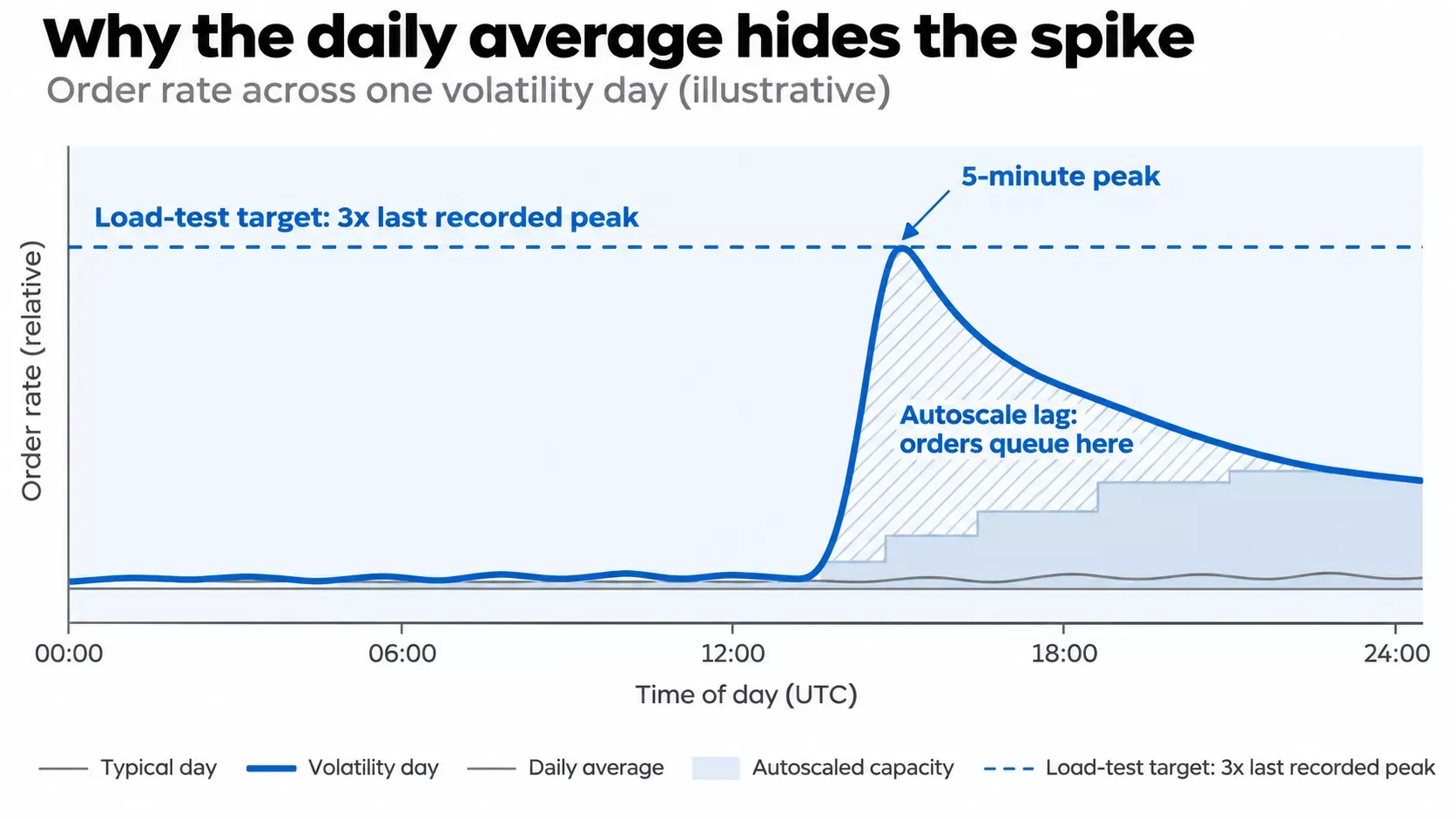
- Peak is the highest order rate you have recorded in any 5-minute window. It is not the daily average. Volatility sets the peak, and volatility arrives without warning.
The Four Scaling Stages
Each stage has one bottleneck that matters most. Work on it before the next one.
|
Stage |
Active users |
First bottleneck |
Signal |
Fix |
Owner |
|---|---|---|---|---|---|
|
1 |
Up to 10K |
Manual operations: KYC review, withdrawal approval, support |
Tickets and manual reviews grow faster than users |
Automate KYC queues and withdrawal screening, add monitoring and alerting |
Head of operations |
|
2 |
10K to 100K |
Engine and database load during volatility, thin books outside top pairs |
p99 latency doubles during a 20% daily move, rejected orders appear |
Read replicas, separate market data path, sharding by trading pair, second market maker |
CTO |
|
3 |
100K to 1M |
Liquidity cost and market access |
Spreads widen on mid-cap pairs, market maker spend climbs while revenue per user stays flat, target markets stay closed |
Renegotiate market maker terms, add liquidity venues, secure licences, staff 24/7 on-call |
COO and CTO |
|
4 |
Over 1M |
Multi-region latency, fragmented regulation, outage blast radius |
Distant users see p99 above target, one incident hits every market |
Multi-region active-active deployment, separate legal entities per market, isolated service cells |
Executive team |
User bands are planning guides. Product mix moves them. A derivatives book loads the engine harder than a spot book at the same user count, so a derivatives exchange often meets Stage 2 problems well below 10K active users. Treat the signal column as the real trigger and the user count as a rough marker.
What each stage asks of you
Stage 1 is an operations problem. The code works, but people approve withdrawals and review identity documents by hand. Every hour a reviewer spends on a routine case is an hour not spent on the cases that carry risk. Automate the routine path first.
Stage 2 is the first engineering test. Volatility exposes every shortcut in the order path. Exchanges at this stage separate market data from order handling, split read traffic from write traffic, and shard by trading pair. A single market maker also becomes a single point of failure here.
Stage 3 shifts the problem to money and permission. Liquidity costs grow with the pair count, and growth depends on markets you have no licence to serve yet. This stage needs the most coordination between engineering, finance, and legal.
Stage 4 is a problem of blast radius. One incident must not reach every user and every market. Isolation, regional deployment, and local legal entities do that work.
Metrics That Trigger Each Move
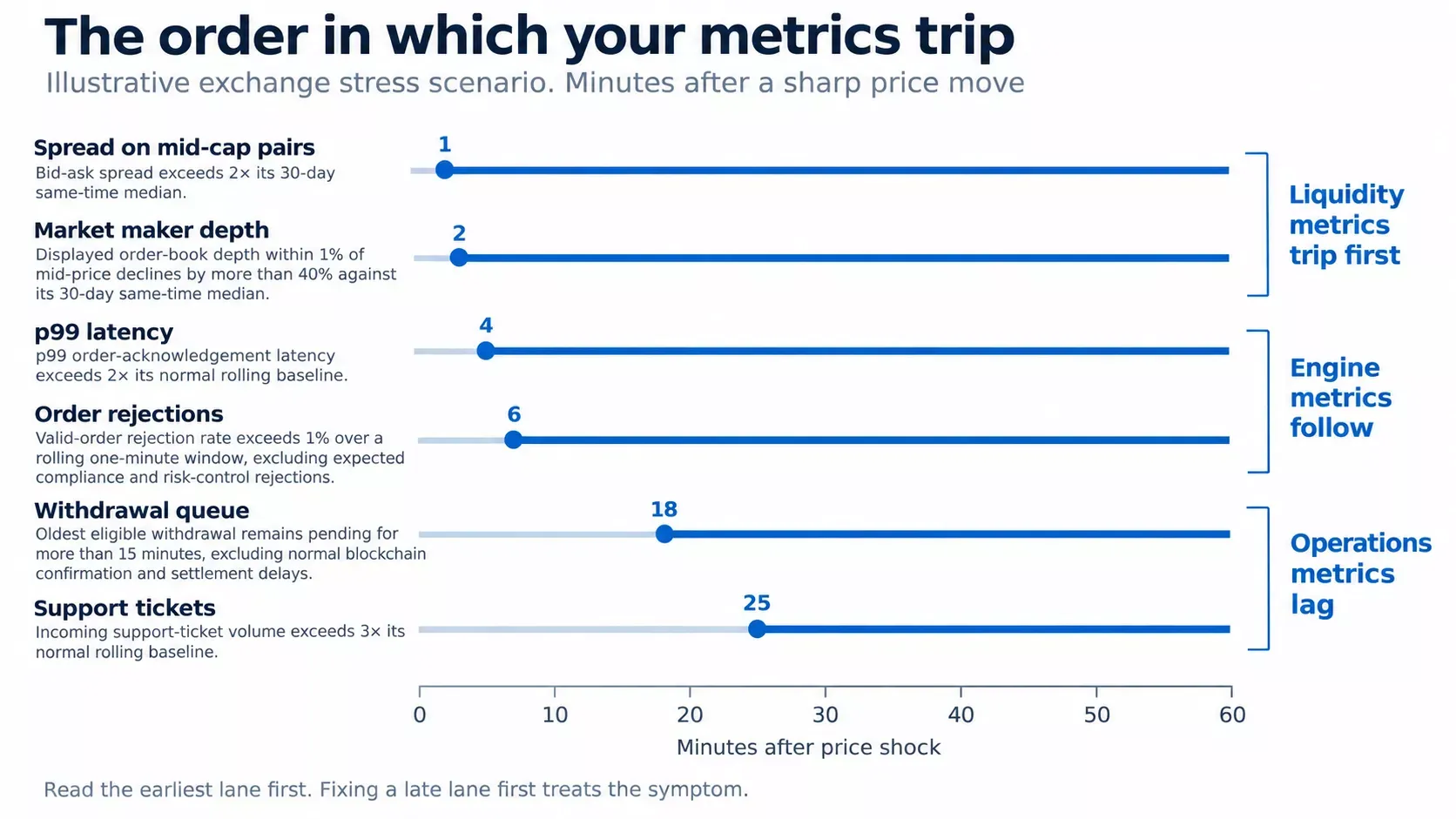
Pick 7 numbers, put them on one dashboard, and review them weekly. Act when a threshold trips.
|
Metric |
Healthy |
Act when |
Action |
|---|---|---|---|
|
p99 order-to-acknowledgement latency |
Under 25 ms (Troniex launch target) |
Above 2x baseline for 15 minutes at peak |
Open a capacity review |
|
Order rejection rate |
Under 0.1% |
Above 0.5% |
Check queue depth, rate limits, and database locks |
|
Spread on top 8 pairs |
Under 1.5% (Troniex launch target) |
Above 3% on any mid-cap pair for 7 days |
Review market maker uptime and depth commitments |
|
Depth within 1% of mid price |
A $50K market order moves price under 1% on top 8 pairs |
Depth falls below that for 3 days |
Add a market maker or raise incentives for that pair |
|
Withdrawal queue time |
Median under 10 minutes for automated withdrawals |
Manual review queue older than 4 hours |
Add reviewers or tighten auto-approval rules |
|
Support tickets per 1,000 active users per week |
Flat or falling |
Rising for 2 weeks in a row |
Audit the top 5 ticket reasons and automate the biggest |
|
CAC payback |
Under 6 months |
Above 9 months |
Cut the weakest acquisition channel |
The latency and spread targets come from our launch checklist. The other thresholds are starting points. Run the dashboard for 30 days, then replace each starting threshold with your own baseline plus a tolerance band.
Two notes on reading the table:
- Use p99, not the average. Averages hide the slow orders that cost traders money. One order in a hundred that takes 10 times longer is the one that ends up in a support ticket.
- Watch AML alerts too. Our launch checklist sets a false-positive target under 4% on the alert queue. Above that, analysts drown, and real cases wait.
Capacity Planning For Volatility Spikes
A bull-run day brings several times your normal order rate in minutes. Exchanges that survive it practiced for it.
Set a quarterly capacity review with a fixed agenda:
- Replay your highest recorded peak against a staging environment at a multiple of its volume. Use at least 3x.
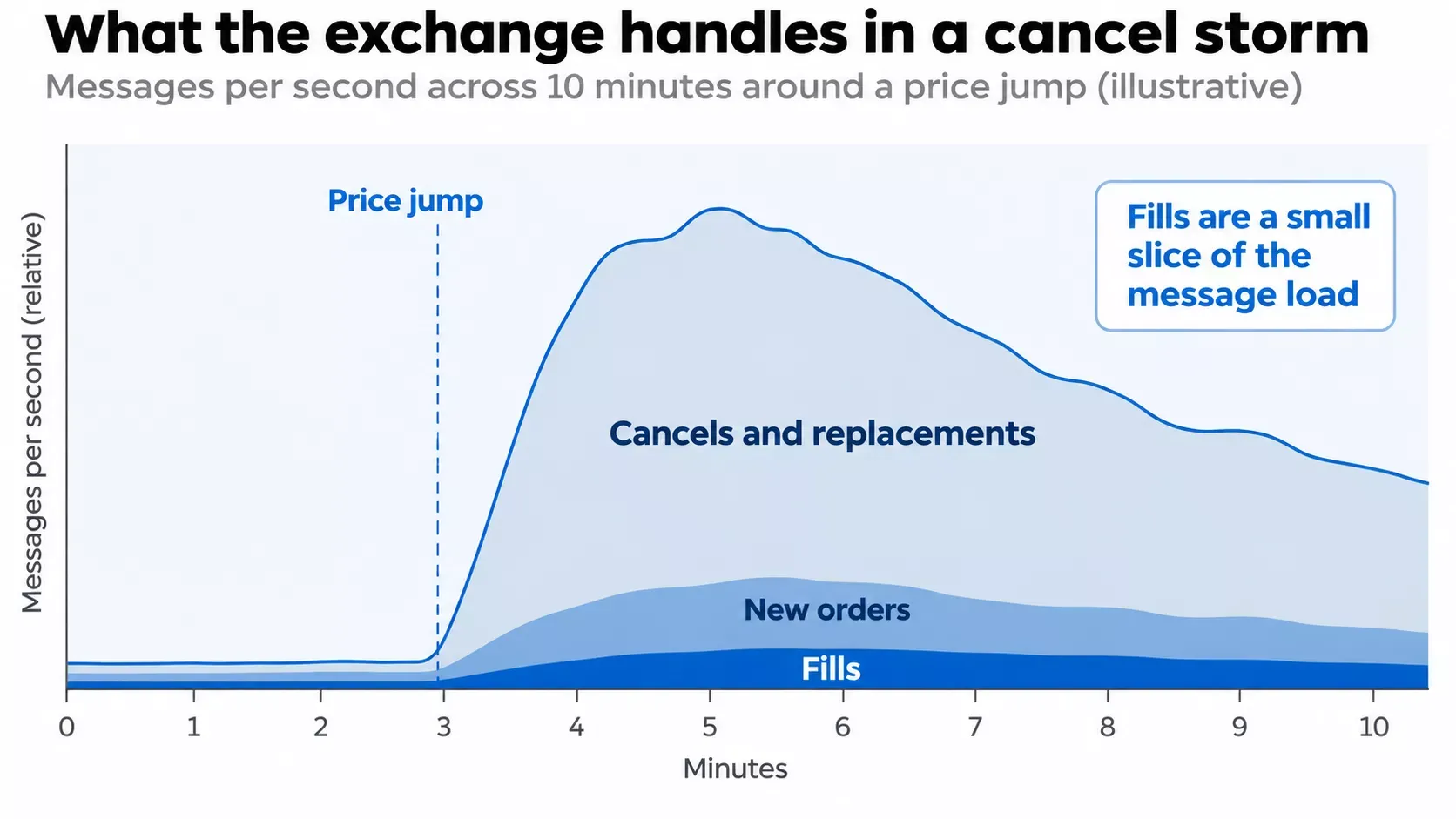
- Run a cancel storm. Market makers cancel and replace thousands of orders at once when prices jump. Fee logic and the order book both break here.
- Test a withdrawal surge. Panic selling comes with panic withdrawing. Check the hot wallet refill path under load.
- Pull the plug on one availability zone. Time the failover.
- Hold a game day. The on-call team handles a staged incident with no warning.
- Write the postmortem and fix the top 3 findings before the next review.
Set autoscaling rules on queue depth and p99 latency. CPU load lags behind the problem. Pre-warm capacity before known events: major listings, protocol upgrades, ETF decisions, and macro data releases.
Keep a one-page runbook for the first 10 minutes of a spike. It names who watches which dashboard, who holds authority to pause a pair, and who talks to market makers. Write it while things are calm.
Engine internals sit outside this guide. Our posts on the order matching engine and crypto exchange architecture cover sequencing, sharding, and component design.
Patch, Re-platform, or Migrate
Every exchange reaches this decision. The wrong call costs quarters.
|
Symptom |
Patch |
Re-platform |
|---|---|---|
|
p99 latency above target at 1.5x peak |
Tune queries, add replicas, raise instance sizes |
Engine design limits throughput after tuning |
|
Rejected orders under load |
Fix rate limits and connection pools |
Single-node matching and database writes block each other |
|
Shipping a new product takes over a quarter |
Refactor the one blocking module |
Every feature touches the same codebase |
|
Market makers complain about API behavior |
Add endpoints and rate tiers |
API design forces them to work around it |
|
Outage affects every pair |
Add isolation to the weakest component |
No isolation exists between components |
Rule: Patch if the system holds p99 targets at 2x your recent peak after tuning. Re-platform if the engine or database fails that test after tuning.
When you have a choice, re-platform in pieces. Migrate the wallet service, the market data feed, and the engine separately. A full rewrite touches too many things at once and gives you no clean place to stop.
How to migrate an exchange without downtime
- Shadow trading. The new engine receives a copy of live orders and produces fills. Compare them to the live engine every day.
- Reconcile balances nightly. Any mismatch stops the project until you explain it.
- Dual-run one low-volume pair. Real users trade on the new engine while the old one stands by.
- Cut over pair by pair, lowest volume first.
- Set a rollback gate. A balance mismatch or p99 above target returns that pair to the old engine within minutes.
- Keep the old engine running for a full month of clean operation before you decommission it.
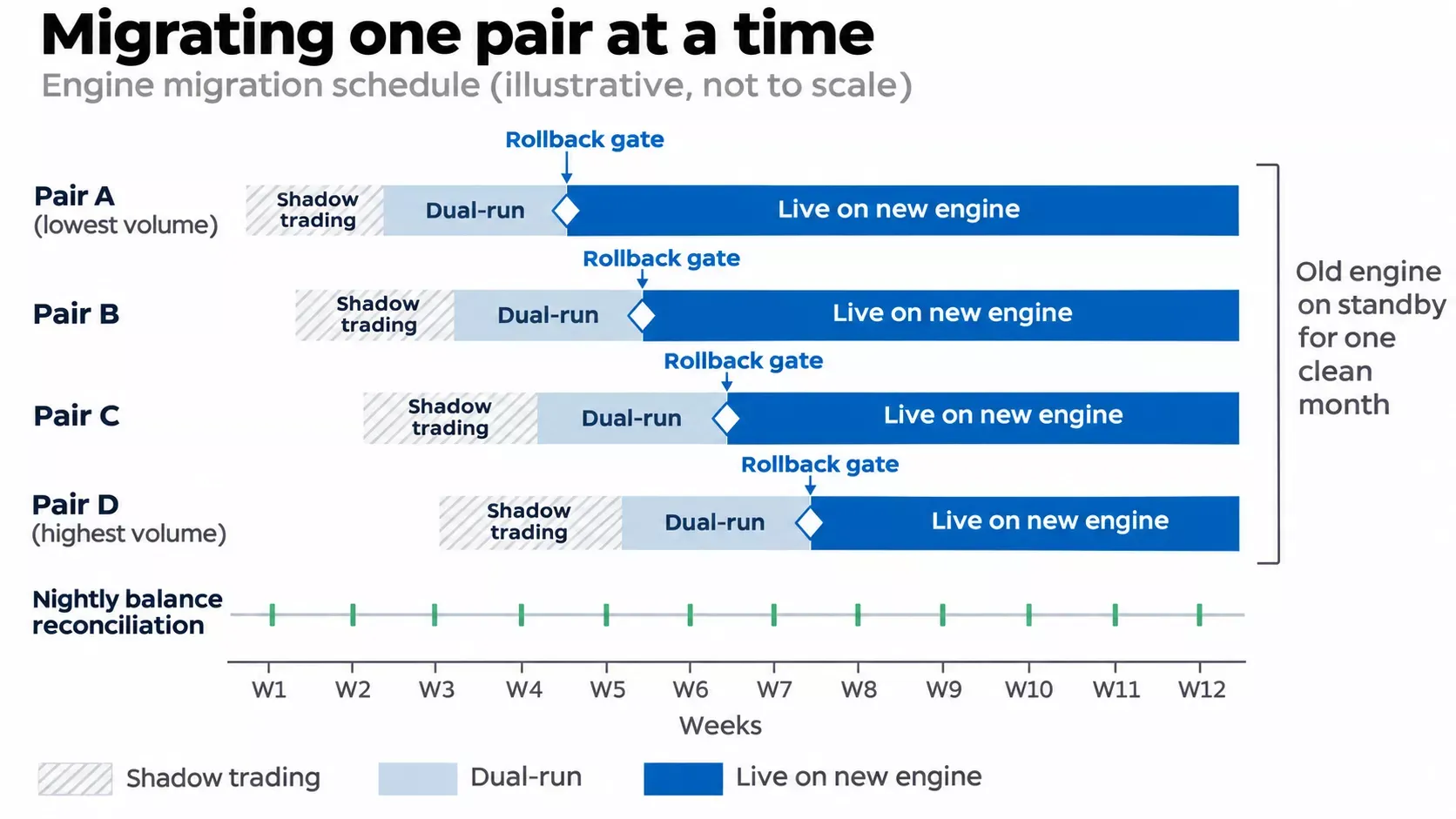
An engine migration takes quarters. Wallet and market data services move faster. The risk list is short and well known:
|
Risk |
Control |
|---|---|
|
Balance mismatch after cutover |
Nightly reconciliation plus a hard stop on any difference |
|
Market makers break on API changes |
Run old and new APIs in parallel, publish a changelog, give a fixed sunset date |
|
Wallet key migration error |
Rehearse on testnet, split the process across approvers, move small balances first |
|
Order-state loss during cutover |
Drain open orders per pair before the switch and replay from a write-ahead log |
Stack choices matter most at this point. Our crypto exchange tech stack guide compares languages, databases, and cloud options.

Get A Patch-or-Rebuild Verdict On Your Exchange
Our engineers review your load profile and give you a written answer, with a migration plan if the answer is rebuild.
Talk To Our ExpertsLiquidity As The Book Grows
Liquidity needs change with each stage.
- Stage 1: Concentrate on 8 pairs. Depth on 8 pairs beats thin books on 40.
- Stage 2: Add a pair only after a market maker commits to depth and uptime in writing.
- Stage 3: Renegotiate. Your volume gives you bargaining power the first contracts never reflected. Measure liquidity cost as a share of trading revenue each quarter.
- Stage 4: Aggregate external venues so a large order reaches deeper books than yours.
A contract with a market maker should state 4 things: the maximum spread, the minimum depth at that spread, the uptime requirement, and the penalty or rebate change when they miss. Without those terms, you pay for presence and get none of the protection.
The tactics for improving depth fill a full guide. We cover them in how to improve crypto exchange liquidity.
Entering New Markets
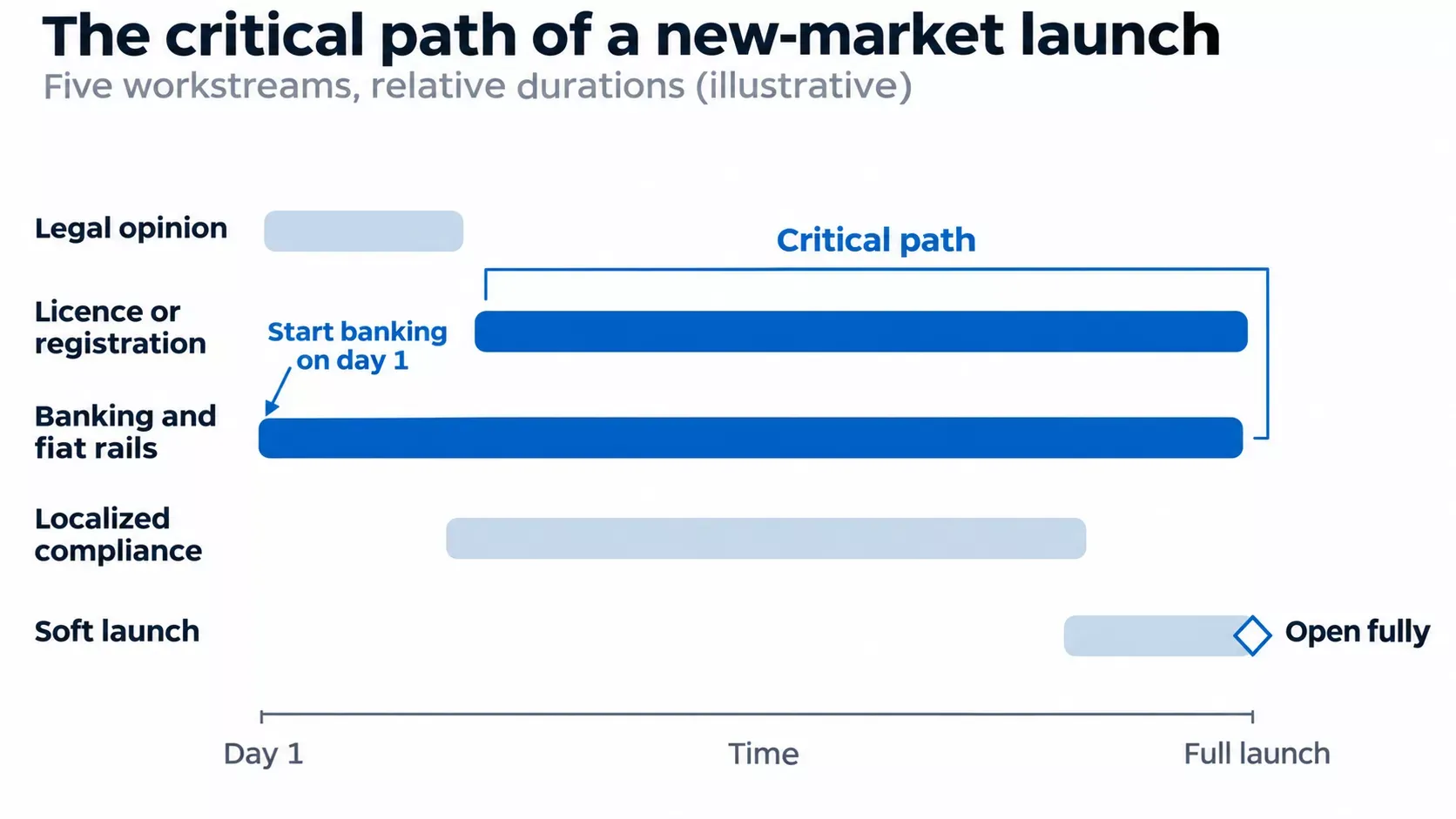
Market entry stalls on banking and licences. Rank candidate markets on 3 factors: regulatory clarity, fiat rail availability, and size of the addressable user base. Start the banking conversation on day 1. It takes the longest.
Localization goes beyond language. Local payment methods drive conversion, and support hours need to match the time zone. A user who deposits at 2 a.m. and meets a closed support desk during a failed deposit does not come back.
Run each new market through the same sequence:
- Legal opinion. Confirm what your product list triggers in that market.
- Licence or registration. File early. Reviews run longer than plans.
- Banking and fiat rails. Line up at least 2 providers.
- Localized compliance. Local sanctions lists, local reporting, local data rules.
- Soft launch. Open to a limited user group, watch the metrics in section 3, then open fully.
The table lists the first regime to check in 5 large markets.
|
Market |
Regime to check first |
What it means for you |
|---|---|---|
|
United States |
FinCEN money services business registration plus state money transmitter licences, New York BitLicense for New York |
Federal and state tracks run in parallel. Full detail in our guide to launching a crypto exchange in the USA with a licence |
|
United Kingdom |
FCA registration under money laundering rules, plus financial promotion rules |
Marketing copy needs compliance sign-off |
|
European Union |
MiCA authorization as a crypto-asset service provider |
One authorization covers passporting across member states |
|
UAE |
VARA licence for Dubai |
Licence categories follow your product list |
|
Singapore |
MAS licence under the Payment Services Act |
Capital and governance requirements apply |
Rules change faster than blog posts. Confirm every row with counsel and the regulator before you act.
Custody And Risk Controls As Balances Grow
Security needs change as assets under custody rise. A control that fits a small customer balance fails at a large one.
- Hot wallet ceilings. Set a hard cap as a percentage of daily withdrawal volume. Top up from cold storage through a multi-person approval flow.
- Withdrawal approval depth. Add approvers and time delays as transaction size grows.
- Proof of reserves. Publish on a fixed cadence once balances reach the level where users ask for it. Monthly and quarterly are common.
- Insurance and incident funds. Size them against your largest single-wallet exposure.
- Fraud detection. Manual review stops working at Stage 3. See how we built AI fraud detection for a crypto exchange.
The full control list lives in our crypto exchange security best practices guide. For storage design, read hot wallet vs cold wallet.
Add Revenue Lines in the Right Order
Every new product adds load, risk, and compliance work. Add each one when its prerequisites exist.
|
Product |
Add when you have |
Watch |
|---|---|---|
|
Spot trading |
Launch baseline |
Fee tiers that reward liquidity |
|
Fiat on-ramp |
Banking partner, KYC at scale |
Chargeback and fraud rates |
|
Margin trading |
Risk engine, liquidation logic, deep books on collateral pairs |
Liquidation cascades |
|
Derivatives |
Margin experience, insurance fund, market surveillance, licence for the product |
Engine load, funding rate integrity |
|
OTC desk |
Institutional KYC, dedicated desk staff |
Counterparty and settlement risk |
|
Staking |
Custody controls, clear user disclosures |
Slashing and lock-up risk |
Our guide on how crypto exchanges make money lists 15 revenue streams. Use it as a menu and this table as the order.
Grow Users and Keep Them
Acquisition without retention burns cash. Measure these 3 numbers per cohort:
- Funded rate: share of registrations that deposit within 14 days.
- Day-30 and day-90 trading retention: share still trading.
- CAC payback: acquisition cost divided by monthly net revenue per retained user.
Referral programs pay back when the reward is a fee discount or a share of fees. A flat cash bonus attracts accounts that deposit, claim, and leave. Cap the reward and tie it to a trading volume threshold.
Trading competitions fit as events. Judge them by net new funded accounts. A competition that adds 5,000 sign-ups and 200 funded accounts costs you money.
Support scales through a knowledge base first, then ticket routing, then chat automation for the top 5 ticket reasons. Keep a human path for every account freeze and every withdrawal dispute. Users tolerate slow chat. Silence after an account freeze ends the relationship.
Team And Operations By Stage
Software scales with hardware. Operations scale with people. Plan hiring ahead of each stage.
|
Function |
Stage 1 |
Stage 2 |
Stage 3 |
Stage 4 |
|---|---|---|---|---|
|
Engineering |
One team owns the full stack |
Split into trading core, wallets, and platform teams |
Add dedicated risk and data engineering |
Regional engineering with shared platform standards |
|
Site reliability |
Shared with engineering |
First dedicated SRE hires, primary and secondary on-call |
24/7 coverage |
Dedicated team with an incident commander role |
|
Compliance and AML |
One officer, outside counsel |
Analyst team and a case management tool |
Market-specific officers |
Regional compliance teams |
|
Support |
Business hours |
Extended weekday coverage |
24/7 |
24/7 multilingual |
Hire when the signal appears, not when the team feels stretched. Stage 2 SRE hires belong before the first major volatility event, because that event is the interview.
Write the incident communication plan before you need it. Name who posts the status update, how often, and where. Users judge an exchange by how it behaves in its worst hour.
What Scaling Costs To Run
Build cost is a different number. For that, read our guide on crypto exchange development cost. This table covers the monthly run cost lines and what moves each one.
|
Cost line |
What drives it |
Grows fastest at |
First lever to pull |
|---|---|---|---|
|
People |
Headcount in engineering, SRE, compliance, support |
Stages 3 and 4 |
Automate routine work before hiring |
|
Market makers and liquidity |
Pair count, depth commitments, rebates |
Stages 2 and 3 |
Cut pairs that fail depth targets, renegotiate terms |
|
Compliance and KYC vendors |
Verifications, alerts, markets served |
Stage 3 |
Tune alert rules to cut false positives |
|
Cloud and infrastructure |
Peak capacity, regions, data retention |
Stage 4 |
Autoscale on queue depth, archive old data |
|
Support |
Tickets, hours covered, languages |
Stages 3 and 4 |
Fix the top 5 ticket reasons at the source |
|
Security and audits |
Audit cadence, bug bounty, insurance |
Every stage, in steps |
Schedule audits ahead of major releases |
Plan for people and liquidity to be your two largest lines. Infrastructure is usually the smallest, and it causes the failures users see. Compute your monthly run cost per active user and track it each quarter. If it rises for two quarters running, a stage transition is overdue.
Scaling Readiness Scorecard
Score 1 point for each yes.
- You replayed your highest recorded peak on staging in the last 90 days.
- p99 latency stays under target at 2x that peak.
- You ran a failover drill in the last 6 months.
- Every top 8 pair holds spreads under 1.5%.
- Market maker contracts carry written depth and uptime terms.
- Routine KYC cases and withdrawals clear automatically without a human touch.
- A hot wallet cap and a multi-person refill flow exist.
- You review the 7 metrics in this guide every week.
- You have a written incident communication plan.
- You know your monthly run cost per active user.
|
Score |
What to do |
|---|---|
|
0 to 4 |
Fix foundations before adding markets or products. Start with items 1 to 3 |
|
5 to 7 |
Fix the lowest-scoring area, then plan the next stage |
|
8 to 10 |
You are ready for the next stage. Pick the bottleneck from the stage table and start |
Turn your Score Into a Scaling Plan
Share your scorecard result and dashboard metrics. We map your next stage, your first bottleneck, and the work it needs.
Contact UsConclusion
Every exchange meets its next constraint on a schedule the market sets. Volatility picks the day, so the work belongs in the weeks before it.
Start with 4 moves this week:
- Build the dashboard. Put the 7 metrics on one screen and set a threshold for each.
- Book the first capacity review. Replay your highest recorded peak at 3x and run a cancel storm.
- Score the readiness checklist. Fix the lowest-scoring item first.
- Open the banking conversation for your next target market, even if launch sits a year away.
Give each stage an owner, a metric, and a date. A bottleneck with a name gets fixed. A bottleneck described as "performance" waits for the next outage.
If the load test or the scorecard exposes a gap your team lacks the capacity to close, Troniex engineers review exchange load profiles and deliver a written patch-or-rebuild verdict. Talk to Troniex exchange engineers.