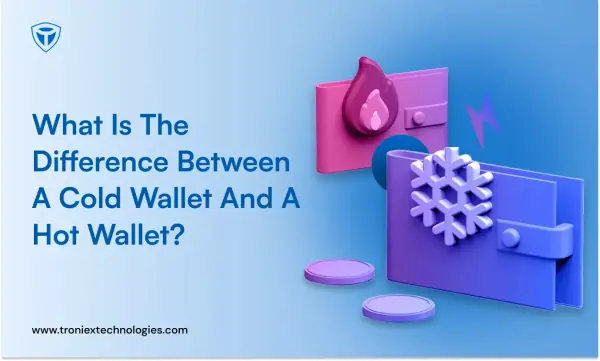
What is the difference between a cold wallet and a hot wallet? Guide 2026
Hot wallet vs cold wallet: compare security, private keys, costs, risks, use cases, and storage options to choose the right crypto wallet in 2026.
Sep 04, 2026
13 mins read
The debate around hot wallets versus cold wallets is no longer about convenience versus security. With crypto adoption accelerating across trading, payments, DeFi, Web3 applications, and institutional asset management, users need to understand where their private keys are exposed, how transactions are signed, and which wallet architecture aligns with how they actually use cryptocurrencies.
And that growth is reflected in the global crypto wallet market. According to Grand View Research, the market is projected to reach $19.3 billion in 2026 from $15.5 billion in 2025, growing at a CAGR of 26.6% to reach $100.8 billion in 2033.
In 2025, hot wallets represented 56.2% of the market. Wallet security is critical at the same time: Chainalysis reports that over $3.4 billion in cryptocurrency was stolen in 2025, including $713 million associated with breaches of personal wallets.
So, what is the difference between a cold wallet and a hot wallet?
A hot wallet allows signing capabilities to be available in an internet-connected environment, making crypto more easily transacted, traded, and used with Web3 applications. Cold wallet: A cold wallet stores private keys or signing material offline. This reduces the attack surface to remote attacks but introduces friction in accessing the funds.
There is no one better choice here, depending on the value of your assets, how often you trade, how much time you want to spend on custody, and your risk appetite.
Hot Wallet vs Cold Wallet: What’s the Difference?
Hot wallet vs cold wallet difference lies in the environment of creation, storage, or use of private keys for authorizing transactions. Hot wallets are for accessibility. Cold wallets prioritize isolation.
|
Factor |
Hot Wallet |
Cold Wallet |
|
Internet connection |
Usually connected |
Private keys kept offline |
|
Accessibility |
High |
Lower |
|
Transaction speed |
Fast and convenient |
Requires additional signing steps |
|
Remote attack exposure |
Higher |
Lower |
|
DeFi/Web3 access |
Excellent |
More deliberate interaction |
|
Hardware required |
Usually no |
Often, but not always |
|
Physical-loss risk |
Lower device dependency |
Hardware/backup can be lost |
|
Best suited for |
Trading, payments, DeFi |
Long-term storage, reserves |
|
Typical asset allocation |
Active funds |
Higher-value holdings |
|
Business use |
Operations/liquidity |
Treasury/reserves |
The difference between hot wallet and cold wallet security therefore goes beyond whether a device happens to be online. The important question is whether sensitive signing material can be reached from an internet-connected environment.
What Is a Hot Wallet Crypto and How Does It Work?
A hot crypto wallet is a wallet that has a signing environment that is still reachable through an internet-connected device or service. This broad category includes mobile wallets, desktop wallets, browser extension wallets, web wallets, and many exchange wallets.
When you start a transaction, the wallet builds the transaction, signs it with the appropriate private key or signing method, and then sends it to the blockchain network.
How Hot Wallets Manage Private Keys
A non-custodial hot wallet usually gives the user control over the keys or recovery credentials. A custodial hot wallet, in contrast, leaves the management of the keys up to a service provider, such as an exchange or custodian.
That distinction is important. “Hot vs cold” refers to the signing environment. Custodial vs Non-custodial refers to who controls the assets or signing authority. They are related concepts, but not interchangeable.
Why Do People Use Hot Wallets?
Hot wallets are good for users who need to access the blockchain on a frequent basis. They can have fast transfers, token swaps, interaction with NFTs, staking, trading, and connection to decentralized applications.
For someone using Web3 every day, repeatedly retrieving an offline signing device for every small transaction may create unnecessary friction. This is why a well-designed Web3 wallet development often balances usability with authentication, transaction controls, secure key management, and risk monitoring.
What Is a Cold Crypto Wallet and How Does Cold Storage Work?
A cold wallet keeps private keys or other critical signing material isolated from environments that are always connected to the internet. The idea is simple: reduce the ability of the attacker to reach the keys over the wire.
Cold storage can take place on hardware, air-gapped computers, offline signing systems, or infrastructure of institutional custody.
Cold Wallets and Hardware Wallets Are Not Always the Same Thing
Hardware describes the device. Cold storage describes how keys are isolated and used. A hardware device can provide strong key isolation, but its actual security depends on configuration, transaction-signing procedures, firmware integrity, recovery practices, and how it interacts with connected software.
Cold Storage Reduces Exposure to Remote Attacks
Imagine your private key as a key to a physical vault.
A hot wallet is like putting that key in a secure room in an office where you can get to it whenever you need. A cold wallet is closer to placing it inside another protected vault and retrieving its signing capability only under controlled conditions.
The second arrangement creates more friction, but it also removes many opportunities for remote attackers to reach the key.

Find the Right Crypto Wallet for How You Actually Use Crypto
Match hot, cold, or hybrid storage to trading, payments, DeFi, long-term holdings, or business operations.
Talk To Our ExpertsWhy Hot and Cold Wallets Have Different Security Models
The real security difference between hot and cold crypto wallets becomes clearer when you look at transaction signing.
A simplified hot-wallet flow looks like this:
User → Wallet App → Signing Environment → Signed Transaction → Blockchain
A cold-storage workflow can instead separate signing from broadcasting:
Unsigned Transaction → Offline Signing Environment → Signed Transaction → Online Broadcaster → Blockchain
The blockchain still needs the signed transaction. The crucial difference is that the private key itself does not need to be exposed to the online broadcasting environment.
Hot Wallet Attack Surface
Hot-wallet risk factors can include phishing, malicious browser extensions, malware, compromised devices, stolen credentials, malicious dApps, unsafe approvals, application vulnerabilities, and compromised key infrastructure (depending on implementation).
That is not to say hot wallets are insecure by nature. This means their security architecture has to cover a broader online attack surface.
Attack Surface of Cold Wallet
Cold storage eliminates a lot of the remote attack vectors, but other attack vectors exist: (1) theft of the device itself, (2) physical damage to the device, (3) lost recovery phrase, (4) compromised backups, (5) supply-chain attacks, (6) coercion, and (7) signing a malicious transaction without verifying it properly.
This is why best practices for crypto wallet security should be more holistic and look at the whole signing and recovery lifecycle, not just the “cold wallet” label.
Are Cold Wallets Really Safer Than Hot Wallets?
Cold wallets generally offer more robust protection against remote attacks for long-term key isolation, as sensitive signing material stays offline. It is not true that "cold wallets cannot be hacked."
A user can still authorize a malicious transaction. A recovery phrase can still be stolen. Hardware can be tampered with. Backups can be exposed. An attacker can also manipulate what the user believes they are signing.
Chainalysis' analysis of 2025 theft activity illustrates why this distinction matters. It found approximately 158,000 personal wallet compromise incidents affecting at least 80,000 unique victims during the year.
Security therefore depends on the entire system:
Key storage + authentication + transaction verification + recovery + device security + user behavior.
Cold storage improves one major part of that equation, but it does not eliminate every risk.
Hot Wallet vs Cold Wallet: Pros and Cons Beyond Security
Security gets most of the attention, but usability can determine whether a wallet architecture succeeds in practice.
A hot wallet makes sense when assets need to move frequently. Traders may need rapid exchange access. DeFi users regularly interact with smart contracts. Businesses may need wallets capable of processing deposits and withdrawals throughout the day.
Cold wallets trade some of that immediacy for isolation.
For long-term holders, corporate treasuries, custodians, and platforms holding significant reserves, that additional operational step can be worthwhile.
Cost also differs. Many software hot wallets are free to install, excluding blockchain transaction fees and service charges. Cold storage can require dedicated hardware or, for businesses, more sophisticated custody, approval, signing, and operational infrastructure.
Which Wallet Should You Use for Different Crypto Activities?
The best wallet for you is more about how you’ll be using your assets than which category seems safest.
If you make daily crypto payments, do smaller transfers, trade actively, or interact frequently with Web3, a hot wallet is usually a more practical option.
If the digital asset is Bitcoin or something that you want to leave untouched for months or years, cold storage may be a better fit for safety.
DeFi is a particularly important tradeoff. Hot wallets are convenient for easy dApp connectivity, but they require you to sign smart-contract transactions regularly, increasing your exposure to phishing and malicious approvals.
Large holders can split active DeFi capital from long-term reserves instead of plugging the whole portfolio into applications.
It is a question businesses also ask, only on a broader scale. A centralized wallet development architecture, for instance, might need immediate liquidity for customer withdrawals while storing the bulk of platform reserves behind stronger controls.
Turn Your Hot-and-Cold Wallet Strategy Into a Production System
Translate storage principles into scalable signing, policy, liquidity, monitoring, and blockchain infrastructure.
Request A ProposalShould You Use Both a Hot Wallet and a Cold Wallet?
For many users, the better question is not hot wallet or cold wallet? It is how should hot and cold wallets work together?
A practical model separates assets by purpose.
- Hot Wallet → Spending / Trading / DeFi / Frequent Transactions
- Cold Wallet → Long-Term Holdings / High-Value Reserves
Funds can periodically move between the two based on predetermined thresholds.
Think of a retail business. It would be inefficient to lock every dollar of working cash in a bank vault but equally unwise to leave the company's entire cash reserve in the register.
Crypto wallet architecture can follow the same principle.
For individuals, the exact percentage allocated to each wallet should depend on transaction frequency, portfolio size, recovery capabilities, and personal risk tolerance. There is no universal "safe percentage."
Hot vs Cold vs Warm Wallets: Is There a Middle Ground?
The traditional cold wallet and hot wallet distinction is becoming more nuanced.
A warm wallet introduces additional controls between always-available hot signing and heavily isolated cold storage. For example, transactions might require human approval, policy checks, multiple authorization steps, or distributed signing.
Warm architectures can be particularly useful for organizations that cannot accept the operational delays of traditional cold storage but do not want unrestricted hot-wallet signing.
This creates a spectrum:
Hot → Warm → Cold
As wallet infrastructure evolves, security increasingly depends on how signing authority is distributed and governed, not simply whether one device has an internet connection.
How MPC, Multisig, and Passkeys Are Changing Wallet Security
Modern wallet infrastructure is also changing the meaning of the hot wallet vs cold wallet debate.
Multi-Party Computation (MPC), for example, can distribute signing capability among multiple parties or environments so that a complete private key does not need to exist in one vulnerable location during signing.
Multisignature wallets take a different approach by requiring multiple independent keys to approve transactions.
Passkeys can strengthen user authentication by replacing traditional passwords with cryptographic credentials. However, authentication should not be confused with transaction signing. A secure login does not automatically make the underlying key-management architecture secure.
For businesses evaluating crypto wallet development, these technologies can support policy-based authorization, role separation, transaction limits, recovery controls, and reduced single points of failure.
Hot Wallet vs Cold Wallet for Businesses and Crypto Platforms
Businesses have different requirements from individual holders.
An exchange cannot realistically place every asset into deep cold storage because customers expect deposits, withdrawals, and trading operations to function continuously. Keeping every asset permanently hot, however, can increase operational exposure.
That creates a liquidity-management problem.
Crypto exchanges, fintech platforms, payment businesses, Web3 applications, and corporate treasuries can divide assets across security tiers based on operational need.
A typical model may use:
- Hot wallet: immediate operational liquidity
- Warm/MPC layer: controlled transaction processing
- Cold storage: strategic reserves
This model also allows businesses to introduce approval thresholds, withdrawal policies, address allowlists, anomaly detection, and audit trails.
How Businesses Design Hybrid Hot-and-Cold Wallet Architecture
A production wallet system is much more than a user interface connected to a blockchain node.
A simplified hybrid architecture may look like:
User → Wallet Interface → Authentication → Policy Engine → Signing/MPC Layer → Hot Wallet / Cold Storage → Blockchain Network
Compliance and monitoring systems can sit alongside the transaction layer to support AML/KYT screening, transaction policies, analytics, alerts, and audit records.
Automated rebalancing can also maintain predefined hot-wallet liquidity levels while moving excess assets into more protected storage.
This is where custom wallet architecture becomes important. Businesses need to determine which chains they support, who controls signing authority, how recovery works, what transaction limits apply, how reserves are segmented, and how security policies change as transaction value increases.
Build vs Buy: Choosing Crypto Wallet Infrastructure
A business does not necessarily need to build wallet infrastructure from scratch.
An existing wallet may be enough for straightforward internal holdings. White-label crypto wallet development can make sense when a business wants to launch branded wallet functionality faster using an existing configurable foundation.
Custom development becomes more relevant when requirements include proprietary custody logic, multi-chain infrastructure, MPC, sophisticated transaction policies, enterprise integrations, high-volume operations, or unusual compliance workflows.
Cost consequently depends on architecture rather than simply the number of screens in the application. Teams evaluating crypto wallet development cost should scope custody, supported networks, security model, integrations, compliance requirements, transaction volume, recovery, infrastructure, testing, and ongoing maintenance before comparing vendor quotes.
Build Your Crypto Wallet With Troniex Technologies
Create custom hot, cold, MPC, or hybrid wallet infrastructure tailored to your security, blockchain, integration, and operational requirements.
Contact UsHot Wallet or Cold Wallet? A Practical Decision Framework
Choose a hot wallet when you prioritize fast access, regular transactions, trading, payments, or frequent Web3 interaction.
Choose a cold wallet when you prioritize offline key isolation, long-term holdings, high-value reserves, or reduced remote attack exposure.
Use both hot and cold wallets when you have assets serving different purposes. Keep operational funds accessible while separating reserves from routine transaction environments.
Businesses with high transaction volumes or complex authorization requirements should also evaluate hybrid, multisig, or MPC-based architectures rather than treating hot and cold storage as the only two possibilities.
Ultimately, the safest crypto wallet is not simply the one that stays offline longest. It is the architecture that appropriately protects keys, verifies transactions, controls authorization, supports reliable recovery, and matches the user's actual operating model.