Sports Prediction Market Development: Architecture, Stack, and APIs
Build a sports prediction market with live-data oracles, in-play settlement, and compliant contracts. Architecture, API stack, and $15K-$40K+ cost breakdown.
Sep 11, 2026
10 mins read
- Sports markets resolve in-play, on live data. A generic prediction market oracle built for elections or crypto prices doesn't transfer.
- Cost: $15K-$40K+. Timeline depends on scope and whether you're extending an existing platform or building fresh.
- FIFA World Cup 2026 runs June 11-July 19. The knockout stage is where volume peaks, and it's not the last forcing function this year: club season kicks off in August, cricket's international calendar reloads every few months.
- CFTC gave sports event contracts conditional approval. Individual player injury markets are banned. That distinction has to live in your smart contract logic, not just your terms of service.
FIFA is the search term spiking right now, but the underlying build problem is the same across football, basketball, and cricket markets, and it doesn't go away when this tournament ends: every match generates dozens of tradeable events, each one resolving in minutes, not days.
Why Sports Markets Break Generic Prediction Market Architecture
A prediction market for a US election resolves once. Polls close, a winner is certified, the oracle reports one outcome, contracts settle. A prediction market for a football match resolves continuously. Who scores next. Whether the match goes to extra time.
Whether a red card gets issued. Each of those is its own market; each one opens and closes within the span of a single game, and each one needs a data feed fast enough to settle before the next play happens.
That's a different oracle problem. UMA's optimistic oracle, the standard for custom event resolution in election and crypto-price markets, works on a propose-and-dispute window measured in hours.
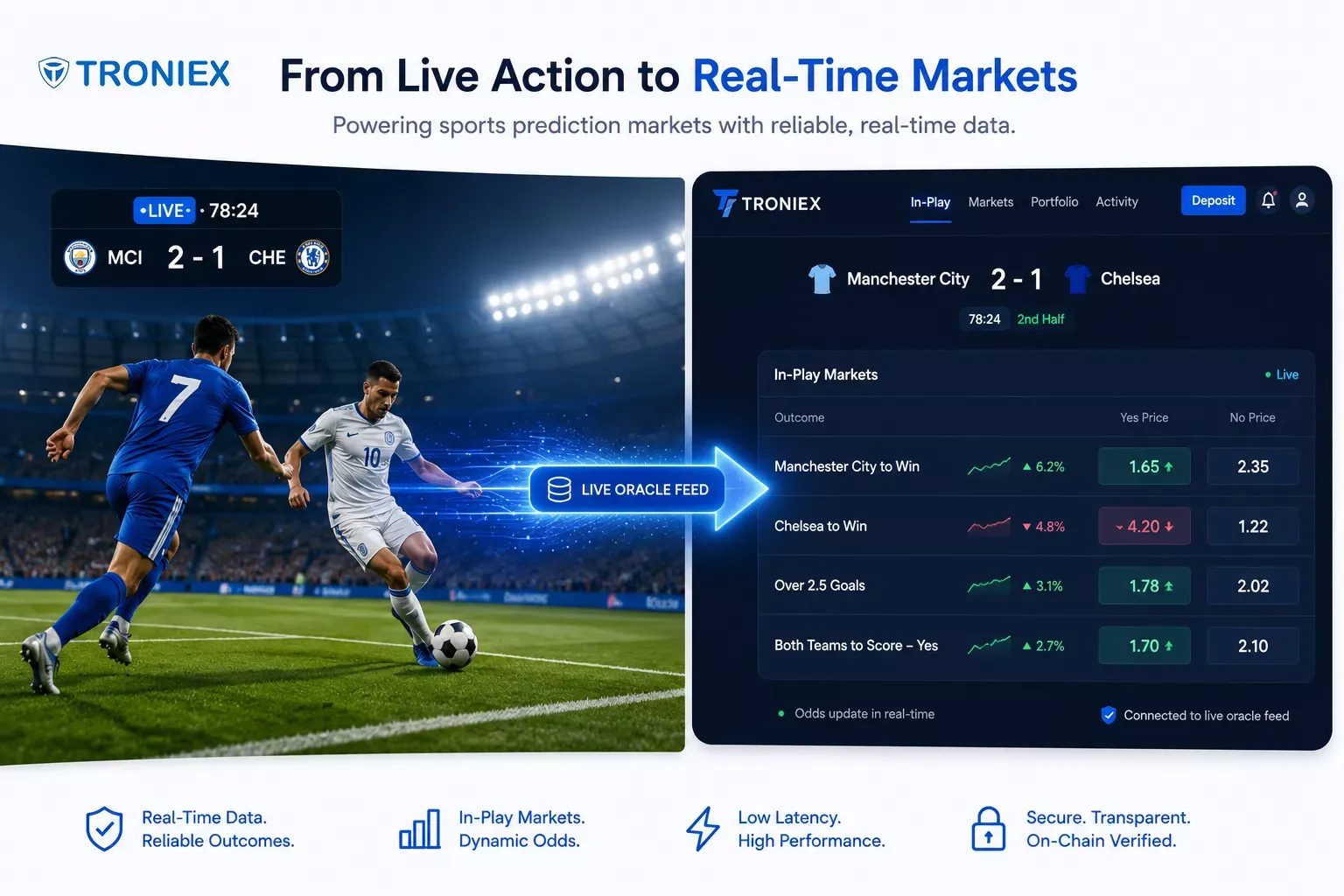
A sports market can't wait hours to settle a "next goal scorer" contract. It needs a feed that reports in near real time and a dispute mechanism that still catches errors (a mis-recorded goal, a VAR reversal minutes after the fact) without freezing every other market on the platform.
Polymarket's early sports markets ran into exactly this. Live in-play contracts settled ahead of official confirmation more than once, because the feed prioritized speed over verification.
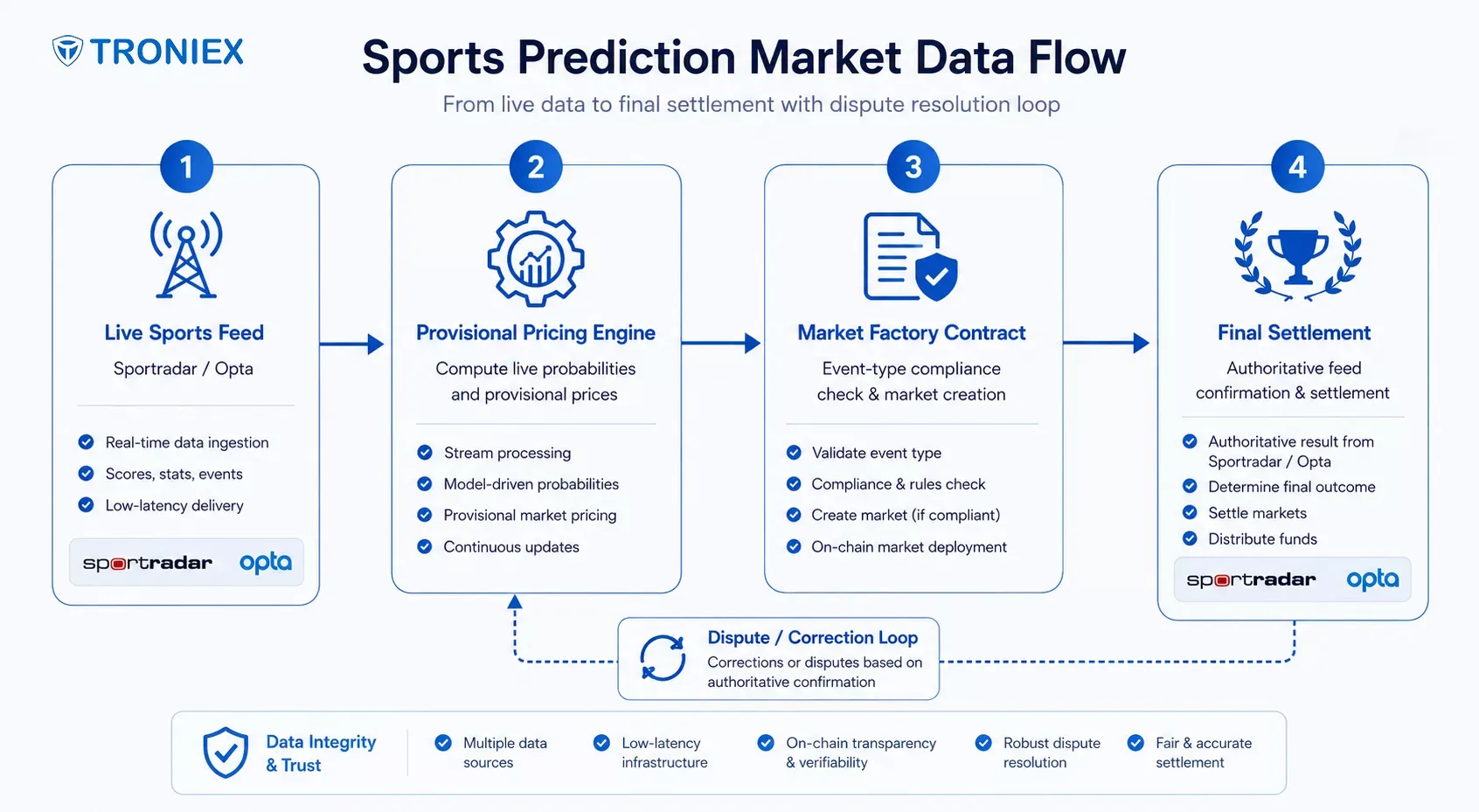
The fix wasn't a faster oracle. It was a two-tier settlement: fast provisional pricing for live trading, held final settlement until an authoritative feed (Opta, Sportradar-class data) confirmed the result.
Evaluating oracle providers for a live sports market? Book a 20-min architecture review.
|
Market type |
Resolution window |
Oracle behavior |
|
Election outcome |
Days |
Single resolved event, dispute window measured in hours |
|
Crypto price threshold |
Minutes-hours |
Continuous feed, resolves once at threshold |
|
Sports in-play (next goal, next card) |
Seconds-minutes |
Continuous feed, provisional pricing, delayed final settlement |
|
Sports match result |
Post-match |
Single resolved event, but needs postponement/abandonment handling |
The FIFA World Cup 2026 Window, and Why Sports Markets Don't Have a Closing Bell
The tournament runs June 11 to July 19, 2026, across the US, Mexico, and Canada. That's the forcing function behind the current search spike. But unlike an election, which resolves once and the market opportunity ends, sports prediction markets don't close when this tournament does.
The knockout stage (starting late June) is where volume concentrates: fewer matches, higher stakes, more in-play trading per game. A platform that shipped untested infrastructure into the group stage is finding its oracle and settlement gaps right now, live, in front of users.
That's the same mistake teams make launching exchanges into a token unlock or a market crash: shipping under load you've never simulated.
For teams reading this after kickoff, the World Cup isn't the only volume event this year. Club football season restarts in August. Cricket's international calendar (T20 series, ODI tournaments) reloads every few months. Basketball has its own season structure.
Prediction market platforms built around sports get recurring volume events, not a single expiring window, which is a stronger long-term case for the build than the FIFA spike alone suggests. TRM Labs tracked prediction market volume scaling to $21B a month in 2026, and sports events are a recurring driver of that, not a one-off.
If you're extending an existing prediction market platform to add a sports vertical, the lift is smaller: reuse settlement and custody, add sport-specific oracle feeds and market templates. If you're building from zero, plan around the next recurring volume event on the calendar, not just the one currently trending in search.
What the Build Actually Requires
Live-odds and event-data oracle. Sports-specific feed providers (Sportradar, Opta-class data, or a sports-focused Chainlink integration) replace or supplement the general-purpose oracle used in election or price markets. The feed needs to report at the pace of the sport: goals and cards in football, scoring plays in basketball, wickets and overs in cricket.
In-play settlement logic. Markets open and close inside a single match. The smart contract layer needs to handle rapid market creation (a new "next event" market every few minutes during play), provisional pricing before final confirmation, and correction handling when an official record overturns a live call.
Postponement and abandonment rules. A match gets delayed, suspended for weather, or abandoned mid-game. The contract logic needs a defined path for voiding, refunding, or extending the resolution window, decided before launch, not improvised when it happens.
Event-type compliance. The CFTC's June 2026 rule gave sports event contracts conditional approval while explicitly banning individual player injury markets (Federal Register). That distinction needs to be enforced at the market factory contract level, at creation time, so a disallowed market type can't get listed in the first place.
Relying on frontend filtering or manual review doesn't hold up under regulatory scrutiny.
Federal approval isn't the whole picture. State-level sports betting law varies, and a prediction market trading event contracts on sporting outcomes can draw scrutiny from state gambling regulators even where the CFTC has cleared the contract type federally.
Multi-state platforms need geo-fencing logic that accounts for both layers, not just the federal one.
Sports Prediction Market Development Cost and Timeline
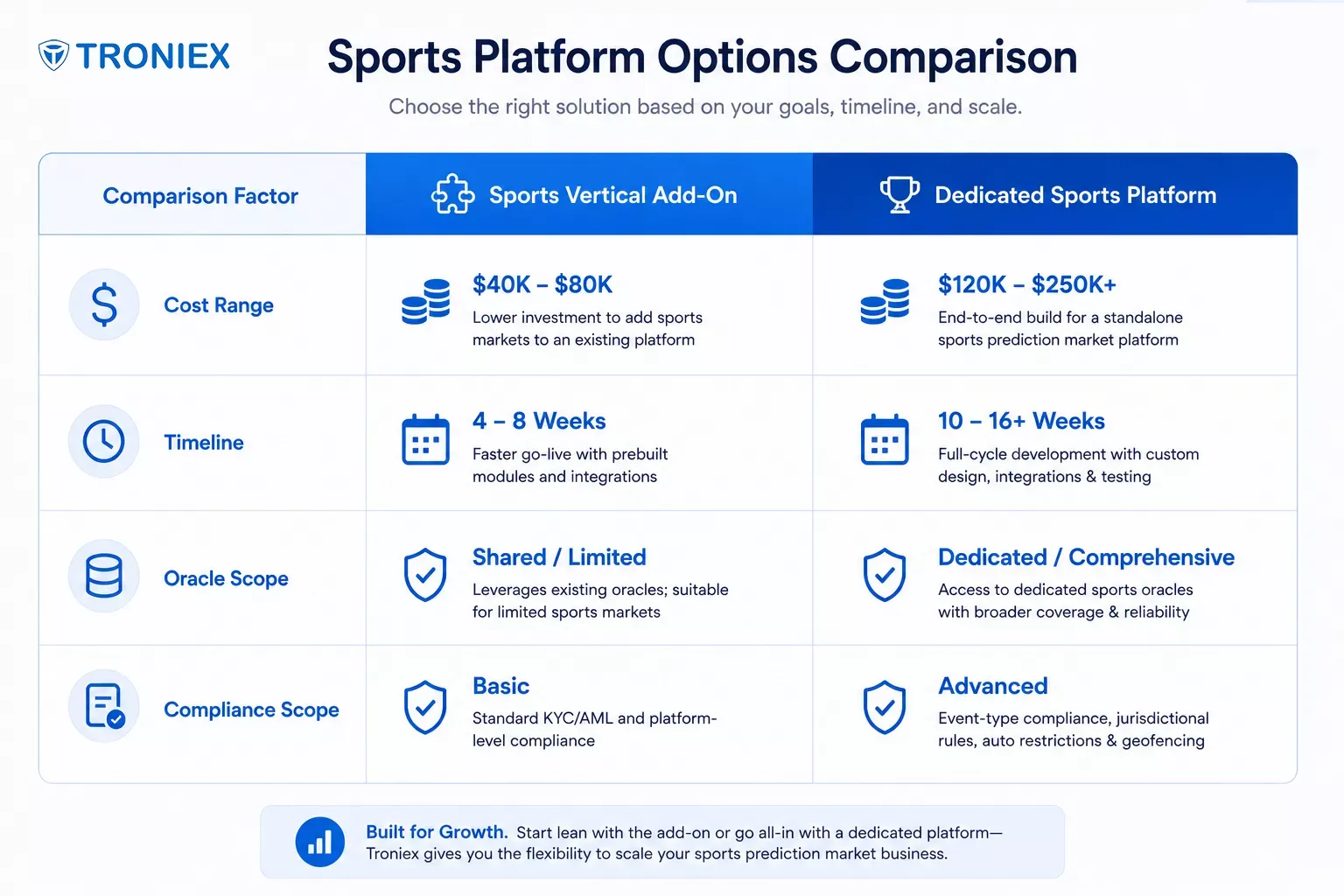
Sports prediction market development starts at $15K and runs to $40K+ depending on scope: whether you're adding sports markets to an existing platform, building a white-label sports module, or standing up a dedicated sports prediction market from architecture up.
|
Cost driver |
Adds to scope |
|
Sports-specific oracle integration |
Feed provider licensing, latency requirements, multi-sport coverage |
|
In-play settlement logic |
Provisional pricing, correction handling, rapid market creation |
|
Postponement/abandonment handling |
Void and refund logic, resolution-window rules |
|
Compliance layer |
Event-type enforcement at contract level, jurisdiction restrictions |
|
Number of sports/leagues at launch |
Each sport needs its own market templates and data mapping |
Teams extending an existing prediction market platform land toward the lower end. A dedicated sports build with multi-sport coverage and full compliance tooling lands toward the top.
For a full breakdown of how these cost drivers compare against non-sports prediction market builds, see prediction market development cost.

Get a Build Estimate for Your Sports Prediction Market
Scope, timeline, and cost - based on your sport, feed provider, and jurisdictions.
Request a Quote30-min call, scoped to your build - not a generic quote.Order Book or AMM: The Same Decision, Sports Adds a Wrinkle
Sports markets inherit the same core architecture decision every prediction market faces: order book vs. AMM. The wrinkle is speed. An order book needs market makers willing to quote in-play odds that move every few seconds, which is a harder liquidity problem than a slower-moving election or price market.
An AMM handles the liquidity side automatically but needs its pricing curve to update fast enough to reflect a goal that just happened, not a goal from 90 seconds ago.
Most production sports prediction markets end up hybrid: AMM-style liquidity for long-tail markets (outright tournament winner, top scorer), order-book-style matching for high-volume in-play markets where tight spreads matter more than automatic liquidity.
That's an architecture decision made at the design stage, not something bolted on after launch.
API Architecture: What Connects to What
A sports prediction market platform runs on 4 API layers, and each one has a different latency requirement.
Market data API. Serves live odds, order book depth, and trade history to the frontend and any third-party integrations. Needs WebSocket streaming, not polling, or the UI lags behind the actual match.
Trading API. Handles order placement, cancellation, and position queries. REST for account and history endpoints, WebSocket for order execution where speed matters (in-play markets close fast).
Oracle/data-feed API. The inbound connection to Sportradar, Opta, or a Chainlink-integrated feed. This is the layer that breaks first under load if it's built for polling instead of push-based updates, because a sports event doesn't wait for your next scheduled fetch.
Admin and compliance API. Market creation, dispute resolution tooling, KYC/AML status checks, geo-fencing rules. Lower latency requirement, higher security requirement: this is the layer that enforces the event-type compliance logic covered above, so it needs strict access control and audit logging.
|
API layer |
Protocol |
Latency requirement |
Failure mode if under-built |
|
Market data |
WebSocket |
Sub-second |
Stale odds shown to traders |
|
Trading |
REST + WebSocket |
Sub-second on execution |
Missed fills, failed cancellations during live play |
|
Oracle/data-feed |
Push-based (webhook or streaming) |
Near real-time |
Delayed or wrong settlement |
|
Admin/compliance |
REST |
Seconds is fine |
Disallowed markets slipping through, audit gaps |
Third-party integrations add a 5th consideration: if the platform exposes its own API for sportsbook aggregators, affiliate partners, or embedded widgets, that surface needs rate limiting and its own auth layer separate from the core trading API.
Skipping this is how internal APIs end up load-tested by external traffic they were never scoped for.
How Troniex Approaches Sports Prediction Market Builds
Troniex treats sports markets as a settlement and data-feed problem first, not a UI skin on an existing prediction market template. The same engineering discipline behind BitBab's high-frequency matching engine applies directly here: rapid order matching, low-latency data handling, and settlement logic built to hold under volume spikes rather than demo load.
That's the same problem a sports prediction market solves during a live match. Markets open and close in seconds, data has to be verified before it settles, and the platform can't freeze when the FIFA World Cup sends 10x normal traffic through it.
If you're scoping a sports prediction market build, or fixing gaps a live tournament just exposed, talk to the Troniex team.