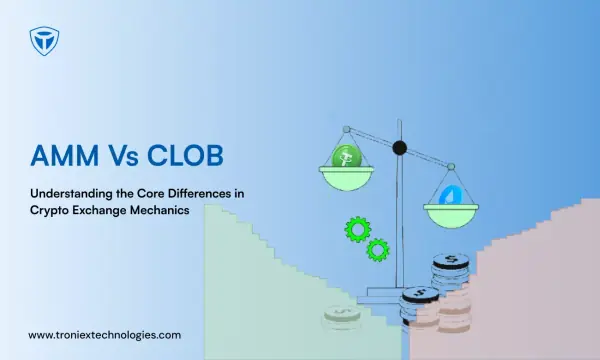
AMM vs CLOB: Understanding the Core Differences in Crypto Exchange Mechanics
Compare AMM and CLOB models to optimize crypto exchange liquidity, execution, scalability, and growth with tailored or hybrid architectures.
Jan 10, 2026
7 mins read
Winning in crypto trading isn’t just about token listings, it’s about liquidity architecture.
Your exchange’s success depends on whether you adopt AMM or CLOB as your engine.
Both models define how traders interact, how liquidity moves, and how prices stabilize.
In a market topping $600B+ monthly on-chain perp volume, design choices drive dominance.
Most trading losses don’t stem from volatility but from poor execution mechanics.
A misunderstood liquidity model silently bleeds user capital and exchange revenue.
Troniex Technologies helps founders launch high-performance exchanges. We design, deploy, and scale both AMM and CLOB infrastructures matched to your growth stage.

Kickstart Your High-Performance Exchange
Scale smarter with architecture built for speed, liquidity, and long-term growth with troniex technologies. Unlock the edge your platform needs!
Talk To Our ExpertsWhat is an AMM (Automated Market Maker)?
An Automated Market Maker (AMM) replaces traditional order books with liquidity pools.
Here, traders exchange tokens directly via smart contracts, eliminating the need for matching.
The system uses a formula like x∗y=k to adjust prices dynamically.
As trades occur, balances shift, and token values rebalance automatically.
Uniswap, SushiSwap, and Balancer pioneered this model for DeFi liquidity.
They proved markets can self-regulate without centralized intermediaries.
How it Benefits Founders
AMMs launch fast, ideal for new tokens with limited trading depth.
LPs supply liquidity and earn passive fees, reducing market-making barriers.
The Cost of Simplicity
- Price slippage worsens in volatile markets.
- Arbitrage bots profit from mispricing, creating LVR (Loss-Versus-Rebalancing) drag.
Still, AMMs guarantee 24/7 on-chain liquidity without the need for pro traders.
They’re efficient, global, and permissionless, key for early DeFi growth.
Troniex builds custom AMM frameworks with adaptive pricing and dynamic fees. This minimizes volatility exposure and enhances yield for liquidity providers.
What is a CLOB (Central Limit Order Book)?
A Central Limit Order Book (CLOB) organizes buy and sell orders by price and time. It’s the beating heart of centralized exchanges like Binance, Coinbase, and Kraken.
Buyers place bids below market price, sellers post asks above it.
Trades execute when the two sides meet in price, producing real-time market discovery.
This transparency ensures traders always access the best available execution.
Pro market makers thrive here, maintaining tight spreads and deep liquidity.
Why Founders Choose CLOBs
They offer price precision and attract professional traders. It is ideal for high-volume trading, derivatives, and institutional users.
Operational Load
- Running a CLOB demands fast infrastructure and deep liquidity support.
- Without enough active orders, books stay thin and user trust weakens.
CLOBs, however, dominate at scale.
Chains like Sei, Injective, and Hyperliquid now deliver sub-second matching.
Troniex Technologies offers enterprise-grade CLOB deployment with hybrid cloud setups. These systems enable seamless integrations with KYC, fiat ramps, and trading APIs.
Key Differences Between AMM and CLOB
Exchange design decisions ripple through user experience and profitability.
Below is a clear founder-focused comparison of both models:
|
Dimension |
AMM |
CLOB |
Founder Takeaway |
|
Mechanism |
Smart contract pools |
Order matching engine |
AMM automates; CLOB orchestrates |
|
Liquidity Source |
Token deposits (LPs) |
Market makers and traders |
AMM needs users; CLOB needs depth |
|
Execution |
Instant swaps |
Price-time-priority trades |
CLOB enables strategic orders |
|
Scalability |
Runs on any EVM chain |
Needs fast chain or backend |
Match infra with speed goals |
|
Fee Model |
LP fees |
Maker-taker rebates |
Each shapes your revenue mix |
|
Best For |
Retail DeFi swaps |
Institutional, pro trading |
Balance per market segment |
AMM Focus
- Faster time-to-market and decentralized access.
- Best for token issuance, yield farms, and pilot liquidity programs.
CLOB Focus
- Ideal for long-term scalability and transparent price discovery.
- Perfect for exchanges targeting pro traders and regulated markets.
Your architecture dictates not just performance but who you attract.
Choosing wrong means losing either retail simplicity or institutional depth.
Use Cases for AMM and CLOB
Different liquidity models drive success in distinct market segments. Here’s where each shines most for founders and investors.
Where AMMs Win?
- Token launches and liquidity bootstrapping.
- Community-driven DEXs prioritizing accessibility.
- Ecosystems aiming for retail yield farming users.
AMMs empower anyone to become a liquidity provider. They drive adoption fast and keep entry friction minimal.
Where CLOBs Win?
- Centralized or regulatory-compliant exchanges.
- High-frequency or institutional trading environments.
- Platforms offering crypto futures, perps, and options.
CLOBs give pros confidence through tight spreads and transparency. They naturally attract bigger trades, volumes, and cross-asset liquidity.
The Hybrid Edge
Founders increasingly opt for hybrid liquidity engines. AMMs bootstrap long-tail pairs; CLOBs handle large spot and derivatives.
Hybrid frameworks bundle both models strategically. They stabilize liquidity on launch and evolve into efficient pro-grade systems.
At Troniex, hybrid architectures are a key focus area. We’ve helped exchanges route liquidity intelligently across pools and books for optimal flow.
Technical and Financial Considerations
Architecture affects costs, scalability, and liquidity demand. Each model carries different burn rates, fee structures, and capital efficiency.
AMM Operational Model
- Low initial cost, launch fully decentralized for ~$15K–$45K+.
- Earn fees instantly once pools attract trading volume.
CLOB Operational Model
- Higher infra setup, requires matching engines, servers, and liquidity providers.
- Revenue scales with volume; top CLOBs earn $10M–$20M monthly in maker-taker flow.
Performance Analytics
- Founders track AMMs by pool depth and slippage rates.
- CLOBs are benchmarked by spreads, fill rates, and latency.
Risk and Compliance
- AMMs rely on smart contract audits for asset safety.
- CLOBs align better with KYC/AML frameworks for regulated growth.
Troniex provides real-time liquidity dashboards for both systems.
Investors monitor daily revenue, execution efficiency, and LP performance seamlessly.
Future Trends in Exchange Architecture
The market is converging toward adaptive models that merge AMM and CLOB DNA.
Innovation now focuses on speed, fairness, and on-chain transparency.
Hybrid Liquidity Engines
Protocols route trades dynamically depending on asset volume and chain speed.
The goal: deliver consistent pricing with both capital efficiency and decentralization.
Smart Improvements Emerging
- Oracles and batch auctions reducing sandwich attacks.
- Just-in-time (JIT) liquidity cutting LP losses.
- On-chain matching delivering off-chain speed parity.
Institutional appetite is accelerating this evolution.
Funds and crypto-native market makers now participate in DeFi order books.
Troniex is pioneering next-gen hybrid frameworks for founders.
Our roadmap includes liquidity intelligence that self-balances books and pools autonomously.
By uniting AMM reach with CLOB precision, tomorrow’s exchanges capture both markets.
That’s how new platforms rival the dominance of centralized giants like Binance and OKX.
Conclusion
Exchange design isn’t a tech decision; it’s a business growth lever. Understanding AMM vs CLOB helps founders define market entry, liquidity depth, and ROI trajectory.
Quick Founder Checklist
- Stage: Launch fast with an AMM, scale with a hybrid.
- Liquidity: Fund community pools or onboard market makers.
- Users: Retail traders prefer simplicity; pros demand control.
- Growth: Align token incentives with volume-based fee structures.
The exchange landscape is shifting toward modular, cross-chain, and liquidity-intelligent architectures. Those who design with hybrid agility win the next cycle of DeFi adoption.
Troniex Technologies equips you with the architecture and intelligence to lead.
Whether AMM, CLOB, or hybrid, we help you move from concept to live exchange faster.
Ready to build your next-gen trading platform?
Explore our Crypto Exchange Development Services, Smart Contract Development for DeFi, and stay tuned for Hybrid Exchange Models: Combining AMM and CLOB for Maximum Efficiency.