How Much Does It Cost to Build a Prediction Market Like Polymarket?
Building a prediction market like Polymarket in 2026 costs $5,000 to $85,000+. A clone script starts at $5,000. A white-label platform ($2000 to $5000 per month) gets you to market in under 14 days. A custom build ($30,000 to $85,000+) gives full control but takes 3 to 9 months.
May 22, 2026
12 mins read
- Build cost ranges from $5,000 (clone script) to $30,000+ (custom build). White-label is the fastest path to a real launch: 2 to 6 weeks.
- Smart contract audit adds $10,000 to $30,000 on top of dev cost; skip it, and you carry the same risk that cost Polymarket a $7M pool in 2025.
- Blockchain and oracle choices lock in 40 to 60 percent of your total budget before UI work begins.
- Start with AMM liquidity; add CLOB only after you prove trading volume.
Prediction market volumes hit $64 billion in 2025. According to FalconX's February 2026 market report, that number is on pace to exceed $325 billion in 2026 based on January's $27 billion monthly run-rate. If you are a Web3 founder evaluating this space, the market timing is real. What is not clear yet is how much it costs to build.
This guide breaks down the cost to build a prediction market like Polymarket in 2026 by build method, blockchain, feature tier, and post-launch budget. You will walk away with specific numbers, not a range so wide it is useless.

🎉 Launch Your Own Prediction Market.
Launch your Polymarket-style prediction market fast and dominate the $325B market now!
Talk To Our ExpertsHow Much Does It Cost to Build a Prediction Market Like Polymarket in 2026?
Building a prediction market platform like Polymarket in 2026 costs between $5,000 and $85,000+, depending on your build method, blockchain, and feature scope.
Three build paths exist. A clone script gets you the lowest upfront number but is not suitable for a production launch with real user funds. A white-label platform sits in the middle, helping you get to market faster. A custom build gives you full control but takes the most time and budget.
|
Build Method |
Cost Range |
Timeline |
Best For |
|
Clone Script |
$5,000 – $25,000 |
2 – 6 weeks |
Proof-of-concept / Demo |
|
White-Label |
$2,000 – $5,000 |
1 – 2 weeks |
Fast market entry |
|
Custom Build |
$30,000 – $85,000+ |
3 – 9 months |
Full control + compliance |
These ranges cover development costs only. Blockchain deployment, smart contract audits, and oracle integrations are separate line items. Each is broken out in detail below.
Looking for a quick start? Check out our ready-to-deploy Polymarket clone script to test ideas without committing to a full build.
What Polymarket Actually Built (Your Technical Benchmark)
Before you budget, you need to understand what you are replicating. Polymarket runs on Polygon, settles all trades in USD Coin (USDC), and uses an off-chain Central Limit Order Book (CLOB) matching engine with on-chain settlement via smart contracts. For outcome resolution, it uses UMA's Optimistic Oracle.
Polymarket has announced plans to migrate away from Polygon and build its own Ethereum Layer 2, called POLY, with the migration listed as its "top priority" as of December 2025.
The chain has not launched yet as of March 2026. This matters for your budget decision: blockchain infrastructure choices have long-term cost consequences. Switching chains after launch adds $10,000 to $30,000 in rewrite costs.
Three-layer architecture at a glance:
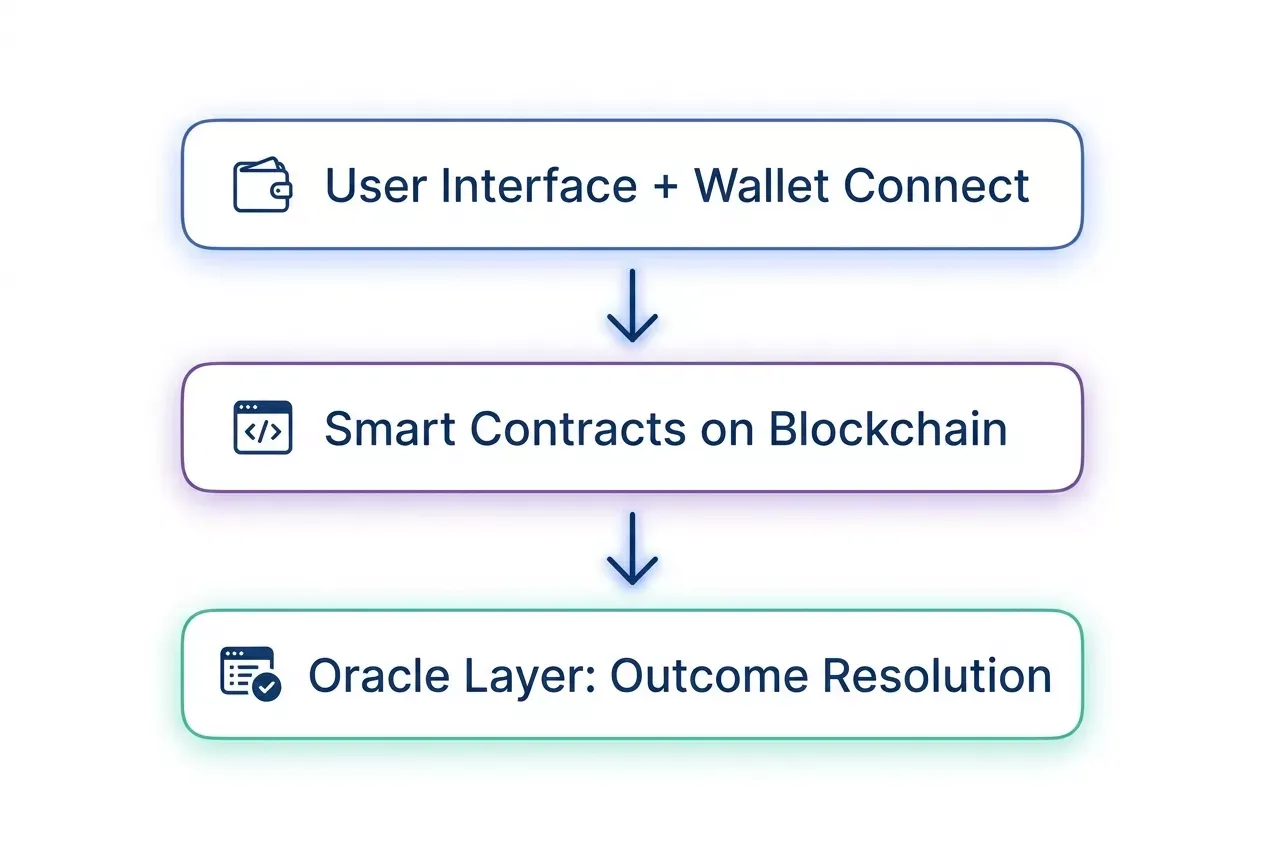
Every build method below maps to this same architecture. What changes is how much of it you own versus license.
If you want to see how this architecture performs in the real world, explore our detailed PrediCone prediction market case study, where we walk through the full journey from concept and infrastructure choices to launch metrics and post‑go‑live optimizations.
In this project, we applied a similar Polygon-based stack with AMM liquidity and oracle integration to ship a production-ready platform under a startup-friendly budget.
The Three Build Methods with Real 2026 Cost Ranges
1. Clone Script ($5,000 – $25,000)
A clone script is a pre-built replica of Polymarket with fixed smart contracts and a templated UI. Deployment takes 2 to 6 weeks. Cost is the lowest of the three paths.
What you get: fast deployment, minimal dev time, a working demo.
What you give up: smart contract customization, brand identity, auditability, and regulatory flexibility. Most clone scripts have not been independently audited. That is a serious liability if you plan to handle real user funds.
Honest verdict: Use a clone script to test an idea or demonstrate a concept internally. Do not launch a production platform on one.
2. White-Label Platform ($2,000 – $5,000/Month)
A white-label platform is a licensed, configurable codebase. You get branding customization, a more reliable smart contract foundation, and in most cases, one basic audit cycle is included.
Cost variables that push your number toward $5,000/Month:
- Additional Oracle integrations beyond a basic setup
- Mobile-responsive UI as a custom build
- KYC/AML module integration
- A second or third market category (sports, finance, politics)
Honest verdict: This is the strongest cost-to-speed ratio for most early-stage prediction market startups in 2026. You get a real, launchable product in 1 to 2 weeks without starting from zero.
-
Custom Build ($30,000 – $85,000+)
A custom build is a fully bespoke platform built to your architecture, smart contract logic, and compliance requirements. You own everything.
Full control includes: market type (binary, scalar, categorical), liquidity model (AMM vs. CLOB), tokenomics design, and jurisdiction-specific compliance layers.
A separate smart contract audit is required and not included in the development cost.
Timeline reality: 3 months for a tight MVP, 6 to 9 months for a production-grade platform with a full feature set.
Honest verdict from Troniex Technologies, a leading prediction market development company: Choose this path if you have a defined niche (sports, DeFi, political), a monetization model you have validated, and at least a 6-month runway. Without those three, a white-label launch is the smarter first step.
The Five Cost Drivers That Shift Your Final Number
Two founders building similar platforms get quotes that differ by $40,000. This section explains why.
1. Blockchain Choice
Your blockchain choice sets your gas cost, your developer pool cost, and your audit cost. It also determines your long-term migration risk.
|
Blockchain |
Gas Cost |
Dev Ecosystem |
Audit Cost Impact |
Best For |
|
Polygon |
Low |
Large |
Baseline |
General markets |
|
Base / Arbitrum |
Low–Medium |
Growing fast |
+5–10% |
DeFi-native markets |
|
Ethereum Mainnet |
High |
Largest |
+15–20% |
High-value enterprise |
|
Solana |
Very Low |
Smaller |
+10% (Rust dev) |
Speed-sensitive markets |
Polygon is the most common starting point, but Polymarket's own migration signals that it has ceiling limitations at scale.
For a 2026 build, Base or Arbitrum offers a strong balance of low gas fees, a growing developer ecosystem, and EVM (Ethereum Virtual Machine) compatibility, the standard smart contract environment shared by Polygon, Base, and Arbitrum, keeping your audit costs close to the Polygon baseline.
2. Smart Contract Development and Audit
Do not skip the audit. In March 2025, a UMA governance attack on Polymarket led to an incorrect settlement of a $7 million prediction pool. A large UMA token holder manipulated oracle voting to resolve a market outcome falsely. That is what an under-tested oracle and contract infrastructure produces at scale.
- Basic smart contract for a binary prediction market: $5,000 – $15,000
- Full independent security audit (firms like ChainSecurity or Certik): $10,000 – $30,000
Budget 20 to 30 percent of your total development cost for the audit. It is not optional when handling real user funds.
3. Oracle Integration
The oracle resolves market outcomes. Your choice here affects both build cost and operational risk.
- UMA Optimistic Oracle (Polymarket's choice): open-source, lower setup cost, dispute risk on niche or ambiguous markets
- Chainlink feeds: higher reliability for financial and crypto markets, subscription cost on top of integration dev time
- Manual resolution: cheapest to build, highest operational risk, not scalable
Budget $3,000 to $10,000 for Oracle integration, depending on which provider and how many market categories you are supporting at launch.
4. Liquidity Mechanism: AMM vs. CLOB
This is the single biggest technical cost gap most articles in this space ignore.
- AMM (Automated Market Maker): Simpler to build, lower cost, less accurate pricing at low volume. Good for an MVP.
- CLOB (Central Limit Order Book): Polymarket's model. Requires an off-chain matching engine plus on-chain settlement. Adds $15,000 to $25,000 to a custom build.
The practical guidance: start with AMM for your MVP. Validate volume. Then migrate to CLOB when your trading activity justifies the infrastructure cost.
5. KYC and Compliance Layer
If you are targeting US users, this is not optional. Polymarket regained US access only in 2025 after completing CFTC compliance work.
- KYC/AML module integration: $3,000 – $8,000
- Legal counsel for jurisdiction review: $5,000 – $20,000
That legal cost is not a development cost, but it is a real budget line. International-first platforms avoid it at launch but face it when they scale into regulated markets.
What You Get at Each Budget Level
|
Feature |
Clone ($5K–$25K) |
White-Label ($2K–$5K/Month) |
Custom ($30K–$85K+) |
|
Binary markets |
Yes |
Yes |
Yes |
|
Wallet connect |
Basic |
Yes |
Yes |
|
AMM liquidity |
Basic |
Yes |
Configurable |
|
CLOB engine |
No |
Optional |
Yes |
|
Oracle integration |
Manual |
Chainlink/UMA |
Configurable |
|
KYC/AML module |
No |
Optional |
Yes |
|
Smart contract audit |
No |
1 cycle |
Full suite |
|
Mobile-responsive UI |
Template |
Yes |
Custom |
|
Custom branding |
No |
Yes |
Yes |
Post-Launch Costs Most Founders Do Not Budget For
Your build cost gets you to launch. What runs the platform after launch is a separate number that most founders discover late.
Ongoing monthly costs to plan for:
- Smart contract monitoring and patches: $1,500 – $4,000/month
- Oracle feed maintenance: varies by data source contract
- Core team minimum to operate: 1 backend developer, 1 smart contract developer, 1 operations lead
On liquidity: according to NS3.AI data reported by Binance Square, Polymarket distributed $13.41 million in total subsidies to liquidity providers as of mid-March 2026, while generating $11.2 million in fee revenue over the same period. You will not spend at that scale as an early-stage platform, but you do need a liquidity incentive budget to keep markets active and spreads tight.
Estimated monthly operational burn at MVP scale: $10,000 – $25,000.
That number does not include your liquidity seeding budget. Plan for it separately.
How to Cut Build Cost Without Cutting What Matters
Four decisions that reduce your upfront spend without adding risk:
- Start on white-label, audit only modified contracts. You do not need to audit the full codebase if you are using a licensed base. Audit only the smart contract logic you changed.
- Use UMA oracle for general markets. Add Chainlink only when you move into financial or crypto price markets where accuracy at the cent level matters.
- Build on Base or Arbitrum. Lower gas fees, EVM-compatible tooling, and a growing developer pool keep your dev costs closer to the Polygon baseline with less long-term migration risk.
- Scope your MVP to binary markets only. Binary Yes/No markets are the simplest to build and the easiest to explain to early users. Categorical and scalar markets add complexity and cost. Add them after you prove demand.
A concrete example: a white-label launch at $28,000 with a 90-day validation window beats a $70,000 custom build that takes 8 months and still has no user data when it ships.
The Decision That Sets Your Entire Budget
Your blockchain and oracle choices lock in 40 to 60 percent of your total build cost before a single UI screen gets designed. Those two decisions come before everything else.
Before you request a single development quote, define three things: your market category (crypto, sports, politics, general events), your target geography (US vs. international), and your liquidity model (AMM for speed, CLOB for accuracy).
Those three answers collapse your real cost range from a spread of $80,000 down to under $30,000.
Get those right first. Then talk to our dev team.
Ready to build? Share your market category, geography, and liquidity model below, and we'll provide a tailored quote in 24 hours. Get a Qustom Quote.