How to Build a Prediction Market That Gets Real Traders?
To build a prediction market people actually use, focus on liquidity, question design, and resolution trust before launch. Seed markets with real capital, write binary, time‑bound questions with named sources, and resolve outcomes via oracles or regulated entities. Polymarket and Kalshi prove that user‑driven product design, not just smart‑contract code, drives real trading volume and retention.
Jun 10, 2026
12 mins read
- Liquidity must come before code: seed markets with at least $10K–$50K per category and choose AMM, order book, or hybrid before launch.
- Treat every question as a contract: it must be binary, have a fixed date, and cite a named authoritative source to avoid disputes.
- Build resolution trust like a product: use oracles for data‑driven markets and regulated‑exchange models for subjective events, with public evidence standards.
- Polymarket and Kalshi remain the two most visible prediction market platforms in 2026. Polymarket reported more than $7 billion in monthly trading volume in February 2026, while regulated event-contract markets continue expanding through Kalshi's U.S. regulatory framework.
- Start narrow and repeatable: pick one vertical (crypto, sports, or macro), launch 10–20 liquid markets, and refine liquidity, questions, and resolution before scaling.
Most teams that decide to build a prediction market focus almost entirely on code. They ship a working smart contract, open a few markets, and wait. Nobody comes. The market sits empty, positions go unfilled, and the project quietly dies.
The code was fine. The product was not.
A prediction market is a trading platform where participants buy and sell positions on the outcome of future events. A "yes" position on "Will the Fed cut rates in June?" pays out $1 if the Fed cuts, $0 if it does not.
The price of that position at any moment reflects what the market collectively believes the probability is. Polymarket and Kalshi are the two dominant entities in the prediction‑market space, together accounting for the lion’s share of consumer‑level prediction‑market volume.
In November 2025, the two platforms reported combined monthly trading volumes approaching roughly $10 billion, with Polymarket alone posting around $3.7 billion in that month, according to analytics compiled by The Block and other on‑chain data aggregators.
During late 2025 and early 2026, prediction market activity accelerated significantly. Industry reporting showed monthly prediction market volume moving into the multi-billion-dollar range, with Polymarket surpassing $7 billion in monthly volume during February 2026, reinforcing growing institutional and retail interest in event-based trading markets.
Getting that mechanism to work technically is the easy part. Getting traders to show up, stay, and trust the resolution is where most builders fail.
This article covers the three product decisions that determine whether your market gets used: liquidity, question design, and resolution trust. For teams who want to build a prediction market from scratch, we also offer end‑to‑end prediction‑market platform development services tailored to your vertical and compliance needs.
Why Most Prediction Markets Fail Before Launch Day
Augur launched in 2018 as one of the first decentralized prediction market protocols on Ethereum. While historically significant, public on-chain activity throughout 2025–2026 remained minimal compared with modern prediction‑market platforms such as Polymarket and Kalshi.
For most builders, Augur now serves more as a historical reference than as a live, high‑volume trading venue.
The three failure modes that kill adoption before it starts:
- Empty markets signal zero confidence: A trader who lands on a market with no open positions sees no price signal, no counterparty, and no reason to commit capital. This is a cold-start problem, and it compounds: thin markets attract fewer traders, which keeps markets thin.
- Ambiguous questions cause disputes: When a market resolves in a way traders did not expect, even if technically correct, they lose trust in the platform. One bad resolution is enough to permanently damage retention.
- Unclear resolution sources give the operator too much discretion: When traders cannot verify in advance exactly how a market will settle, they treat it as a black box. Sophisticated traders avoid black boxes.
These three failure modes are product decisions, not code problems. Each one is solvable before you write a single line of production code.
The Liquidity Problem: Solve It Before You Open
Prediction market liquidity is the single biggest adoption blocker for new platforms. Traders need a price to trade against. Without liquidity, there is no price. Without a price, there is no market.
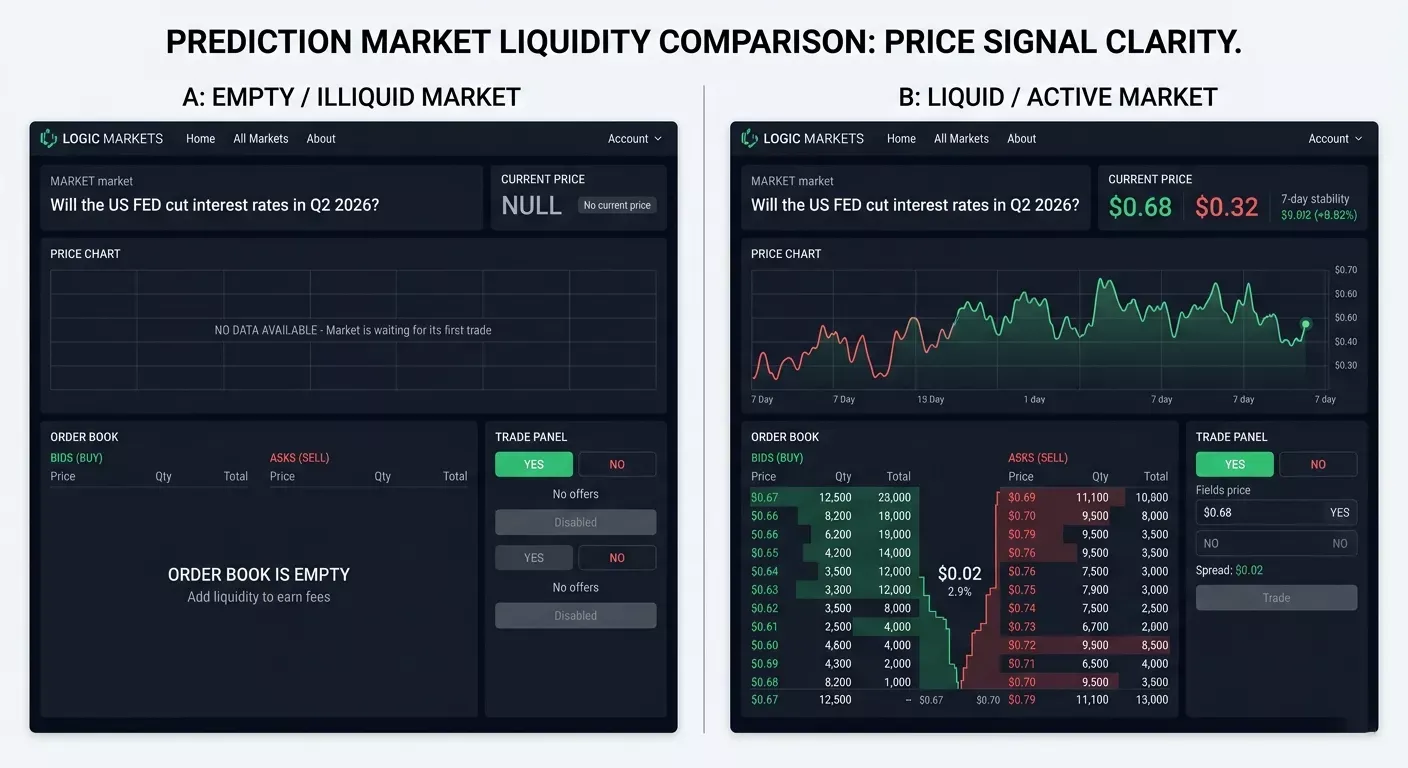
You have two structural choices for how your market generates liquidity.
|
Model |
How It Works |
Best For |
Trade-off |
|
Automated Market Maker (AMM) |
Protocol holds positions on both sides; prices adjust algorithmically |
Early-stage platforms with low volume |
Less accurate pricing; protocol absorbs risk |
|
Order Book |
Human market makers post bids and asks |
Platforms with sufficient organic volume |
Requires external market makers to function |
Most new platforms choose AMMs for early-stage liquidity, then layer in order book mechanics as volume grows.
Polymarket was launched in 2020 and has raised multiple rounds from institutional investors, including a $112‑million acquisition of QCEX’s CFTC‑licensed derivatives exchange and clearinghouse entities, which positioned it as a regulated‑schema prediction‑market operator in the United States and laid the groundwork for its 2026 surge past $7 billion in monthly volume.
Their early approach involved seeding curated markets with internal liquidity to maintain tight spreads before opening to external traders.
For liquidity bootstrapping, the three most common approaches are:
- Protocol-owned liquidity. The platform seeds initial positions with its own treasury. This works if you have capital and are willing to absorb early losses. A common bootstrapping floor is $10,000 to $50,000 in seeded positions per active market category.
- Market maker incentives. Pay professional market makers a spread subsidy to post positions. This is how Kalshi attracted early liquidity before organic volume arrived.
- Subsidized early positions. Offer traders a fee discount or reward for being the first to take a position in a new market. This shifts the risk from the protocol to early adopters, who accept it in exchange for a price advantage.
Make this decision before launch. Opening markets with no liquidity plan is the fastest way to confirm that nobody will use your platform.
For builders who want a Polymarket‑style prediction‑market platform with liquidity‑rewards mechanics and oracle‑based resolution, Troniex offers a Polymarket‑style clone script that can be customized around your chosen oracle stack and fee‑curve design.
Question Design Is a Product Decision, Not an Afterthought
The question in a prediction market is not just a label. It is a contract. Every word determines how the market resolves.
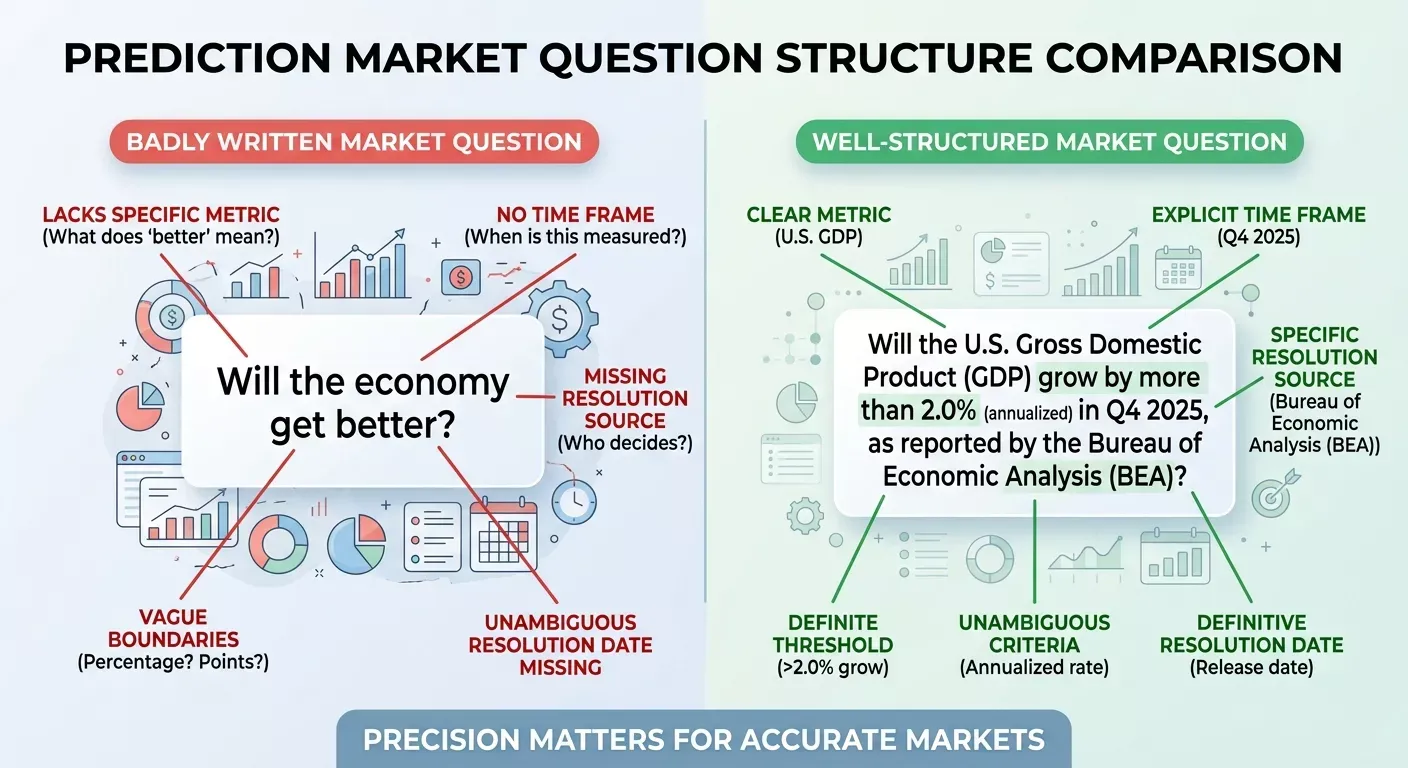
A well-designed prediction market question has three required properties:
- Binary resolution criteria. The outcome is either yes or no, with no room for interpretation.
- A fixed resolution date. The market closes on a specific date. Open-ended markets create uncertainty about when traders get paid.
- A named authoritative source. The resolution source is specified in the market before trading begins.
Here is the same question written two ways:
|
Version |
Question |
Problem |
|
Bad |
"Will inflation fall below 3% this summer?" |
No threshold definition, no resolution date, no named source |
|
Good |
"Will US CPI be below 3% on June 30, 2025, per BLS data released July 10, 2025?" |
Binary outcome, fixed date, named source, no ambiguity |
Beyond structure, question scope is a product decision in its own right.
Narrow questions ("Will ETH close above $3,000 on April 30?") attract traders with specific knowledge or data access. These markets tend to have tighter spreads and more accurate pricing.
Broad questions ("Will the US enter a recession in 2025?") attract casual participants who have general opinions but less edge. These markets tend to have wider spreads and more volume from non-specialist traders.
Neither type is wrong. They serve different audiences. Decide which audience you are building for before you write your first question.
A practical rule: before any market opens, read the question to someone who has never used your platform and ask them to explain exactly how it resolves. If they hesitate, rewrite the question.
Resolution Trust Is the Only Thing That Keeps Traders Coming Back
Traders accept losses. What they do not accept is losing to a process they do not understand or trust.
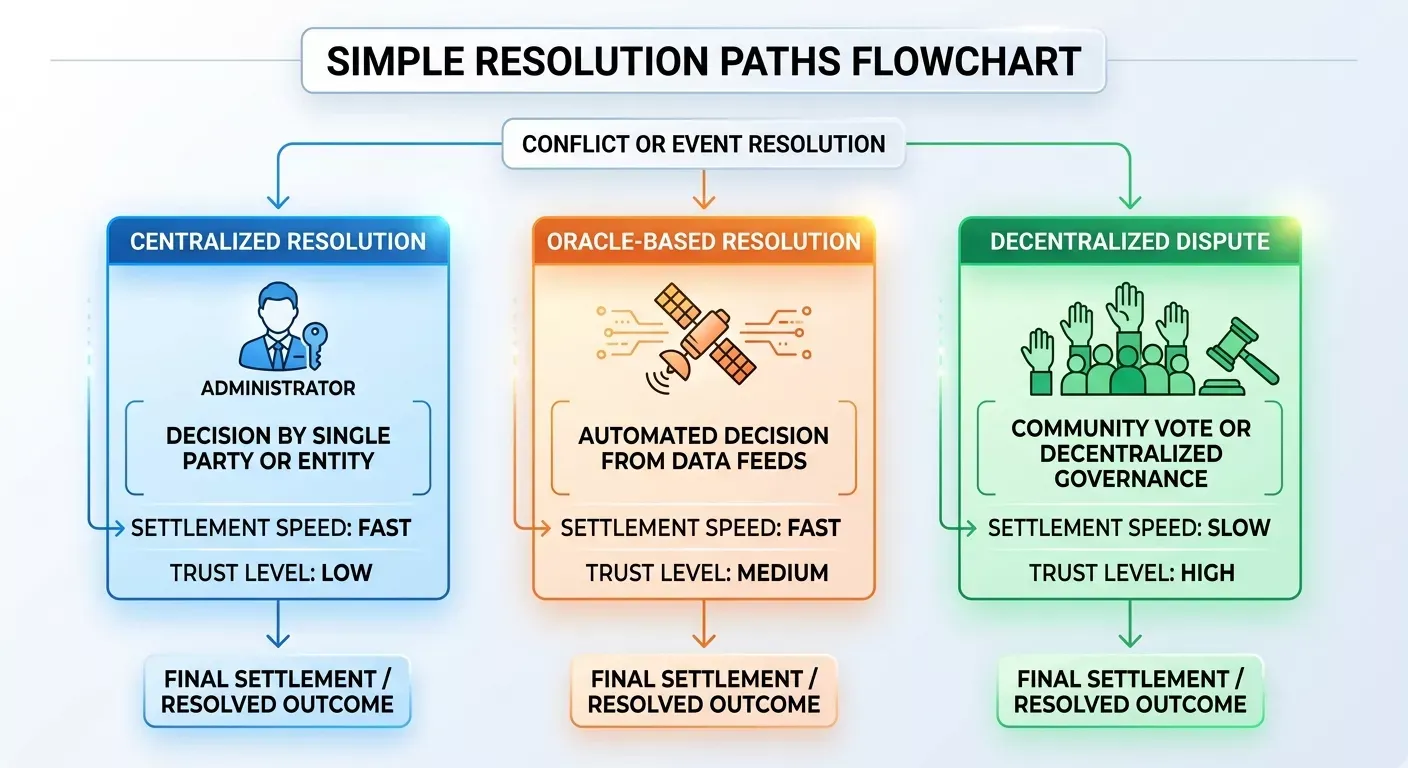
Two dominant resolution models continue to define prediction markets in 2026: regulated centralized resolution systems and decentralized oracle-based resolution frameworks. Increasingly, hybrid architectures combine automated oracle feeds, dispute windows, and human oversight to improve trust and reduce settlement risk.
|
Resolution Model |
Speed |
Trust Source |
Best For |
|
Centralized |
Minutes to hours |
Platform brand and regulatory accountability |
Regulated exchanges with existing credibility |
|
Oracle-based (Chainlink, Pyth) |
Near-instant |
Automated data feed; no human discretion |
Quantitative markets (prices, economic data) |
|
Decentralized dispute (UMA, Kleros) |
2 hours to 4 days |
Economic incentives and token holder voting |
Subjective or long-tail event markets |
Kalshi operates with self-certifying outcomes based on authoritative data sources. Resolution typically happens within hours. The trust model is simple: users trust Kalshi, which is a CFTC-regulated entity with a reputation at stake.
If you are inspired by Kalshi’s regulated‑exchange model, you can also explore a Kalshi‑style regulated‑schema prediction‑market clone script that mirrors its event‑contract structure while keeping resolution flexible for your target jurisdiction.
Polymarket markets are resolved by the UMA Optimistic Oracle, a smart‑contract‑based system that underpins many of its event‑based prediction‑market contracts. When a market resolves, holders of winning shares receive $1 per share, and holders of losing shares become worthless.
The key mechanic: any user can propose an outcome by posting a bond of several hundred dollars. If the proposal is unchallenged within a short window (often on the order of a few hours), the outcome is automatically accepted. Disputes escalate to voting among UMA tokenholders, with the Optimistic Oracle handling the vast majority of resolution requests without full‑on disputes.
For most builders, the right approach is a combination. Use oracle-based resolution for quantitative markets where a clean data source exists. Use centralized resolution for qualitative markets, but document your evidence standard publicly and build in a 48-hour dispute window.
The evidence standard matters. Before each market resolves, publish the exact data your team used to reach the resolution decision. Make it public and timestamped. Traders who verify a loss accept it. Traders who cannot verify it churn.
Liquidity, Questions, and Resolution Work Together
These three components are not independent. The way they interact is sequential.
Liquidity is what gets a trader to take a position. Question clarity sets their expectations for how the market will settle. Resolution is what determines whether they return.
Pre-launch scoring checklist for every market:
|
Check |
Question |
Pass Criteria |
|
Liquidity |
Does this market have a seeded position or committed market maker on both sides? |
Yes |
|
Question quality |
Does the question have binary criteria, a fixed resolution date, and a named source? |
Yes |
|
Resolution |
Is the resolution source specified in the contract before the market opens? |
Yes |
A market that fails any one of these three checks should not open. Opening a bad market costs you more than leaving the slot empty.
What to Build First If You Are Starting From Zero
Start with one vertical where you have a data or distribution advantage.
- If you cover crypto, build price markets.
- If you have sports data provider relationships, start there.
- If you have a macro-focused newsletter audience, build economic indicator markets.
A platform with ten active, liquid markets and a clean resolution history is a stronger product than one with fifty empty markets and two disputed resolutions.
Practical steps before you open publicly:
- Set resolution sources in the market contract before launch, not after a dispute forces the decision.
- Seed initial liquidity before the platform opens publicly. Whether that is $10,000 from your treasury, a paid market maker relationship, or a subsidized early-trader program, the first trader who arrives should see a price.
- Write ten sample market questions before writing production code. Score each one against the three-property checklist above. Fix failing questions first.
- Choose your Oracle architecture before you pick your question types. Your question types must match your Oracle support.
The Non-Code Checklist Before You Go Live
A working smart contract is the start of building a prediction market, not the finish. The contracts do not determine whether traders show up.
Before you write production code, write ten sample market questions for your first launch. Score each one: Does it have binary resolution criteria? A fixed date? A named source? If any question fails, fix the question first.
Liquidity depth, question precision, and resolution credibility are what determine whether anyone uses what you build.