How to Choose a Prediction Market Development Company in 2026
To choose a prediction market development company, evaluate 7 criteria: a shipped prediction market in their portfolio, oracle architecture depth, order book vs. AMM stance, compliance capability, security audit history, post-launch SLA, and realistic timeline. Costs range from $8K (white-label) to $75K+ (custom). Disqualify any vendor without production experience in event resolution and smart contract security.
Jun 24, 2026
12 mins read
- Prediction market development costs generally range from $8K–$75K+, depending on whether you choose a white-label or custom build.
- Evaluate on 7 criteria: live prediction market in portfolio, oracle design depth, order book vs. AMM opinion, compliance capability, security audit history, post-launch SLA, and realistic timeline.
- Instant disqualifiers: no shipped prediction market, no in-house smart contract team, no security audits, no stance on oracle architecture.
- Compliance is an architecture decision, not a bolt-on feature.
In this guide, we break down those 7 criteria with examples of what a capable vendor's answer should look like on each, so you can separate real prediction market builders from teams that bolted a new label onto an NFT marketplace.
Prediction market trading volume hit $240 billion in 2026, up 370% from 2025 (Bernstein via CNBC). Monthly unique wallets tripled to 840,000 in 6 months. The new CFTC chairman withdrew proposed restrictions, issued Polymarket a no-action letter, and opened the US market back up.
The question shifted from "should we build a prediction market?" to "who do we build it with?" That second question is harder. Most development companies that listed "prediction markets" on their services pages were building NFT marketplaces 18 months ago.
The wrong vendor means burning 6–12 months and $200K+ on a platform that breaks under real trading load, fails a regulatory review, or gets exploited through a bad oracle integration.
At Troniex, we've seen this pattern firsthand over 4+ years of building exchange and trading infrastructure (including projects like BitBab's high-frequency matching engine and HYBRID's custom Layer 1 on the Cosmos SDK). The engineering problems in prediction markets are the same ones we solve in exchange builds: settlement, custody, order matching, and compliance.
Why The Vendor Decision Is Higher-Stakes For Prediction Markets
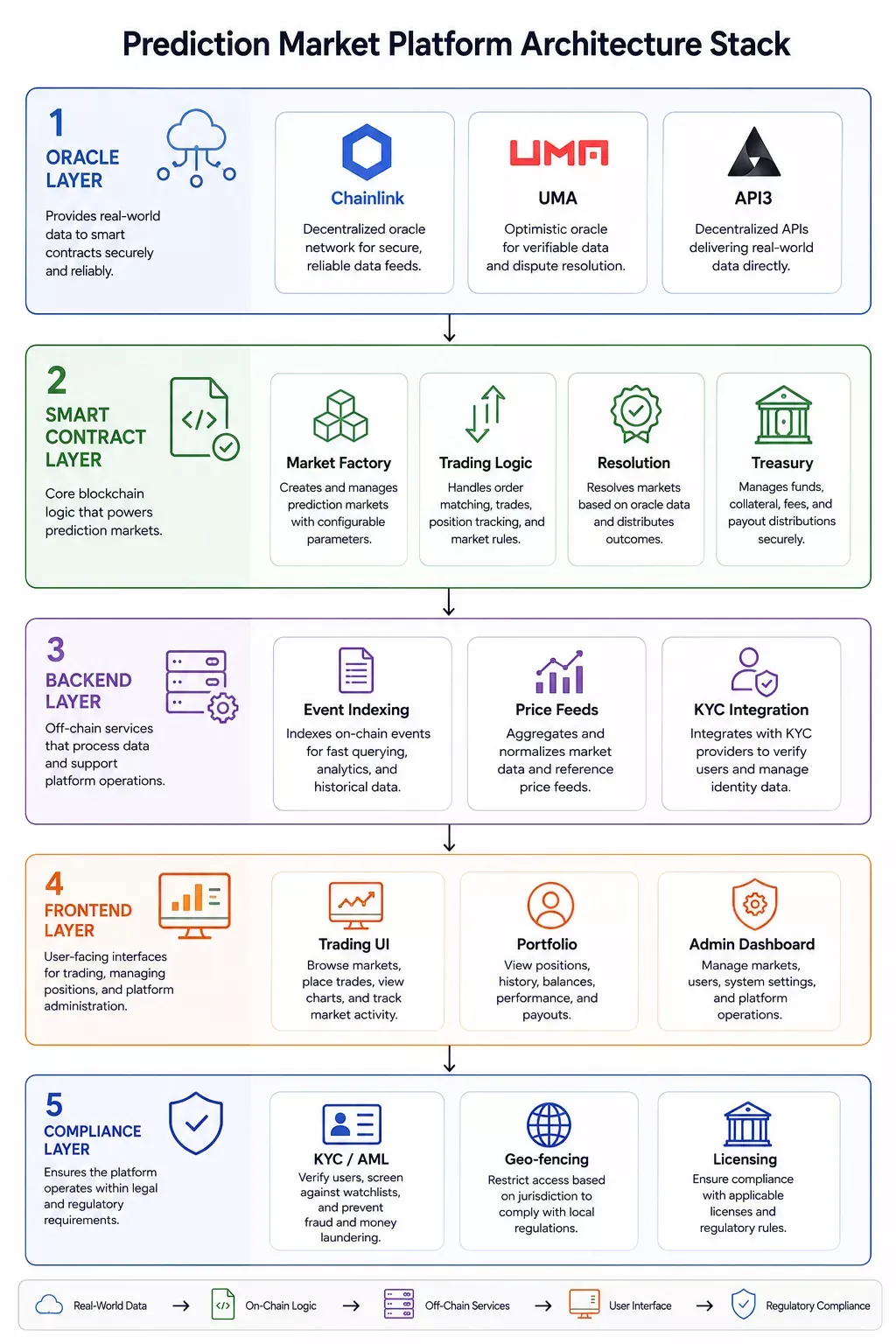
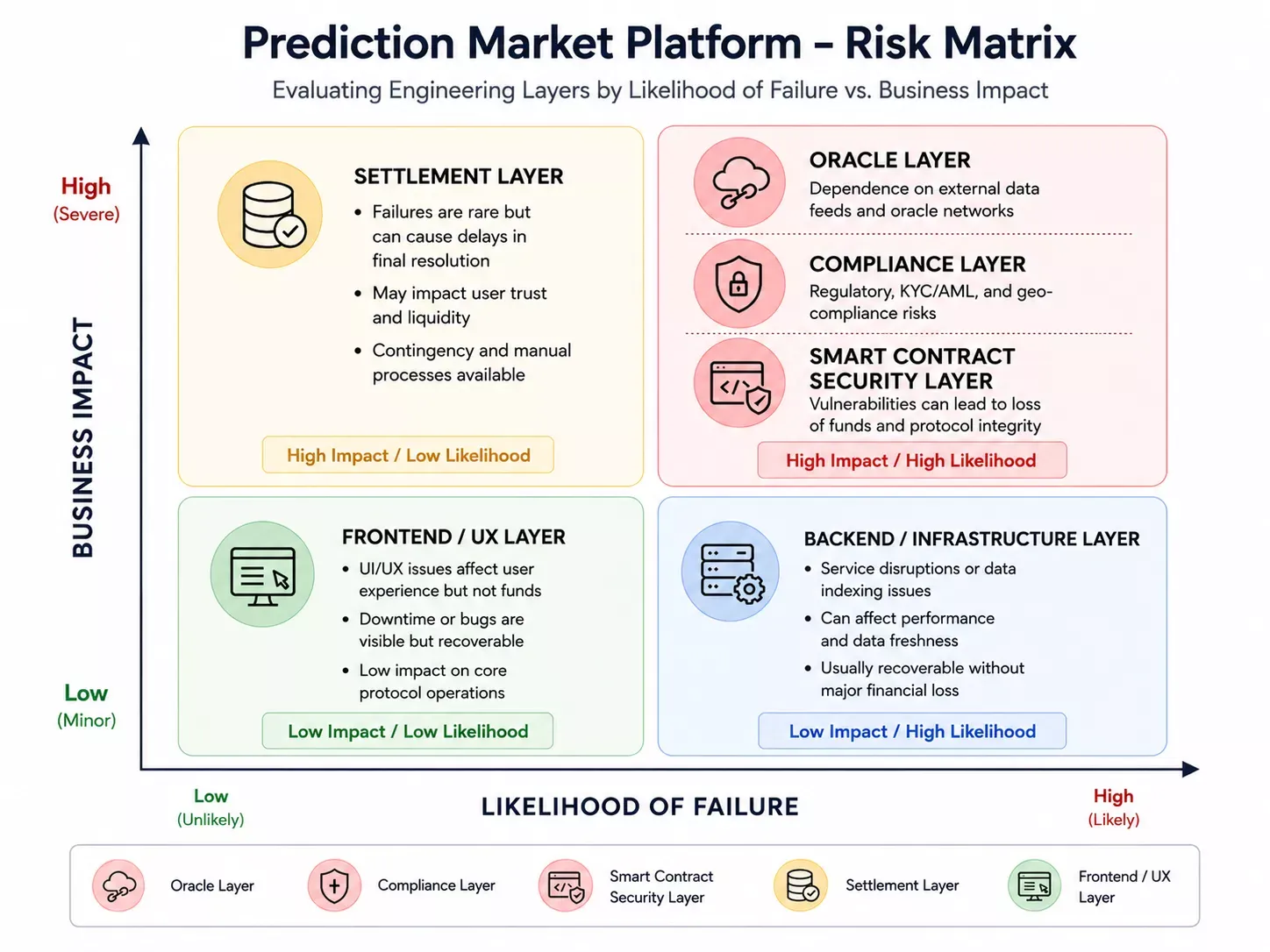
A prediction market sits at the intersection of 3 hard engineering problems. Get anyone wrong, and the platform fails.
Event resolution depends on the Oracle infrastructure. Your platform pulls real-world outcomes and settles contracts on them. A bad oracle integration means disputed markets, stuck funds, or manipulation vectors. Polymarket learned this with early UMA disputes that took days to resolve and eroded user trust.
Financial settlement requires either on-chain order books or AMM pools handling real money at speed. This choice determines capital efficiency, slippage, and throughput ceiling.
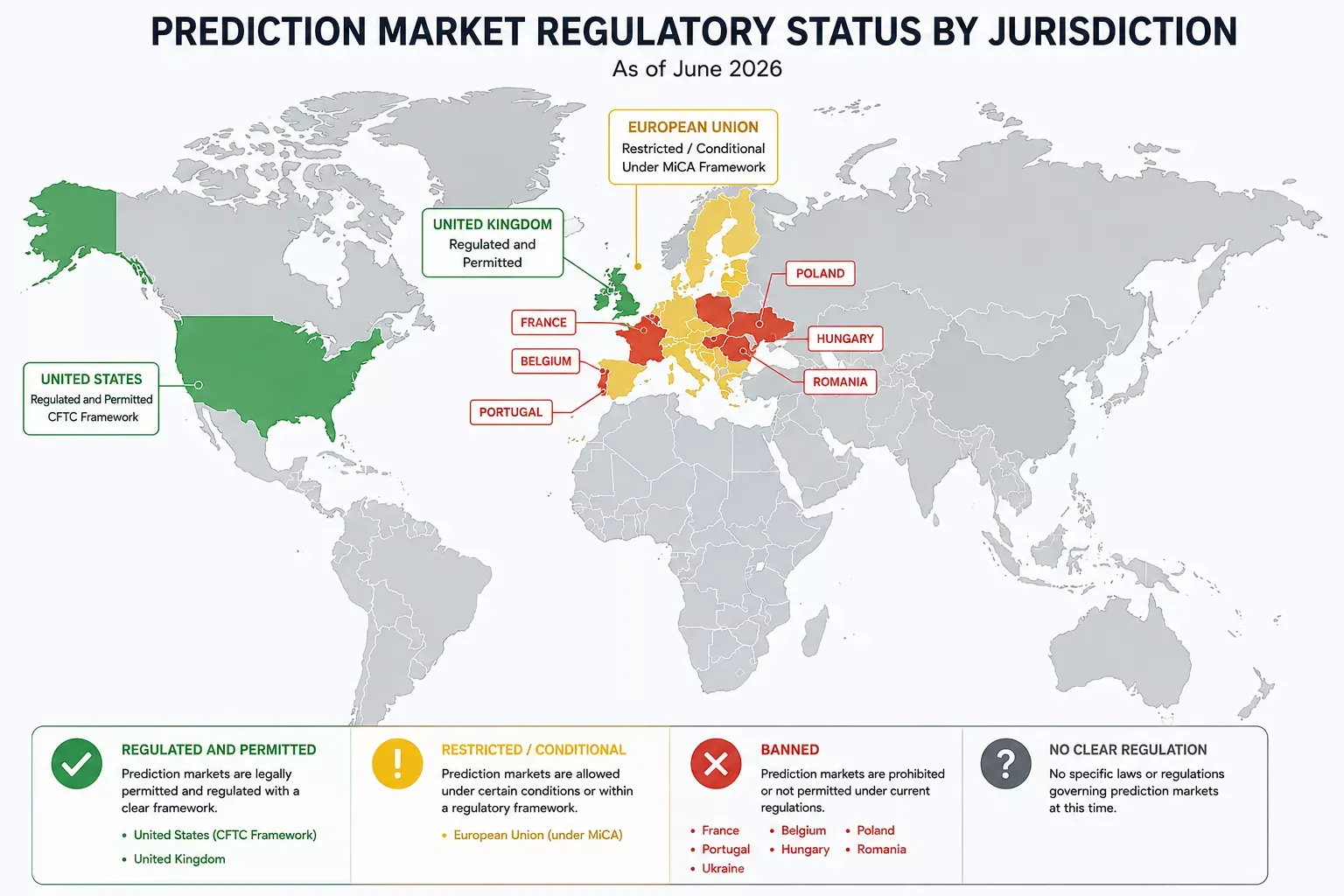
Regulatory compliance is moving fast, and each rule change hits your architecture directly. The CFTC published a proposed rule on June 10, 2026, defining permissible event contracts.
Sports events got conditional approval. Individual player injuries have been banned. This matters architecturally because your market factory contract needs to enforce allowed event types at creation time, not just in the UI, and your oracle layer must handle category-specific resolution logic (sports outcomes resolve differently from election outcomes or crypto price feeds).
MiCA's grandfathering period ends in July 2026, and 7 EU countries have banned or restricted prediction markets outright. For EU-targeted platforms, that means KYC/AML must be baked into the deposit and withdrawal flows, geo-fencing needs to operate at the smart contract level (not just frontend IP checks), and the oracle's data source jurisdiction matters for regulatory defensibility.
|
Engineering layer |
What breaks when done wrong |
Severity |
|
Oracle integration |
Disputed markets, stuck funds, and manipulation |
Critical |
|
Settlement architecture |
High slippage, slow resolution, and capital inefficiency |
High |
|
Compliance framework |
Regulatory shutdown, geo-fencing failures |
Critical |
|
Smart contract security |
Fund exploits, payout logic bugs |
Critical |
|
Frontend/UX |
Low retention, abandonment at the deposit stage |
Medium |
7 Things To Evaluate Before You Sign A Contract
Before signing with any prediction market development company, vet them against these 7 non-negotiable criteria:
- Blockchain experience: production deployments on your target chain, not testnet demos
- Oracle architecture: in-house design for event resolution, not a plug-and-play wrapper
- Order book vs. AMM stance: a clear opinion backed by trade-offs, not "we do both"
- Compliance capability: CFTC and MiCA readiness built into architecture, not bolted on
- Security audit history: third-party audits on shipped prediction market contracts
- Post-launch SLA: defined uptime, response time, and incident ownership
- Realistic timeline: scoped estimates with dependency mapping, not blanket "8 weeks"
1. Blockchain experience and protocol selection
Your vendor needs production deployments on your target chain. Not testnets. Not "we've worked with Solidity." EVM chains (Ethereum, Polygon, Arbitrum, Base) dominate prediction market platforms in 2026. Solana works for high-frequency, low-value markets. Some teams build custom L2s when throughput requirements exceed existing chains.
-
Good: 2–3 production deployments on your target chain with transaction volumes and uptime data.
-
Bad: "We're chain-agnostic" with no specific production history.
2. Order book vs. AMM architecture
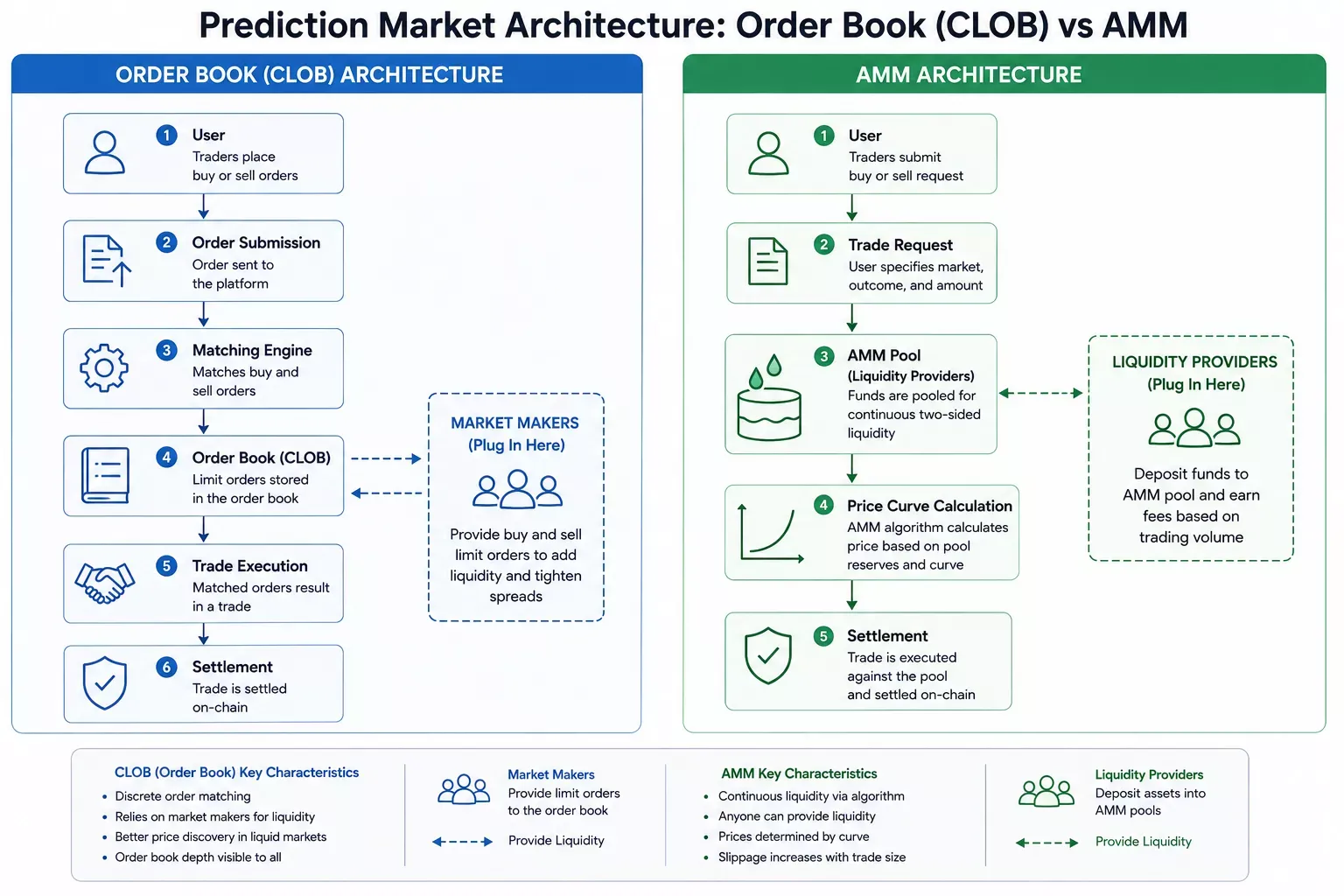
The single biggest technical decision in a prediction market build. Your vendor should have a strong opinion on which fits your use case.
Order book (CLOB): better price discovery, tighter spreads, needs market makers. Kalshi uses this. High engineering complexity.
AMM: lower barrier to market creation, no market makers needed, higher slippage on large positions. Polymarket uses a hybrid CLOB on Polygon. Medium complexity.
|
Factor |
Order book (CLOB) |
AMM-based |
|
Price discovery |
Strong |
Weak on thin markets |
|
Liquidity requirement |
Needs market makers |
Self-bootstrapping |
|
Slippage on large bets |
Low |
High |
|
Engineering complexity |
High |
Medium |
|
Best for |
High-volume, sophisticated users |
Long-tail markets, UGC |
If your vendor doesn't ask about your liquidity strategy within the first 2 calls, they're building features, not a business.
3. Oracle integration
Oracles resolve markets. They tell your smart contracts who won the election, which team scored, or where oil landed. This is the most trust-sensitive component.
Chainlink handles price feeds and standardized data. For custom events (political outcomes, niche sports, weather), you need UMA's optimistic oracle, API3, or a custom design with dispute resolution.
Test your vendor: ask them to walk through the Oracle architecture for 3 market types: a clean binary outcome, a subjective resolution, and a delayed outcome. Same answer for all three means they haven't thought about it.
|
Oracle provider |
Best for |
Dispute resolution |
|
Chainlink |
Price feeds, standardized data |
None (feed-based) |
|
UMA (optimistic oracle) |
Custom events, politics, sports |
Built-in (propose + dispute) |
|
API3 |
First-party data sources |
Provider-dependent |
|
Custom oracle |
Niche markets, proprietary data |
You build it |
4. Regulatory compliance capability
Minimum capabilities to verify:
- KYC/AML integration (Jumio, Onfido, or Sumsub)
- Geo-fencing at wallet and IP level
- Age verification for markets touching gambling classification
- Licensing pathway for CFTC DCM registration, MiCA compliance, or local gambling licenses
Red flag: "We'll add compliance later." Compliance affects smart contract design, user flows, and data architecture. Retrofitting costs 2–3x more than building it in.
5. Post-launch support and SLA terms
A prediction market is a live financial product. Markets resolve 24/7. Oracle feeds break. Users dispute outcomes.
Get these in writing before signing: incident response time (under 30 minutes for critical), on-call coverage scope, Oracle monitoring and failover procedures, smart contract upgrade path, and SLA penalties for downtime during active resolution.
6. Security audit track record
Your platform holds user funds. A single smart contract exploit kills the platform's reputation permanently.
Verify: past audits by recognized firms (CertiK, Trail of Bits, OpenZeppelin, Halborn, Quantstamp), bug bounty programs, wallet security architecture (hot/warm/cold, MPC, multi-sig), and whether they run internal reviews before external audits. Ask for audit reports. If they won't share them, even redacted, walk away.
7. Time-to-market and development approach
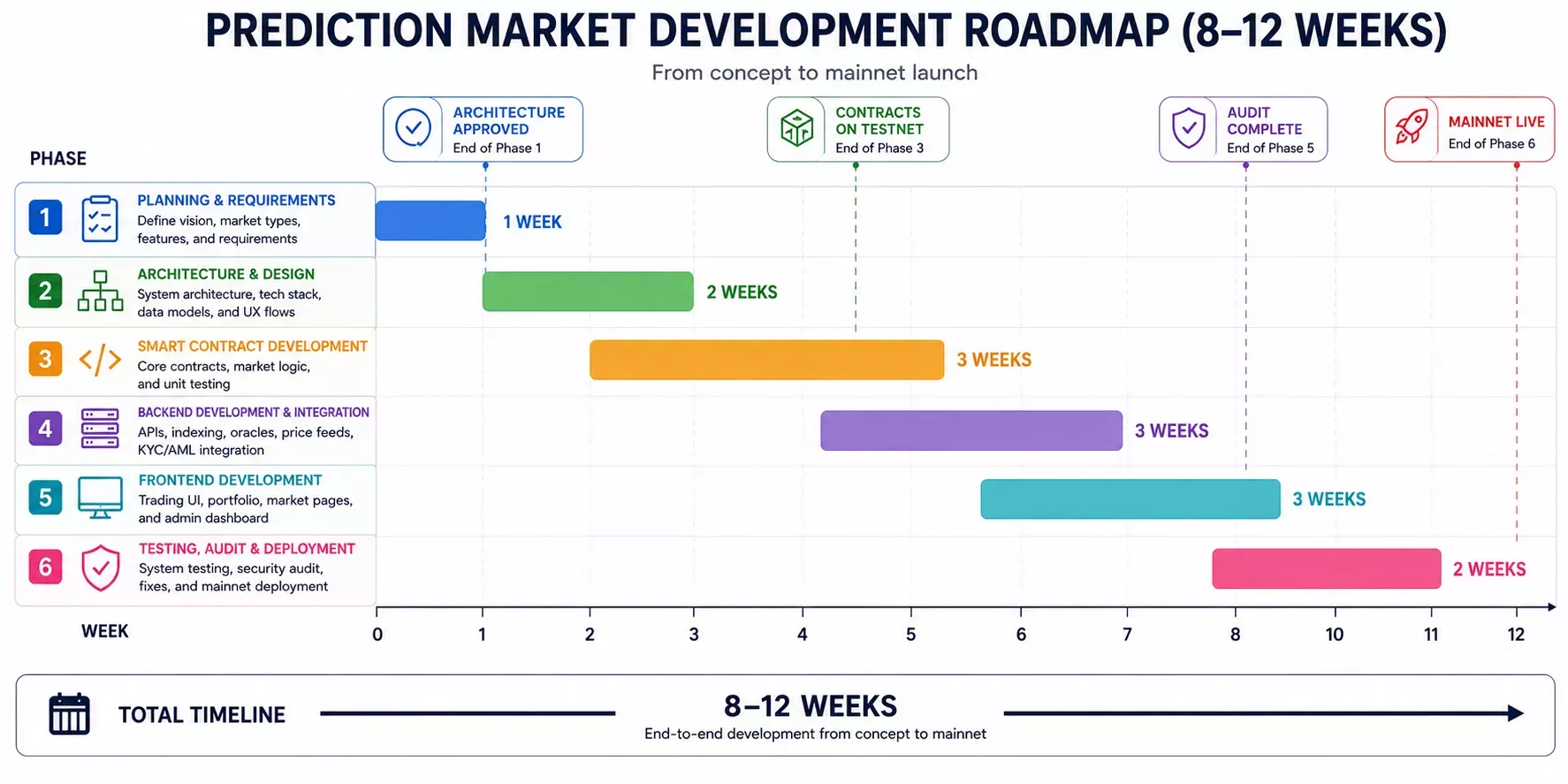
Prediction markets have timing windows that close (political events, regulatory changes, market cycles). A good vendor proposes an MVP in 3–4 months with a post-launch roadmap.
|
Phase |
Duration |
Output |
|
Discovery and architecture |
1-2 weeks |
Tech spec, chain selection, architecture |
|
Smart contract development |
2 weeks |
Market factory, trading, resolution, treasury |
|
Frontend and integration |
2-3 weeks |
Trading UI, wallet, and admin dashboard |
|
Testing and QA |
2-3 weeks |
Testnet deployment, load testing |
|
Security audit |
1-2 weeks |
External audit + remediation |
|
Launch prep |
1–2 weeks |
Mainnet deployment, monitoring, KYC |
|
Total Timeline |
8–12 weeks |
Any vendor promising production-ready in under 12 weeks is cutting corners on security, testing, or both.
Red Flags That Disqualify A Vendor
- No live prediction market in portfolio. Adjacent DeFi experience (DEX, lending) doesn't transfer cleanly. Event resolution, market creation workflows, and trading mechanics are distinct.
- No in-house smart contract team. If core contract logic goes to a subcontractor, you lose direct access to the people who understand your most critical code.
- No security audit history. Never had code audited = never built anything holding real money at scale.
- They lead with features, not architecture. A good vendor talks system design, trade-offs, and failure modes first. A weak one shows UI mockups.
- No opinion on Oracle design. If you have to explain UMA or Chainlink, they haven't worked in this space.
6 Questions That Separate Real Vendors From Pretenders
- "Walk me through how you'd resolve a disputed market outcome." Good answers reference Oracle integration, dispute windows, escalation, and fund handling during disputes. "We use Chainlink" alone is wrong (Chainlink doesn't handle custom event disputes).
- "Order book or AMM for our use case, and why?" Should ask about your volume, user sophistication, and liquidity sources before recommending.
- "Show me an audit report from a past project." Should share a redacted report and walk through remediation. "Our code is secure" is a red flag.
- "How do you handle geo-fencing?" Should cover IP blocking, wallet restrictions, VPN detection, and KYC flow integration.
- "How portable is the codebase if your team goes away?" Should confirm you own the code, explain documentation standards, and rule out proprietary lock-in.
- "What's the most expensive mistake you've seen in a prediction market build?" Should be a specific, detailed answer from real experience.
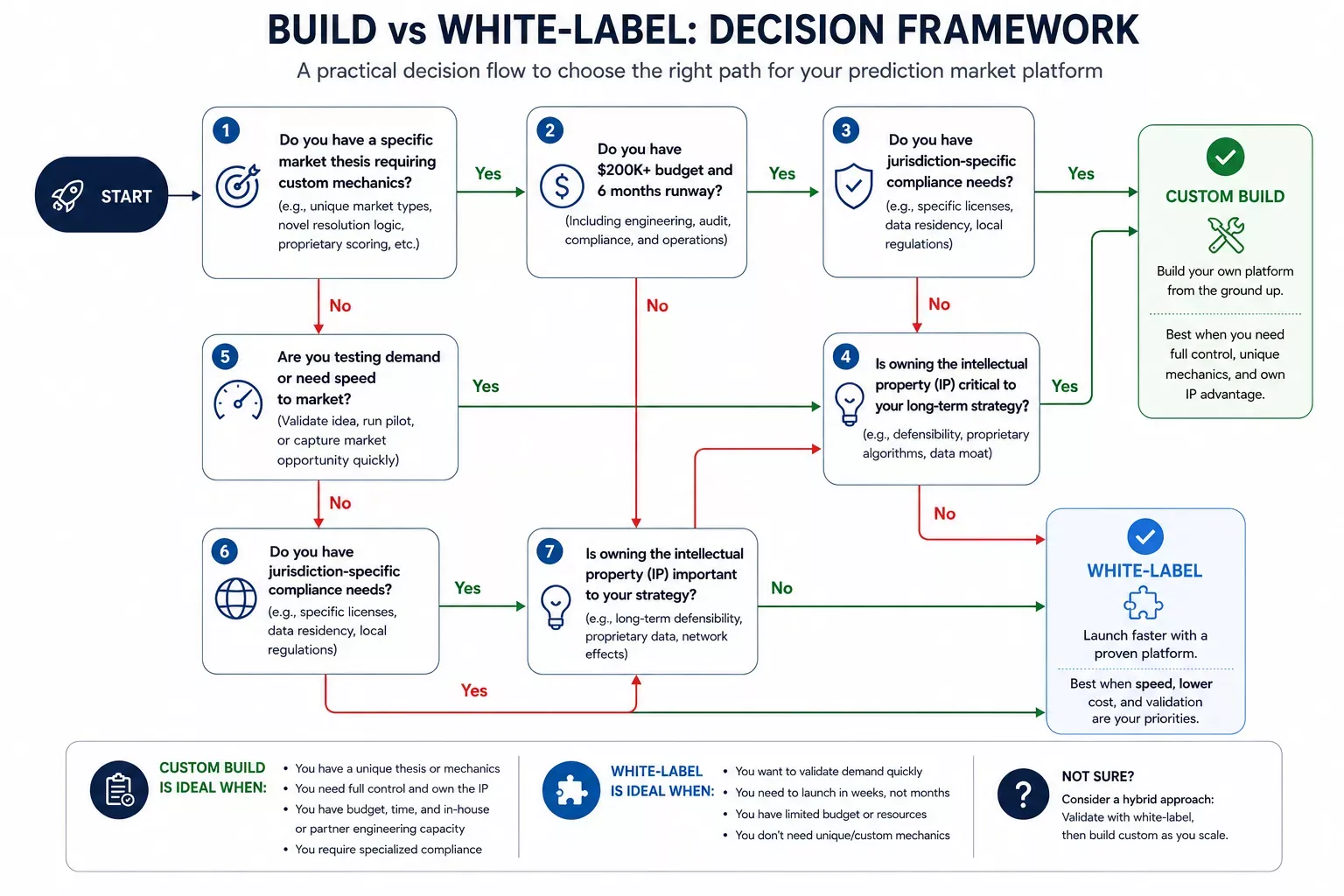
Build Vs. White-Label: When Each Makes Sense
Decide before talking to vendors. It determines which vendors you talk to.
|
Factor |
Custom build |
White-label |
|
Time to launch |
2-3 months |
2-4 weeks |
|
Upfront cost |
$15K–$75K+ |
$3K–$15K |
|
Differentiation |
Full control over UX, mechanics, branding |
Limited to the base product |
|
Maintenance |
You own it |
Vendor handles core updates |
|
Regulatory flexibility |
Architecture-level compliance |
Constrained by the vendor's framework |
|
Best for |
Funded startups with a specific market thesis |
Operators testing demand |
If you're leaning white-label, Troniex offers white-label crypto exchange solutions that share the same settlement and compliance stack used in prediction market builds.
How Troniex Technologies Approaches Prediction Market Development
Troniex builds prediction market infrastructure the same way it builds exchange infrastructure: architecture-first, with security and compliance designed into the foundation.
The team shipped BitBab (high-frequency exchange with deep liquidity and a matching engine built for speed), HYBRID (a modular Layer 1 on Cosmos SDK for DeFi and enterprise smart contracts), and PokerBet (provably fair blockchain casino with instant payouts and wallet integration).
That's 4+ years of production work across matching engines, custody systems, wallet architecture, and smart contract development, all directly transferable to prediction market builds. See how Troniex built the Predicone prediction market from architecture to launch.
Prediction markets are trading platforms. The settlement layer changes. The engineering discipline doesn't.
If you're evaluating vendors and want a technical conversation, reach out to the Troniex team.