Crypto Prediction Market Development: Complete 2026 Guide
Crypto prediction markets scaled fast: monthly volume grew from $1.2B (early 2025) to $20B+ (January 2026), making 2026 a strong entry window. A production-ready build needs five layers: smart contracts, AMM liquidity, oracle infrastructure, wallet integration, and frontend UX. Realistic budgets range from $15K for a basic launch to $230K for a full custom platform with audit and compliance.
Jun 20, 2026
17 mins read
- Prediction market trading hit $64B in 2025, on pace for $240B in 2026.
- A production-ready platform requires 5 core layers: smart contracts, AMM, oracle, wallet integration, and frontend.
- Custom builds run $80,000–$230,000; a basic, ready-to-launch script approach costs $15,000–$35,000+.
- Oracle selection is the highest-risk technical decision: UMA for binary events, Chainlink for price-based markets.
- Security audit is mandatory before any mainnet launch: budget $15,000–$50,000 and 2–4 weeks.
Monthly trading volume in prediction markets went from $1.2 billion in early 2025 to $21 billion by January 2026. That's a 17x jump in under a year (TRM Labs, 2026).
Polymarket and Kalshi together dominate global prediction market volume, though market share has shifted rapidly through 2026, with Kalshi gaining significant ground as regulatory clarity has attracted institutional and retail flow to its platform. The remaining market is an open field.
For founders and technical teams looking to enter this market, the build decision is essentially made. The real question is what architecture gets you to the mainnet without getting exploited.
If you're scoping the mechanics before committing to architecture, our guide on how to build a prediction market covers core system design, user behavior, and market resolution logic in detail.
This guide covers the 5-layer architecture, chain selection, oracle strategy, build costs, compliance considerations, and the build vs. white-label decision.
The Prediction Market Opportunity in 2026
In 2025, total prediction market trading volume reached $64 billion (up from $15.8 billion in 2024), with more than 840,000 unique wallets active monthly by February 2026. The sector went from niche experiment to a measurable segment of the global financial system in roughly 24 months.
A prediction market is a platform where users trade outcome shares priced as probabilities. Correct side pays $1.00 at resolution, wrong side pays zero. The math is simple. The engineering underneath it is not.
Platform revenue comes from several channels:
- Trading fees, typically range from 0.5% to 2% per trade.
- Spread capture from AMM-based liquidity.
- Optional fees for market creation.
- Governance token launches (note: these can increase regulatory exposure)
The timing argument is clear. Polymarket and Kalshi control the market today, but both are US-centric with specific geographic restrictions and use-case focus.
International markets, niche verticals (sports, science, governance), and white-label B2B deployments are all underserved.
The 97.5% market concentration doesn't signal maturity. It signals that nobody has seriously competed yet outside the US consumer context.
White-label prediction infrastructure for regulated operators in Southeast Asia, Europe, and Latin America has no clear market leader.

Source: TRM Labs, 2026. Intermediate months estimated from reported growth trajectory.
In 2026, global prediction market trading volume is projected to reach $240 billion, up from $64 billion in 2025 (Bernstein via CoinLaw, 2026). Monthly volume exceeded $21 billion by January 2026, with 840,000 unique wallets participating.
A platform opportunity most B2B infrastructure builders have left untouched.

See the Prediction Market Platform in Action
Book a live demo to explore our white‑label prediction engine and compliance-ready stack.
Request DemoCore Architecture of a Decentralized Prediction Market
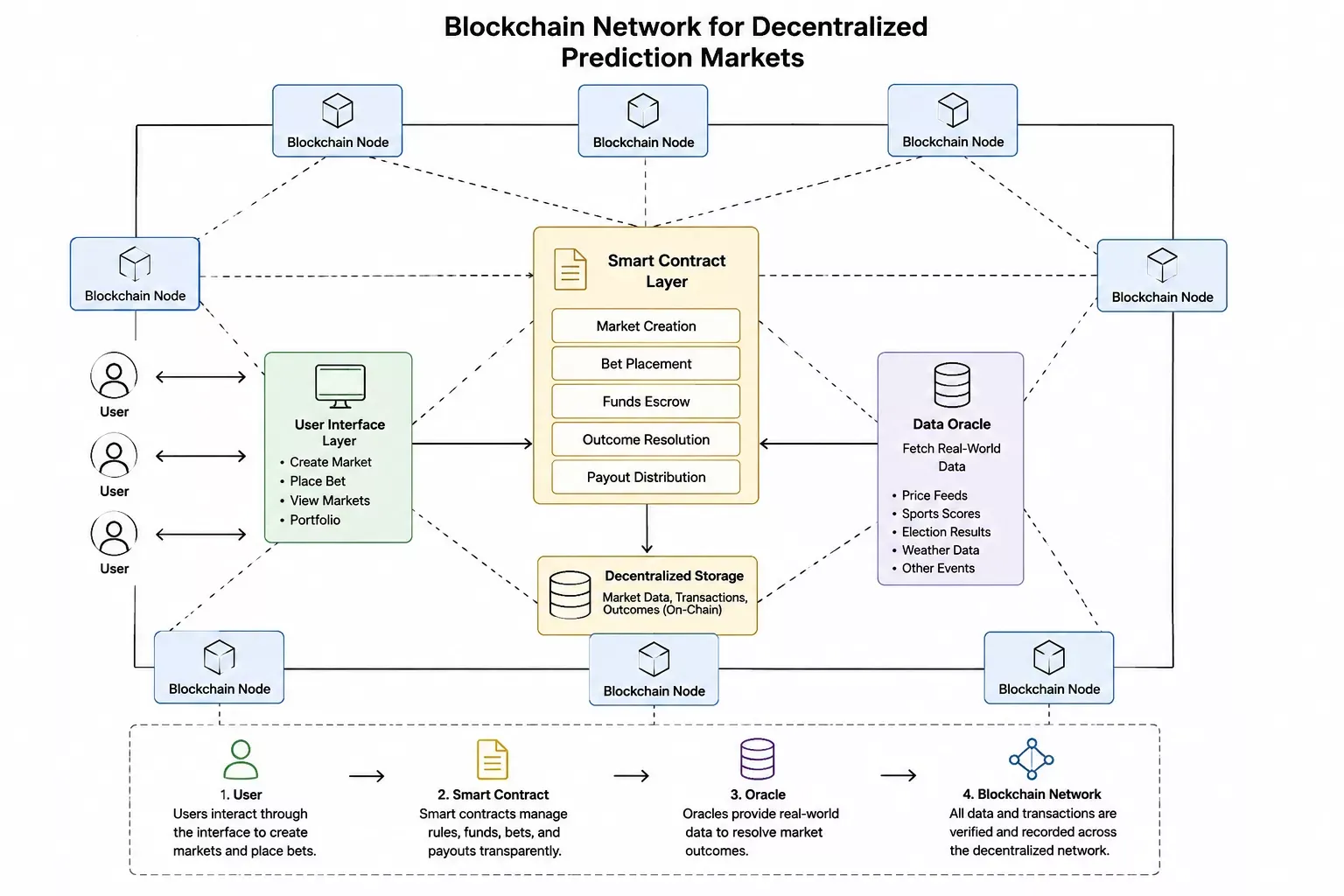
Every production-grade prediction market runs on 5 layers. Miss any one of them, and you either ship a broken product or create security holes that get exploited before you hit meaningful volume.
Layer 1: Smart contracts. This is where market logic lives: creation, trading, settlement, and payout. Written in Solidity for EVM chains (Ethereum, Polygon, Arbitrum, Base) or Rust for Solana. All trading rules are encoded here and are immutable once deployed. That immutability is what builds user trust. It's also what makes bugs expensive.
Layer 2: Automated Market Maker (AMM). Prediction markets need continuous liquidity. Two AMM models dominate: LMSR (Logarithmic Market Scoring Rule), mathematically precise and suited to binary markets, used by Augur; and CPMM (Constant Product Market Maker), simpler and gas-efficient, closer to what Polymarket uses. CPMM is the default for most new builds.
Layer 3: Oracle. The bridge between your smart contracts and real-world events. This is the make-or-break component, covered in the oracle section below. Polymarket's dual-oracle approach, UMA Optimistic Oracle for subjective events and Chainlink Data Streams for price-based markets, is the current de facto standard (Gate Learn, 2025).
Layer 4: Wallet integration. Users connect crypto wallets to trade directly. MetaMask for desktop, WalletConnect for mobile, and multi-wallet support. No custodial accounts. Users hold their own funds. This is non-negotiable for any decentralized platform.
Layer 5: Frontend. React or Next.js with Web3.js or Ethers.js. The interface needs real-time price feeds, market browsing, position tracking, and a clean resolution display. This layer is consistently underestimated in timeline scoping.
For teams coming from traditional exchange backgrounds, our breakdown of crypto exchange architecture maps how matching engines, settlement layers, and wallet systems translate into the prediction market context.
Production prediction market platforms require 5 layers: smart contracts for trading logic, an AMM for liquidity, an oracle for event resolution, wallet integration for custody-free trading, and a Web3 frontend.
Polymarket's architecture (CPMM for pricing, UMA Optimistic Oracle for binary events, Chainlink for price feeds) is the current reference implementation.
Which Blockchain Should You Build On
In March 2026, Polymarket processed $10.57 billion in monthly trading volume (its first time crossing the $10 billion mark), running on Polygon, an EVM-compatible chain with sub-cent gas costs. That makes Polygon the default starting point for most new prediction market builds.
But the right chain depends on your market type and audience.
|
Chain |
Gas costs |
TPS |
EVM-compatible |
Best for |
|
Polygon |
Low |
7,000+ |
Yes |
General prediction markets |
|
Ethereum |
High |
~30 |
Yes |
High-value, low-frequency markets |
|
Solana |
Very low |
65,000 |
No (Rust) |
High-frequency, fast-settling markets |
|
Arbitrum |
Low |
4,000+ |
Yes |
EVM apps need higher throughput |
|
Base |
Low |
4,000+ |
Yes |
Consumer-facing, Coinbase ecosystem |
Three factors drive the chain decision:
-
EVM vs. non-EVM. Building on Solana gives throughput and gas advantages, but you're writing Rust instead of Solidity, which cuts your available developer pool significantly. If your team is EVM-native, Polygon or Arbitrum are the pragmatic choices.
-
Cross-chain complexity. Some platforms build cross-chain from day one, allowing markets to be created on one chain and settled on another. This adds architectural complexity that most initial launches don't need. Save it for v2.
-
Liquidity depth. Chains with more DeFi activity tend to have better AMM liquidity conditions. Polygon and Arbitrum both outperform Solana here for most market types.
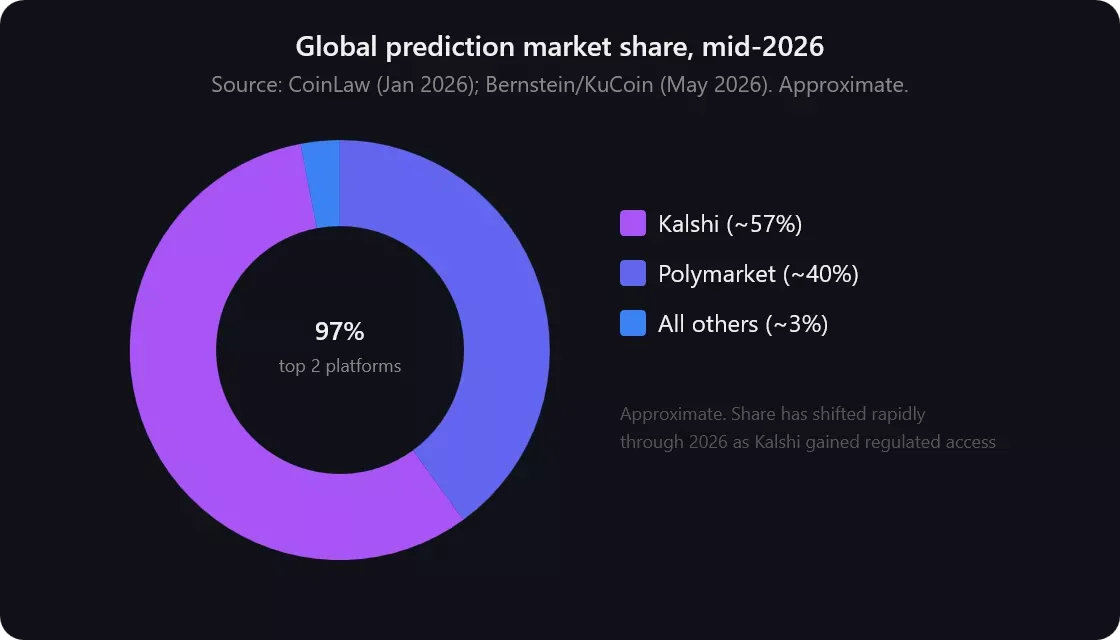
Source: CoinLaw (January 2026) and Bernstein/KuCoin data (May 2026). Market share is approximate and has shifted materially throughout 2026 as Kalshi's regulatory approval attracted institutional volume.
In March 2026, Polymarket processed $10.57 billion in monthly trading volume running on Polygon, an EVM-compatible chain with sub-cent gas fees.
Polygon's combination of EVM tooling compatibility and low transaction costs makes it the most practical starting point. Teams that choose a different chain should have a specific reason, not a stylistic preference.
Oracle Integration: The Make-Or-Break Component
If your oracle resolves incorrectly, you pay out the wrong side. On a platform with any meaningful volume, that's a protocol-ending event.
Oracles are the bridge between your smart contracts and real-world events, and wrong oracle selection is the single most expensive architecture mistake in prediction market development.
There are 3 main Oracle options worth evaluating in 2026:
UMA Optimistic Oracle. UMA works on an optimistic assumption: proposed outcomes are assumed correct unless disputed. The process has 3 steps.
- A proposer submits an answer, which can be challenged by disputers within a set window (typically 2 hours)
- UMA token holders vote to resolve disputes when they arise
- Polymarket leverages UMA for binary event markets such as elections, sports, and policy outcomes, where no single authoritative data source exists
Chainlink Data Streams and Automation. Chainlink connects contracts to real-time external data via a decentralized node network. Best for markets that resolve against a specific number, crypto price markets, financial indexes, and sports scores with a clear data provider.
Polymarket uses Chainlink for its 15-minute crypto price markets precisely because Chainlink resolves automatically without human dispute cycles.
Pyth Network. Lower latency than Chainlink, designed for DeFi applications needing sub-second price data. Growing adoption in prediction markets built around real-time price events.
Here's how to match Oracle to market type:
|
Market type |
Recommended oracle |
Why |
|
Binary events (elections, sports) |
UMA Optimistic Oracle |
Handles subjective outcomes, dispute mechanism for edge cases |
|
Real-time price markets |
Chainlink Data Streams |
Automated resolution, low-latency, no dispute delay |
|
Fast-settling financial events |
Pyth Network |
Sub-second latency for high-frequency markets |
|
Multi-outcome events |
UMA |
Flexible resolution, community governance fallback |
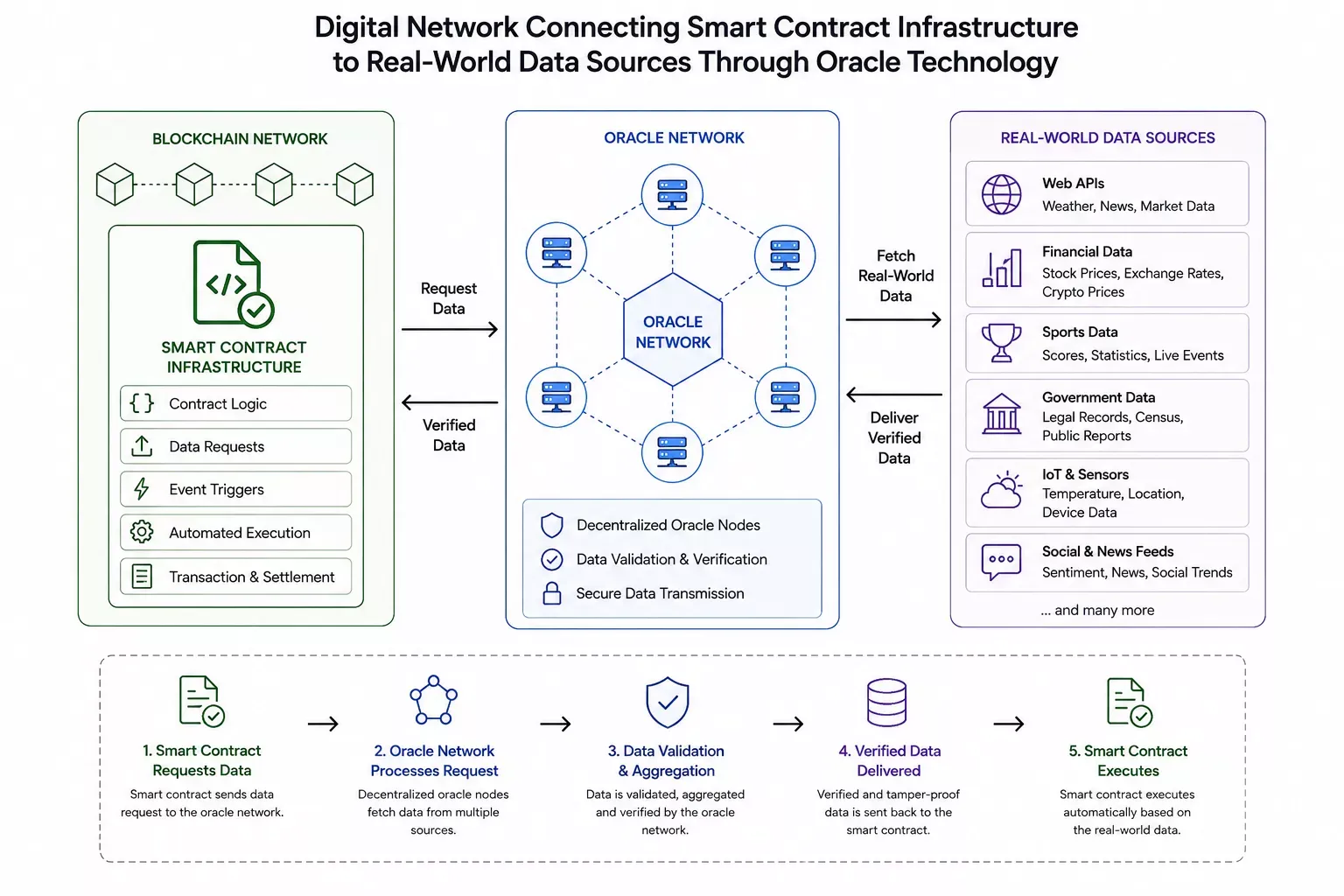
Oracle integration is consistently underestimated across prediction market builds; teams typically discover 30–50% more time is needed than their initial scope. The API integration is fast. The edge case handling (disputed outcomes, stale data, oracle downtime) is where time disappears. Budget 2–4 weeks for Oracle integration, not 1.
Oracle selection and event resolution mechanics are covered in depth in our how to build a prediction market guide, including the UMA dispute window configuration and Chainlink automation setup.
Polymarket uses a dual-oracle approach: UMA Optimistic Oracle for binary events (elections, policy decisions) and Chainlink Data Streams for real-time price markets like 15-minute crypto price contracts.
Oracle selection is the highest-risk architecture decision in prediction market development. A wrong choice means either slow resolution or no dispute mechanism, depending on which direction you get it wrong.
See the Prediction Market Platform in Action
Book a live demo to explore our white‑label prediction engine and compliance-ready stack.
Request DemoDevelopment Phases And Realistic Timelines
A production-ready prediction market takes 3 to 9 months from architecture to mainnet. The range is wide because "prediction market" covers everything from a basic binary event platform to a full-featured exchange with advanced order types, cross-chain support, and institutional-grade APIs.
Here's how a standard build breaks down:
|
Phase |
Duration |
What gets built |
|
Architecture and design |
2–4 weeks |
Chain selection, smart contract architecture, UI wireframes, oracle decision |
|
Smart contract development |
4–8 weeks |
Market creation, trading, settlement, payout logic in Solidity or Rust |
|
Oracle integration |
2–4 weeks |
Oracle selection, API integration, edge case handling |
|
Frontend and wallet integration |
4–6 weeks |
React/Next.js UI, MetaMask and WalletConnect, market display, position tracking |
|
Security audit |
2–4 weeks |
Independent smart contract audit, mandatory before mainnet |
|
Testing and QA |
2–3 weeks |
Testnet deployment, load testing, edge case simulation |
|
Mainnet launch |
1–2 weeks |
Deployment, monitoring setup, and incident response runbook |
Total: 17–31 weeks, roughly 4–8 months for a production build.
The security audit slot is fixed. No reputable audit firm completes it faster without cutting scope. Budget $15,000–$35,000+ and 4-8 weeks. Any team offering to skip it or compress it significantly is a team you should walk away from.
Post-mainnet, the operational surface expands significantly. You need real-time monitoring for oracle resolution events, automated alerts for failed transactions, an admin interface for market creation and management, and a treasury process for fee collection and protocol liquidity.
Teams that plan this layer during the build phase ship cleaner and recover faster from incidents than those who bolt it on after launch.
If you're building market-making or automated trading on top of prediction market infrastructure, our crypto trading bot development resource covers the integration patterns for on-chain execution and position management.
The most common source of timeline slippage in prediction market builds is oracle edge cases and the wallet layer integration, not the smart contracts. Both are underspecified in most initial briefs. Teams that nail the architecture phase, specifically mapping every market type to its resolution path before writing a line of code, ship faster and with fewer mainnet surprises.
Smart contract development and independent security auditing represent the single largest cost component in prediction market development, ranging from $40,000 to $120,000 combined (Interexy, 2026).
Any platform handling real user funds requires a full audit before mainnet deployment. The cost of an exploit exceeds the cost of the audit by orders of magnitude.
What Does It Cost To Build A Prediction Market Platform?
In 2026, a custom prediction market platform costs $80,000–$230,000 for a full build. An MVP or clone-based approach runs $15,000–$35,000+.
Here's how costs break down by component:
|
Component |
Cost range |
|
Smart contract development + audit |
$40,000 – $120,000 |
|
Frontend development |
$15,000 – $40,000 |
|
Backend infrastructure |
$10,000 – $30,000 |
|
Oracle integration |
$5,000 – $15,000 |
|
Wallet integration |
$5,000 – $10,000 |
|
QA and testing |
$5,000 – $15,000 |
|
Total (custom build) |
$80,000 – $230,000 |
|
Basic script/clone approach |
$15,000 – $35,000+ |
The smart contract + audit line is the hardest to compress. Cut corners there, and you pay it back in exploitation losses.
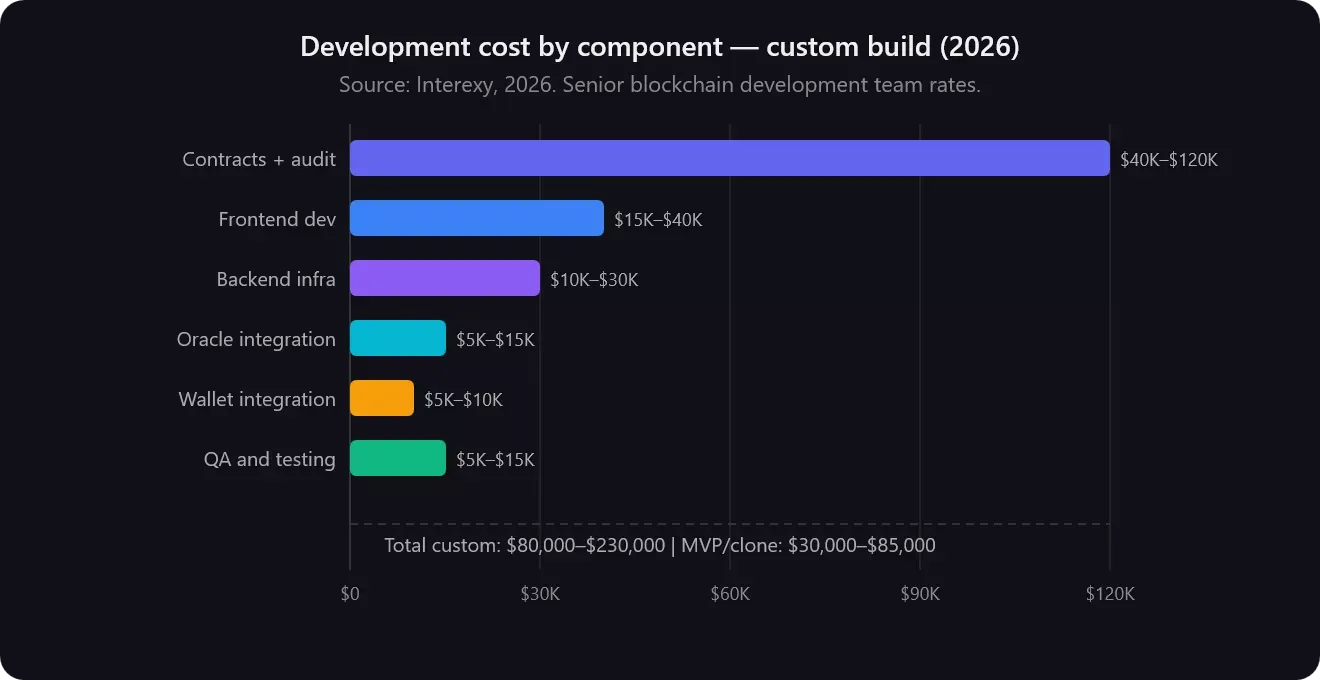
Source: Interexy, prediction market platform development cost report, 2026.
For a component-level breakdown with vendor comparisons and team structure options, see our dedicated post on the cost to build a prediction market like Polymarket.
Compliance And The Regulatory Landscape In 2026
The US CFTC is the primary regulator for prediction markets in the United States. Kalshi received comprehensive approval for event contracts under CFTC oversight, and the market priced that clarity in. Kalshi raised over $1 billion at a $22 billion valuation in March 2026. Regulatory certainty has a measurable premium.
For most new entrants, the practical compliance picture in 2026 looks like this:
- US market: Launching a US-facing prediction market without CFTC approval risks operating in a gray area, unable to serve US users, and exposed to enforcement; Kalshi required years of regulatory engagement, so plan accordingly.
- Offshore incorporation: Many decentralized prediction platforms incorporate in Cayman, BVI, or Singapore to reduce single-jurisdiction risk, though regulatory exposure remains.
- KYC/AML: Fiat on-ramps require KYC/AML; crypto-only platforms often skip KYC but face growing scrutiny in the EU and UK.
- Geo-blocking: Common practice is to block US IPs at the frontend while keeping smart contracts public (as Polymarket did during its restricted period).
The regulatory trajectory in 2026 points toward more enforcement. Factor legal structuring costs into the project budget from day one. This section is informational context. Get jurisdiction-specific legal counsel before launch.
Kalshi's $22 billion valuation reflects something most prediction market builders haven't priced in: regulatory clarity is a competitive moat, not a compliance checkbox. Platforms that are structured correctly from day one can serve regulated clients, institutional audiences, and licensed operators.
Platforms that don't are capped at the gray-zone audience, which is large today but is narrowing as enforcement increases.
Build Vs. White-Label: Which Path Fits Your Launch
White-label prediction market platforms cut time to market from 6–9 months to 4–8 weeks. The tradeoff is differentiation and platform dependency.
|
Factor |
Custom build |
White-label |
|
Time to market |
6–9 months |
4–8 weeks |
|
Cost |
$80K–$230K |
$15K–$50K |
|
IP ownership |
Full |
Partial or none |
|
Customization |
Complete |
Limited to platform parameters |
|
Maintenance burden |
On you |
On vendor |
|
Differentiation |
High |
Low |
|
Security audit |
Your responsibility |
Vendor's (verify it actually happened) |
When white-label makes sense: You need to validate demand before committing to a full build. Your differentiation is in distribution, not platform features. You're entering a vertical where speed to market beats technical depth.
When custom is the right call: You need specific market types that white-label platforms don't support. Your business model requires full IP ownership, whether for B2B licensing or white-labeling your own product to operators. You're building for institutional or regulated audiences that need custom compliance logic and full audit trails.
Ask whether the white-label vendor's architecture can be replaced later without a full rebuild. Some vendors lock you into their oracle, their chain, and their fee structure in ways that become expensive to exit. Read the contracts before the API docs.
If you're evaluating options on the clone side, our comparison of Polymarket clone script options, alongside alternatives like the Kalshi clone script and Manifold Markets clone script, covers the main platforms worth considering before committing.
White-label prediction market platforms reduce time to market from 6–9 months to 4–8 weeks, at a cost of $15,000–$35,000+ versus $80,000–$230,000 for a custom platform. White-label is appropriate for market validation but typically can't support institutional compliance requirements or B2B licensing models that require full IP ownership.
See the Prediction Market Platform in Action
Book a live demo to explore our white‑label prediction engine and compliance-ready stack.
Request DemoConclusion
The architecture decision tree for a prediction market build is more constrained than most founders expect. Chain selection narrows quickly once you've defined your market types and target geography.
Oracle selection is dictated by those market types. The security audit isn't negotiable. What's left is the build vs. white-label question, which is really a question about whether you're validating demand or building a differentiated product.
That question has a clear answer depending on whether you need IP ownership, regulated-client support, or control over your own roadmap. If you're evaluating build options, our prediction market platform development team covers both custom and white-label paths from architecture through mainnet.
The regulatory window is open but narrowing. Teams that structure correctly now have a material advantage over those who retrofit compliance 12 months into operations. The cost of getting that right at the start is a fraction of what it costs to unwind a poorly structured entity after traction.
Troniex builds prediction market platforms from architecture through mainnet, both custom and white-label. Talk to our team if you're scoping a build.