Tech Stack To Build A DeFi App In 2026
Build on an EVM L2 with Solidity, OpenZeppelin and Foundry. Read prices from Chainlink or Pyth and check them against a TWAP. Index with The Graph, build the frontend in Next.js with wagmi and viem, and hold admin keys in a multisig with a timelock. Audit independently before mainnet and monitor after.
Oct 09, 2026
12 mins read
The default DeFi stack in 2026 is Solidity with OpenZeppelin on an EVM L2, Foundry for testing, Chainlink prices checked against a TWAP, The Graph for indexing, and Next.js with wagmi and viem on the frontend. Add a multisig with a timelock for admin keys, an independent audit before mainnet, and live monitoring after it.
If you'd rather hand the build to a team, a DeFi platform development company covers every layer below. This guide covers the stack only. Contract patterns and lending logic have their own guides.
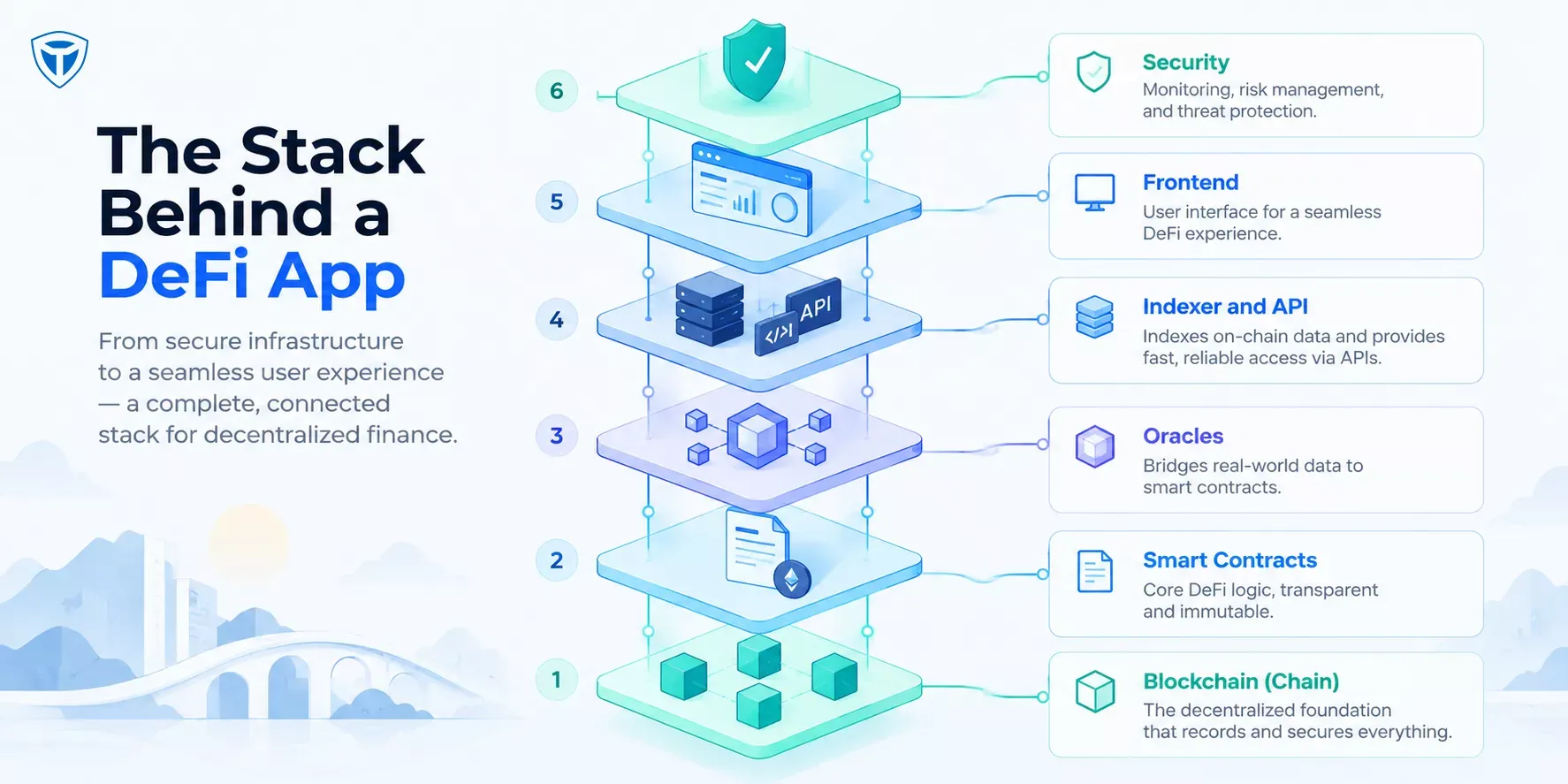

Planning a DeFi build and unsure which layers to buy, fork, or write?
Troniex's DeFi team scopes the chain, contracts, and oracle setup with you before any code gets written.
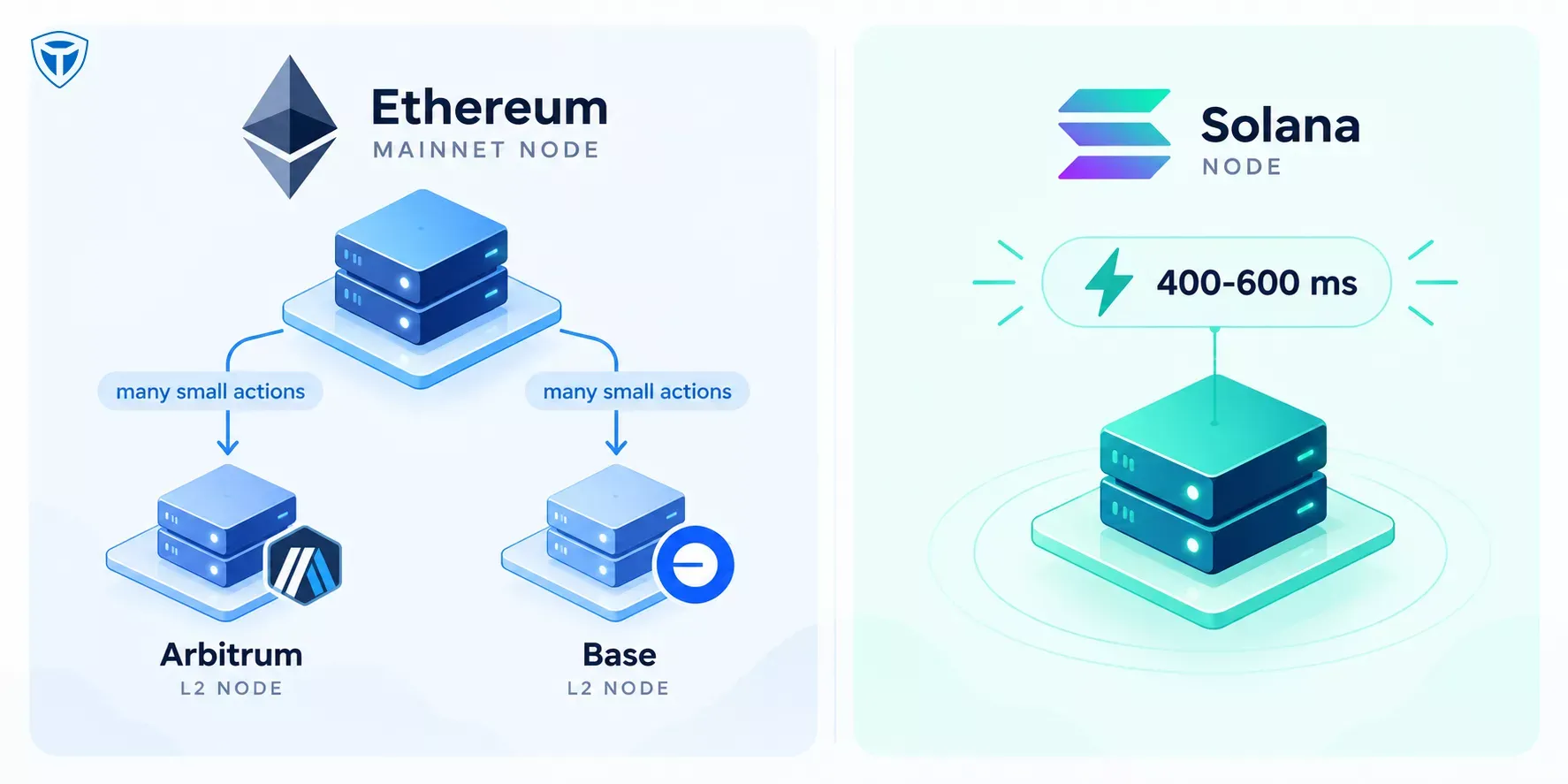
Talk to Our Experts- Start on an EVM chain. Use an L2 for apps with many small actions and keep mainnet for the treasury.
- Foundry gives you exact gas reports and a built-in fuzzer. Hardhat stays useful for TypeScript-heavy teams.
- Spot prices from thin pools are the classic oracle hole. Read a Chainlink or Pyth feed and check it against a TWAP.
- Admin keys belong in a multisig (2-of-3 at least) behind a timelock.
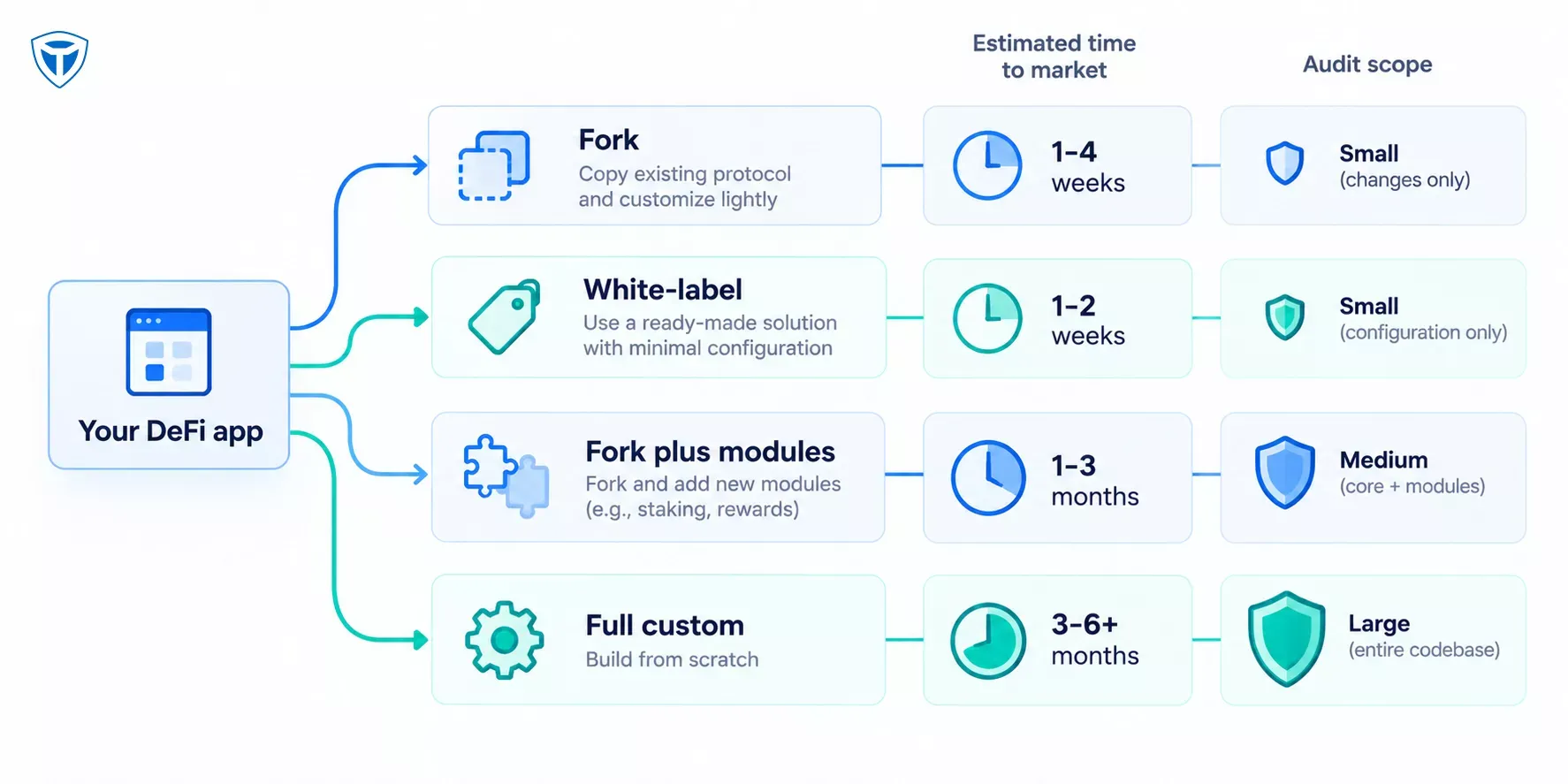
- A fork of an audited protocol launches in about 2-4 months against 4-8 for a full custom build, and every changed line still needs its own audit.
Best Blockchain For A DeFi App: EVM L2, Mainnet, Or Solana
Your chain decides your language, your auditors, your liquidity, and your fee model. Pick it first.
EVM mainnet and L2s
Most DeFi teams start on an EVM chain because the contracts, wallets, audit firms, and developer tools are all there. If your users make many small actions (swaps, rebalances, claims, votes), deploy on an L2 and keep mainnet for the treasury. Our cross-chain and L2 DEX development guide covers that split in detail.
Solana and non-EVM chains
On Solana, you write programs in Rust, usually with the Anchor framework, and get confirmation in about 400-600 ms. That speed suits order books and high-frequency trading (see AMM vs CLOB for when an order book wins).
The cost is a separate toolchain and a smaller pool of auditors who know it well. The Solana EVM-to-SVM guide maps the differences for Solidity teams.
Solana's DeFi scene changes fast. Check live protocols and liquidity on the day you choose, and pick it only if your product needs that speed.
Smart Contract Language And Framework for DeFi Development
Use Solidity with OpenZeppelin libraries on EVM chains and Foundry as the test framework. Foundry reports exact gas per function and ships a built-in fuzzer, so you catch cost and edge-case bugs before the audit.
Keep Hardhat when your team lives in TypeScript scripts and plugins.
Hardhat vs Foundry for DeFi
Foundry writes tests in Solidity and, by one 2026 benchmark, runs them 10-100x faster than Hardhat.
Uniswap v4 chose it.
Run forge test --gas-report in CI and you get gas per function on every commit, which is the cleanest way to compare gas costs between framework choices and contract versions.
Hardhat still wins when your deploy scripts and plugins live in TypeScript. Plenty of teams run both: Foundry for tests, Hardhat for deploys.
|
Foundry |
Hardhat |
|
|---|---|---|
|
Test language |
Solidity |
JavaScript / TypeScript |
|
Gas reporting |
Built-in, per function |
Plugin |
|
Fuzzing |
Built in |
Plugin or external |
|
Best for |
Contract-first teams |
TypeScript-heavy teams |
Upgradeable contracts and admin keys
If you use a proxy pattern, someone holds the upgrade key. Put it in a multisig, at least 2-of-3, and add a timelock on upgrades so users see a change before it takes effect.
The contract build itself (patterns, testing, deployment, verification) has its own guide: DeFi smart contract development.
DeFi Oracles: Chainlink, Pyth and TWAP Price Checks
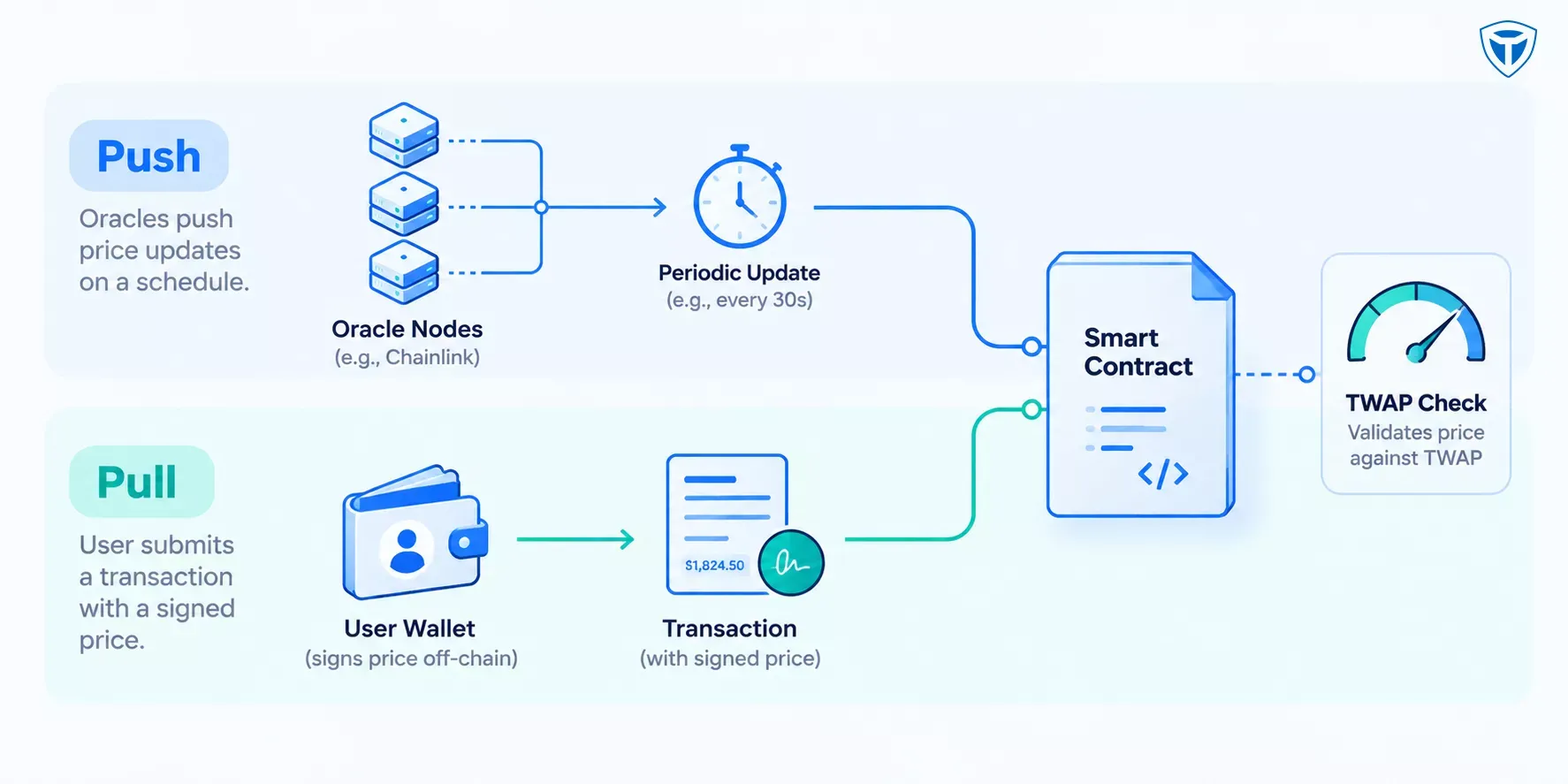
DeFi apps read prices from oracles. Push oracles such as Chainlink post prices on-chain from independent nodes, which makes them hard to move with a flash loan. Pull oracles such as Pyth attach a signed price to the user's transaction. Add an on-chain TWAP as a sanity check on the primary feed.
Push vs pull oracles
Push feeds update on a heartbeat or when price moves past a threshold, and your contract reads the latest value. Pull feeds let the user bring a fresh signed price with the transaction, which suits fast markets. Both need a staleness check in your contract.
|
Push (Chainlink) |
Pull (Pyth) |
|
|---|---|---|
|
Who posts the price |
Oracle nodes, on a heartbeat or deviation |
The user, inside the transaction |
|
Best for |
Lending, vaults, slower markets |
Perps, fast markets |
|
Staleness check |
Required |
Required |
TWAP fallbacks and manipulation risk
OWASP ranks price oracle manipulation in its 2026 smart contract top 10. A spot price from a thin DEX pool is the classic hole: a flash loan moves the pool, your contract reads the moved price, and the attacker borrows against it.
A TWAP over a deep pool makes that attack expensive. Use it as a check against your main feed and pause when the two disagree.
Lending is the product most exposed to a bad price, because liquidations fire on it. If that's what you're building, see our DeFi lending platform development service.
Price feeds decide whether a lending or trading app survives its first volatile week. Bring your oracle and liquidation design to a free 30-minute review with our blockchain engineers.
Indexing, RPC, and Backend APIs For A DeFi App
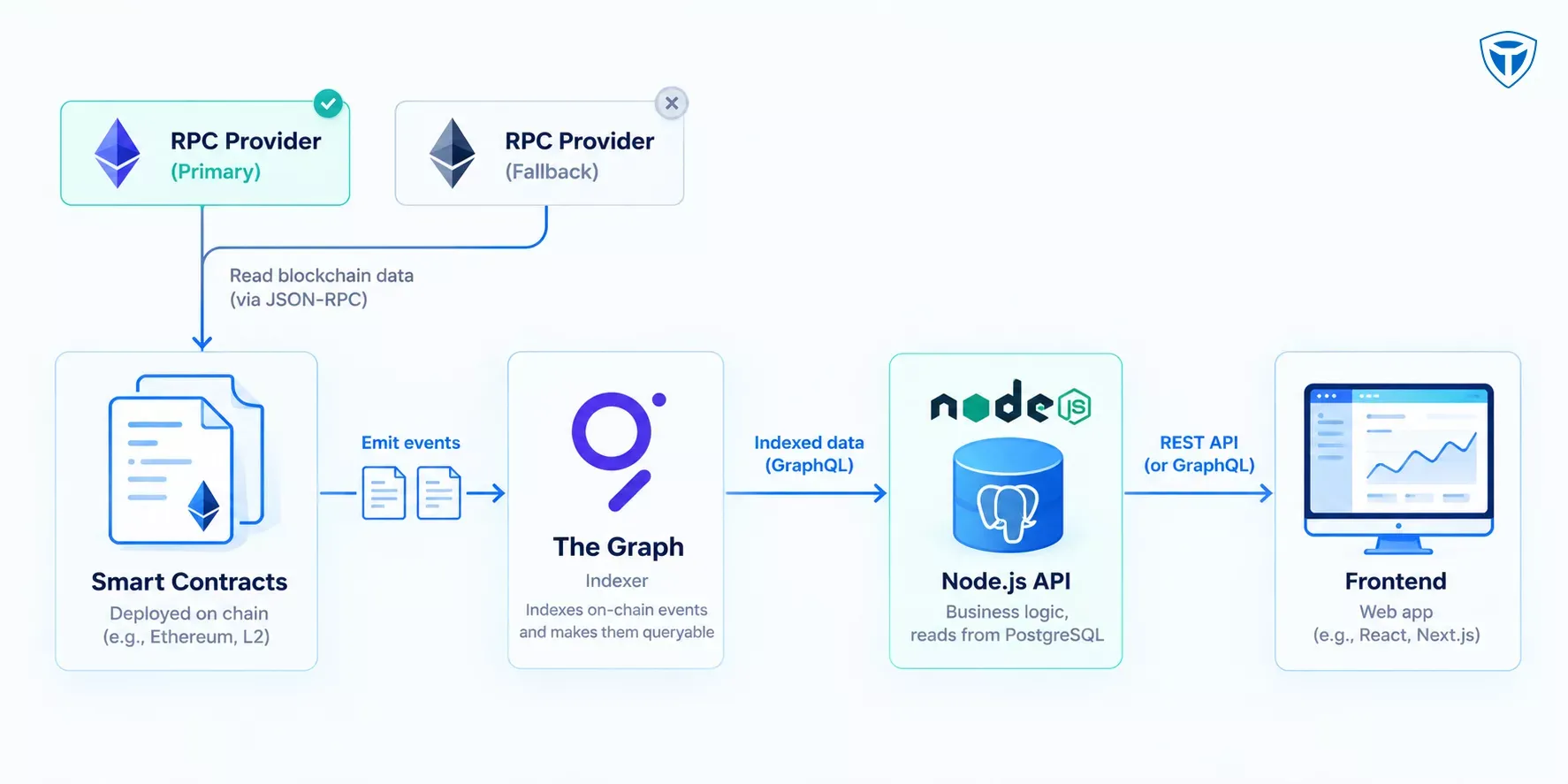
A DeFi app needs a backend next to its contracts. You need an RPC provider to read and send transactions, an indexer to turn events into queryable data, and an API layer for anything off-chain such as notifications or compliance checks.
Subgraph or custom indexer
The Graph is the default: write a subgraph, query it over GraphQL. Envio is quicker on large historical backfills, and Ponder gives you full TypeScript control. The speed comparison comes from Envio's own benchmark, so test on your own contracts before you switch.
Keep off-chain state such as user settings and compliance flags in PostgreSQL behind a Node.js API.
RPC provider or your own node
Start with a managed RPC provider and a second one as fallback. Alchemy, an RPC vendor, puts self-hosting for large projects at around $86,000 a year. Run your own node when you need guaranteed throughput or archive data, and have the ops team handle it.
DeFi Frontend And Wallet Connection: Wagmi, Viem, And Embedded Wallets
React or Next.js with wagmi and viem
Build the frontend in React or Next.js with wagmi hooks over viem. Viem's bundle is reported to be about 35x smaller than ethers.js, which shows up in load time on mobile. Use RainbowKit or WalletConnect for the connect modal.
Embedded wallets and account abstraction
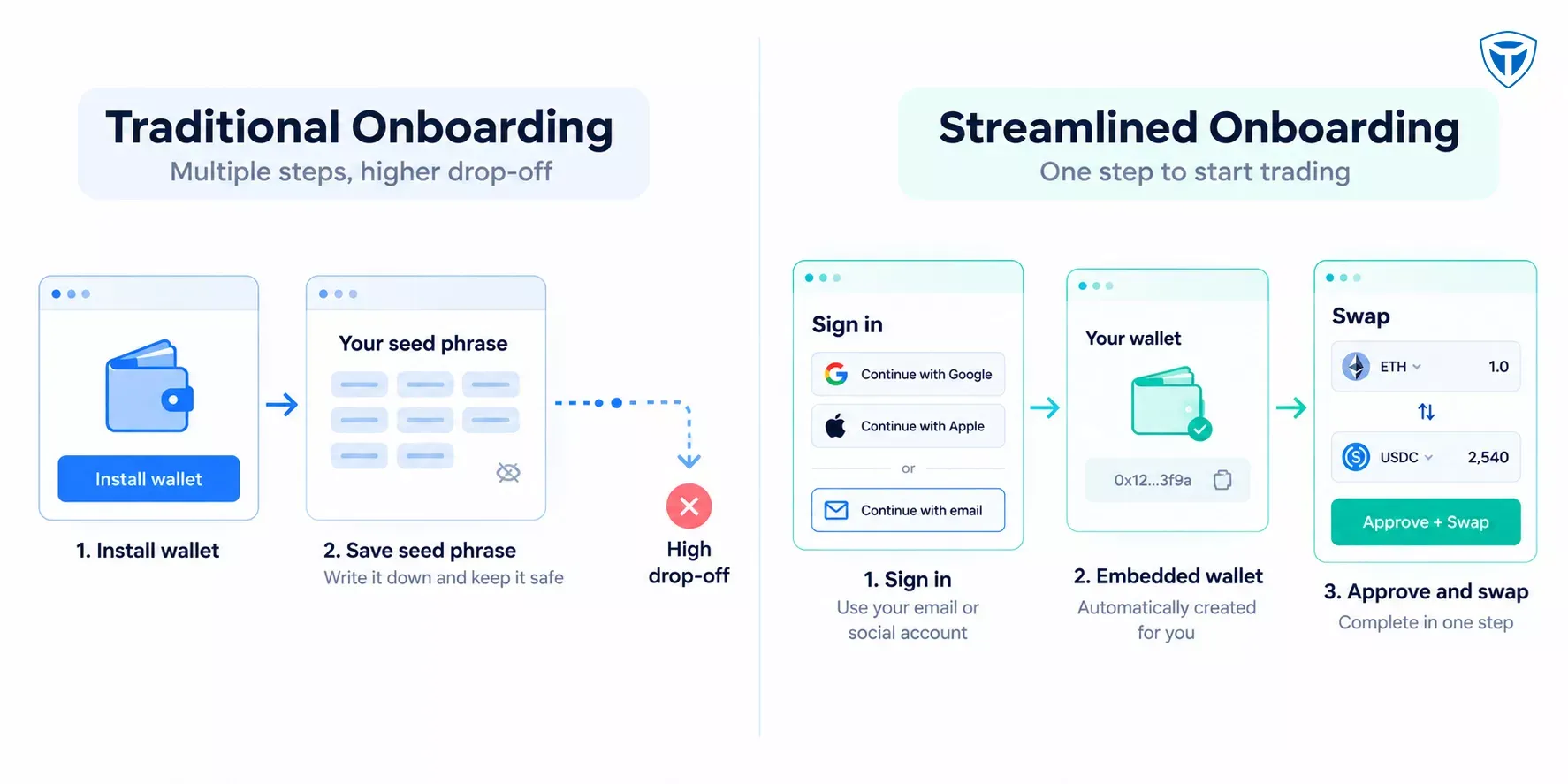
First-time users drop off at "install a wallet". Offer email or social login with an embedded wallet first, and let power users connect MetaMask later. ERC-4337 smart accounts let you sponsor gas and batch an approval and a swap into one click.
For the wallet side of the product, see our DeFi wallet development service.
DeFi Security Stack: Audits, Fuzzing And Monitoring
Before mainnet
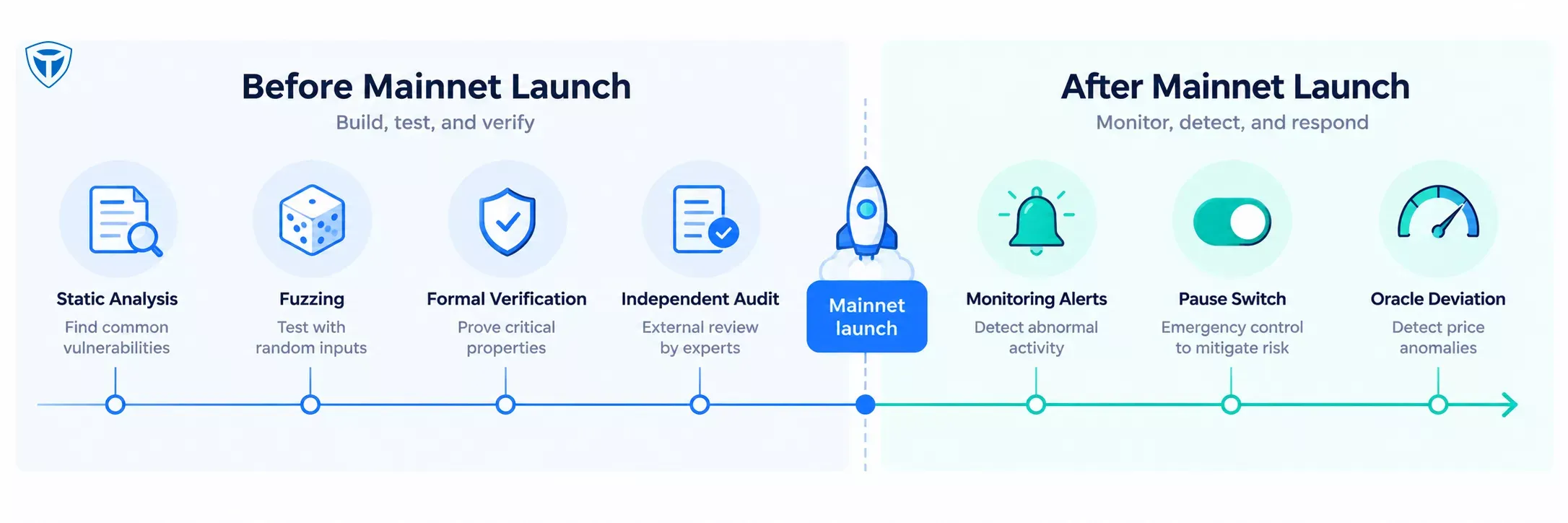
Run Slither on every commit. Fuzz with Foundry or Echidna, and use formal verification for the core math (interest rates and AMM curves). Then book an audit with an independent firm. Our smart contract development services team preps contracts for that review.
Every build we ship gets 100% QA with code audits and stress testing, and the independent audit comes on top of that.
After mainnet
Watch the contracts live: alerts on large withdrawals, admin calls, oracle deviation and failed liquidations, plus a pause you trigger in minutes. OpenZeppelin ended its hosted Defender service on July 1, 2026, so teams now self-host OpenZeppelin Monitor and Relayer. Forta adds community detection bots on top.
Fork, White-Label, Or Custom DeFi Protocol Build
|
Route |
Time to launch |
Audit scope |
Control over tokenomics |
Licence check |
|---|---|---|---|---|
|
Fork of an audited protocol |
Fastest |
Every changed line |
Limited to what the fork exposes |
Required |
|
White-label |
Fast |
Vendor code plus your config |
Set by the vendor |
Read the vendor terms |
|
Fork plus custom modules |
Medium |
Changed lines plus new modules |
High |
Required |
|
Full custom |
Slowest |
Everything |
Full |
Only your dependencies |
A fork of an audited protocol plus custom modules is the usual middle route. Fork-based builds take about 2-4 months to launch, against 4-8 for full custom. A fork still needs its own audit for every line you change.
Check the licence before you fork. Uniswap v3 started under BUSL 1.1 and later moved to GPL, and v4 sits under a four-year BUSL. Fork-based DEX builds, such as an aggregator, carry the same check. See our DeFi DEX aggregator development guide.
The same build-or-buy call applies on the centralized side. Our tech stack to build a crypto exchange guide covers it for a CEX. We've spent 4+ years on blockchain builds.
DeFi Tech Stack By Layer: Default Picks And Alternatives
|
Layer |
Default pick |
Pick the alternative when |
|---|---|---|
|
Chain |
An EVM L2 such as Arbitrum or Base |
Deepest liquidity: Ethereum mainnet. High-speed trading: Solana |
|
Contract language |
Solidity with OpenZeppelin |
Solana: Rust with Anchor |
|
Test framework |
Foundry |
TypeScript-heavy team: Hardhat |
|
Admin keys |
Multisig with timelock |
|
|
Oracle |
Chainlink push feeds |
Fast markets: Pyth pull feeds |
|
Oracle check |
TWAP over a deep pool |
|
|
Indexer |
The Graph |
Big backfills: Envio. Full TypeScript control: Ponder |
|
Backend |
Node.js API with PostgreSQL |
|
|
RPC |
Managed provider plus fallback |
Archive data or guaranteed throughput: own node |
|
Frontend |
Next.js with wagmi and viem |
|
|
Wallet connection |
RainbowKit or WalletConnect |
First-time users: embedded wallet with ERC-4337 |
|
Static analysis |
Slither |
|
|
Fuzzing |
Foundry |
Property-based campaigns: Echidna |
|
Monitoring |
OpenZeppelin Monitor, self-hosted |
Community bots: Forta |
Conclusion
Your chain and your oracle setup are the two choices hardest to reverse after launch. Move chains, and you rewrite contracts, re-audit, and rebuild liquidity. Swap a weak price feed after launch, and you do it while user funds sit behind it. The indexer, the frontend library, and the RPC vendor all move later with effort and no existential risk.
Make those two calls first, then work down the layers in order: framework, admin keys, indexer, frontend, monitoring. Book the independent audit once the contracts are feature-complete and the oracle checks are in, because auditors price and schedule against a frozen scope. Teams that audit early pay for a second review after every change.
If you're choosing between a fork and a custom build, decide on tokenomics. When your mechanics match an audited protocol and its licence allows a fork, fork it. When they differ, build custom and budget 4-8 months.
Get a Stack Review Before You Book the Audit
Bring your chain and contract plan to a free 30-minute strategic consultation, and leave with a stack you can hand to an auditor. Our clients rate us at 99.6% satisfaction.
Talk to Our Experts