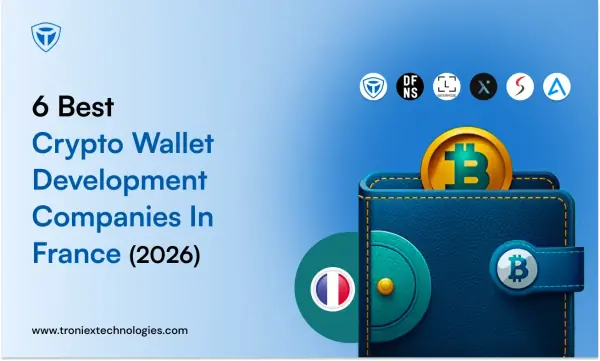
6 Best Crypto Wallet Development Companies In France (2026)
6 vetted crypto wallet development companies for France, checked against the AMF's MiCA CASP deadline, with real pricing and delivery timelines.
Sep 21, 2026
9 mins read
Search "crypto wallet development company France" and you get a mix of Paris-based startups, offshore agencies claiming EU coverage, and directory pages recycling the same 10 names.
None of it tells you who can actually ship a wallet, hold it under MiCA once the AMF's transition window closes, and support you after launch.
We vetted vendors on delivery track record, wallet-specific technical depth (custody model, multi-chain support, key management), and compliance capability under the AMF's incoming CASP regime, then cut anyone who couldn't back a claim with a live case study or a second source.
How We Selected These Crypto Wallet Development Companies
We looked for:
- A dedicated wallet product or service page, not a generic "we do blockchain" line
- Custody architecture detail: MPC, multi-sig, HSM, or hardware-backed, not just "secure wallet"
- A verifiable data point (funding round, client count, assets secured, years shipping wallets)
- Compliance awareness relevant to MiCA and the AMF's CASP authorization process
We excluded resellers with no in-house engineering team, agencies that mention wallets only as a feature of a broader DApp build, and companies whose only public evidence was a directory listing.
France's wallet infrastructure market is genuinely thin. Two vendors below are France-headquartered and wallet-native.
The rest are established international developers with confirmed enterprise wallet delivery and MiCA-relevant compliance tooling, included because local supply alone doesn't clear a real shortlist. We say so plainly instead of padding the list with names that don't hold up.
Compare The Top Crypto Wallet Developers In France At A Glance
|
Company |
Specialty |
Wallet capability |
Est. timeline |
Best for |
|---|---|---|---|---|
|
Troniex Technologies |
Custom exchange, wallet, DeFi, payment gateway builds |
Custodial, non-custodial, multi-chain wallets built alongside exchange infrastructure |
8-16 weeks |
Founders who want wallet and exchange infrastructure from one team |
|
Dfns |
Wallet-as-a-service (MPC/TSS) |
100+ chains, keyless MPC wallets, custody APIs |
Days to weeks (API integration) |
Fintechs and neobanks embedding wallets fast |
|
Ledger Enterprise (Vault) |
Institutional custody and wallet infrastructure |
HSM-backed self-custody, policy-driven approvals |
Weeks to months |
Institutions needing hardware-grade custody |
|
PixelPlex |
Custom blockchain and wallet development |
Mobile, web, desktop, MPC, NFT wallets |
10-16 weeks |
Enterprises wanting a fully custom wallet build |
|
Suffescom Solutions |
White-label and custom crypto wallets |
Custodial, non-custodial, MPC, multi-chain, WaaS |
2 weeks (white-label) to 16 weeks (custom) |
Startups needing a fast, budget-conscious launch |
|
Antier |
White-label and enterprise wallet development |
Multi-sig, Web3, decentralized wallets |
3+ weeks (white-label) |
Businesses wanting a market-ready wallet fast |
Don't Launch Until You've Run This Checklist.
The exact readiness checklist we run at Troniex before any product or service goes live - licensing, custody, and security covered in one place.
Free · Takes 2 minutes
- Regulator fit confirmed
- Key management architecture set
- Source code ownership in writing
- Cold storage + audit confirmed
The 6 Best Crypto Wallet Development Companies In France
1. Troniex Technologies
Troniex builds custom crypto wallets alongside exchange and DeFi infrastructure, which matters if you're launching a wallet as part of a broader platform rather than a standalone app. The team handles custodial and non-custodial builds, multi-chain support, and integration with exchange liquidity and payment rails in a single build.
Strengths:
- One team for wallet, exchange, and payment gateway work, so integration points don't fall through the cracks between vendors
- Custom architecture rather than a rebranded template
- Direct involvement through the build, not a handoff to a support desk after launch
- Works with founders scoping MiCA-aligned compliance requirements from day one
Limitation: Not the fastest route to market if you only need a bare-bones white-label wallet with no exchange or DeFi component attached.
2. DFNS
DFNS is a Paris-based wallet infrastructure company. It doesn't build you a bespoke wallet app. It gives you the API layer (MPC key generation, multi-chain wallet creation, custody, transaction policy), and you build the product on top.
Strengths:
- $16M Series A led by Further Ventures, with Bpifrance among the backers
- 400+ fintech and institutional clients including Standard Chartered, Kraken, Circle, and MoonPay
- $100B+ in client assets secured and $10B+ in monthly transaction volume
- SOC 2 Type I & II and ISO 27001/27017/27018 certified, with zero reported key losses since 2022
Limitation: This is infrastructure for a team that's already building a product, not a full-service dev shop that hands you a finished app.
3. Ledger Enterprise (Vault)
Ledger's institutional arm, also Paris-based, sells the same hardware-security philosophy that made the consumer Ledger wallet a category leader, rebuilt for institutions. Keys are generated and stay inside HSMs, and approvals run through policy engines with a physical trusted display.
Strengths:
- 100+ institutions have launched client-facing digital asset services on the platform
- Zero hacks or asset losses since operations started in 2019
- Lets institutions self-custody rather than routing assets to a third-party custodian
- Deep hardware security pedigree from the consumer Ledger product line
Limitation: Built for institutional self-custody at scale, not a fit for a startup that needs a simple consumer-facing wallet app shipped in a few weeks.
4. PixelPlex
PixelPlex is a global blockchain developer with an 11-year track record in the space and offices spanning New York, London, and Zug. Its wallet work covers mobile, web extension, desktop, and MPC wallets, built as fully custom products rather than templates.
Strengths:
- 450+ delivered blockchain projects and 200+ smart contracts on mainnet
- Clients include TON, Qtum, and Hedera, plus three clients that reached unicorn status
- MPC and multi-chain wallet capability, not just custodial basics
- European office presence (London, Zug) for time-zone-aligned delivery
Limitation: No France office, so expect remote-first delivery rather than in-country presence.
5. Suffescom Solutions
Suffescom has shipped 185+ wallet projects since 2011, with both white-label (2-week deployment) and fully custom builds. Its service list covers MPC, DeFi wallet integration, and wallet-as-a-service, and the company lists MiCA readiness as a feature on its wallet product page.
Strengths:
- 185+ wallet projects delivered, one of the higher volume counts we found
- White-label option live in 2 weeks for teams that need speed over customization
- MiCA compliance readiness called out directly, relevant given the AMF's 2026 CASP deadline
- Both custodial and non-custodial builds under one roof
Limitation: No confirmed France or EU client case study, so compliance claims should be verified against your specific licensing scope before signing.
6. Antier
Antier has been building white-label crypto wallets for over a decade, with offices across India, the UK, UAE, and the US. Its wallet line covers multi-sig, decentralized, and Web3 wallets, deployable in under three weeks for teams that need a market-ready product fast.
Strengths:
- Sub-three-week deployment for white-label builds
- Multi-sig and decentralized wallet options beyond basic custodial wallets
- UK office gives at least partial EU-adjacent delivery coverage
- Over a decade of blockchain-specific delivery history
Limitation: Strongest at speed-to-market white-label work, weaker evidence of deep custom engineering compared to PixelPlex or Troniex.
What To Check Before Hiring A Crypto Wallet Developer In France
- AMF and CASP readiness. France's PSAN regime is winding down. From 1 July 2026, only MiCA-authorized CASPs (or firms using the Article 60 notification route) can legally provide crypto-asset services in France. Ask any vendor directly how their build supports your CASP application, not just whether they've "heard of MiCA."
- Source code ownership. Confirm in writing that you own the code at delivery. Some white-label vendors license rather than transfer ownership, which locks you into their platform for updates.
- Custody architecture, named. "Secure wallet" means nothing. Ask whether it's MPC, multi-sig, HSM-backed, or a hot wallet with a nice UI. Each has different cost, speed, and audit implications.
- Post-launch support SLA. Wallets get patched constantly as chains upgrade and vulnerabilities surface. Get response-time commitments in the contract, not a verbal promise.
- Audit history. For any wallet touching smart contracts or DeFi integrations, ask for the audit firm name and the report itself. A vendor that can't produce one shouldn't be building custody infrastructure.
- ACPR overlap for AML/CFT. For wallets tied to fiat on/off-ramps, the ACPR weighs in on anti-money-laundering controls alongside the AMF. Confirm the vendor understands where that split applies.
Cost To Build A Crypto Wallet In France
Pricing tracks build type, not geography. France-based delivery doesn't carry a meaningful premium over offshore teams once you account for compliance work.
- White-label: €25,000-€90,000. Fastest path, live in 2-4 weeks, limited customization and often licensed rather than owned code.
- Custom build: €45,000-€450,000+. Full ownership of security model, chain support, and UX, at a build time of 8-16 weeks.
- Enterprise/institutional custody: €135,000+ and up, often priced as ongoing infrastructure (Dfns, Ledger Enterprise) rather than a one-time build fee.
Suffescom's public pricing (roughly $10,000-$150,000, or about €9,300-€139,500 at current rates) and PixelPlex's project history both sit inside these ranges, though neither publishes France-specific rate cards.
How To Choose The Right Crypto Wallet Development Partner For Your Business
Match the vendor type to what you're actually launching, not the flashiest case study.
- Building a wallet as one piece of a larger exchange or DeFi platform: pick a team that builds all of it together (Troniex), so integration doesn't become your problem later.
- Need wallet infrastructure to embed into an existing fintech product fast: go API-first (Dfns).
- Managing institutional-scale assets and need hardware-grade custody: Ledger Enterprise's model fits better than a custom app build.
- Need a market-ready wallet in weeks on a fixed budget: white-label (Suffescom, Antier) beats custom every time.
- Want full ownership of a bespoke wallet and have 3-4 months: custom development (PixelPlex, Troniex, or Suffescom's custom track) is the right call.
Picking The Right Build Partner
Compliance readiness under the AMF's CASP regime and a verifiable delivery track record matter more than a polished landing page. Check both before you commit to a provider of crypto wallet development services.
Ready to scope a wallet build against MiCA requirements? Request a consultation with Troniex to compare custody models and timelines for your project.