How Much Does Crypto Wallet Development Cost in 2026?
Crypto wallet development cost in 2026 explained. Compare MVP, multi-chain, Web3, and enterprise wallet pricing, cost factors, timelines, and hidden fees.
Aug 28, 2026
16 mins read
The cost of developing a crypto wallet in 2026 can range from tens of thousands of dollars for a narrowly scoped product to hundreds of thousands of dollars for a production-grade, multi-chain, or institutional platform. The final budget will depend on custody architecture, blockchain networks, applications, security, compliance, integrations, infrastructure, and post-launch requirements.
Demand for wallet infrastructure is growing with the increase in digital asset adoption. The global crypto wallet market size is expected to grow from $15.5 billion in 2025 to $19.3 billion by 2026 at a CAGR of 26.6% during the forecast period of 2023 to 2033 to reach $100.8 billion. Crypto.com has reported that there are 741 million owners of cryptocurrencies worldwide in 2025, equivalent to a year-on-year growth of 12.4%.
But for businesses, market growth is only part of the investment story. The more important question is what should your specific wallet actually cost to build, launch, secure, and operate?
Crypto Wallet Development Cost at a Glance
|
Wallet Scope |
Indicative Planning Budget |
Typical Timeline |
Best Fit |
|
MVP |
$2,000–$4,000 |
3–5 months |
Startup launch |
|
Production Wallet |
$5,000–$10,000 |
4–7 months |
Commercial product |
|
Advanced Web3 / Multi-Chain |
$10,000–$20,000+ |
6–10 months |
Web3/DeFi businesses |
|
Enterprise / MPC |
$20,000–$35,000+ |
8–14+ months |
Institutions |
These are planning bands rather than fixed market prices. For context, current competitors themselves publish substantially different estimates; Appinventiv places development broadly between $20,000 and $100,000+, reinforcing why project assumptions must be defined before comparing quotes.
Why are the costs of developing a crypto wallet so different in 2026?
There is no universal crypto wallet app price because two products that appear similar on-screen may rely on completely different custody, signing, infrastructure, recovery, security, and compliance architectures.
Prototype vs Production-Ready Wallet Pricing
A prototype validates user flows and blockchain connectivity. A production wallet must withstand real transactions, edge cases, device failures, network disruptions, malicious activity, scaling requirements, monitoring, and security review. Production readiness therefore costs considerably more than feature demonstration.
What Is Usually Included in a Development Quote?
A well-defined proposal may cover architecture, UI/UX, frontend and backend engineering, blockchain integrations, testing, deployment, documentation, and project management.
What Crypto Wallet Quotes Don't Tell You
Independent security audits, RPC subscriptions, KYC providers, fiat gateways, cloud infrastructure, app-store maintenance, regulatory advice, new-chain integrations, and long-term support may be quoted separately.
Why Two Similar-Looking Wallets Can Cost Very Different Amounts
A non-custodial single-chain wallet and an institutional MPC product can display similar balance and transfer screens while using fundamentally different signing and operational systems.
Businesses defining those architectural choices can explore Troniex's crypto wallet development company capabilities before comparing estimates.
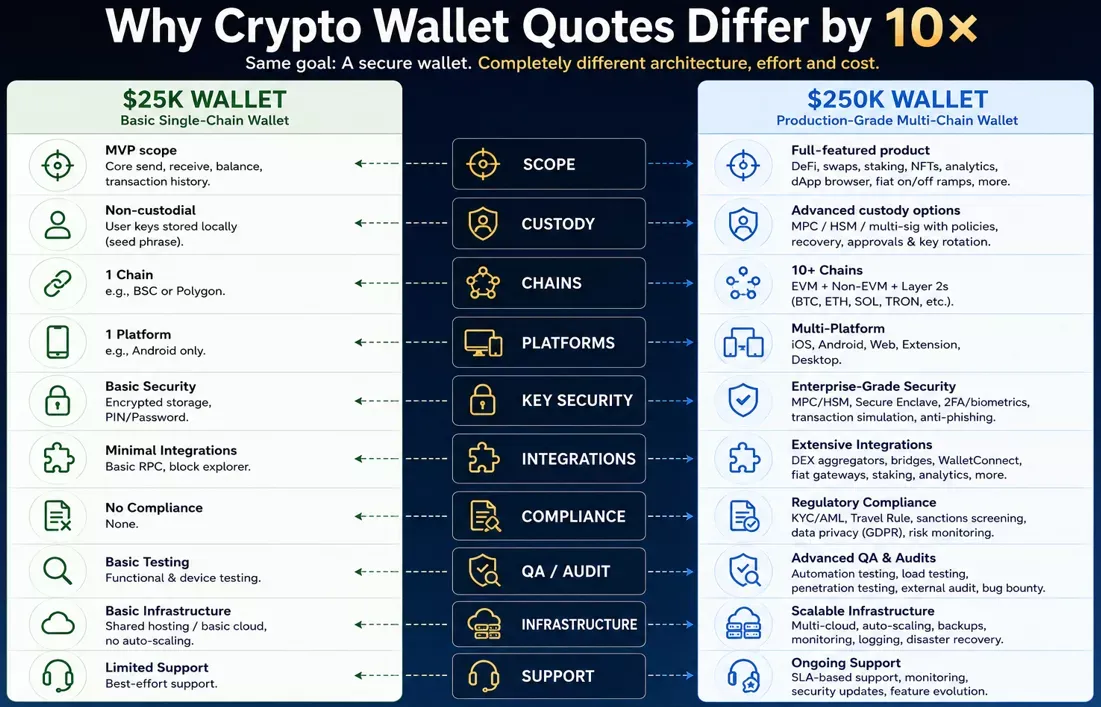
How Much Should You Budget for Crypto Wallet Development in 2026?
Budgeting should be based on product maturity and technical scope rather than labels such as “simple” or “advanced.”
Crypto Wallet Prototype or Proof-of-Concept Cost
A PoC normally validates wallet generation, signing, transfers, blockchain connectivity, and selected user workflows without carrying every production requirement.
MVP Crypto Wallet Development Cost
An MVP adds deployable UX, authentication, transaction history, essential security, testing, analytics, and enough infrastructure for controlled market validation.
Production-Ready Crypto Wallet Cost
Production products require stronger observability, recovery flows, security hardening, scalable infrastructure, device testing, failure handling, and operational controls.
Advanced Web3 and Multi-Chain Wallet Cost
Multiple networks, swaps, staking, NFTs, dApps, cross-chain functionality, and smart accounts add integration and security complexity.
Enterprise and Institutional Wallet Cost
Enterprise systems may require MPC, HSM integration, approval policies, roles, audit trails, compliance tooling, cold-storage workflows, and institutional reporting.
For network-intensive products, Troniex's guide to multicurrency wallet development provides additional context around multi-network architecture.
Cost of Crypto Wallet Development by Wallet Types & Features.
Custody architecture is one of the biggest drivers of cryptocurrency wallet development cost, as it dictates where keys live, who authorizes transactions, and how recovery works.
Custodial Wallet Development Cost
Custodial platforms control signing infrastructure on users' behalf and may require stronger backend security, withdrawal policies, KYC/AML integrations, operational controls, and auditability.
Non-Custodial Wallet Development Cost
Non-custodial products give users control over their keys. Engineering focuses heavily on secure local signing, backup and recovery, phishing resistance, usability, and device-level protection. Troniex's non-custodial wallet development guide explores this model in greater detail.
MPC Wallet Development Cost
MPC architecture distributes cryptographic operations across multiple parties or key shares, reducing dependence on a single exposed signing key. Its protocol integration, recovery, orchestration, and testing increase implementation complexity.
For institutional use cases, see Troniex's MPC wallet development guide.
Multi-Signature Wallet Development Cost
Multi-signature systems require multiple keys or approvals before selected transactions execute. Costs depend on policy logic, supported chains, signing UX, and organizational workflows.
Smart Wallet and Account-Abstraction Development Cost
Smart accounts can add programmable permissions, transaction batching, gas sponsorship, session keys, recovery logic, and passkey-based experiences. They may also introduce smart-contract auditing costs.
Embedded and Seedless Wallet Development Cost
Embedded wallets reduce onboarding friction with SDKs, passkeys, social authentication or managed key infrastructure. Businesses need to consider provider fees, migration strategy and vendor dependency.

Calculate Your Crypto Wallet Development Cost for 2026
Define your wallet type, platforms, blockchain networks, security model, integrations, and launch requirements to establish a realistic development budget.
Talk To Our ExpertsWhat Are the Most Influencing Factors of Crypto Wallet Development Cost?
The cost of building a crypto wallet depends on a number of interlinked architectural decisions.
Supported Blockchains Number and Type
Adding Ethereum-compatible networks is not the same as adding Bitcoin or Solana. Different chains may need different transaction formats, token rules, SDKs, signature schemes, fee mechanisms, indexers and tests.
Platforms: Web, Extension, Desktop, Android and iOS
Each additional interface expands engineering and QA scope. Browser extensions also introduce distinct permission and phishing considerations.
Custody and Key-Management Architecture
Seed phrases, secure enclaves, multi-signature systems, MPC, HSMs, recovery policies, and transaction approvals create different security requirements.
UI/UX and User-Onboarding Complexity
Seedless onboarding, portfolio dashboards, transaction simulation, recovery journeys, and advanced trading workflows require additional design and validation.
Third-Party APIs and External Integrations
Fiat providers, market data, compliance APIs, swaps, bridges, staking services, WalletConnect, and analytics may introduce both implementation and recurring fees.
Scalability, Performance, and Infrastructure Requirements
Transaction volume, active users, RPC demand, analytics workloads, redundancy, and monitoring determine backend and infrastructure requirements.
Which Crypto Wallet Features Add the Most to Development Cost?
Not every feature affects the blockchain wallet development cost equally.
Core Send, Receive, and Transaction Features
Wallet generation, balances, transfers, fees, address validation, and transaction history form the baseline.
Portfolio Tracking and Market Data
Real-time prices, token discovery, charts, and portfolio valuation normally depend on external data services.
Fiat On-Ramp and Off-Ramp Integration
Payment and banking providers introduce API integration, identity, geography, transaction-state, and compliance considerations. Businesses planning this capability can also evaluate crypto payment gateway development.
In-Wallet Token Swaps and DEX Aggregation
Quote management, slippage logic, transaction simulation, approvals, and smart-contract interactions are all required for swap routing.
Staking, Yield, and DeFi Integrations
DeFi features increase smart contract, protocol, risk, and testing requirements. Troniex's DeFi wallet development services provide a related implementation pathway.
NFTs and Digital Asset Management
NFT wallets may support metadata, multiple standards, collections, previews, transfers, and marketplace connectivity.
WalletConnect and dApp Connectivity
Session permissions and smart-contract interactions need secure user confirmation flows. Related products can connect naturally with dApp development.
Cross-Chain Swaps & Bridge Integration
Cross-chain activities involve network-specific contracts, routing, confirmation states, and bridge-related risk management.
Social Recovery, Passkeys, and Smart Wallet Features
Modern recovery can improve usability but adds identity, authorization, smart accounts, and security architecture.
AI-powered fraud detection and risk monitoring
Deterministic security controls still lead the way for authorization, but artificial intelligence can help with anomaly detection, transaction classification, behavioral risk scoring, and contextual alerts.
How Much Should You Budget for Wallet Security and Compliance?
Security should be treated as architecture, not a feature added at the end. Appinventiv estimates security and compliance can represent 20–30% of some crypto wallet project budgets.
Private-Key Generation and Secure Storage
Secure entropy generation, encryption, backups, signing isolation, and recovery policies are foundational.
MPC, HSM, and Secure-Enclave Infrastructure
Higher-value or institutional environments may require distributed signing or hardware-backed protection.
2FA, Biometrics, and Device Security
Device binding, biometric verification, MFA, session management, and anti-tampering measures protect application access.
Transaction Simulation and Anti-Phishing Controls
Showing users the likely outcome of contract interactions can reduce blind signing and improve transaction safety.
Penetration Testing and Smart Contract or Wallet Audits
Independent testing should be budgeted separately from ordinary QA.
KYC and Identity Verification Integration
Custodial or regulated business models may need external identity systems and ongoing verification workflows.
AML/KYT and Sanctions Screening
Transaction-monitoring services add integrations and recurring usage charges.
Travel Rule, Privacy, and Data-Governance Requirements
Requirements vary by business model and jurisdiction.
Development Cost vs Regulatory Licensing Cost
Software engineering, compliance-provider subscriptions, legal advice, and licensing expenses should be estimated separately rather than combined into one generic figure.
How Do Technology Stack, Blockchain Infrastructure, and Platform Choices Affect Cost?
Technology affects development speed, security, maintainability, and long-term operating expense.
Native vs Cross-Platform Mobile Development
Native applications maximize platform-specific control, while cross-platform frameworks can reduce duplicated UI engineering for appropriate use cases.
Swift, Kotlin, Flutter, and React Native
Swift and Kotlin serve native iOS and Android development; Flutter and React Native can share more application logic across platforms.
Backend Technologies for Crypto Wallets
Node.js, Go, Rust, Python, and other stacks may support APIs, indexing, notification systems, policy services, and administrative functionality.
Blockchain SDKs and Wallet Libraries
Selecting mature libraries reduces unnecessary custom engineering, but every dependency needs security and maintenance review.
RPC Providers, Blockchain Nodes, and Indexers
RPC access and indexing allow wallets to read balances, transactions, tokens, and blockchain state.
Self-Hosted Nodes vs Managed Blockchain Infrastructure
Self-hosting provides greater operational control but requires DevOps resources. Managed providers accelerate deployment while introducing recurring fees.
Open-Source Components: Cost Savings vs Security Risk
Open source can reduce engineering effort, but unaudited or poorly maintained components can create technical debt.
Browser Extension and Web Wallet Security Requirements
Extensions require careful permission management, domain protection, storage design, signing isolation, and phishing defenses.
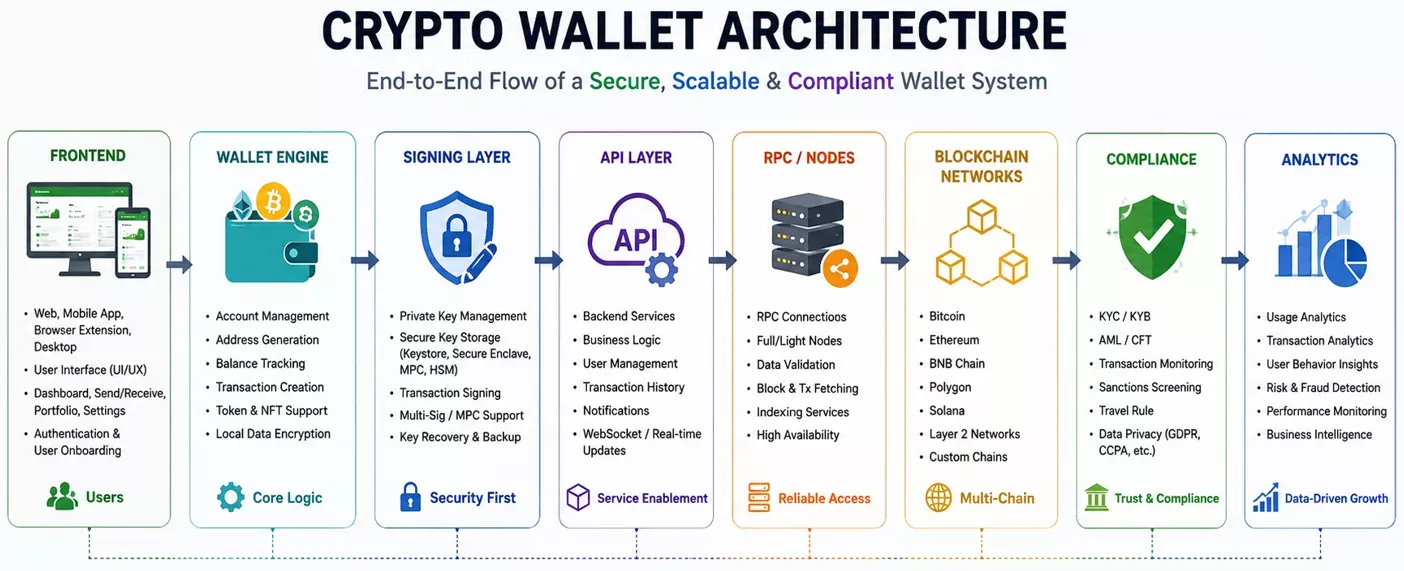
Custom vs White Label vs Wallet-as-a-Service: Which Is More Cost-Effective?
The cheapest initial option is not necessarily the lowest-cost option over the product lifecycle.
Custom Crypto Wallet Development
Custom engineering offers maximum architectural, branding, integration, security, and roadmap control.
White Label Crypto Wallet Development
Reusable wallet components are the bedrock of white-label infrastructure, reducing development effort when requirements match the underlying framework.
Embedded Wallet SDKs and Wallet-as-a-Service
WaaS can speed up key management and onboarding but brings with it provider pricing, contractual dependency, and migration considerations.
Open-Source Wallet Forking
Forking can reduce initial engineering but still requires security review, modernization, customization, testing, and ongoing upstream maintenance.
Why Cheap Clone Scripts Can Add to Your Technical Debt
Cheap builds are expensive to maintain because of unsupported dependencies, bad cryptography, incomplete documentation, and inflexible architecture.
Which Development Model has the lowest TCO in the long term?
The correct comparison is custom vs white label vs WaaS over several years, not only their launch prices.
Estimate Your MVP Crypto Wallet Cost Before You Build
Prioritize essential wallet creation, transfers, authentication, transaction history, and blockchain connectivity before investing in advanced functionality.
Request A ProposalIn-House or Crypto Wallet Development Company: Which is Better?
The right delivery model is based on technical capability, hiring capacity, roadmap ownership, and operational maturity.
In-House Wallet Development
Internal teams provide direct control but require wallet, blockchain, DevOps, QA, security, product, and compliance expertise.
Specialized Crypto Wallet Development Company
A specialized partner can bring established architecture patterns, blockchain experience, integration knowledge, and security workflows into one delivery model.
Freelance Development Team
Freelancers may suit narrow prototypes but create coordination, continuity, and ownership risks for larger production systems.
Hybrid Development Model
Businesses can retain product ownership internally while using specialists for blockchain, custody, security, or infrastructure components.
Why the Lowest Hourly Rate Does Not Mean the Lowest Project Cost
A more useful model is
Total Project Cost = Engineering + Security + Infrastructure + Integrations + Compliance Engineering + QA + Audit + Rework + Maintenance
How Long Does Crypto Wallet Development Take?
A PoC may require a few months, while advanced multi-chain, Web3, or enterprise systems can require six months or considerably longer. Current competitor estimates similarly show timelines expanding with complexity.
What Hidden and Post-Launch Costs Should You Include in Your Budget?
The cost to create a cryptocurrency wallet continues after the mainnet launch.
RPC and Node Provider Fees
Usage grows with chains, traffic, and query volume.
Blockchain Indexing and Market-Data APIs
Portfolio and transaction intelligence may depend on commercial services.
Cloud Hosting and Infrastructure Scaling
Database, cache, logging, notification, and redundancy requirements rise with adoption.
Security Re-Audits and Vulnerability Management
Major architecture or smart-contract changes can trigger additional testing.
OS, Browser, and App Store Updates
Platform changes require continuing compatibility work.
Blockchain Forks, Network Upgrades, and New Token Standards
Wallets must adapt as supported ecosystems evolve.
Customer Support and Account-Recovery Operations
Recovery and transaction support can become material operating expenses.
Monitoring, Logging, and Incident Response
Production wallets need observability and procedures for identifying abnormal behavior.
Vendor Lock-In and Migration Costs
Switching custody, RPC, analytics, or WaaS providers can involve significant engineering.
What Is the 3-Year Total Cost of Owning a Crypto Wallet?
A development quote shows the launch investment; total cost of ownership shows the business commitment.
Initial Product Development and Launch
Year-one spending includes design, engineering, testing, deployment, audits, and launch preparation.
Annual Infrastructure and API Costs
RPC, cloud, compliance, analytics, fiat, indexing, and other external services generate recurring expenditure.
Maintenance and Security Updates
Dependencies, devices, networks, APIs, and threat models continue evolving.
Compliance and Monitoring Costs
Relevant businesses may need continuing transaction monitoring and reporting infrastructure.
New Feature and Blockchain Integration Costs
Market expansion often introduces new chains, smart wallets, swaps, staking, or enterprise features.
Customer Support and Incident Management
Support, recovery processes, monitoring, and incident response should be forecast from the start.
3-Year Wallet TCO = Initial Development + Infrastructure + Third-Party APIs + Security + Maintenance + Compliance Engineering + Feature Expansion + Support
How Much Does It Cost to Build a Wallet Like MetaMask, Trust Wallet, or Coinbase Wallet?
Comparable-product queries help with initial planning, but no credible vendor can determine exact development cost from a brand name alone.
Cost to Build a Wallet Like MetaMask
Scope may include mobile and browser experiences, EVM support, dApp connectivity, token swaps, account management, and phishing protection.
Cost to Build a Wallet Like Trust Wallet
Broad network coverage, token discovery, staking, NFTs, swaps, and consumer-scale UX increase complexity.
Cost to Build a Wallet Like Coinbase Wallet
Comparable functionality can include Web3 connectivity, multiple networks, smart-account experiences, and ecosystem integrations.
Why Feature Parity Does Not Mean Cost Parity
Feature parity ≠ architecture parity ≠ security parity ≠ infrastructure parity ≠ operational parity.
Copying visible screens does not reproduce the systems beneath them.
How to Reduce Wallet Development Cost Without Compromising Security
Start with deliberate chain coverage, phase nonessential features, use maintained SDKs, avoid inventing cryptography, design modular architecture, budget security early, and evaluate managed infrastructure where it reduces operational burden.
How Should You Evaluate a Crypto Wallet Development Quote?
A useful quote should explain what the business is buying rather than present one unexplained price.
Is the Custody Architecture Clearly Defined?
The proposal should state who controls keys and how signing and recovery work.
Which Blockchains and Token Standards Are Included?
Networks and supported asset standards should be explicit.
Are Mobile, Web and Extension Platforms Clearly Scoped?
Do not assume one interface implies the others.
Are Security Audits Included?
Separate internal QA from independent security assessment.
Are API and Third-Party Fees Separated?
Recurring provider charges should be visible.
Is Source-Code Ownership Included?
Clarify ownership, repositories, deployment assets, documentation, and licensing.
What Post-Launch Support Is Included?
Define warranty periods, maintenance, monitoring, and response commitments.
How Are Scope Changes Priced?
A formal change process reduces budget disputes.
Are Maintenance and Security SLAs Defined?
Production systems need measurable operational commitments.
Is the 3-Year TCO Explained?
The lowest initial estimate may become expensive when you include recurring fees and maintenance.
Lead Magnet: 25-Point Crypto Wallet Development Quote Checklist
Request Your Crypto Wallet Development Cost Estimate
Turn your product requirements into a scope-based estimate covering development, integrations, security, infrastructure, timeline, and post-launch ownership costs.
Contact UsHow Does Troniex Technologies Estimate Crypto Wallet Development Cost?
Troniex Technologies approaches wallet pricing through requirements and architecture rather than applying one generic figure to every product. Its wallet services cover multi-chain, Web3, custodial, non-custodial, MPC, and related architectures.
Business and Product Requirements
Define target users, transactions, jurisdictions, business model, rollout strategy, and product objectives.
Custody and Key-Management Architecture
Choose custodial, non-custodial, MPC, multi-signature, smart-account, or hybrid signing architecture.
Blockchain and Platform Requirements
Map supported chains and determine whether the product needs iOS, Android, web, browser extension, or desktop interfaces.
Feature and API Integration Mapping
Identify swaps, staking, NFTs, fiat services, compliance providers, market data, dApps, notifications, analytics, and external APIs.
Security and Compliance Scope
Define signing protection, authentication, penetration testing, audits, KYC/KYT integrations, monitoring, and relevant data controls.
Engineering Timeline and Resource Planning
Estimate UI/UX, frontend, backend, blockchain, QA, DevOps, security, and project-management effort.
Maintenance and 3-Year TCO Forecast
Model infrastructure, providers, support, new chains, feature expansion, audits, maintenance, and other post-launch costs.
Crypto wallet development can make commercial sense for exchanges, fintech companies, Web3 startups, DeFi platforms, payment businesses, institutional asset platforms, and enterprise treasury products when wallet infrastructure directly supports customer access, digital-asset operations, or new revenue-generating services.