Cost of Building vs Buying AI Agents: Real Costs, Failures, and What Actually Works
Buying is cheaper for fast deployment, but building wins at scale (over 10,000 monthly transactions) or for core IP. Hidden costs like data cleaning and monitoring can double budgets. While platforms serve as excellent "training wheels," custom builds offer better long-term ROI and control for high-volume, competitive workflows. Case-by-case execution determines if you hit a 6x return.
Jan 30, 2026
12 mins read
Most "build vs buy" conversations about AI agents start with pricing.
Teams ask two questions.
- How much does it cost to build?
- How much is the SaaS license?
You miss the real issue.
AI agent projects fail for execution reasons. Teams underestimate data problems. Workflows break easily. Integrations take months. Nobody owns the project. Production differs from demos. Agents behave unpredictably.
This article skips traditional cost comparisons. Engineering hours do not determine success. Vendor fees matter less than you think.
Outcomes depend on three factors.
- Who owns the system?
- Who handles failures?
- Does your organization treat AI as a living system?
SMEs avoid six-figure mistakes with this approach. Mid-market teams scale past pilots. Enterprises deliver real ROI.
Your decision excludes build versus buy. You decide if your organization owns the consequences of your choice.

Tired of AI Agent Pilots that Fizzle?
Troniex Technologies, a premier AI Agent Development Company, helps to build your own outcomes, data, and workflows.
Talk To Our ExpertsThe AI Cost Iceberg: Quoted Prices vs Real First-Year Spend
AI agent budgets start with quoted prices. Teams approve them. Real first-year spend doubles.
What Vendors And Teams Usually Budget For?
Quoted build costs range from $75K to $300K. You see engineers for months. LLM API usage. Cloud hosting. Vague maintenance lines. Numbers look manageable.
Quoted buy costs range from $5K to $50K. Platform subscription. Setup fees. Short pilot budget. Teams see fast value. Low risk.
The eight hidden cost categories that distort ROI
Spend ends up 1.5 to 2x higher.
Data & Model Costs
Data preparation and governance
Data preparation takes 20 to 30 percent of budgets. You clean CRM records. Fix inconsistent fields. Label examples. Business rules change. Data decays. Teams assume data works. Data rarely works.
Model retraining and performance decay
Model retraining costs $10K to $100K yearly. Q1 agents fail by Q3. Customer language shifts. Products evolve. Edge cases grow. Accuracy drops without tuning.
Infrastructure & operations
Inference costs spike at volume. Each API call looks cheap. Millions of calls add up. Vector storage hits $2,500 monthly. Logging for compliance doubles storage spend.
Monitoring, observability, and debugging
Monitoring tools cost $1K to $3K monthly. Agents produce wrong answers without errors. You need dashboards. Traces. Human review loops. Tools run continuously.
Organization & risk
Security, compliance, and legal exposure
Security audits cost $25K to $75K yearly. Prompt injection leaks data. Bad outputs create liability. Pen tests slow deployment. Access controls add overhead.
Talent and opportunity cost
Talent pulls senior engineers from revenue work. Data specialists tune models. DevOps manages infrastructure. Six-figure salaries compound over months.
Change management and adoption
Change management costs $20K to $50K. Staff reject agents without training. Workflows need redesign. Support teams handle distrust. Adoption determines ROI.
Build or buy triggers these costs. Vendors hide them in subscriptions. Internal teams face them upfront. Wrong budgets anchor to software models. AI agents demand living system budgets.
Buying AI Agents: Cost Deferral, Not Cost Elimination
Buying AI agents postpones costs. You do not eliminate them.
You choose buy to avoid complexity. You push costs into usage and scale.
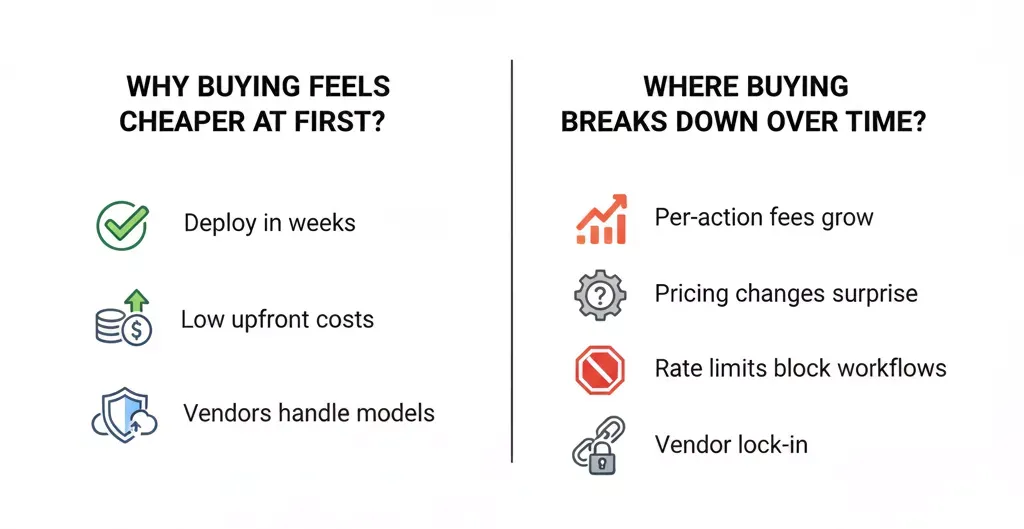
Why buying feels cheaper at first?
You deploy in weeks. Demos impress stakeholders. Pilots show early wins. Speed beats months of engineering.
Upfront costs stay low. No six-figure builds. No new hires. Subscriptions feel optional.
Vendors handle models and hosting. Your team focuses on business logic.
These benefits front-load. Downsides compound over time.
Where buying breaks down over time?
Per-action fees grow with volume. Platforms charge per message. Per workflow step. Low usage hides costs. Scale turns fees into taxes.
Pricing changes surprise teams. Vendors reprice models. Monthly bills double. Usage stays constant.
Rate limits block critical workflows. Time-sensitive tasks slow. Premium tiers unlock basics. You lose control.
Vendor lock-in traps workflows. Prompts tie to platforms. Migrations create downtime. Retraining disrupts operations.
Buying Summary: When The Math Works, When It Collapses?
Buying works when:
- Usage is low to moderate
- Workflows are standardized
- Speed matters more than optimization
- You’re still validating ROI
- The math collapses when:
- Volume increases
- Customization becomes necessary
- Reliability matters more than convenience
- AI becomes core to operations
This is the real trade-off: control vs convenience. Buying gives you speed and simplicity early. It takes away cost predictability and ownership later.
For many teams, buying is the correct first move. The mistake is assuming it stays cheap forever.
Also Read: Stammer AI Clone Script: Build Your Own AI Voice Agent Platform
Building AI Agents: Where Most Teams Underestimate Reality
Building AI agents works in development. Production exposes problems.
In controlled environments, limited data, known inputs, cooperative users, custom agents behave well. Demos pass. Test accuracy looks high. Stakeholders get confident. Then the system hits production, and the economics change.
Why Custom Builds Fail In Production, Not Development?
Multi-step workflows lose reliability. Each step works 95 percent of time. Five steps drop to 77 percent overall. Ten steps hit 60 percent. Production demands chains of steps.
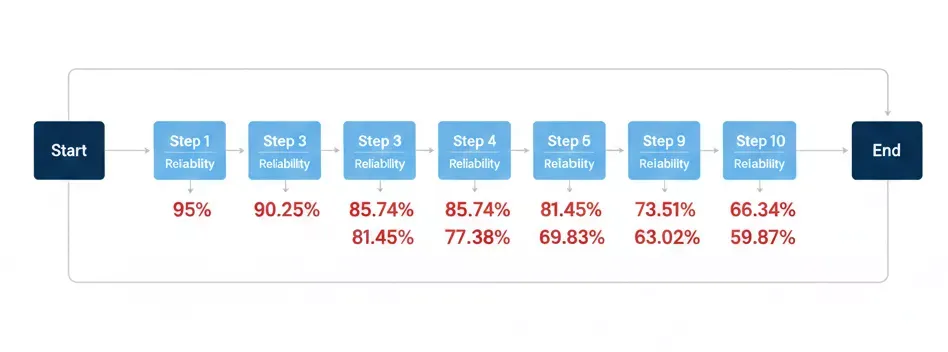
Test-to-production accuracy drops 20 to 30 percent. Users phrase queries oddly. Real inputs break assumptions. Benchmarks miss this gap. No code changes cause the drop.
Edge cases dominate production. Unusual phrasing derails workflows. Conflicting constraints halt agents. Brittle systems break daily.
Hallucination, Drift, And Inconsistency As Operational Problems
Agents fail silently. Traditional software crashes with logs. Agents return wrong answers confidently. Validation layers catch few errors.
Same inputs produce different outputs. Model updates change behavior. Prompt variations create variance. Deterministic processes receive probabilistic results.
Wrong outputs create business risk. Compliance errors trigger audits. Customer errors lose trust. Costs appear as escalations, not budget lines.
Debugging And Observability As First-Class Costs
Agents produce wrong answers without stack traces. You replay prompts. You inspect intermediate steps. You reconstruct context after failures.
Teams spend days diagnosing issues. Data changes cause silent failures. External APIs shift behavior. Fixes require retraining or re-prompting.
Monitoring runs continuously. Accuracy checks track performance. Cost dashboards watch spend. Anomaly detection flags issues. Human review loops remain permanent.
Production exposes development gaps. Custom agents demand living system budgets. You build for controlled tests. You operate in a messy reality.
Why Most AI Agent ROI Disappoints (Regardless Of Build Or Buy)
By the time teams start calculating ROI, most AI agent projects have already lost the game.
Not because the technology didn’t work, but because success was never clearly defined, protected, or operationalized.
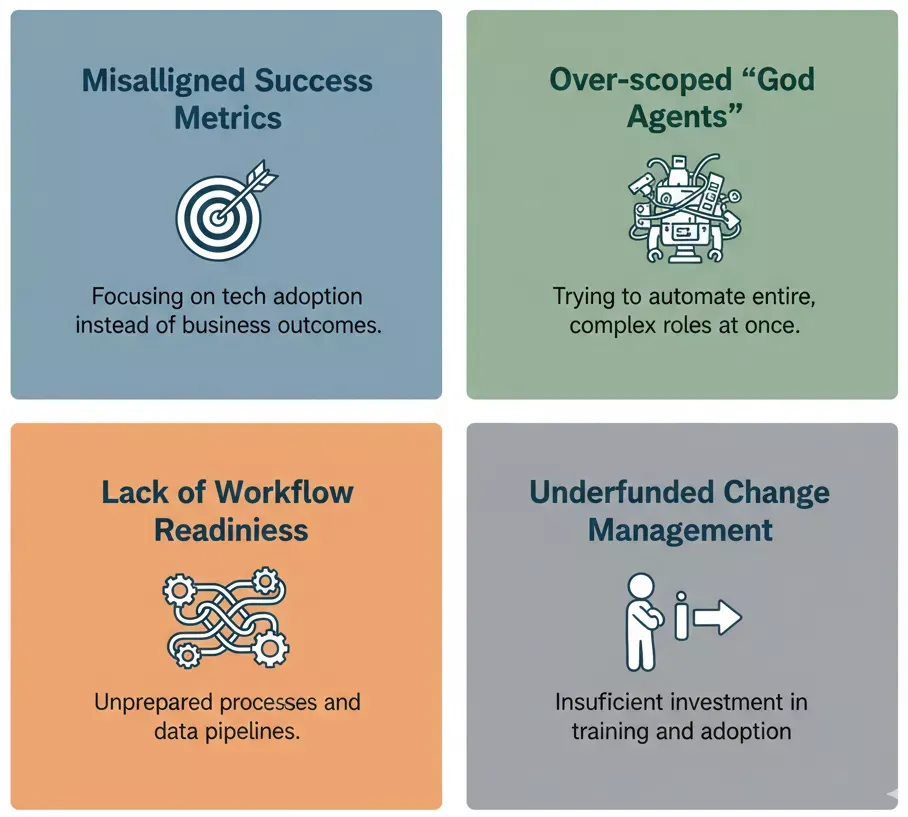
This pattern shows up whether teams build in-house or buy from vendors.
Misaligned success metrics
You track model accuracy. Response quality. Task completion rates. You ignore business outcomes. Resolution time stays flat. Conversions show no lift.
Human workloads persist. Metrics create debates. Agents appear functional. ROI stays unproven.
Over-scoped "God agents"
Early wins expand scope. Agents handle support. Leads. System updates. Exceptions. Reliability drops to 60 percent in multi-step chains. Costs double. Oversight triples.
Agents create work instead of eliminating work.
Lack of workflow readiness
Agents expose broken processes. Workflows lack documentation. Inputs vary. Handoffs confuse. Edge cases consume 70 percent of runtime. Agents function technically. Operations fail.
Underfunded change management
Staff bypass agents without training. Communication skips rollout plans. Feedback loops disappear. Agents run. Costs accrue. Humans default to manual work. ROI hits zero.
Organizations overestimate technology. Execution determines outcomes. Fix execution before chasing ROI.
When AI Agents Actually Work: Repeatable Success Patterns
AI agents work when ambition is boring and scope is tight.
Every real success story I’ve seen follows the same pattern. Different industries. Different tools. Same constraints.
Narrow, high-friction problems
You assign one objective. Classify tickets. Qualify leads. Retrieve answers. Broader scope fails.
You define pass/fail metrics. Ticket resolves without escalation. Lead routes correctly. Humans agree on success. Optimization follows.
Customer support as the most reliable category
Support workflows repeat daily. Inputs vary. Outcomes measure easily. Escalation paths exist. Humans intervene on failures.
Agents handle Tier-1 and Tier-2 tickets. SaaS companies report 30 percent resolution time drops. Fintech sees 25 percent fewer escalations. Healthcare operations cut repeat inquiries by 20 percent.
Revenue acceleration beats cost reduction
Agents respond to leads in seconds. Close rates rise 15 percent. Speed compounds across thousands of opportunities.
Agents flag churn risks early. Routing improves 40 percent. Retention grows through faster intervention.
Guided interactions lift conversions 18 percent. Qualification filters weak leads. Revenue appears directly.
Teams measure ROI correctly
You track outcomes. Dollars moved. Hours saved. Error rates reduced.
You avoid activity metrics. Conversations handled. Tokens consumed. Tasks completed.
Median ROI hits 10 percent because teams scale early. They measure usage, not value. Top teams capture 3 to 6x returns.
You succeed with narrow scope. You measure business outcomes. You accept human oversight. Agents deliver leverage.
Build Vs Buy Decision Framework (Non-Ideological)
The build vs buy decision isn’t philosophical. It’s situational.
Teams get stuck arguing ideology, control vs speed, ownership vs flexibility, when the real answer is contextual. The right choice depends on economics, risk, and organizational maturity, not technical purity.
When Building Makes Sense?
You run differentiated workflows. Custom logic creates advantage. Platforms fail on edge cases. Domain reasoning sets you apart.
High volume shifts economics. Per-action fees grow punitive. You predict heavy usage. Ownership beats subscriptions after 12 months.
Regulations demand control. Data residency requires ownership. Audit trails need design. Security reviews block vendors.
AI forms core IP. You build product capabilities. Outsourcing creates risk. Knowledge stays internal.
When Buying Makes Sense?
Speed beats optimization. You test assumptions fast. Demand validation precedes builds. Progress appears in weeks.
Budgets limit engineering. Small teams lack runway. Subscriptions predict costs. Internal projects expand.
Workflows match standards. Support triage runs generic. Lead qualification exists. Reinvention wastes time.
AI maturity stays low. Operations lack experience. Vendors provide guardrails. Risk drops despite long-term fees.
You choose based on trade-offs. Building shifts costs upfront. Buying spreads costs over time. Hybrids emerge from reality.
Ready to apply this Build vs Buy framework to your AI needs? Partner with Troniex Technologies, a leading AI Agent Development Company, for expert guidance on custom builds, smart buys, or hybrid solutions that drive your business forward.
The Hybrid Model Most Successful Organizations Converge On
You buy commodity capabilities. Generic NLP runs standard. Retrieval follows patterns. Workflow orchestration exists. Integrations match vendors. You save engineering time.
You build competitive differentiation. Domain logic creates advantage. Decision rules stay proprietary. Custom pipelines process unique data. Control matters here.
You govern centrally. Teams avoid tool sprawl. Prompts stay consistent. Costs track predictably. Reliability receives ownership. Standards cover data, evaluation, security. Systems stay operable.
Why Hybrid Outperforms Pure Strategies?
- Cost control: You avoid vendor premiums on generic tasks. You prevent internal builds for solved problems.
- Flexibility: You swap vendors without rewrites. You upgrade models independently. You internalize components over time.
- Incremental ownership: You rent capabilities first. You own what proves valuable. Maturity guides ownership decisions.
Pain Points By Stakeholder (Who Absorbs The Damage)
Technical teams
- Infra overload: AI agents add pipelines. Model endpoints multiply. Vector stores grow. Monitoring layers stack. Small projects become platforms.
- Debugging paralysis: Failures lack clear causes. Data drift confuses diagnosis. Model updates shift behavior. Engineers chase probabilistic issues.
- Cost volatility: API bills spike without warning. Engineers contain costs. They lose improvement time.
Business leaders
- Budget overruns: Costs creep through new use cases. Volume grows quietly. Reversal becomes expensive.
- Missed ROI: Dashboards show activity. Impact stays unproven. Projects run without value proof.
- Timeline erosion: Delivery dates slip. Reliability work extends timelines. Quarters become years.
SMBs
- Capital constraints: Mistakes consume growth budgets. Vendor bills surprise cash flow.
- Skills gaps: Teams lack evaluation skills. Monitoring requires learning. Cost control demands expertise.
- Vendor dependency: Pricing shifts hit hardest. Negotiating power stays low. Replacement creates disruption.
Stakeholder alignment determines outcomes. You match decisions to readiness. Technology follows execution.
Organizational Readiness: The Real Success Predictor
Organizational readiness predicts success. Foundations beat models.
Readiness checklist
- Problem clarity
- Measurable success metrics
- Data quality
- Documented workflows
- Governance
- Change management
- Continuous monitoring
Readiness thresholds and outcome patterns
- You hit five or more factors. Expect 3x ROI in year one.
- You hit two or fewer factors. Projects fail operationally.
- Readiness creates outcomes. Weak foundations guarantee disappointment.
The Myth of Fully Autonomous AI Agents
Fully autonomous AI agents exist as marketing claims. Operations demand humans.
Why human-in-the-loop persists?
Ambiguity blocks automation. Edge cases consume 70 percent of runtime. You own decisions and consequences.
Automation hits ceilings
Workflows reach 65 to 75 percent coverage. Oversight costs exceed savings beyond this point.
Escalation controls risk
Reliable agents hand off cleanly. You define triggers. You preserve trust. Systems scale with humans.
Agents compress routine work. You escalate uncertain cases. Vendors overpromise autonomy. You operate realistic systems.
Also Read: How Autonomous AI Agents Make Money?
High-Stakes Domains: When Building is Unavoidable
In high-stakes domains, “buy” stops being a shortcut and starts being a liability.
Crypto, DeFi, compliance, and financial workflows face constant adversarial conditions. Edge cases dominate operations. One error creates regulatory exposure. Financial losses hit instantly. Transactions reverse poorly.
Buying fails here. Generic platforms lack precision. Transaction logic stays hidden. Validation layers run shallow. Audit trails vanish. You own vendor failures.
You accept higher upfront costs. Rollouts proceed slowly. Conservative design prevails. Human oversight runs continuously. Explicit rules override models. Deep testing prevents disasters.
Conclusion
Build vs buy is a false binary. Costs, risk, and failure ownership determine outcomes.
Execution drives ROI. You scope narrowly. You measure outcomes. You fund operations.
Hidden costs end projects. Unbudgeted monitoring accrues. Integrations delay delivery. Change blocks adoption. Debugging consumes time.
You optimize systems. Workflows receive priority. Governance prevents sprawl. Economics guide decisions. Build creates advantage. Buy covers commodities.