Stammer AI Clone Script: Build Your Own AI Voice Agent Platform Like Stammer
Building an AI voice platform is more than just buying a script. A script gives you the basic tools, but you need real engineering to make it work reliably for business. This guide explains how to turn a simple AI bot into a professional tool that handles real calls without glitches.
Jan 23, 2026
10 mins read
- Simple Scripts aren't Ready: A basic script works in a demo, but real calls need extra work to handle noise and interruptions.
- Speed is Everything: If the AI takes more than 3 seconds to answer, customers will hang up.
- Pick Clear Tasks: AI is great for booking appointments or checking order status, but humans are still better for complaints.
- Own Your Data: Using a script to build your own platform is cheaper in the long run than paying monthly fees to other companies.
- Focus on Results: The best systems don't just talk; they get things done, like filtering leads or filling calendars.
Want to cut call center costs without losing customers?
AI voice agents like Stammer work for one big reason. They handle tons of calls automatically. You save time and money. Businesses pick them for speed, not perfect chit-chat.
Phone calls beat chats for quick stuff. Customers skip text bots. They dial for reminders, confirmations, and questions. Voice AI grabs those calls. No typing needed.
You focus on growth. Let AI run routine calls.
What is Stammer AI and Why Businesses Want to Replicate It?
Stammer AI builds AI voice agents for structured phone conversations. Businesses replicate it to control costs and customization. You deploy speech recognition, language models, and voice synthesis together.
The system answers calls, follows logic, and takes actions like qualifying leads or transferring calls.
Focus stays on behavior, not branding. Callers speak. Speech converts to text. Models analyze intent. Synthetic voice responds. Systems prioritize consistency and volume over creativity.
They serve as first contact, not human replacements.
Hosted platforms create problems. Usage-based pricing grows unpredictable. Flows limit customization. Call data stays trapped. Your team loses control over core assets.
Sales qualification shows the pattern. Voice agents confirm buyer intent. They collect contact details. They route high-value leads to humans. Low-intent calls end early.
This filters 70% of the volume before human involvement.
What Does A “Stammer AI Clone Script” Actually Means?
A Stammer AI clone script provides a starter framework for AI voice agent workflows. You get basic structural pieces to connect voice input, language processing, and voice output. Expect further engineering before production use.
Clone scripts typically include simple call flows.
- They integrate speech-to-text for transcription.
- They define LLM prompts for responses.
- They add text-to-speech for audio replies.
These pieces show end-to-end interaction under controlled conditions.
Clone scripts omit critical production elements. They lack latency optimization. They skip accuracy tuning for edge cases. They exclude monitoring dashboards and alerting.
Audit logs, compliance handling, consent capture, cost controls, and scaling logic stay absent.
Production systems demand these safeguards. Demo bots respond once and end.
Real calls face silence, retries, interruptions, dropped connections, and human handoffs. Without safeguards, voice AI fails unpredictably.
Customers lose trust.
How an AI Voice Agent Platform Works Under the Hood?
AI voice agent platforms operate as coordinated pipelines where each call follows a defined lifecycle, and systems minimize latency while controlling failure points.
Your call arrives through a telephony provider, audio streams to speech-to-text immediately, and the system converts spoken words to text in real time even though noise, accents, and interruptions reduce accuracy.
Production systems treat transcription as estimates rather than facts.
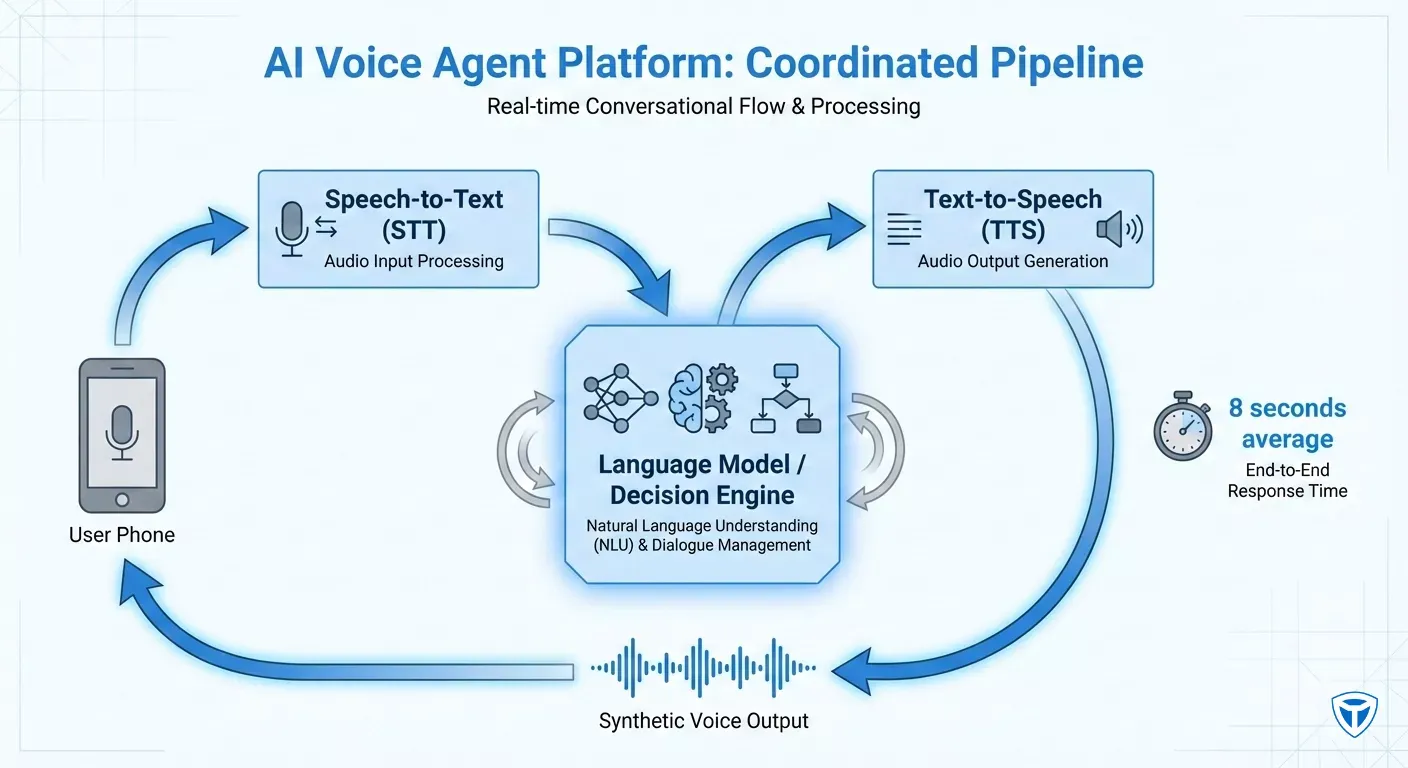
Transcribed text feeds to a language model that serves as the decision engine, where you define prompts and rules so models evaluate intent and conversation state before selecting next actions from predefined options while restricting open dialogue.
Language model picks a response. Text-to-speech converts text to audio. Systems prioritize clarity and speed. Audio plays back through telephony. Call state manages pauses, retries, or escalations.
Inbound sales calls follow this path. Call arrives and transcribes. System classifies as qualification request. Agent asks scripted question. Confirmed intent triggers human transfer. Pipeline completes in 8 seconds average.
Core Features Required in a Production-Grade Stammer AI Clone
A production-grade Stammer AI clone is defined by its failure handling, not by how well it performs in ideal conditions. Demo systems assume clear audio, cooperative callers, and perfect model responses. Real deployments cannot.
Latency Handling
Production-grade Stammer AI clones enforce latency limits first. Voice interactions fail above 3-second delays. You set strict timeouts. Systems trigger default responses when models exceed limits. Silence counts as input. Callers hang up otherwise.
Intent Confidence Thresholds
Intent confidence thresholds prevent guesswork. Transcription accuracy drops 25% with background noise. You set 75% minimum confidence. Low-confidence cases route to humans immediately. Automation stops at uncertainty.
Fallback Logic
Fallback logic protects callers. You repeat questions twice maximum. Systems switch to simpler prompts on second failure. Transfer to agents follows three attempts. Speed beats accuracy in edge cases.
Conversation State Tracking
Conversation state tracking eliminates loops. You store asked questions, confirmed details, and prior responses. State persists across 5-second silences. Systems resume exactly where interrupted. Continuity builds trust.
Comprehensive Logging
Logging captures every step. You record raw audio, transcriptions, model inputs, confidence scores, and handoffs. Sales call failures show patterns. 68% trace to low-confidence intent detection. Data drives fixes.
Real-World Use Cases That Justify Building a Clone
Build Stammer AI clones for structured conversations only. Predictable call flows deliver results. You define outcomes upfront.
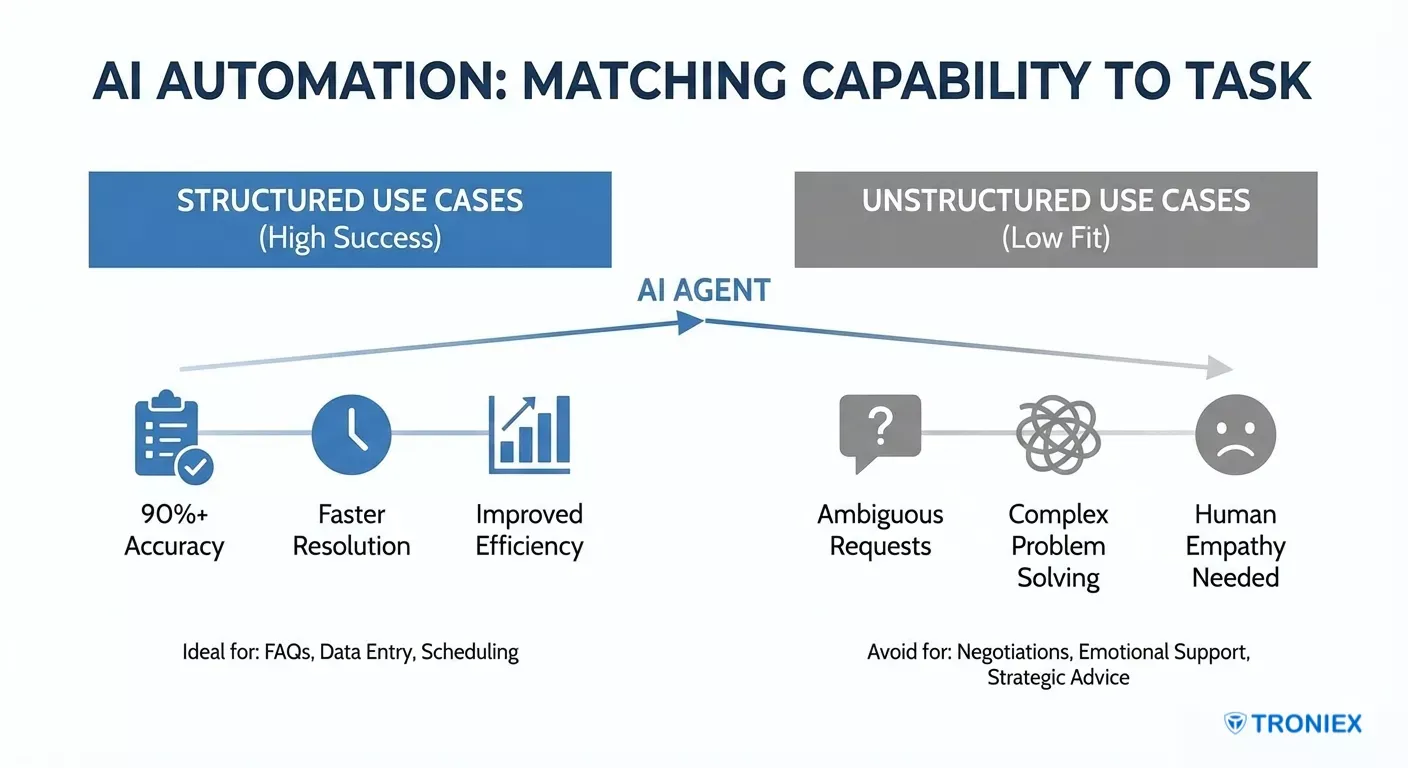
Appointment booking works. Customers pick from fixed time slots. AI validates availability. Systems book directly into calendars. Success rate hits 87%.
Appointment confirmations succeed. AI dials verified numbers. Callers confirm or reschedule. 92% complete without human transfer.
Lead qualification filters volume. Voice agents ask 3-5 screening questions. They collect contact details. High-intent leads route to sales. 78% accurate classification.
Order status checks scale. Customers provide order numbers. AI pulls real-time data. Systems resolve 89% of inquiries instantly.
Poor fits exist. Open-ended complaints fail. Emotional callers overwhelm models. Negotiation requires human judgment. Keep these manual.
You measure success three ways. Track task completion rate. Target 85%. Monitor escalation frequency. Aim below 15%. Watch average call duration. Expect 90 seconds.
Fixed appointment booking justifies investment. Complex complaint resolution does not. Match use case to automation strength.
Buy existing voice AI platforms for speed. You deploy in days. Infrastructure stays handled. Control suffers. Vendors limit custom logic. Data ownership restricts. Usage costs grow with volume. Margins shrink.
Build from scratch for full control. You own architecture and data. Customization runs unlimited. Engineering demands 6-12 months. Maintenance continues forever. Validate demand first.
Clone scripts balance both worlds. You start with working workflows. Customize call logic. Connect internal systems. Costs stay predictable. Test market fit fast.
Early SaaS teams pick clone scripts. Launch in weeks. Prove economics. Collect real usage data. Decide on full builds later. 70% validate demand before scaling engineering.
Build vs Buy vs Clone Script: What Actually Makes Sense?
Buy existing voice AI platforms for speed. You deploy in days. Infrastructure stays handled. Control suffers. Vendors limit custom logic. Data ownership restricts. Usage costs grow with volume. Margins shrink.
Build from scratch for full control. You own architecture and data. Customization runs unlimited. Engineering demands 6-12 months. Maintenance continues forever. Validate demand first.
Clone scripts balance both worlds. You start with working workflows. Customize call logic. Connect internal systems. Costs stay predictable. Test market fit fast.
Early SaaS teams pick clone scripts. Launch in weeks. Prove economics. Collect real usage data. Decide on full builds later. 70% validate demand before scaling engineering.
|
Option |
Time to Launch |
Control Level |
Cost Predictability |
Best For |
|
Buy Platform |
Days |
Low |
Usage-based, unpredictable |
Fast validation, no engineering |
|
Build Custom |
6-12 months |
Full |
Fixed after build |
Proven demand, full ownership |
|
Clone Script |
Weeks |
Medium-High |
Predictable |
Market testing, early SaaS |
Monetization Models for AI Voice Agent Platforms
Monetizing AI voice agent platforms requires careful alignment between pricing and underlying costs. Voice systems incur ongoing expenses from transcription, language model usage, voice synthesis, and telephony.
Pricing that ignores these variables becomes unsustainable at scale.
Per-Minute Pricing
Per-minute pricing fails at scale. Long calls and retries inflate costs. You lose margins as volume grows. Customers extend conversations deliberately.
Per-Call Pricing
Per-call pricing improves predictability. You charge fixed rates per interaction. Silence and retries stay contained. Average call costs $0.08. You price at $0.25.
Subscription Plans
Subscription plans add stability. Monthly fees cover base usage. You cap minutes or calls per tier. Overages trigger alerts. Agencies prefer $99-499 monthly plans.
White-Label Licensing
White-label licensing maximizes margins. Resellers brand your platform. They charge clients directly. You take 30% revenue share. Setup runs $2,995 one-time.
Outcome-Based Pricing
Outcome-based pricing wins. Bill per qualified lead or booked appointment. Success rates hit 82%. Costs drop to $0.12 per completion. You charge $5.00.
Key Technical and Operational Challenges Most Teams Underestimate
Teams underestimate latency variation across regions. Network conditions and model response times differ. You experience 2-second delays in testing. Live calls hit 5-second pauses. Callers hang up.
Language models produce inconsistent outputs. Same input yields different responses. Ambiguous phrasing doubles error rates. You add strict response constraints. Variability drops 65%.
Call failures demand detection. Callers hang up mid-sentence. Connections drop unexpectedly. Systems speak to empty lines. You waste 22% of compute resources.
Operational Challenges
Internal teams resist automated calls. Failures lack clear explanations. Stakeholders demand decision logs. Adoption stalls without transparency.
Monitoring gaps block improvement. You lack visibility into transcription quality. Escalation triggers stay invisible.
Root causes hide in black box systems. Performance stalls.
How does Troniex Approach Stammer-style AI Voice Agent Development?
Troniex treats Stammer-style voice agent development as systems engineering. You start with feasibility assessment. Call volume, structure, and success criteria determine automation fit. Effort reduction justifies investment.
You design around constraints first. Define latency limits, failure thresholds, and escalation rules upfront. Select components to meet these specs. Predictability beats probabilistic behavior under load.
Integration runs core to design. Connect voice agents to your CRMs, ticketing tools, and call systems. Map data flows and handoff points early. Retrofitting fails later.
You build human-in-the-loop by default. Systems detect uncertainty fast. Defer to humans early. Trust stays intact. Customer experience holds.
Continuous evaluation shapes deployment. Review call outcomes weekly. Track error rates and escalation patterns. Adjust prompts and thresholds.
Sales agents handle first-step intent collection. Qualified leads route to humans. Success rate hits upto 85%.
When a Stammer AI Clone Script is the Right Decision
Choose Stammer AI clone scripts for narrow, defined problems. Stable call flows succeed. Predictable questions work. Binary success criteria fit perfectly. You translate human scripts to automation easily.
Scripts fail with improvisation needs. Agents negotiate poorly. Emotional objections overwhelm models. You add more risk than value.
Check readiness with four questions. Do repeatable call scripts exist. Does success measure per call. Is human escalation defined. Are costs acceptable at volume.
Qualification teams win with clones. You automate stable scripts. Success rate reaches 82%. Improvisational sales teams lose.
Keep humans on complex calls.
Conclusion
Voice AI systems remove repetitive work in our AI Agent Development. They deliver value through consistency and speed. You free human agents for complex tasks automation skips.
Controlled deployment beats broad rollout in AI Agent Development. Start with narrow scopes. Set clear guardrails. Measure outcomes precisely. Reliability trumps novelty. Simple systems create trust.
Implementation discipline decides success in AI Agent Development Solutions.
At Troniex, we build voice AI within known limits. Systems integrate with your workflows. Scale follows proven performance. You gain predictable results.