AI Agent Development for Small and Medium Businesses: Practical Guide
In 2026, SMBs win with AI by replacing "shiny object syndrome" with a 90-day ROI-first roadmap. Success requires connecting specialized agents to proprietary data while using Human-in-the-Loop guardrails to stop hallucinations. Prioritize narrow, high-frequency workflows over general automation to turn technical debt into a 3.7x financial return.
Oct 08, 2026
10 mins read
- The 90-Day Kill Switch: If your AI agent doesn't show measurable value by day 91, it’s a failure. Focus on rapid, 3-month deployment cycles to protect your budget.
- The 30-Minute Intern Rule: Only automate tasks a human intern could learn in 30 minutes. High-frequency, low-complexity wins provide the fastest path to ROI.
- Legacy Systems Kill ROI: Aging CRMs and messy data are the primary causes of project failure. Clean your data before you write a single line of AI code.
- Autonomy is a Myth: Build "Human-in-the-Loop" systems. Let AI handle 90% of the volume, but ensure it pings a human for edge cases to protect your brand.
- Budget for the "AI Tax": Deployment is only 40% of the cost. Always budget an extra 15% for monthly token creep, model tuning, and API maintenance.
AI agents sound like a dream for SME’s, But Are They Burning Your Budget?
Want AI agents that work for your business, not against it?
Good AI agents could save up to 114 hours per year and return $3.70 for every $1 invested. Most SMBs still lose money on them.
Here's why yours won't.
But for every win, three projects die after six months.
Most owners trip between the sales pitch and real payback.
By 2026, tech isn't the problem. Poor rollout is.
This guide gives founders, CTOs, and ops folks a clear path to AI agents that deliver ROI without blowing the budget.
Start small. Win big…
💡 Why listen to Troniex?
We’ve analyzed 50+ AI rollouts in 2025. Our framework focuses on preventing "Token Creep" and ensuring your AI doesn't become a "black box" expense.

Ready to Build AI Agents That Actually Save Money?
Skip the guesswork. Talk to Troniex experts today & eliminate "Token Creep" and boost productivity up to 4X.
Talk To Our ExpertsWhat Actually Stops SMBs from Building AI Agents?
Big companies have endless servers and AI teams. SMBs don't. These four roadblocks decide if your project lives or dies, before you write any code.
Legacy systems drag everything down
SMB tech stacks are a mess: decade-old CRMs, Excel-only accounting, undocumented inventory apps. AI needs solid APIs, but yours don't exist. Quick fixes pile up as debt, stretching two-week jobs to three months.
We recently helped a $10M wholesale client bridge a 2012 ERP with a modern Sales Agent. By building a custom "data-cleaning" middleware first, we cut their order processing time by 65% without replacing their legacy software.
Error rates that hit hard
Enterprises shrug off 2% mistakes. For you, that's a lost client or bad press. AI hallucinations, spouting wrong info with total confidence, can't happen when every customer counts. No room for "fail fast" here.
Like a support bot promising refunds on non-refundable items, leaving you to cover the bill.
Costs that sneak up
Model fees are cheap. The real bill, data prep, integrations, endless tweaks, add up fast. Dev work is just 40%; token usage explodes in real workflows. Then models update, and you tune forever.
A $15k MVP hits $45k after one extra warehouse link.
Bad data kills it quietly
Junk data means junk output, no matter the model. Your CRM has duplicates, silos, and no structure. Gemini or GPT-4o just speeds up the garbage.
Dead leads get marked "hot," burning sales hours.
Most agencies will sell you a 'fully autonomous' bot. Don't buy it. We build 'Escalation-First' agents. If the AI is only 80% sure, it asks a human. This one rule prevents 99% of brand-damaging hallucinations.
- Raja Sekar, CTO, Troniex Technologies
Market Realities Most Small and Medium Businesses Underestimate
Before building a custom agent, you must understand the environment you are launching into. The "AI Gold Rush" of 2024 has settled into a 2026 reality defined by two factors: price and outcome.
Beat the $20/month trap
You are effectively competing with "generic" tools like ChatGPT or Microsoft Copilot.
If your custom agent doesn't do something fundamentally more specialized than a $20 subscription, you are wasting money.
Generic AI is great for drafting emails; vertical AI is for running workflows.
"Interested" doesn't mean they'll buy
In the SMB world, everyone says they want AI until it's time to pay for it. Most "interested" users are looking for a magic wand.
If your agent requires a 90-day implementation period and a high upfront cost, the "sounds great" conversation will end as soon as the credit card is requested.
They want results, not tech
SMBs don't care about "agents" or "large language models." They care about the outcome.
An agent that generates a "configurable dashboard" is less valuable than a simple automation that ensures every invoice is paid on time.
Where AI Agents Actually Deliver Measurable Value for Small & Medium Businesses?
If you want ROI, focus on high-frequency, low-complexity tasks. According to 2025-2026 data, these four areas offer the fastest path to profitability.
- Customer support automation
- Sales qualification and lead scoring
- Operational and back-office automation
- E-commerce personalization
How SMB’s Should Choose the Right AI Agent Use Case?
The "shiny object syndrome" is the fastest way to blow your budget. To succeed, you must use a ruthless evaluation matrix.
Start with friction, not ambition
Don't try to "transform your business." Instead, find the one task that everyone hates doing.
Look for narrow decision loops, tasks where the steps are clear and the data is available.
Rule of Thumb: If a new intern can learn the task in 30 minutes, an AI agent can likely do it.
The SMB use-case evaluation matrix
Score every potential project from 1 to 10 on these three metrics:
- Impact: How much money does this save/make?
- Feasibility: Is the data clean and accessible?
- Risk: What happens if the agent gets it wrong?
Target the "Quick Wins": High Impact, High Feasibility, Low Risk (e.g., Support Triage).
What a Realistic AI Agent Architecture Looks Like for SMBs?
Fancy designs fail fast. Aim for reliability. Build a "human-in-the-loop" (HITL) system. The agent handles 90% of tasks. It knows when to pause and ping a human.
Example: The AI drafts the email response to a customer complaint, but a human hits 'Send' after a quick 2-second review.
Hybrid Approach
Skip full autonomy. Design agents to escalate smartly. They process routine work. Humans step in for edge cases. This cuts errors and builds trust.
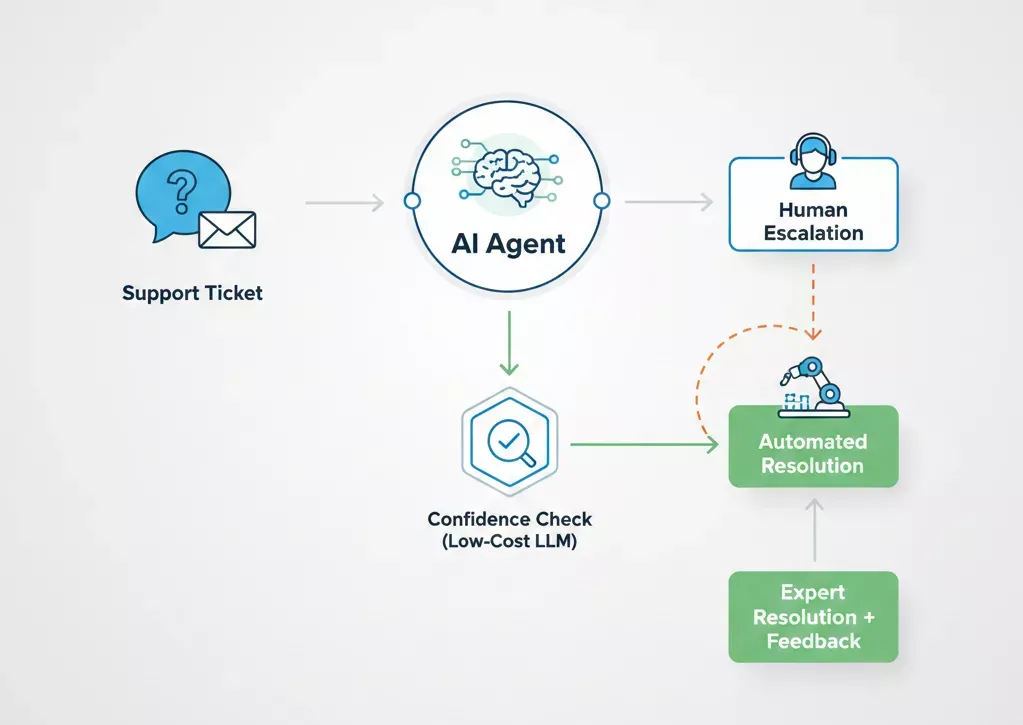
Safety Checks
Layer in "guardrail" models. These are small, low-cost LLMs. Their job: Check the main agent's output. Spot errors, wrong facts, or off tone. Reroute bad ones before they ship.
No-Code vs. Custom Builds
In 2026, start with no-code. Tools like Relevance AI or Zapier Central handle most needs. Fast setup, low cost.
Switch to custom only if needed: Python with LangGraph for complex chains. Use when off-the-shelf skips multi-step logic or unique rules.
This stack keeps costs down. Delivers steady wins. Scales as you grow.
At Troniex Technologies, we help founders with HITL expertise. Our clients see agents live 3x longer and ROI hit in weeks, not months.
Your Realistic 90-Day AI Agent Launch Plan
Success follows a specific timeline. If you haven't seen value by day 91, the project is likely a failure.
|
Days |
Phase |
Key Actions |
|
1–30 |
Discovery |
Audit data. Check storage and cleanliness. Pick one KPI (e.g., cut ticket time 40%). |
|
31–60 |
Prototyping |
Map workflow. Build HITL version. Staff approves all AI outputs first. |
|
61–90 |
Pilot & Scale |
Test on 10% traffic. Track KPI daily. Scale if accuracy >95%. |
What Consistently Fails in SMB AI Agent Projects?
Avoid these four "death traps" that wipe out 90% of SMB AI project efforts:
- Features over fixes: Chasing shiny add-ons before nailing the main pain. Solve one problem first.
- One agent for everything: No jack-of-all-trades bots. They hallucinate across sales, support, and HR. Build narrow specialists.
- Budget blind spots: Ignore the 15% monthly hit for updates and fixes. It adds up.
- Build and bail: Agents drift like bad hires. Tune data, review output, or they rot.
Governance, Risk, and Adoption Reality
The technology is easy; the people are hard. Successful adoption requires Change Management.
Employees must see the agent as a tool that removes their "grunt work," not a replacement for their job.
Establish clear Escalation Rules:
- When should the AI stop talking?
- Who owns the AI's "mistakes"?
In 2026, brand safety is a board-level concern, even for a 5-person startup.
How Troniex approaches AI agent development for SMBs?
We design for your limits. Deliver enterprise reliability on a small-business budget.
We skip the LLM models selection and features upfront. We check ROI first. Every project kicks off with one question: Does this deliver real impact in 90 days? If the Answer is - NO! - It stops there.
Design fits your constraints from the start, old software, spotty APIs, messy data, small teams. No ripping out stacks or shaky hacks. We build inside those walls.
Integrations account for legacy junk. Controlled flows, middleware, and backups cut debt and risk.
Humans oversee from launch. We limit solo runs on risky stuff, accuracy, rules, brand. Escalations, logs, and approvals set day one.
After go-live, no "set it and forget it." We track accuracy, costs, escalations, and KPIs. Tune as things shift.
Find the right AI development company in the UK by reviewing providers, services, expertise, and development capabilities.
Conclusion: The Reality Check SMBs Need
AI Agent Development boosts teams without replacing people or decisions. They speedup workflows, add consistency, and grow capacity in tight spots. Wrong or ineffective usage? Should leverage the Risks, costs, and breakdowns.
Small and Medium scale business should win with small, locked-down bets, not grand overhauls. One agent slashing reply times, weeding out junk leads, or killing paperwork beats tangled systems that never launch.
Top agents hide in the background. They earn keep through numbers, not flash. Can't prove worth fast? It's debt, not gain.
Do this:
- Pinpoint one repeat headache.
- Build for steady output, not tricks.
- Keep humans checking until the data says running autonomously.
- Only grow what already pays off by hand.
Most SMBs are sitting on one "Gold Mine" workflow that could pay for an entire AI build in 3 months.
Stop guessing. Let’s audit.
What you get: A 15-minute diagnostic call to find your highest-ROI use case.
The Goal: We’ll tell you if your data is ready or if you’re heading for an "AI Tax" trap.
Ready to Build AI Agents for Your Business?
Most SMBs lack in-house AI expertise, which is why partnering with a custom AI development company that understands your budget constraints and business goals can accelerate your time-to-value. We offer flexible engagement models, from proof-of-concept pilots starting at $35K to full production systems, specifically designed for small and medium businesses.
Frequently Asked Questions
Basic AI agent implementations start around $5,000 – $15,000 using no-code tools. Custom, integrated agents with proprietary data typically range from $30,000 or more.
A production-ready AI agent deployment usually takes 4 to 12 weeks. This includes data auditing (Weeks 1–2), prototyping and "Human-in-the-Loop" testing (Weeks 3–6), and a phased public rollout with performance stabilization (Weeks 7–12).
Well-scoped projects should show a positive ROI within 3 to 6 months. If it takes longer than a year, the complexity is likely too high.
Rarely, AI agents serve as force multipliers, not replacements. They usually "replace" the 20% of an employee's day spent on repetitive data entry, allowing them to focus on higher-value tasks.
Yes, provided you use Private LLM instances (like Azure OpenAI or Google Vertex AI) where your data isn't used to train public models.
SMBs should invest in custom AI development when they require:- Proprietary Data Integration: Using internal SOPs or customer history to guide AI actions.
- Workflow Automation: Moving beyond text generation to executing tasks in CRMs or ERPs.
- Strict Security: Ensuring data privacy for HIPAA, GDPR, or SOC2 compliance.
- SMBs should invest in custom AI development when they require:
- Proprietary Data Integration: Using internal SOPs or customer history to guide AI actions.
- Workflow Automation: Moving beyond text generation to executing tasks in CRMs or ERPs.
- Strict Security: Ensuring data privacy for HIPAA, GDPR, or SOC2 compliance.