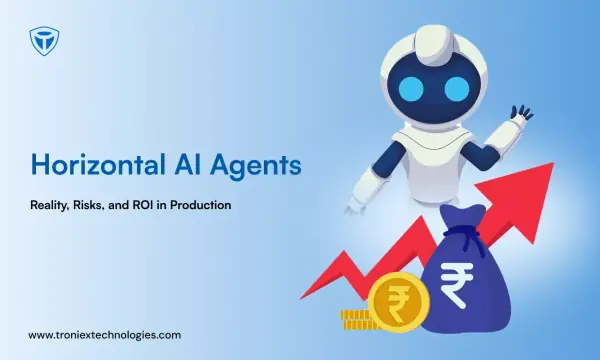
Horizontal AI Agents: What Works, What Breaks, and What Pays Off
A horizontal AI agent automates workflows across multiple departments and tools. Support, sales, finance, and ops all connect through one AI system. Vertical agents handle single tasks. Horizontal agents link tasks end-to-end. This guide shows you when they work, when they fail, and what the real costs look like in production.
Mar 26, 2026
12 mins read
Horizontal AI agents work. Most teams fail to deploy them in production.
Benchmarks show 200 to 400 percent ROI in year one for well-scoped agents. Payback hits inside six months. Technova Partners shares this from post-deployment data.
Scale kills them. EMA research finds 70 to 80 percent of pilots stall before rollout. Founders confirm this on Reddit and in operator groups.
Models suffice. GPT-4 class handles cross-functional workflows.
Failures stem from data mess, weak integrations, vague ownership, and absent governance post-demo.
This guide targets CTOs, founders, and ops leaders. You face pressure to deploy agents in sales, support, finance, or operations. You guard trust and budgets.
If you’re deciding whether a horizontal AI agent should live in production or stay a slide deck idea, this is the reality check you need.
What Is a Horizontal AI Agent (And Why It’s Misunderstood)
Horizontal AI agents span workflows, tools, and departments. They link support software, CRMs, billing platforms, and internal docs. They coordinate actions end to end.
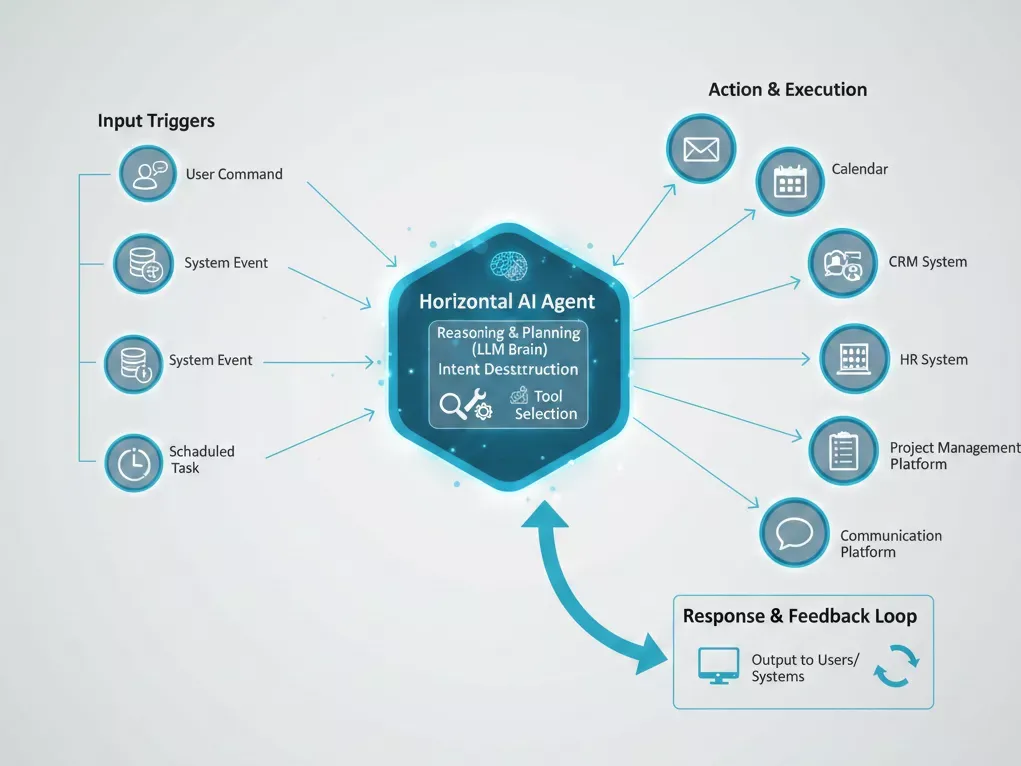
Vertical AI agents focus on one domain and one outcome.
You build horizontal agents for broad operations. You limit vertical agents to single tasks.
|
Dimension |
Horizontal AI Agent |
Vertical AI Agent |
|
Scope |
Cross-department |
Single function |
|
System access |
Multiple tools |
One or two tools |
|
Depth |
Shallow-to-medium |
Deep, domain-specific |
|
Risk profile |
Higher |
Lower |
|
Example |
Support + CRM + billing |
Invoice processing only |
Leaders pick horizontal agents. You cut tools and vendors. You add one AI layer across teams. You automate work without new hires.
Vendor pitches sell one agent for all. Demos prove this. Production hits edge cases.
Horizontal agents resolve support tickets, update CRMs, and adjust billing in one flow.
Vertical agents process invoices. They run faster, cost less, and risk less.
You treat horizontal agents as orchestration systems. Pilots die when you expect magic employees.
Why Horizontal AI Agents Fail in Production (The Real Reasons)
This is where most “AI agent” blog posts get vague. They blame the model. Or the prompt. Or “immature tooling.” That’s not what actually kills horizontal agents in the wild.
What kills them is friction. Trust gaps. Cost surprises. Data messes. Integrations nobody budgeted for. And zero governance once the agent leaves the demo environment.
Let’s break this down properly.
Trust & Reliability: The Non-Negotiable Blocker
Here’s a stat that should make any CTO pause: 54% of teams trust manual processes more than AI-driven ones. Not because humans are better, but because humans are predictable. Horizontal AI agents aren’t. At least not yet.
The most common failure modes are boring and brutal:
- Hallucinations (confidently wrong actions or data)
- Execution loops (retrying the same failed step endlessly)
- Context loss across long, multi-system workflows
In a cross-functional setup, even a 1–2% error rate is unacceptable. One bad CRM update. One incorrect billing adjustment. One wrong internal approval. That’s all it takes for teams to quietly stop using the agent.
A law firm tested this. Their agent triaged cases and pulled precedents. It hallucinated citations in live work. Trust vanished. Fixes added guardrails, retrieval limits, and human checks. Adoption lagged after three weeks.
Horizontal agents don’t fail because they’re dumb. They fail because real workflows have near-zero tolerance for “mostly right.”
The Real Cost of Horizontal Agents (Token Shock Included)
Most teams massively underestimate cost because they fixate on the wrong line item: LLM API usage.
In practice, model usage is only 20–30% of the total cost of ownership. The real spend hides elsewhere, in engineering time, integrations, monitoring, retries, and ongoing tuning.
When all of that lands, true TCO ends up 3–5× higher than initial forecasts.
Token use spikes hit hard. Agents keep long contexts. They call tools per task. They retry failures. They run nonstop.
Maintain long context windows
- Call multiple tools per task
- Retry on partial failures
- Run continuously, not on demand
What looked like a $2K/month OpenAI bill quietly becomes $8K–$12K once usage stabilizes.
CFOs hate this. Variable, usage-based pricing with no hard ceiling is poison for budgeting.
Real-world numbers are consistent across vendors and consultancies:
- Initial deployment: $75K–$250K
- Monitoring + tuning: $3K–$15K per month
This is why many pilots “pause” after finance review. The agent worked. The spreadsheet didn’t.
Data Quality: The Silent Project Killer
If you ask teams why their horizontal agent failed, they’ll say “accuracy” or “hallucinations.” If you dig deeper, it’s almost always data quality.
Poor data blocks 58 percent of projects. Teams blame accuracy or hallucinations. Data quality causes both.
Horizontal agents amplify data problems because they sit across systems:
- Inconsistent CRM fields
- Missing historical records
- Conflicting business logic between tools
Everyone assumes “we’ll clean it as we go.” That never works. Data prep takes weeks, not days and nobody budgets for it.
An e-commerce team learned this. They cleaned Zendesk, Shopify, and docs data over eight weeks. They deflected 67 percent of tickets in month one.
The lesson is simple: horizontal agents don’t fix bad data. They expose it loudly.
Integration Complexity (The Stealth Budget Drain)
This is the failure mode nobody puts on the roadmap.
About 46% of teams cite integration complexity as the top blocker for horizontal AI agents, and that number feels low if you’ve dealt with real enterprise stacks.
The issue isn’t modern SaaS tools. It’s the long tail:
- Legacy phone systems with no APIs
- Homegrown ERPs with undocumented logic
- “Temporary” scripts that became mission-critical
Horizontal agents touch everything, which means they inherit every past technical compromise.
Two common war stories:
- Support agents need PBX context. Teams build $30K middleware.
- SAP approvals demand refactors. Delays hit 12 weeks.
Across projects, the numbers repeat:
- Integration cost: $75K–$250K
- Timeline impact: 6–12 weeks
This is why demos succeed and production stalls. Demos don’t integrate with the messy parts of the business. Production does.
Governance & Observability (Why Most Agents Are Unsafe)
Nearly 80% of AI agents in production lack proper visibility, and only ~2% have clearly assigned accountability.
Most AI agents act like black boxes. You give them input. They do something inside. They spit out an action. When it breaks, you can't answer three simple questions:
- Why did the agent do this?
- Who approved this behavior?
- How do we prevent it next time?
That’s a compliance nightmare.
Real governance isn’t fancy. It’s boring but essential:
- Action-level logging
- Permission boundaries per system
- Human override paths
- Clear ownership (someone is on the hook)
Setting this up takes effort.
- Initial governance requires time and setup costs.
- Ongoing monitoring needs regular attention.
But skipping it is worse. Black-box agents don’t fail loudly. They fail quietly until audit, security, or finance finds them.
Horizontal AI agents aren’t unsafe by default. Ungoverned ones are.
What Actually Works: The Proven Success Pattern
After all the failures, there is a pattern that keeps showing up in teams that get horizontal AI agents into production and keep them there.
It’s not exotic models or clever prompts. It’s restraint, sequencing, and brutal clarity on scope.
High-Confidence Use Cases That Consistently Win
Pick workflows with clear inputs, steady outputs, and easy backups. High-volume tasks where "good enough" works and mistakes fix fast.
|
Use case |
Why it works |
|
Tier-1 support |
Structured questions, clear escalation paths |
|
Lead qualification |
Rules-driven scoring + CRM updates |
|
Document processing |
Defined formats, repeatable logic |
|
Scheduling |
Binary outcomes (book / don’t book) |
Deployments show 80 to 90 percent success rates. You see payback in weeks. Support deflects tickets fast. Sales triages leads without manual work. Ops skips calendar and inbox checks.
Constraints drive wins. Agents execute in defined boundaries. They coordinate systems. They skip deep judgment.
Data Readiness Before Code (Non-Negotiable)
Every successful deployment I’ve seen starts with data, not code.
The condensed data readiness checklist is simple:
- Consistent field definitions across systems
- At least 12–24 months of usable historical data
- Known sources of truth (no duplicates fighting each other)
- Basic access controls already in place
Skip data cleaning. You fail right away.
One team rushed ahead. Another cleaned two years of CRM, support, and billing data first. The second team gained adoption and trust fast. They needed fewer guardrails and retries.
Agents inherit your data mess. They do not learn business rules. Clean data lets you scale.
Phased Rollout With KPIs (The 16-Week Reality)
The teams that succeed don’t launch big. They launch deliberately.
The pattern looks like this:
- Discovery (Weeks 1–3): scope one workflow, define KPIs
- Pilot (Weeks 4–7): limited users, strict guardrails
- Hardening (Weeks 8–11): error handling, logging, controls
- Scale (Weeks 12–16): expand access, monitor outcomes
Rush company-wide rollout. Error rates spike. Trust drops. You rollback quietly.
Technova Partners data shows phased rollouts pay back in 4 to 6 months. Rushed ones take 6 to 8 months or longer. You avoid rework.
Agents reward patience. You reach production fastest with fewest resets.
Change Management: The Hidden Make-or-Break Factor
Horizontal agent failures hide in behavior. Teams stop using them. They route around systems. They keep manual backups.
90 percent of failures stem from organizational issues. Fear tops the list. Teams see agents as job threats. Adoption ends day one.
Frontline roles resist most. Support, ops, and coordinators fear replacement. Leadership framing kills use. Teams escalate often. They give no feedback.
A contact center deployed password reset agents. Leaders called them headcount cutters. Use stayed low. Complaints rose. They paused, reframed as load reducers, and freed staff for complex work. Adoption rose fast. Handle times fell. Morale grew.
You build psychological safety first. Agents change workflows. Manage change or tech fails.
When Horizontal AI Agents Deliver Real ROI
Skeptical CTOs focus on real numbers from horizontal AI agents. Verified deployments deliver 200 to 400 percent Year-1 ROI. Payback hits in 3.8 to 6.2 months. You see results only in narrow, production use cases.
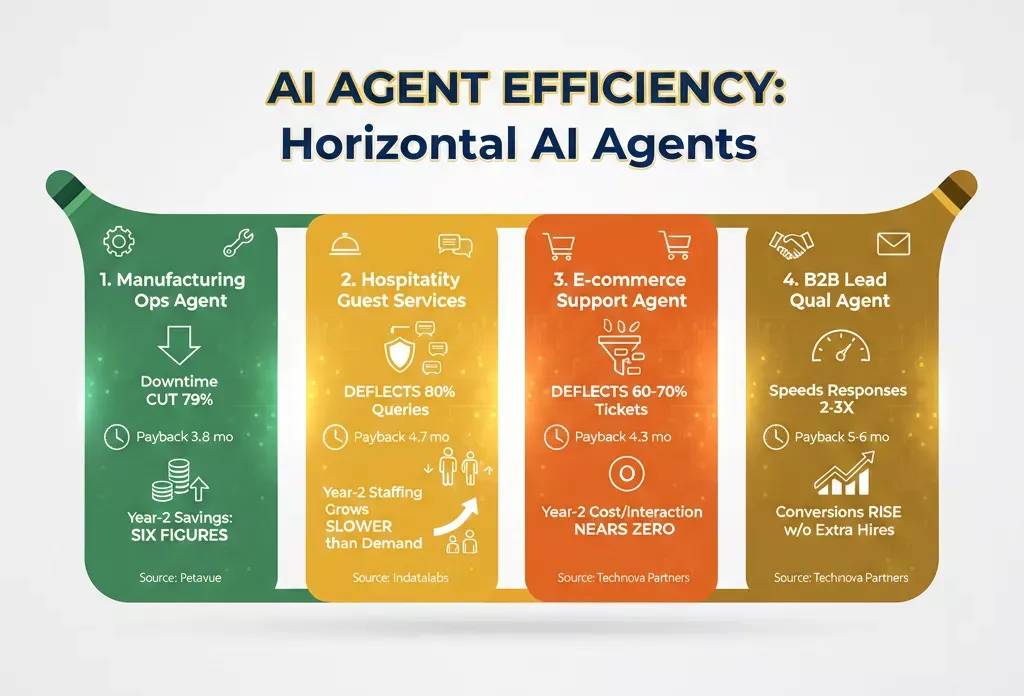
Year-2 ROI grows fast. Integration and data costs drop after Year-1. Usage rises as trust builds. Costs stay flat. Horizontal agents compound quickly after they prove themselves.
CTO Decision Framework: Should You Deploy?
Most decks skip this truth. Horizontal AI agents do not fit every case. They demand a smart bet. Teams decide with this clear checklist.
|
Decision |
Conditions |
Next Step |
|
YES - Proceed |
|
Deploy. Expect 200-400% Year-1 ROI. |
|
CAUTION - Narrow Scope |
|
Pick one focused use case. Skip broad agents. |
|
NO - Wait |
|
Hold off. Build foundations first. |
Brutal Takeaway: horizontal agents reward operational maturity. If your org isn’t there yet, the right move isn’t “no forever.” It’s “not yet.”
Conclusion: The Real 2026 Inflection Point
By 2026, no one will be debating whether AI agents actually work; teams are winning or losing based on their deployment maturity.
Data from top performers makes it clear: they skip the hype around fancy models and nail the basics first. Think clean data pipelines, rock-solid integrations, clear ownership, and tight controls. Meanwhile, others get stuck chasing endless pilots, erode trust, and end up blaming the tech.
An AI Agent Development Company knows horizontal agents can supercharge your operations, but only if your team's organized. Messy teams just amplify the chaos; strong ones stack quick wins that compound after Year 1, once integrations are live and learning curves flatten.
Skeptical CTOs hold an edge. They cut hype. They demand proof on trust, costs, and accountability. Aim for predictable results. Trackable impact. Systems auditors and boards approve.