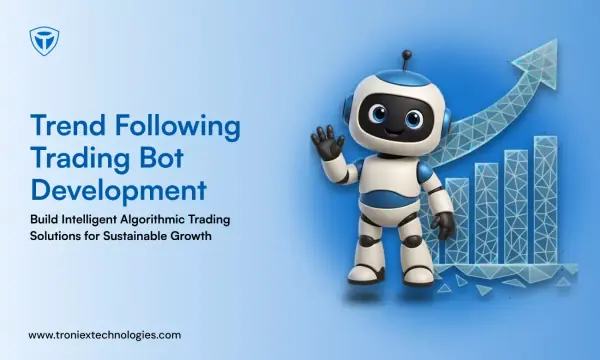
Trend Following Trading Bot Development: Build Intelligent Algorithmic Trading Solutions for Sustainable Growth
Launch AI-powered trend following trading bot development solutions with multi-exchange support, automation, and enterprise-grade security from Troniex.
Sep 11, 2026
16 mins read
Trend-following trading bot development is vital as automation reshapes finance, improving execution speed and minimizing emotional trading. These bots are essential for crypto exchanges, fintech startups, proprietary trading firms, and institutional investors leveraging data-driven strategies.
They exploit market trends, enabling rapid business actions without constant human oversight. The algorithmic trading market is projected to reach USD 42.99 billion by 2030, while automated crypto trading may grow to USD 66.6 billion by 2033, underscoring automation's importance.
A well-crafted trend-following bot enhances trading consistency, supports multiple exchanges, executes strategies swiftly, manages risk, and offers valuable analytics. Selecting the right technology partner is crucial for scalability, security, and profitability in bot development.
What Is Trend Following Trading Bot Development?
Trend following trading bot development refers to building automated systems that detect market trends and execute trades based on predefined rules. It combines trading strategy logic with software automation to help businesses capture momentum-driven opportunities efficiently across financial markets.
Understanding Trend Following in Algorithmic Trading
Trend following is one application of algorithmic trading development, where systematic rules transform market momentum signals into automated trading decisions. It relies on systematic rules and indicators to identify direction, allowing bots to follow market momentum and maintain positions until clear signals indicate trend exhaustion or reversal.
How Trend Following Bots Execute Trades Automatically
Trend following bots execute trades by analyzing real-time market data, generating signals through technical indicators, and placing orders via exchange APIs. The entire workflow, from detection to execution, is automated, ensuring fast, consistent, and emotion-free trading across volatile market conditions.
Trend Following vs Manual Trading
Trend following bots eliminate emotional bias present in manual trading by strictly following predefined rules. While manual traders rely on judgment and reaction time, bots execute decisions instantly, improving consistency, speed, and discipline in fast-moving financial markets and reducing costly human errors.
Trend Following vs Mean Reversion Strategies
Trend following strategies aim to profit from sustained market momentum, while mean reversion strategies assume prices will return to an average level. Bots using trend following hold positions longer during strong trends, whereas mean reversion systems focus on short-term price corrections.
How Does a Crypto Trend Following Trading Bot Work?
A trend-following trading bot continuously collects market data, identifies price movements, validates trading opportunities with technical indicators, and executes trades automatically based on set rules. Unlike manual trading, it operates with a structured workflow for faster execution, consistency, and disciplined risk management.
Developing a high-performance trading bot requires more than just connecting to an exchange; all components, from analysis to execution, must integrate smoothly for accurate and scalable performance.
Market Data Collection
The bot gathers real-time and historical market data from cryptocurrency exchanges using APIs. This includes price movements, volume, order book depth, and volatility metrics. Accurate data collection keeps the trading system reacting quickly to market changes and maintains reliable signal generation.
Technical Indicator Analysis
This stage processes market data using indicators like EMA, MACD, RSI, ADX, and ATR. The bot evaluates trend direction, momentum, and strength to filter noise. This helps ensure only high-probability market conditions are considered for trading decisions.
Trade Signal Generation
The system applies predefined strategy rules to confirm valid trading opportunities. When multiple indicators align, the bot generates buy or sell signals. This rule-based mechanism removes emotional bias and supports consistent, structured decision-making across varying market conditions.
Automated Order Execution
Once a signal is confirmed, the bot executes trades via exchange APIs. It places market or limit orders with defined stop-loss and take-profit levels. Execution happens instantly, ensuring minimal delay and improved accuracy in fast-moving cryptocurrency markets.
Position Monitoring and Exit Management
After execution, the bot continuously tracks open positions in real time. It adjusts stop-loss levels, locks profits, and exits trades based on strategy rules or market reversals. This achieves disciplined risk control and optimized trade performance.
Key Features of an AI-Powered Trend Following Trading Bot
A modern trend-following trading bot is an advanced system that analyzes markets, executes strategies accurately, and adapts to changing conditions using AI. For crypto exchanges and trading firms, feature depth is vital for profitability and scalability, ensuring efficient execution and optimization of strategies.
Multi-Exchange API Integration
Enables proper connectivity with multiple cryptocurrency exchanges securely through secure APIs, allowing simultaneous trading, liquidity aggregation, and arbitrage opportunities. It ensures faster execution, improved redundancy, and broader market access for scalable algorithmic trading operations across global digital asset platforms.
AI & Machine Learning Signal Optimization
Combining trend indicators with crypto price prediction models can provide an additional intelligence layer for evaluating momentum and potential market direction. It reduces false entries, adapts to volatility, and continuously improves strategy accuracy, making trading decisions more intelligent, adaptive, and performance-driven over time.
Real-Time Market Analysis Engine
Processes live market data instantly to identify emerging trends, price movements, and liquidity shifts. It ensures trading decisions are based on the most current information, improving execution timing, reducing latency, and strengthening responsiveness during high-volatility market conditions.
Smart Risk Management System
Dynamically manages trading risk by controlling position sizes, exposure limits, stop-loss levels, and portfolio balance. It protects capital during volatile conditions and ensures consistent risk-adjusted returns through automated safeguards and real-time portfolio monitoring mechanisms.
Portfolio Monitoring & Analytics Dashboard
Provides real-time visibility into trading performance, including profits, losses, active positions, and strategy effectiveness. It helps decision-makers evaluate performance, optimize allocations, and gain actionable insights for improving long-term trading outcomes and operational efficiency.
Backtesting & Paper Trading Environment
Allows strategies to be tested using historical data and simulated market conditions before live deployment. It helps validate performance, reduce risk, and refine algorithms through controlled experimentation across different market cycles and volatility scenarios.
TradingView Integration for Signal Automation
Connects TradingView indicators directly to the trading bot, enabling automatic execution of strategy signals. It streamlines workflow, eliminates manual intervention, and allows traders to deploy custom technical strategies with real-time precision and responsiveness.
Enterprise-Grade Security Layer
Implements strong security measures including encrypted API keys, role-based access control, audit logs, and secure authentication. It ensures protection of sensitive trading data and safeguards financial operations across multi-user and multi-exchange environments.
Adaptive Market Intelligence Layer
Continuously analyzes market conditions to detect regime changes such as trending, ranging, or volatile phases. It dynamically adjusts strategies and parameters, ensuring consistent performance across different market environments through intelligent, context-aware decision-making systems.

Build a High-Performance Trend Following Trading Bot Today
Start building automated trading systems that execute trend-based strategies with precision, speed, and zero emotional bias.
Talk To Our ExpertsTop Trend Following Strategies and Indicators Used in Trading Bots
Trend following trading bots use technical indicators and systematic strategies to identify market direction and execute trades accurately. These indicators filter noise, confirm trends, and establish optimal entry and exit points. AI-driven momentum models can also support leveraged trend trading when combined with disciplined position sizing.
Choosing the right strategies is crucial for algorithmic trading systems, as it affects profitability, risk, and long-term performance.
EMA & SMA Crossover Strategies
EMA and SMA crossover strategies identify trend direction by comparing short-term and long-term moving averages, generating buy or sell signals when crossovers occur, ensuring systematic and rule-based trade execution.
MACD Trend Confirmation Strategy
MACD (Moving Average Convergence Divergence) uses EMA(12) minus EMA(26) to generate momentum signals, with a signal line of EMA(9), helping trading bots validate entries, reduce false signals, and strengthen trend-following accuracy during evolving market conditions.
ADX for Trend Strength Measurement
ADX measures trend strength rather than direction, enabling bots to filter weak or sideways markets and execute trades only when strong directional momentum supports reliable trend-following opportunities.
Donchian Channel Breakout Strategy
Donchian Channel breakout strategy identifies price movements beyond recent highs or lows, allowing bots to capture early-stage trends and enter trades during strong breakout momentum phases.
Supertrend Strategy
Supertrend uses volatility-based calculations to determine bullish or bearish conditions, helping bots generate clear directional signals and maintain simplicity in automated trend-following trading systems.
ATR-Based Stop-Loss and Volatility Management
ATR-based management adjusts stop-loss levels dynamically based on market volatility, helping trading bots reduce premature exits while maintaining adaptive risk control across changing market conditions.
Multi-Indicator Strategy Combinations
Multi-indicator strategies combine EMA, MACD, ADX, and volume signals to improve accuracy, reduce false entries, and ensure trading decisions are validated through multiple confirmation layers.
These trend-following strategies are widely adopted across both cryptocurrency and traditional Forex markets.
Enterprise Architecture Behind a Scalable Trend Following Trading Bot
A scalable trend following trading bot relies on a modular, distributed architecture where each system component handles a specific responsibility such as data processing, strategy execution, order routing, and risk control to ensure performance, reliability, and enterprise-grade scalability.
Recommended Technology Stack
|
Layer |
Recommendation |
Reason |
|
Backend |
Node.js or Python |
Low-latency API handling, async processing |
|
Data Processing |
Redis Streams/Kafka |
Real-time market data pipeline |
|
Database |
TimescaleDB/InfluxDB |
Time-series market data storage |
|
API Connectivity |
WebSocket preferred |
Real-time market data feeds |
|
Security |
HashiCorp Vault/WASM |
Secure key management, isolated execution |
|
Cloud |
AWS/GCP multi-region |
Minimal latency, failover redundancy |
Strategy Engine
The Strategy Engine processes market data and applies predefined trading rules and indicators to generate buy or sell signals, forming the core decision-making layer of the entire trading system. This engine is typically part of larger algorithmic trading software development architecture used in institutional trading systems.
Order Management System (OMS)
The OMS handles trade execution, order lifecycle management, slippage control, and partial fills while ensuring accurate order placement across exchanges with minimal latency and consistent execution reliability.
Risk Management Engine
This engine enforces capital protection rules by controlling position sizing, exposure limits, stop-loss levels, and portfolio risk thresholds to prevent excessive losses and maintain trading discipline.
Market Data Processing Layer
It collects, cleans, and standardizes real-time and historical market data from multiple exchanges, ensuring accurate inputs for strategy evaluation and reducing noise-driven trading errors.
API Gateway & Exchange Connectivity
This layer securely connects the bot to multiple exchanges using APIs, handling authentication, rate limits, retries, and real-time data exchange for seamless and stable trade execution.
Cloud Infrastructure Layer
The cloud layer ensures scalability and uptime by using containerized deployments, load balancing, and auto-scaling systems, allowing uninterrupted trading during high volatility and peak market activity.
Security Framework
The Security Framework protects sensitive trading data using encryption, secure API key storage, role-based access control, and audit logging to ensure safe and compliant trading operations.
Trend Following Trading Bot Development Process
Creating a trend-following trading bot involves a structured engineering process that merges financial strategy with effective software development, ensuring the system is functional, scalable, secure, and optimized for real-world trading.
Requirement Analysis & Business Discovery
The development process begins with understanding the client’s trading goals, asset classes, risk appetite, and operational requirements.
This phase defines:
- Trading objectives
- Target exchanges
- Asset selection
- Budget constraints
- Risk tolerance levels
Clear requirements ensure the system is aligned with business outcomes. This step is similar to onboarding in crypto trading bot development services, where trading objectives define system architecture.
Strategy Design & Algorithm Development
Once requirements are defined, trading strategies are designed and converted into algorithmic logic.
This includes:
- Indicator selection (EMA, MACD, ADX, etc.)
- Entry and exit conditions
- Risk management rules
- Position sizing logic
- Multi-strategy configurations
This phase transforms trading ideas into executable logic.
System Architecture Design
Engineers design the full system architecture, including:
- Strategy engine structure
- Data flow pipelines
- Database schema
- API integrations
- Security model
A well-designed architecture ensures long-term scalability and maintainability.
Backend Development & Integration
This phase focuses on building the core system components.
It includes:
- Strategy engine implementation
- Exchange API integration
- Order execution logic
- Data processing systems
- Risk engine development
The backend forms the operational core of the trading bot. This phase overlaps with core engineering in HFT trading bot development projects requiring low-latency execution.
Testing, Simulation & Backtesting
Before deployment, the system undergoes rigorous testing to validate performance and reliability.
Testing includes:
- Historical backtesting across market cycles
- Paper trading in simulated environments
- Stress testing under high volatility
- Strategy optimization and tuning
This ensures the system performs reliably in real market conditions.
Deployment & Production Launch
Once validated, the system is deployed into production environments.
This involves:
- Cloud deployment setup
- CI/CD pipeline configuration
- Monitoring system activation
- Real-time trading activation
Deployment is designed for stability and zero-downtime operation.
Monitoring, Maintenance & Optimization
Post-deployment, continuous monitoring ensures system health and performance.
This includes:
- Performance tracking
- Bug fixes and updates
- Strategy refinements
- Infrastructure scaling
- Security patching
This ensures long-term operational stability and performance improvement.
Business Benefits and Use Cases of Trend Following Trading Bots
Trend following trading bots help businesses improve trading efficiency, automate execution, reduce emotional bias, and scale operations across multiple markets while improving profitability through consistent, data-driven decision-making and optimized risk management.
Case Study: Institutional Trend-Following Bot for Crypto Hedge Fund
A $50M AUM hedge fund deployed a custom trend following bot across 5 major exchanges. Results after 6 months:
- 23% improvement in signal accuracy (reduced false entries)
- 15ms average execution latency vs 200ms previous manual execution
- 12% reduction in max drawdown through adaptive stop-loss logic
- $2.3M in realized profits from systematic position management
This deployment demonstrates the measurable impact of proper architecture and risk controls.
Cryptocurrency Exchanges
Trend following trading bots enable exchanges to increase trading volume, improve liquidity, and offer automated trading features to users, resulting in higher platform engagement, retention, and long-term revenue growth.
Hedge Funds
Hedge funds use trend following bots to systematically capture market momentum, reduce manual trading dependency, and achieve stable risk-adjusted returns through automated, data-driven portfolio management and strategy execution.
Proprietary Trading Firms
Prop trading firms use these bots to execute high-speed strategies, optimize capital allocation, and scale multi-asset trading operations while improving consistency, efficiency, and profitability across volatile market conditions.
Fintech Startups
Fintech startups integrate trend following bots to launch automated trading products quickly, reduce development overhead, and offer users intelligent trading features that enhance engagement and platform monetization potential.
Brokerage Platforms
Brokerage platforms deploy trend following bots to attract active traders, increase transaction frequency, and deliver automated trading tools that improve user experience, retention rates, and overall trading volume.
Institutional Investors
Institutional investors use these bots to manage large portfolios efficiently, reduce human error, and execute disciplined, rule-based trading strategies that enhance long-term capital preservation and risk-adjusted performance.
Startups often combine this with AI trading bot development to launch scalable trading products faster.
Choose the Right Trend Following Trading Bot Solution
Compare SaaS bots, white-label platforms, and custom-built systems before making a decision.
Request A ProposalChoosing the Right Crypto Trend Following Trading Bot Solution
This section helps businesses decide between ready-made platforms and custom-built systems by evaluating cost, flexibility, scalability, and control. It directly supports commercial decision-making and vendor selection for long-term trading infrastructure investments.
Ready-Made Trading Bots
Ready-made trading bots offer quick deployment with prebuilt strategies and integrations. They suit beginners but often lack customization, scalability, and advanced risk controls required for institutional or enterprise trading environments.
White-Label Solutions
White-label trading bots allow businesses to rebrand existing platforms quickly. They reduce time-to-market but may limit innovation, customization depth, and long-term competitive differentiation in highly competitive trading ecosystems.
Open-Source Frameworks
Open-source frameworks provide flexible foundations for building trading bots with full control over logic and architecture. However, they require strong technical expertise, ongoing maintenance, and security management capabilities.
Fully Custom Development
Fully custom development delivers enterprise-grade trading systems tailored to specific strategies, infrastructure, and business goals. It offers maximum scalability, security, and performance but requires higher investment and development timelines.
Cost of Trend Following Trading Bot Development
Understanding the cost of trend following trading bot development is essential for planning investment, as pricing varies based on features, complexity, scalability, and integration requirements for enterprise-grade trading systems.
Key Cost Factors
Development cost depends on strategy complexity, number of indicators, exchange integrations, real-time data handling, UI requirements, and level of automation, security, and scalability required for production trading systems.
AI & Advanced Feature Costs
AI features such as machine learning models, predictive analytics, and adaptive strategy optimization increase development costs due to training data requirements, model tuning, and continuous performance improvement cycles.
Infrastructure & Maintenance
Ongoing infrastructure and maintenance costs include cloud hosting, server scaling, monitoring systems, security updates, API upkeep, and continuous optimization to ensure uninterrupted trading bot performance.
Estimated Budget by Project Complexity
Budget varies based on complexity, from basic bots with limited strategies to enterprise-grade systems with AI integration, multi-exchange support, advanced risk engines, and high-frequency execution capabilities.
ROI Considerations
ROI depends on trading efficiency, reduced manual intervention, improved execution speed, and long-term profitability gains achieved through automated strategies, consistent performance, and scalable trading infrastructure.
Why Choose Troniex Technologies for Trend Following Trading Bot Development?
Troniex Technologies delivers secure, scalable, and AI-driven trend following trading bot development tailored for enterprises, startups, and crypto trading businesses globally.
- Custom AI-Powered Solutions: Build intelligent, adaptive trading bots tailored to unique strategies.
- Enterprise-Grade Security: Implements strong encryption, access control, and secure trading infrastructure.
- Multi-Exchange Expertise: Smooth integration across major crypto exchanges with reliable execution.
- Dedicated Development Team: Experienced engineers focused exclusively on your trading bot project.
- Ongoing Technical Support: Continuous maintenance, monitoring, and performance optimization after deployment.
- End-to-End Project Delivery: Complete development lifecycle from concept to production deployment.
Partner With Experts in Trend Following Trading Bot Development
Work with experienced developers to design, build, and deploy custom trading automation systems.
Contact UsConclusion
Trend-following systems remain one of the most reliable approaches in algorithmic trading when combined with automation, risk controls, and data-driven execution. Businesses that invest in a trend-following trading bot development company gain a competitive advantage through speed, discipline, and scalability.
Whether you are a startup building a trading product or an enterprise optimizing execution infrastructure, a custom-built solution ensures long-term flexibility and performance.