Differences Between DCA and Grid Bot Trading: Which Strategy Is Best for Your Crypto Trading Platform?
Discover the key differences between DCA and Grid bot trading, including strategy mechanics, ROI potential, risk profiles, and ideal market conditions.
Aug 12, 2026
14 mins read
As cryptocurrency markets grow more competitive, automated trading has become essential for traders and fintech firms. Intelligent trading bots continuously monitor markets, execute orders quickly, and minimize emotional decision-making. This evolution is driving growth in algorithmic and AI-driven trading, making the choice of strategy crucial.
The automated crypto trading market is expected to expand from USD 22.2 billion in 2025 to USD 66.6 billion by 2033, with a CAGR of 14.8%. The broader algorithmic trading market is projected to increase from USD 23.5 billion in 2026 to USD 43.0 billion by 2030, fuelled by AI adoption.
Among popular strategies, dollar-cost averaging (DCA) and grid trading stand out for their systematic execution across various market conditions. Both strategies reduce emotional trading and improve efficiency but serve different goals and risk profiles. Choosing the wrong strategy can affect profitability and long-term success.
This guide explores the differences between DCA and Grid Bot Trading, detailing their mechanics, strengths, limitations, and ideal use cases within the context of crypto trading bot development. Whether launching a crypto exchange or developing an automated trading platform, this article will help you identify the best strategy for your objectives.
What Is a DCA Trading Bot and How Does It Work?
A dollar-cost averaging (DCA) trading bot automates crypto trading by placing buy or sell orders at set price intervals. It diversifies investments across multiple orders to mitigate short-term volatility and lower the average purchase price.
DCA bots track market trends and adjust trades based on parameters like investment size. If the market drops after a purchase, the bot buys more at lower prices to enhance the average entry cost, closing the position automatically when the profit target is met, thus reducing emotional trading.
Core Working Mechanism
- Executes an initial market or limit order.
- Places additional safety orders when prices move against the position.
- Recalculates the average entry price after each purchase.
- Automatically exits the trade once the profit target is achieved.
Best Market Conditions
DCA bots perform particularly well in bullish markets, gradual market recoveries, and temporary price corrections when long-term appreciation is expected.
Advantages
- Reduces emotional trading decisions.
- Lowers the average acquisition cost during market dips.
- Ideal for long-term investment strategies.
- Easy to configure for beginners and experienced traders alike.
Limitations
- Capital may remain tied up during prolonged bear markets.
- Returns can be slower than high-frequency trading strategies.
- Less effective in highly volatile sideways markets.
What Is a Grid Trading Bot and How Does It Work?
A grid trading bot is an automated system that profits from market fluctuations by placing buy and sell orders at set price intervals, known as "grids". It buys at lower levels and sells at higher ones, capturing small profits as prices fluctuate.
Traders define upper and lower boundaries, and the bot places evenly spaced orders. As the market moves, completed buy orders trigger sell orders, allowing continuous trading without manual input, making grid bots effective in range-bound markets.
Core Working Mechanism
- Defines upper and lower trading boundaries.
- Divides the price range into multiple grid levels.
- Places automated buy and sell orders across the grid.
- Reinvests profits as market movements trigger additional trades.
Best Market Conditions
Grid bots are most effective during sideways, range-bound, and moderately volatile markets where prices fluctuate without establishing a strong long-term trend.
Advantages
- Generates frequent trading opportunities.
- Maximizes profits from short-term price oscillations.
- Fully automated once configured.
- Suitable for active traders and high-volume trading platforms.
Limitations
- Performance declines during strong directional trends.
- Requires careful grid configuration and capital allocation.
- Poorly configured grids can increase drawdowns during extreme volatility.
Unlike DCA and Grid strategies, trend following trading focuses primarily on capturing sustained directional price movements.
DCA Bot vs Grid Bot: Complete Feature-by-Feature Comparison
DCA and Grid trading bots serve distinct purposes in crypto trading. A DCA bot gradually accumulates assets for long-term investors, while a Grid bot exploits short-term price changes through multiple buy and sell orders. Recognizing these differences aids traders in selecting the appropriate strategy for their goals and market conditions.
|
Feature |
DCA Trading Bot |
Grid Trading Bot |
|
Primary Objective |
Build long-term positions by averaging purchase prices |
Generate profits from short-term price fluctuations |
|
Trading Philosophy |
Accumulation and disciplined investing |
Frequent buying and selling within a price range |
|
Market Direction |
Performs best in trending or recovering markets |
Excels in sideways and range-bound markets |
|
Order Execution |
Places periodic or conditional buy orders |
Places multiple buy and sell orders across predefined grid levels |
|
Capital Allocation |
Invests gradually over time |
Allocates capital across all grid levels at the start |
|
Profit Generation |
Gains from long-term price appreciation |
Earns multiple small profits from market volatility |
|
Trading Frequency |
Moderate |
High |
|
Risk Level |
Moderate, with reduced timing risk |
Moderate to High, depending on grid configuration |
|
Drawdown Management |
Lowers the average entry price during market declines |
Can experience larger unrealized losses during strong trends |
|
Ideal Users |
Long-term investors and portfolio builders |
Active traders seeking frequent trading opportunities |
|
AI Compatibility |
AI can optimize entry timing, position sizing, and risk management |
AI can dynamically adjust grid spacing, trading ranges, and volatility parameters |
|
Business Use Case |
Investment platforms, wealth management apps, and portfolio automation |
Crypto exchanges, trading terminals, and high-frequency trading platforms |
When Should You Choose a DCA Bot?
A DCA bot is ideal for long-term portfolio growth with controlled risk. It's suited for investment platforms and users who trust in digital asset appreciation. Businesses targeting beginners can enhance their offerings with DCA automation.
When Should You Choose a Grid Bot?
A grid bot suits traders looking to profit from frequent price changes without needing to predict market direction. It's particularly useful for crypto exchanges and trading platforms that operate in volatile or sideways markets, enhancing user engagement through continuous trading activity.
Which Strategy Is Better for Crypto Businesses?
DCA and grid bot trading meet distinct user needs. DCA suits long-term investors preferring a low-risk strategy, while grid trading appeals to active traders seeking flexibility. Many crypto platforms now provide both options, allowing users to choose based on market conditions and personal goals, enhancing satisfaction and attracting a wider investor base.

Choose the Right Trading Bot Based on Your Business Model
Understand how exchanges, fintech platforms, and SaaS products should decide between DCA and Grid automation.
Talk To Our ExpertsWhich Market Conditions Favor DCA or Grid Trading?
Market context is essential for evaluating DCA and grid bot performance, as both strategies depend on market conditions like trends and volatility. DCA strategies thrive in bullish markets by averaging entry prices during dips, making them suitable for accumulation-focused investors. In contrast, grid trading is effective in sideways markets, facilitating buy-low and sell-high cycles for consistent profits.
Bull Market Conditions
In strong upward trends, DCA bots excel by accumulating assets at higher prices, while grid bots may falter as prices breach upper boundaries, limiting trades.
Bear Market Conditions
In prolonged downturns, DCA bots lower average entry prices but may lock capital. Grid bots risk losses as repeated buys may lack sell opportunities.
Sideways Market Conditions
Sideways markets are ideal for Grid bots, enabling constant buy and sell cycles. DCA bots, however, see limited activity unless volatility prompts more entries.
High Volatility vs Low Volatility Environments
High volatility aids grid bots in range-bound markets but poses risks during breakouts. Low volatility supports DCA strategies for long-term investors aiming for steady accumulation.
Which Strategy Carries Greater Trading Risk?
Risk behaviour varies between DCA and grid bots, impacting trading strategies and trust. DCA bots typically have lower psychological risks by spreading investments over time but can face significant drawdowns in bear markets.
Grid bots encounter structural and volatility risks; they perform well in stable markets but may falter during strong trends when prices exceed grid limits, leading to potential losses from poor capital distribution.
Capital Exposure Risk
DCA bots concentrate risk gradually over time, whereas Grid bots allocate capital across multiple active orders simultaneously, increasing exposure to short-term fluctuations.
Drawdown Behavior
DCA strategies typically experience smoother drawdowns due to averaging mechanisms. Grid bots, however, may show sharper unrealized losses during breakout conditions.
Strategy Failure Scenarios
- DCA fails primarily in prolonged stagnation with no recovery.
- Grid fails primarily in strong directional markets without reversion.
Risk Mitigation Techniques
Advanced implementations can reduce risk in both strategies:
- AI-based market regime detection
- Dynamic grid resizing
- Stop-loss and trailing logic in DCA bots
- Hybrid strategy switching between DCA and Grid
Which Trading Bot Generates Better Long-Term ROI?
The ROI of DCA and Grid bots varies with market conditions. DCA bots provide steady, long-term returns, particularly in bullish markets, while Grid bots focus on quick profits from price fluctuations, yielding higher short-term ROI in sideways markets but may underperform in trending conditions.
Profit Stability vs Profit Frequency
DCA emphasizes stability and long-term capital growth, while grid trading focuses on frequent but smaller profit cycles.
Capital Efficiency
Grid bots often utilize capital more actively, whereas DCA bots may leave capital partially idle between entries, depending on configuration.
Realistic Performance Expectations
Neither strategy guarantees consistent profitability. ROI depends on:
- Market cycles
- Configuration quality
- Risk parameters
- Execution efficiency
Can You Combine DCA and Grid Strategies?
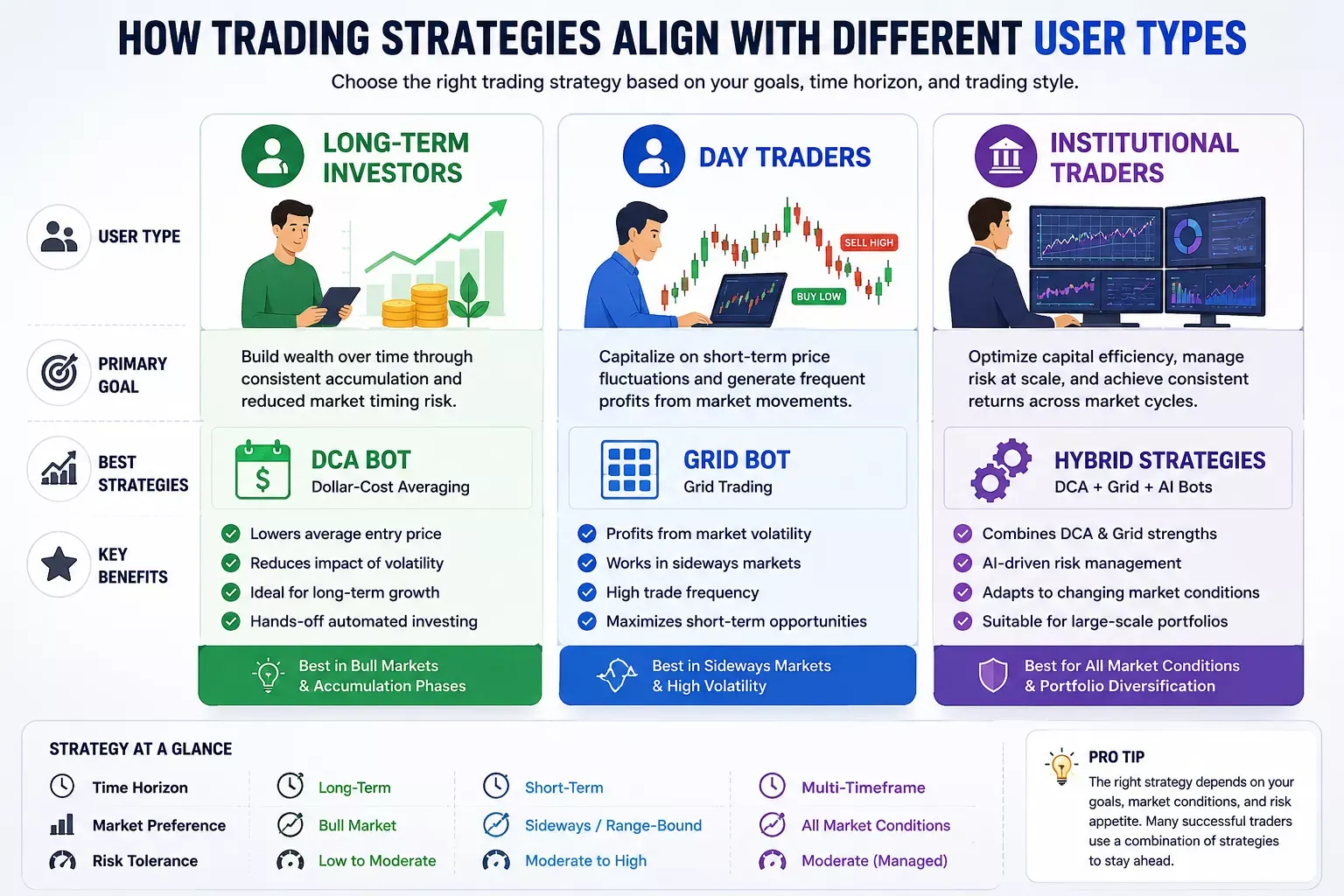
In advanced trading, DCA and Grid strategies have combined into hybrid models that adapt to market changes. A hybrid DCA/Grid model uses DCA for long-term investments and Grid logic for short-term volatility, allowing traders to benefit from both long-term accumulation and short-term market fluctuations.
How Hybrid Bots Work
- DCA module builds core asset positions over time
- Grid module activates when volatility stabilizes
- AI or rule-based engine switches strategies dynamically
- The portfolio is continuously rebalanced based on market regime
Benefits of Combining DCA and Grid
- Improves capital utilization across market cycles
- Reduces dependency on a single market condition
- Enhances profit consistency in mixed volatility environments
- Provides flexibility for both conservative and active traders
Limitations of Hybrid Strategies
- Higher system complexity
- Requires advanced risk management logic
- Increased development and maintenance cost
- Needs accurate market regime detection for effectiveness
AI-Powered DCA and Grid Bots: The Future of Automated Trading
The evolution of crypto trading automation, including the rise of the AI crypto trading bot, now integrates AI and machine learning into DCA and Grid strategies. AI-powered bots analyze market data and volatility in real time, allowing DCA bots to adjust purchase frequency and Grid bots to modify trading parameters dynamically.
Key AI Enhancements in Trading Bots
- Predictive market trend detection
- Dynamic position sizing based on volatility
- Reinforcement learning for strategy optimization
- Sentiment analysis from news and social signals
- Adaptive grid recalibration in real time
Why AI Matters for Crypto Businesses
For exchanges and fintech platforms, AI-driven automation is a key competitive advantage. Intelligent trading systems enhance user engagement, retention, and attract advanced traders.
Future Direction of Trading Automation
The future lies in self-optimizing trading ecosystems, where bots:
- Automatically select between DCA, Grid, or hybrid modes
- Continuously learn from historical performance
- Adjust risk exposure based on macro conditions
- Operate with minimal human intervention
Build Smarter Trading Systems with AI-Powered Automation
See how artificial intelligence is transforming traditional DCA and Grid strategies into adaptive trading systems.
Request A ProposalChoosing Between DCA and Grid Bot Development for Your Crypto Platform
For crypto exchanges, fintech, and trading platforms, choosing between DCA and grid bots is strategic, impacting user behaviour and revenue. DCA bots suit long-term investors and beginners, while Grid bots cater to active traders and high-frequency trading behaviour. Successful platforms typically offer both strategies to enhance engagement and market reach.
Business Decision Factors
- Target user base (investors vs traders)
- Revenue model (volume-based vs subscription-based)
- Market positioning (retail vs professional trading)
- Infrastructure scalability requirements
- Competition differentiation strategy
Platform Strategy Recommendation
- Use DCA as a foundational onboarding strategy
- Use Grid bots to drive active trading engagement
- Combine both for maximum user retention and monetization
How to Build a Custom DCA or Grid Trading Bot
Developing an effective DCA or grid trading bot involves more than basic trading logic. It demands a scalable architecture for real-time data, secure order execution, and flexible risk management. Although both bots have common elements, their strategies and execution differ.
Core Architecture Components
- Exchange API integration (Binance, Coinbase, etc.)
- Real-time market data engine (WebSocket streams)
- Order management system (OMS)
- Risk management module
- Strategy engine (DCA or Grid logic)
- Portfolio tracking system
- Logging and analytics dashboard
Key Development Considerations
- Low-latency execution for competitive trading
- High availability infrastructure (cloud-based scaling)
- Secure API key management
- Fail-safe mechanisms for order recovery
- Backtesting environment for strategy validation
Deployment Models
- SaaS-based trading platforms
- White-label exchange solutions
- Custom enterprise trading systems
DCA Bot vs Grid Bot Development Cost
The cost of developing a DCA or Grid trading bot varies based on complexity, features, and target users. While they may seem similar, their engineering efforts differ significantly. Basic bots are straightforward, but advanced features greatly increase costs.
Key Factors Influencing Development Cost
- Number of exchange integrations (Binance, Coinbase, Kraken, etc.)
- Complexity of trading logic (static vs AI-driven strategies)
- Real-time data processing and WebSocket infrastructure
- Security architecture (API key encryption, user data protection)
- UI/UX dashboard complexity
- Backtesting and simulation engine
- Scalability requirements (SaaS vs enterprise deployment)
Estimated Development Range
- Basic DCA or Grid Bot: Suitable for MVPs and startups with limited features
- Mid-Level Trading Bot: Includes multi-exchange support, analytics, and improved risk controls
- Advanced AI-Powered Bot: Enterprise-grade systems with adaptive strategies, machine learning, and real-time optimization
Grid bots typically need more configuration complexity, while advanced DCA bots require deeper risk modelling.
Long-Term Cost Considerations
Beyond initial development, businesses must also account for:
- Ongoing infrastructure hosting costs
- Market data API subscriptions
- Maintenance and upgrades
- Security audits and compliance updates
- Feature scaling based on user demand
Take Action: Build Your Own Crypto Trading Bot Strategy Today
Discover how businesses can move from strategy selection to full-scale bot development.
Contact UsBuild AI-Powered DCA and Grid Trading Bots with Troniex Technologies
Creating a successful trading automation system requires strong architecture, market insight, and ongoing optimization. At Troniex Technologies, we develop AI-driven crypto trading bots, including DCA and grid systems, tailored for startups and fintech platforms. We deliver scalable, secure trading infrastructure that adapts to market needs, offering tailored support for crypto exchanges and automated trading features.
Why Choose Troniex Technologies
- Custom-built DCA and Grid trading bot development
- AI-driven strategy optimization and market adaptation
- Multi-exchange and high-frequency trading support
- Secure and scalable cloud-based architecture
- White-label solutions for fast deployment
- Enterprise-grade risk management systems
Business Value We Deliver
We help businesses:
- Increase platform trading volume through automation
- Improve user retention with intelligent trading tools
- Enable multi-strategy trading ecosystems
- Reduce operational complexity with automated execution systems
Partner With Us
If you are planning to build or scale a crypto trading platform, selecting the right automation strategy is critical. Our team can help you design and deploy DCA, Grid, or hybrid AI trading systems tailored to your business goals and user base.