Tech Stack to Build a Crypto Wallet: Key Custody to Frontend
Pick the key model first: custodial, non-custodial, MPC or a smart-contract account. Then choose the wallet SDK, key storage, app and backend languages, dApp connection standards and chain access. Use an embedded SDK for speed, an HSM or KMS for custodial signing, and an RPC provider with an indexer for chain data.
Nov 05, 2026
12 mins read
- Key model first. It sets who holds funds and how users recover a lost device. Every other layer follows from it.
- SDK. Embedded SDKs such as Privy and MetaMask Embedded Wallets give fast sign-up. Build your own for custom key logic or a self-hosted signer.
- Key storage. Mobile wallets encrypt the seed with an enclave or Keystore key. Custodial wallets sign in an HSM or cloud KMS. MPC removes the single full key.
- Gas. ERC-4337 paymasters sponsor new users. EIP-7702 extends smart-account features to existing accounts.
- dApps. Build EIP-1193, EIP-6963 and WalletConnect from day one.
- Chains. One adapter per chain family, an RPC provider with a fallback endpoint and an indexer for history.
- Build path. White-label for speed, custom when key handling is your product, hybrid to keep the vendor shell and own the key layer.
The key model is the hardest pick to reverse. It decides who loses funds when something breaks and how a user recovers a lost device. Choose it first, then build the rest of the tech stack for crypto wallet development around it.
The Troniex crypto wallet development company team works through these layers with founders before the first line of code. Troniex brings 4+ years in blockchain and AI to that review.
What a Crypto Wallet Tech Stack Covers
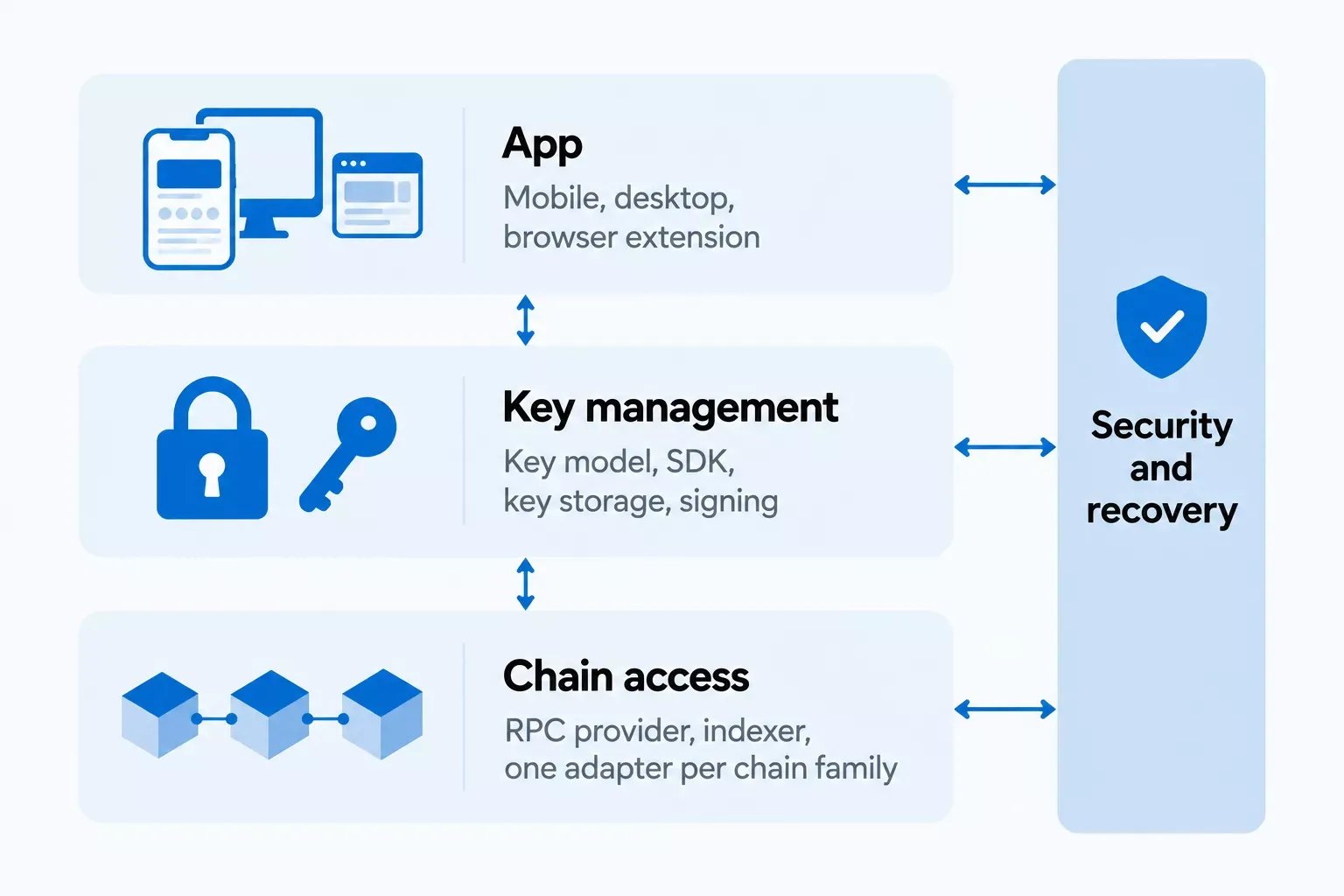
A wallet stack runs in tiers. Chain access sits at the bottom, key management in the middle and the app on top. Security and recovery cut across all three.

Not Sure Which Key Model Fits Your Product?
Bring your target chains and custody plan. Our team reviews the stack with you before development starts.
Talk to Our ExpertsCustodial, non-custodial, MPC or Smart-contract Account: Choose the Key Model
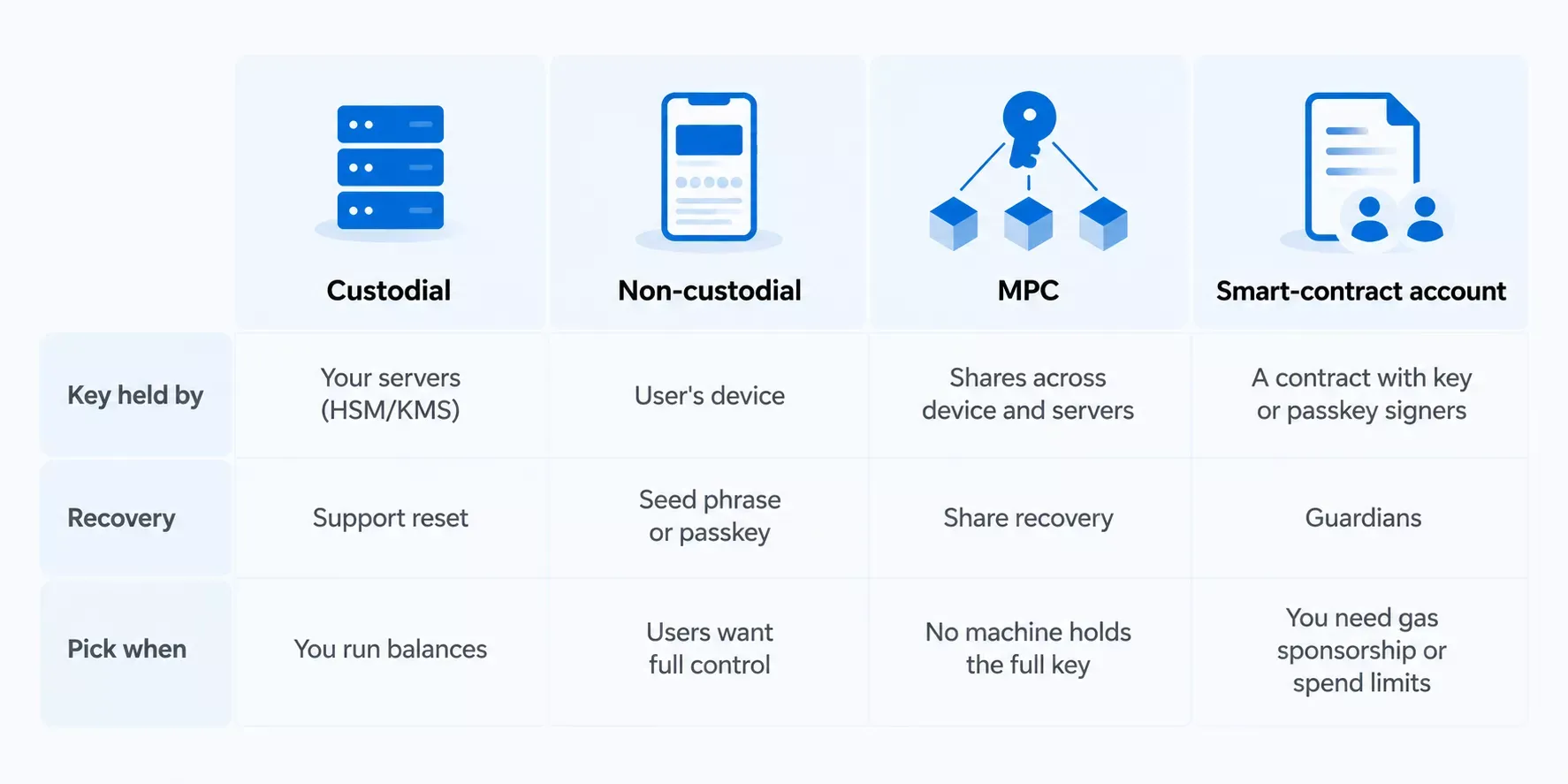
Pick custodial when you run the balances. Pick non-custodial when users hold their own keys. Pick MPC or a smart-contract account when you want user control with a recovery path.
|
Model |
Who holds the key |
Recovery |
Audit scope |
Fits when |
|---|---|---|---|---|
|
Custodial |
Your servers, in an HSM or cloud KMS |
Account reset through your support flow |
Key storage, signing API, access controls and operations |
You run balances, as in an exchange or payment product |
|
Non-custodial |
The user, on their device |
Seed phrase or passkey backup |
App code and key generation |
Users want full control and you never hold their funds |
|
MPC |
Key shares split across the device and your servers |
Share recovery, with optional social recovery |
Share protocol, signing service, recovery flow and share storage |
No single machine holds the full key |
|
Smart-contract account |
A contract, with keys or passkeys as signers |
Contract rules, such as guardians |
Contract code, bundler and paymaster setup |
You need gas sponsorship, spend limits or batched actions |
The full custody decision sits in our non-custodial wallet development company guide.
Wallet SDKs and Sign-up Flows
Pick a wallet SDK that creates keys on the user's device, supports social or passkey login and exports the key on request. Check chain coverage, recovery method, pricing per active wallet and whether you self-host later.
To build a non-custodial wallet SDK flow, let the SDK own key creation and login, and let your app own everything after sign-up.
Embedded SDK or build your own
Use an embedded SDK when sign-up speed matters more than owning the key flow. Build your own when you need custom key logic or a self-hosted signer. Two embedded options show what to check:
- Privy. Its wallet docs describe non-custodial user wallets across hundreds of blockchains, including Ethereum and Solana. Users sign in with email, SMS, passkey or social accounts. Users export their private key, and a DENY policy switches export off. Privy also offers wallets that your own servers control. Those are not user-held, so label them custodial in your own model.
- MetaMask Embedded Wallets (formerly Web3Auth). The docs describe wallet infrastructure with social, email and SMS login, and state that users keep full control of their non-custodial wallets. It provides a key provider for a custom wallet.
Account abstraction for gas sponsorship
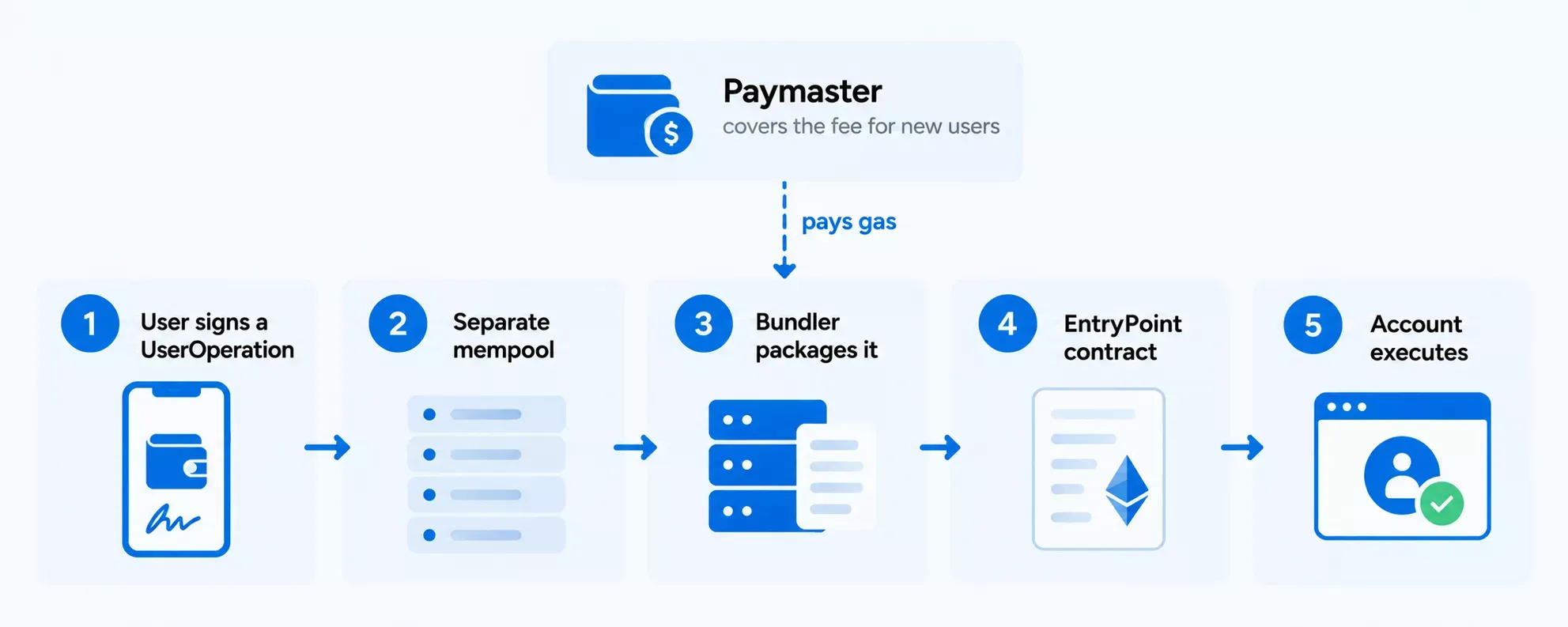
Use ERC-4337 when new users hold no gas tokens. The standard adds account abstraction without consensus-layer changes. Users submit UserOperations to a separate mempool, and bundlers package them into transactions. A paymaster is a helper contract that agrees to pay for the transaction in place of the sender, so your app covers fees for new users.
EIP-7702 (live since the Pectra upgrade in May 2025) lets an existing account delegate to smart-contract code. Existing users keep their address and gain batching and sponsorship. Pick 7702 for existing accounts and ERC-4337 accounts for new ones.
Key Management: HSM, KMS and Device Storage
Store private keys on-device behind the platform keystore, or server-side with an HSM or cloud KMS. Add MPC or threshold signing when no single machine is allowed to hold the key.
On-device storage and curves
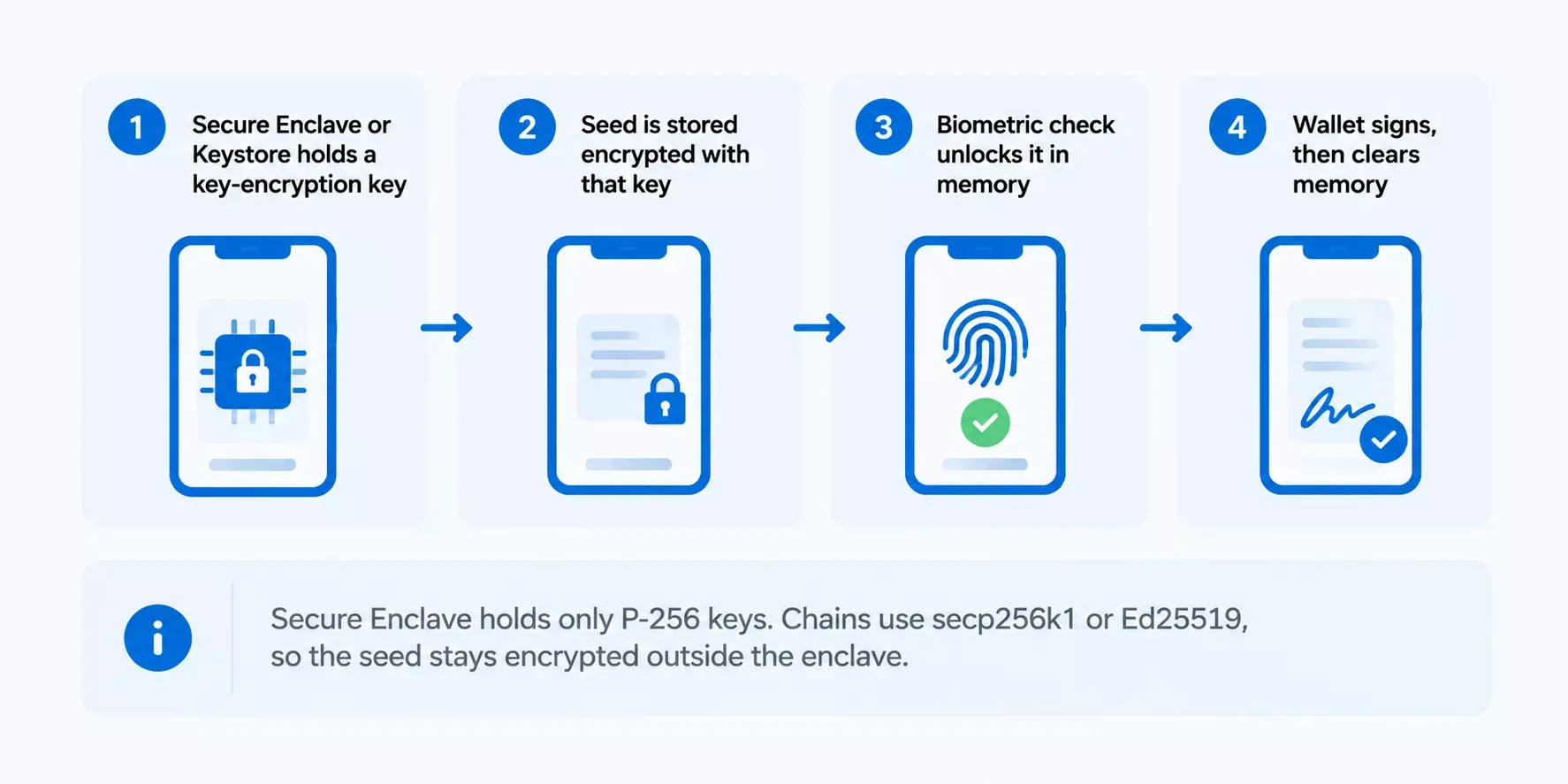
Apple's Secure Enclave holds only P-256 keys. It does not generate secp256k1 or Ed25519 keys, the curves most chains use. So keep a key-encryption key in the Secure Enclave (iOS) or Keystore with StrongBox (Android), encrypt the seed with it and decrypt in memory only to sign. Gate decryption behind biometrics.
HSM and cloud KMS for custodial wallets
Use a cloud KMS or HSM for the hot-wallet signing key of a custodial product. AWS KMS supports the secp256k1 curve for cryptocurrency use and Ed25519 for signing and verification only. Its docs say the private key of an elliptic curve key pair never leaves AWS KMS unencrypted.
Pick the chain first, then check that the KMS or HSM supports its signing curve.
MPC and threshold signing
Pick MPC when custody must survive the loss or compromise of any one server or device. The key exists only as shares, so no machine holds all of it. Depth on share protocols and recovery sits in our MPC wallet development guide.
Compare Your Plan with How We Build Wallets
Share your architecture and get feedback from engineers who have shipped custodial, non-custodial and MPC wallets.
Talk to Our ExpertsChoosing Languages for App and Backend
Native app: Kotlin and Swift. Cross-platform app: React Native and Flutter for one codebase. Backend: Node.js or Go to talk to blockchain nodes. Rust: where the chain demands it, as on Solana, or for signing code that must be fast and memory-safe.
Build steps for the app sit in our guide to build a crypto wallet app.
Backend language by job
Pick Node.js when the team shares TypeScript with the app and the work is mostly calls to nodes and APIs. Pick Go for indexers and services that hold many concurrent connections. Reach for Rust on Solana programs or in signing code that must be fast and memory-safe.
Mobile and Desktop Frontend
Go native when you need platform keystore access and biometric signing. Go cross-platform with React Native or Flutter when you ship iOS and Android together on a smaller team. Browser extensions and desktop apps need a separate web stack and a stricter origin model.
Browser extension wallets
Chrome's Manifest V3 replaces background pages with service workers that run only when needed, and an extension executes only JavaScript included in its package.
Service workers stop when idle, so keep no decrypted key in memory between requests. Show the requesting site's origin on every approval prompt. Give each site a request channel.
Connecting to dApps
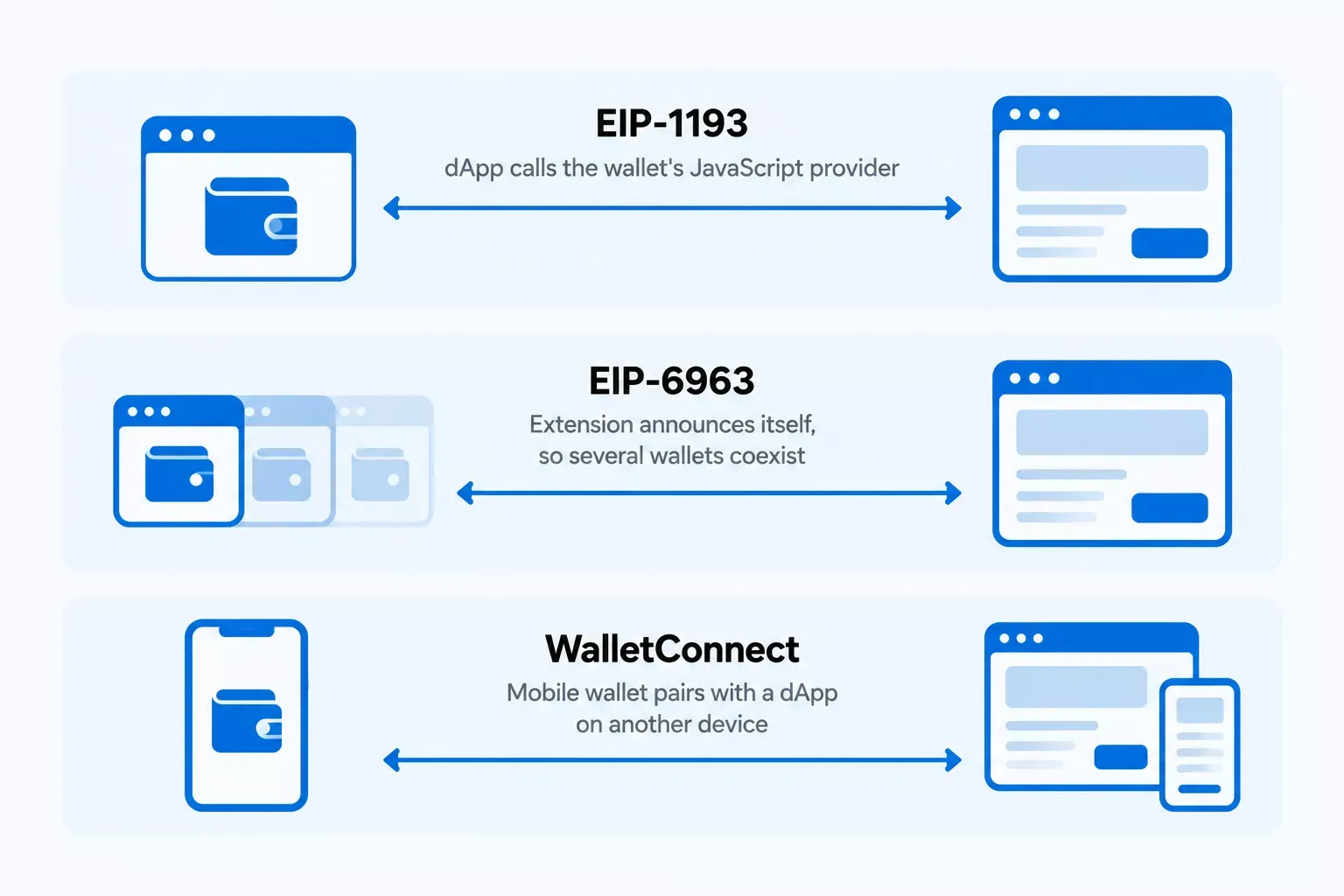
A non-custodial wallet needs a way to talk to dApps. Build to three standards:
- EIP-1193. The JavaScript provider API that dApps call.
- EIP-6963. Lets a browser extension announce itself, so several wallets coexist on one page.
- WalletConnect. Pairs a mobile or desktop wallet with a dApp running in another browser or device.
Pick these on day one. Retrofitting a provider API after launch breaks every dApp integration.
Multi-chain Infrastructure: RPC and Indexers
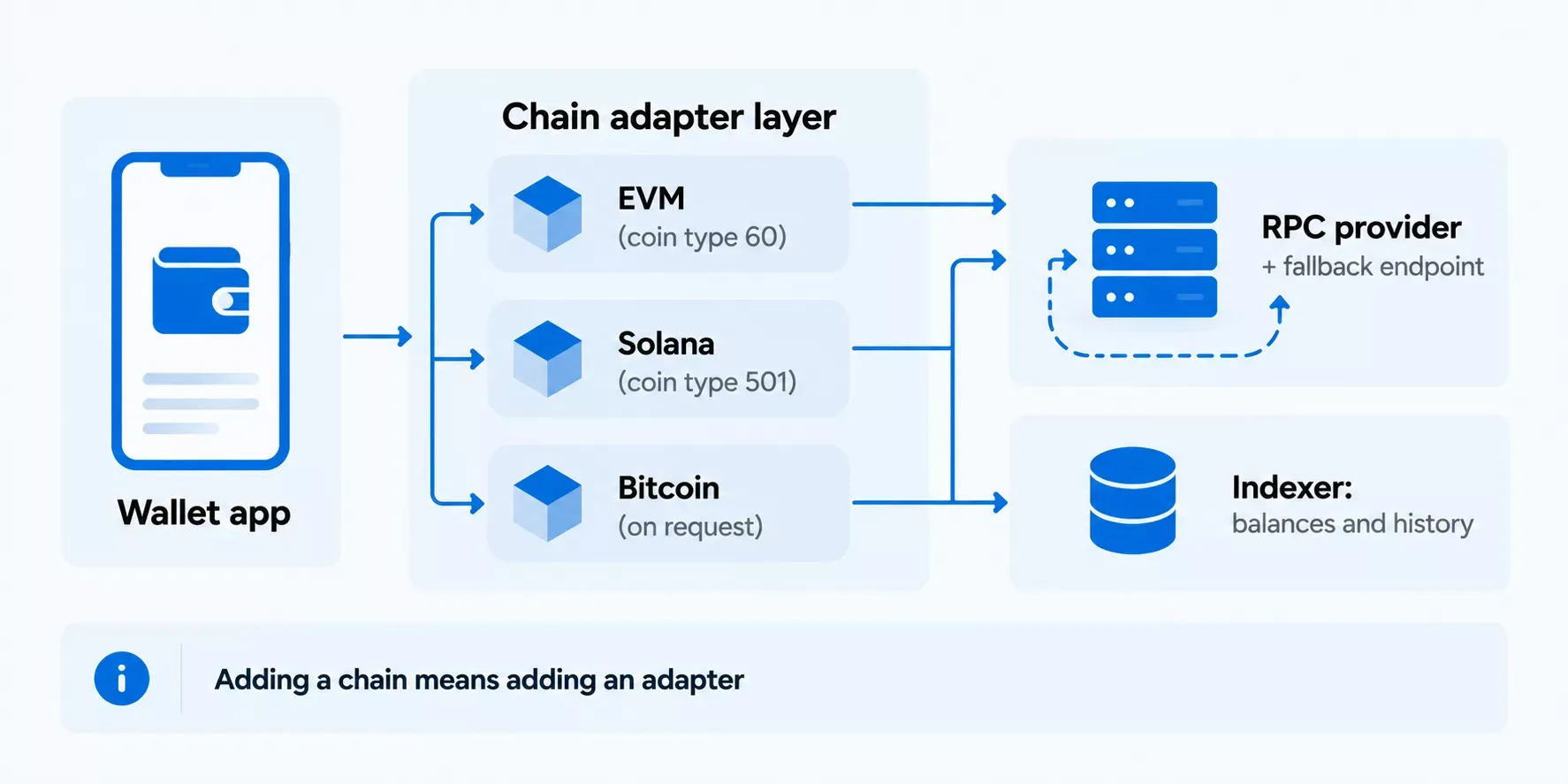
Use one adapter per chain family, so adding a chain means adding an adapter. Read through an RPC provider with a fallback endpoint. Add an indexer for balances and history, because raw node calls are too slow for a wallet home screen.
Holding several currencies in one app adds balance and fee logic on top. Our multi-currency wallet development guide covers that layer.
Own node or RPC provider
Start with an RPC provider and a fallback endpoint. Run your own node when provider rate limits or data-privacy needs justify the upkeep.
EVM and Solana adapters
Build the EVM adapter once and reuse it for each EVM chain. Build a separate Solana adapter, because transaction format, signing and fees differ.
- Derivation paths. BIP-44 defines the path as m / purpose' / coin_type' / account' / change / address_index. EVM wallets follow it directly. Check each non-EVM chain's own derivation scheme before you reuse the path.
- Coin types. SLIP-44 lists coin type 60 for Ethereum and 501 for Solana.
Add a Bitcoin adapter on request.
Security Stack and Recovery
Security work runs from the first commit to the signing API after launch. Our crypto wallet security best practices guide covers the user-facing side.
Before release
Run dependency scanning and static analysis to catch obvious issues. Add third-party code review to spot logic flaws.
All Troniex builds get 100% QA with code audits and stress testing.
Recovery paths: seed phrase and MPC
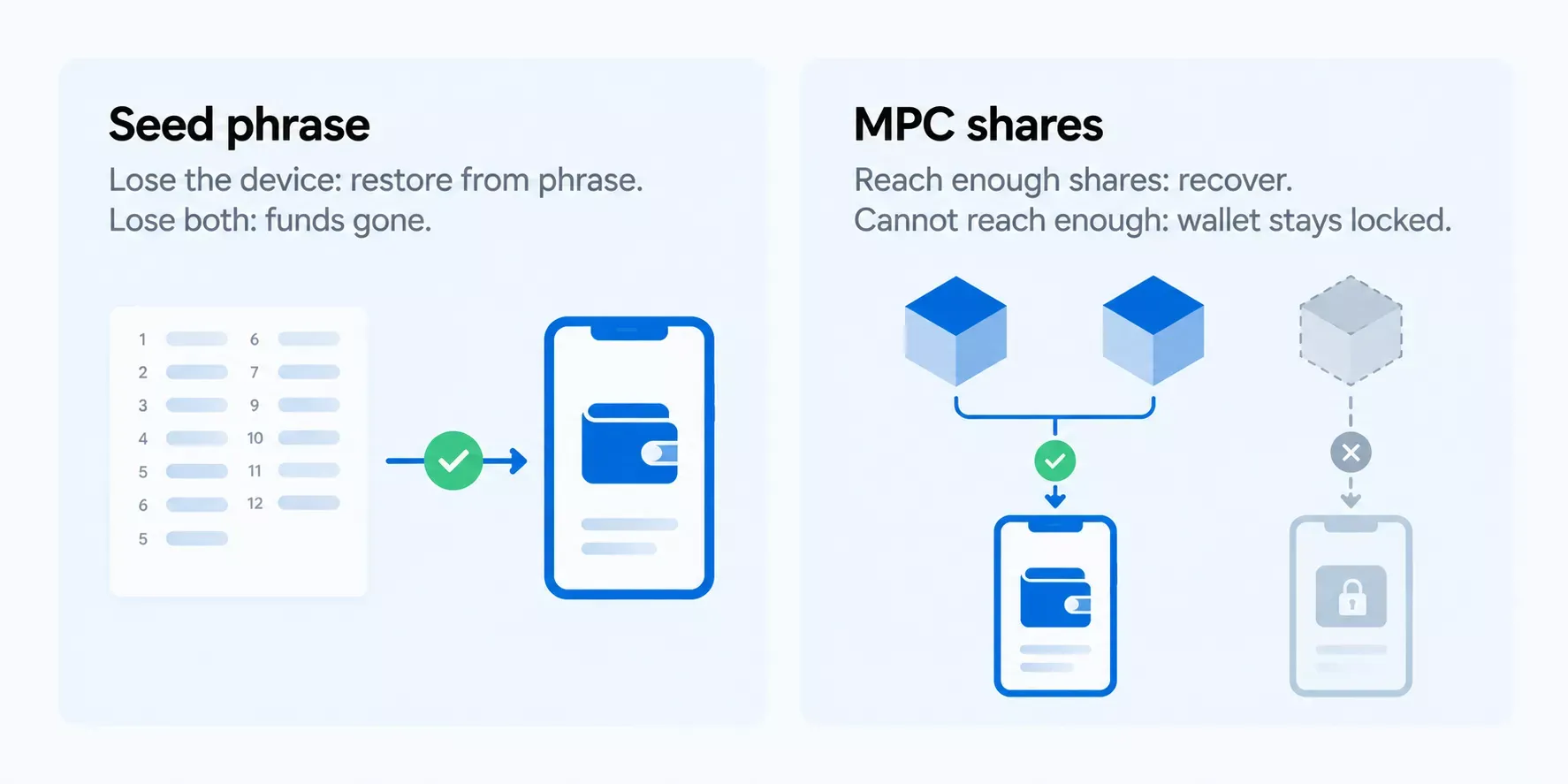
A seed phrase lets users recover if they lose the device. If they lose the phrase and the device, the funds are gone.
MPC share recovery, with optional social recovery, replaces the phrase. If the user cannot reach enough shares, the wallet stays locked.
After release: simulation and limits
Simulate each transaction before the user signs, and show the result. Rate-limit the signing API. Add phishing warnings as a second signal.
Build Custom or Start from a White-label Wallet
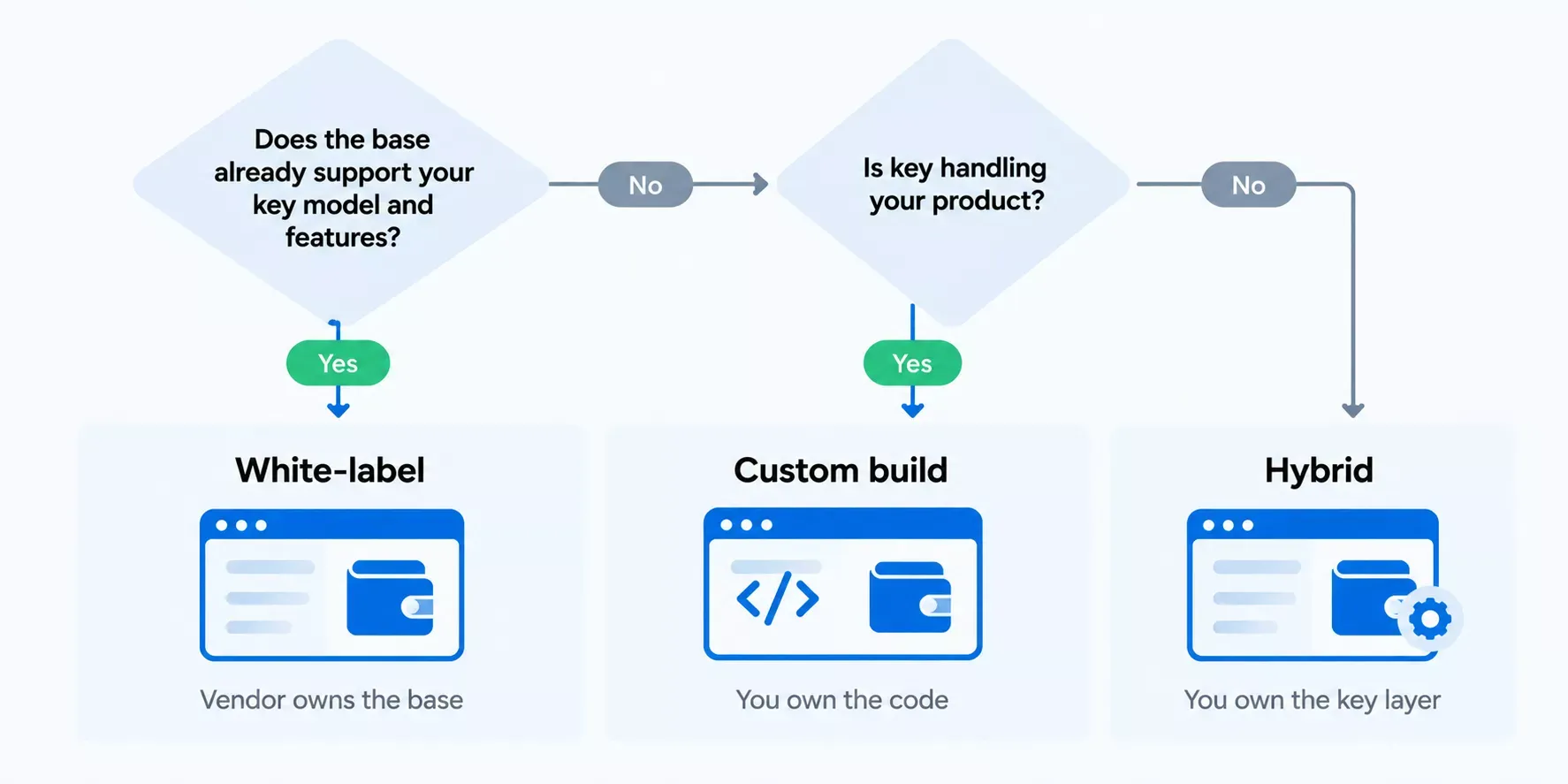
Choose white-label when the key model and feature set you need already exist in a base. Choose a custom build when key handling is your product. A hybrid keeps the vendor's app shell and swaps in your own key layer.
|
Option |
Who owns the code |
Key model choices |
Lock-in |
|---|---|---|---|
|
White-label base |
Vendor owns the base. You own your modules |
Those the base supports |
Vendor roadmap and licence terms |
|
Wallet clone script |
Depends on the licence |
Fixed by the script |
Licence terms and your own upkeep |
|
Custom build |
You |
Any key model above |
Your chosen vendors' APIs only |
|
Hybrid |
Vendor owns the shell. You own the key layer |
You swap the key layer |
The vendor's app shell |
Our white-label crypto wallet development service covers the buy option. Troniex has delivered 150+ projects.
Quick Picks by Layer
|
Layer |
Default pick |
Pick the alternative when |
|---|---|---|
|
Key model |
Non-custodial or MPC |
Custodial when you run the balances |
|
Wallet SDK |
An embedded SDK such as Privy or MetaMask Embedded Wallets |
Build your own for custom key logic or a self-hosted signer |
|
Key storage |
Key-encryption key in the secure enclave or Keystore |
HSM or cloud KMS for custodial signing. MPC when no machine holds the full key |
|
Gas |
The user pays gas |
ERC-4337 paymaster to sponsor new users. EIP-7702 for existing accounts |
|
App |
React Native or Flutter |
Kotlin and Swift for keystore and biometric signing |
|
Backend |
Node.js |
Go for indexers. Rust for Solana or signing-critical code |
|
dApp connection |
EIP-1193, EIP-6963 and WalletConnect |
None. Build all three |
|
Chain access |
RPC provider with a fallback endpoint, plus an indexer |
Your own node for rate-limit or privacy needs |
|
Build path |
Hybrid |
White-label for speed. Custom when key handling is the product |
Ready to Build Your Crypto Wallet?
Send us your requirements and get a scoped plan covering key model, stack and build path.
Start Your Wallet Project