KuCoin Trading Bot Development: Build Custom Automated Trading Solutions
Build a custom KuCoin trading bot with automated strategies, API integration, risk controls, backtesting, dashboards, and secure execution.
Sep 19, 2026
12 mins read
Automated trading has become an important part of modern digital-asset infrastructure, particularly for businesses that need consistent execution, programmable strategies, and reduced dependence on manual trading operations.
Grand View Research estimates that the global automated crypto trading market was valued at $22.2 billion in 2025 and is projected to reach $25.3 billion in 2026, with a forecast CAGR of 14.8% from 2026 to 2033.
Asia Pacific accounted for 33.7% of the market in 2025. These figures represent the broader automated crypto trading market rather than KuCoin-specific bot development.
KuCoin trading bot development involves building software that connects automated trading strategies, market-data processing, risk controls, order management, and monitoring with KuCoin's trading infrastructure.
A custom bot can be designed for crypto businesses, trading firms, entrepreneurs, professional traders, and organizations that need more control than a predefined bot platform provides.
Unlike KuCoin's built-in trading tools or third-party SaaS bots, a custom solution can be engineered around specific strategies, business workflows, risk policies, dashboards, and future integrations.
Troniex Technologies can approach this as an end-to-end software engineering project rather than simply configuring an existing trading-bot interface.
What Is KuCoin Trading Bot Development and How Does It Work?
KuCoin trading bot development is the process of engineering an automated trading application that receives market information, evaluates predefined strategies, validates trading signals, applies risk controls, and communicates orders through the KuCoin API.
A typical workflow is:
Market Data → Strategy Engine → Signal Validation → Risk Management → Order Management → KuCoin API → Execution → Monitoring
The market-data layer supplies relevant prices and trading information. The strategy engine evaluates conditions such as grid ranges, DCA rules, arbitrage opportunities, momentum signals, or other programmed logic. Signal validation determines whether a potential trade satisfies the strategy's conditions.
Before an order is submitted, the risk engine can check position limits, exposure, trade size, drawdown rules, and other restrictions. The order-management layer then handles submission, status tracking, cancellation, and synchronization.
For businesses exploring crypto trading bot development services, this layered architecture provides greater control over how trading logic and operational rules are implemented.
Why Build a Custom KuCoin Trading Bot Instead of Using an Existing Platform?
Existing trading-bot platforms can provide convenient access to predefined strategies and dashboards. However, they may not provide the degree of customization required by a trading business with proprietary algorithms, specialized risk rules, or unique operational workflows.
|
Capability |
Existing Bot Platform |
Custom KuCoin Bot |
|---|---|---|
|
Strategy customization |
Usually limited |
Engineered around requirements |
|
Branding |
Platform-dependent |
Fully customizable |
|
Proprietary algorithms |
May be restricted |
Can be implemented |
|
Risk engine |
Predefined controls |
Custom controls |
|
Execution logic |
Platform-defined |
Business-specific |
|
Business workflows |
Limited |
Custom |
|
Data and infrastructure control |
Provider-dependent |
Greater control |
|
Future integrations |
Platform-dependent |
Designed for expansion |
Custom development can therefore make sense when a business needs proprietary execution logic, specialized risk management, customized reporting, or direct ownership of its application architecture.
The decision should depend on requirements, budget, development resources, security expectations, and the degree of customization required, not simply on whether a custom solution is technically possible.
KuCoin Trading Bot Development Architecture
A production-oriented KuCoin trading bot should separate trading logic from authentication, risk controls, execution, persistence, and monitoring.
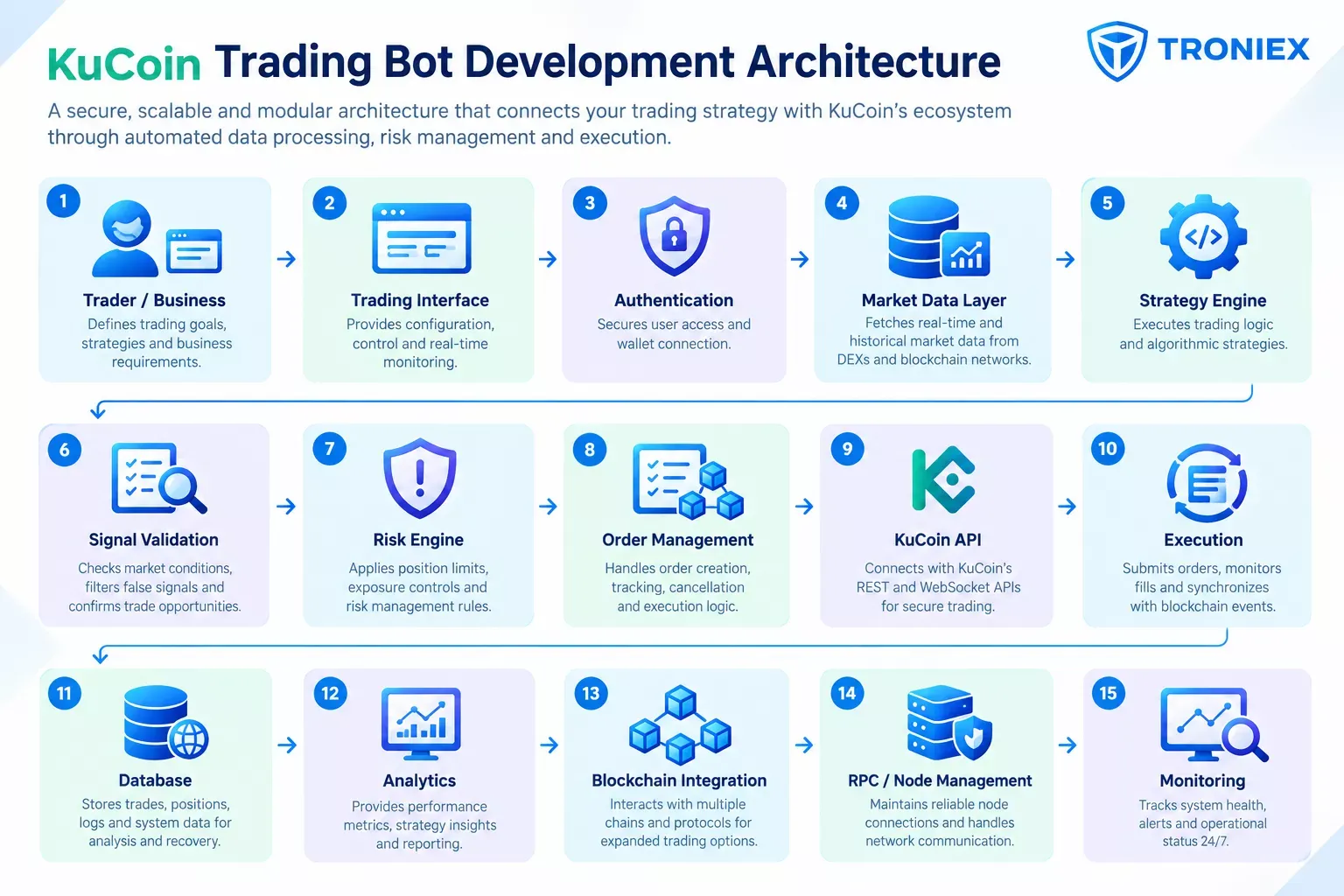
The trading interface allows authorized users to configure strategies, review positions, manage settings, and monitor activity. Authentication protects access to operational functions.
The market-data layer processes exchange information required by the strategy engine. The strategy engine contains the actual trading logic, while signal validation ensures that generated signals meet predefined conditions.
The risk engine acts as a control layer before execution. It can enforce maximum positions, exposure limits, trade-size restrictions, and emergency rules.
The order-management layer manages the complete order lifecycle. The KuCoin API layer handles communication with the exchange, while databases preserve configuration, order, and operational records.
Finally, analytics and monitoring provide visibility into system behavior, execution events, errors, and operational health.
This architecture is also where a crypto trading bot development company should demonstrate engineering depth: every layer has a defined responsibility and failure-handling strategy.

Build a Custom KuCoin Trading Bot Around Your Strategy
Turn your trading logic into a structured software system with configurable strategies, automated execution, risk controls, monitoring, and KuCoin API integration.
Talk To Our ExpertsCore Features of a Custom KuCoin Trading Bot
A custom KuCoin trading bot can combine trading, strategy, risk, and operational capabilities according to the project's requirements.
Trading Features
- Automated order execution
- Spot and futures support where required
- Market and limit orders
- Stop-loss and take-profit rules
- Position management
- Order-status synchronization
Strategy Features
- Configurable strategies
- Multiple strategy support
- Strategy parameters
- Backtesting
- Paper or demo trading
- Strategy activation and deactivation controls
Risk Features
- Position limits
- Exposure controls
- Maximum trade-size rules
- Drawdown protection
- Trade validation
- Emergency shutdown controls
Operations Features
- Trading dashboard
- Performance analytics
- Execution history
- Notifications
- System logs
- Monitoring and reporting
The feature set should be determined by the intended trading model rather than adding functionality simply to increase the scope of the application.
KuCoin Trading Strategies for Automated Execution
Different trading strategies create different software-engineering requirements. A KuCoin bot should therefore be designed around the strategy rather than treating every strategy as the same automation problem.
|
Strategy |
Development Considerations |
|
Grid Trading |
Range detection, order placement, rebalancing |
|
DCA |
Scheduling, allocation rules, position tracking |
|
Arbitrage |
Price-difference detection and execution synchronization |
|
Scalping |
Fast processing and strict execution controls |
|
Market Making |
Spread management, inventory and exposure controls |
|
Momentum |
Signal generation and confirmation logic |
|
Trend Following |
Entry, exit and position-management rules |
|
AI-Assisted |
Model integration, signal validation and safeguards |
Grid trading requires logic for defining or responding to price ranges and managing multiple orders. DCA bots need scheduling and allocation rules. Arbitrage systems require reliable price comparisons and carefully synchronized execution.
For businesses exploring crypto arbitrage bot development, the engineering challenge extends beyond identifying price differences; the system must account for execution timing, fees, liquidity, order status, and failure conditions.
AI-assisted strategies can introduce additional components such as predictive models, feature processing, model inference, and signal validation. AI should supplement a clearly defined trading architecture rather than replace risk controls.
KuCoin API Integration, Order Execution, and Data Management
KuCoin API integration is one of the most important technical components of a custom trading bot.
KuCoin's current API documentation organizes REST functionality around areas including market data, account information, orders, and positions, while its WebSocket APIs provide public, private, and trading channels.
A robust integration should address:
- API authentication
- API-key permissions
- Market-data retrieval
- Account information
- Order creation
- Order modification or cancellation
- Order-status tracking
- Execution synchronization
- Error handling
- Rate-limit management
- Retry behavior
- WebSocket connections
- REST/WebSocket coordination
KuCoin recommends WebSocket for real-time data where an appropriate WebSocket endpoint is available, while REST APIs remain important for supported operations.
Rate-limit handling must also be designed into the application. KuCoin's current UTA documentation describes rate-limit pools and states that exceeding an applicable quota can result in HTTP 429 responses. It also recommends reusing WebSocket connections instead of repeatedly establishing new ones.
KuCoin has also continued updating its UTA API and rate-limit infrastructure during 2026, so integrations should be maintained against current documentation rather than treated as a one-time implementation.
Security and Risk Management for KuCoin Trading Bots
Security should cover both the application itself and the trading actions it is authorized to perform.
A production-oriented bot can incorporate:
- Encrypted API credentials
- Restricted API permissions
- IP restrictions
- Secure secrets management
- Strong authentication
- Role-based access control
- Audit logging
- Rate-limit protection
- Abnormal-order detection
- Trade validation
- Position limits
- Emergency shutdown mechanisms
- Monitoring and alerts
- Infrastructure hardening
- Regular security testing
KuCoin's own API resources recommend adding IP restrictions to API keys and guide on handling API rate limits and reconnection behavior.
Risk controls should also exist independently from strategy logic. For example, a strategy may generate a valid buy signal while the risk engine rejects the order because the portfolio has already reached its maximum permitted exposure.
This separation creates an important safety boundary between what the strategy wants to do and what the system is permitted to execute.
Automated trading can reduce manual execution workload and improve consistency, but it does not eliminate market risk or guarantee profitability.
Get a Custom KuCoin Trading Bot Development Plan
Define your strategies, API requirements, dashboard features, security controls, testing requirements, and deployment model before development begins.
Request A ProposalCustom KuCoin Trading Bot Development Process
A structured development process helps reduce technical ambiguity and makes vendor evaluation easier.
Requirement Analysis → Strategy Definition → Architecture → UI/UX → API Integration → Strategy Engine → Risk Engine → Testing → Security Review → Deployment → Monitoring → Maintenance
1. Requirement Analysis
Define the target users, markets, strategies, workflows, integrations, and operational requirements.
2. Strategy Definition
Convert trading rules into explicit technical conditions, parameters, entry/exit logic, and risk constraints.
3. Architecture
Design the system components, data flows, API layer, database, security model, and infrastructure.
4. Development
Build the dashboard, strategy engine, risk layer, API integration, order management, and supporting services.
5. Testing
Test strategy logic, API behavior, order handling, edge cases, failures, security, and performance.
6. Deployment and Monitoring
Deploy the application, configure observability, establish alerts, and monitor production behavior.
7. Maintenance
Update the integration, address API changes, improve infrastructure, and evolve strategies or functionality.
For organizations also evaluating broader blockchain development, the same engineering discipline can extend to additional digital-asset infrastructure and integrations.
KuCoin Trading Bot Technology Stack and Infrastructure
The technology stack should be selected according to strategy complexity, performance requirements, security, scalability, and maintenance needs.
Backend
Python, Node.js, or another appropriate backend technology can support strategy processing, API services, business logic, and integrations.
Data Layer
The system may use databases, caching, event-processing components, and market-data pipelines depending on the trading model.
API Layer
A dedicated KuCoin service layer can separate exchange communication from strategy logic.
Frontend
A web-based dashboard can provide strategy configuration, portfolio information, order history, analytics, alerts, and administration.
Infrastructure
Cloud infrastructure, containers, monitoring, logging, CI/CD pipelines, automated testing, and secure deployment practices can support production operations.
The objective is not to choose a fashionable technology stack. It is to create an architecture that remains reliable as strategy complexity, users, trading activity, and operational requirements increase.
KuCoin Trading Bot Development Cost in 2026
The cost of KuCoin trading bot development depends primarily on scope rather than the exchange integration alone.
Major cost drivers include:
- Bot type
- Strategy complexity
- Number of strategies
- Spot/Futures requirements
- Dashboard requirements
- API integrations
- AI/ML functionality
- Backtesting
- Risk-engine complexity
- Infrastructure
- Security requirements
- Testing
- Monitoring
- Maintenance
A basic MVP may require considerably less engineering than a multi-strategy platform with advanced risk controls, analytics, backtesting, and enterprise infrastructure.
For procurement planning, it is useful to separate projects into MVP, custom strategy bot, multi-strategy platform, and enterprise trading infrastructure rather than treating every KuCoin bot as the same product.
For a broader breakdown of development variables, link the phrase "crypto trading bot development cost" to your dedicated cost article. This keeps the KuCoin page focused on its exchange-specific topic while allowing the cost article to own the broader pricing query.
How Long Does It Take to Build a KuCoin Trading Bot?
Development time depends on the scope of the trading system.
|
Build Type |
Primary Timeline Variables |
|---|---|
|
MVP |
Core strategy, API integration, basic dashboard |
|
Custom Strategy Bot |
Strategy engine, risk controls, testing |
|
Multi-Strategy Platform |
Multiple strategies, analytics, portfolio controls |
|
Enterprise Infrastructure |
Security, scalability, monitoring, and integrations |
The largest variables are usually strategy complexity, number of integrations, dashboard requirements, backtesting, security testing, deployment architecture, and post-launch requirements.
A realistic estimate should therefore be produced after defining the technical scope rather than promising a universal number of development days.
How to Choose a KuCoin Trading Bot Development Company
Selecting a development partner requires evaluating engineering capabilities rather than relying solely on a portfolio or a low initial quotation.
Consider whether the vendor can demonstrate:
- KuCoin API expertise
- Crypto trading-system experience
- Strategy-engine development
- Risk-management implementation
- Secure API key handling
- Backtesting and testing processes
- Scalable architecture
- Monitoring and observability
- Technical documentation
- Source-code ownership terms
- Maintenance and upgrade support
- Post-launch assistance
- Transparent development estimates
Start Your Custom KuCoin Trading Bot Development Project
Discuss your trading strategy, technical requirements, expected users, API scope, security model, dashboard requirements, and long-term roadmap with the Troniex Technologies development team.
Contact UsBuild Your Custom KuCoin Trading Bot With Troniex Technologies
A custom KuCoin trading bot should be engineered around the business's strategy, risk model, execution requirements, security expectations, and future roadmap.
Troniex Technologies can support the development lifecycle from requirements and architecture through KuCoin API integration, strategy-engine development, risk controls, dashboards, testing, deployment, monitoring, and maintenance.
Whether the objective is an MVP, a specialized strategy bot, or a larger multi-strategy trading platform, the architecture should be designed around measurable technical requirements rather than generic bot functionality.