DEX Trading Bot Development: Build Secure, Scalable Automated Trading Systems
Build secure, scalable DEX trading bots with custom strategies, multi-DEX integration, MEV controls, wallet security, automation, and real-time monitoring.
Sep 18, 2026
15 mins read
Decentralized exchanges (DEXs) have moved well beyond their earlier niche role in crypto trading. CoinGecko’s 2026 CEX & DEX Trading Activity Report found that DEX spot trading volume share increased from 6.9% in January 2024 to 13.6% in January 2026, while absolute DEX spot volume more than doubled from $95.86 billion to $231.29 billion.
Perpetual DEX activity has also expanded significantly, with DEX perpetual volume reaching $739.48 billion in January 2026. Current on-chain activity remains substantial. DefiLlama's live DEX dashboard currently tracks hundreds of DEX protocols and reports approximately $9.1 billion in 24-hour DEX volume and $255.5 billion over 30 days.
These figures fluctuate continuously, so they should be treated as market-activity indicators rather than a fixed "DEX trading bot market size". For businesses entering this market, the opportunity is not simply to automate buy and sell orders.
A production-grade DEX trading bot needs reliable blockchain connectivity, strategy execution, wallet integration, transaction simulation, gas and slippage controls, MEV-aware execution, monitoring, and a security architecture capable of operating under changing on-chain conditions.
This guide explains how DEX trading bot development works, the architecture and features involved, development costs and timelines, security considerations, and how businesses can approach custom or white-label implementation.
What Is DEX Trading Bot Development?
DEX trading bot development is the process of designing and building software that automatically analyzes on-chain or market data, identifies trading opportunities, generates strategy signals, and executes transactions through decentralized exchanges or DEX aggregators.
Unlike a conventional centralized-exchange bot that communicates primarily through exchange APIs, a DEX bot interacts with blockchain infrastructure.
Depending on the strategy, it may connect wallets, read liquidity pools, monitor blockchain events, construct transactions, estimate gas, simulate execution, and submit signed transactions through RPC infrastructure.
A production system may combine a strategy engine with smart contracts, blockchain nodes or RPC providers, DEX protocols, aggregators, wallet infrastructure, databases, and monitoring systems.
How Does a DEX Trading Bot Work?
A DEX trading bot typically follows a continuous execution cycle:
Market Data → Opportunity Detection → Strategy Evaluation → Risk Validation → Transaction Construction → Simulation → Wallet Signing → Blockchain Submission → Confirmation → Monitoring
The bot first collects relevant information such as token prices, liquidity, pool reserves, trading activity, gas conditions, and blockchain events. Its strategy engine then determines whether the conditions satisfy predefined rules.
For example, an arbitrage bot may compare prices across multiple liquidity pools. A sniper bot may monitor newly created liquidity or token events. A grid bot can generate orders around predefined price levels, while a market-making system continuously evaluates inventory and liquidity conditions.
Before execution, risk controls can check trade size, maximum slippage, gas costs, token permissions, contract addresses, liquidity thresholds, and other constraints. The transaction is then constructed and signed through the configured wallet architecture before being submitted through an RPC endpoint or other execution infrastructure.
After submission, the system monitors confirmation, failure, replacement, or revert conditions and records the transaction for analytics and operational monitoring.
Why Businesses Invest in DEX Trading Bot Development
Growing DEX activity creates demand for automation across trading, liquidity management, market-making, arbitrage, and other on-chain strategies. Automation can allow a business to monitor markets continuously rather than relying entirely on manual execution.
The business case, however, depends on the strategy and infrastructure rather than simply having a bot. Execution speed, liquidity, transaction costs, competition, slippage, market conditions, and smart-contract behavior can materially affect results.
Custom development is particularly relevant when a business requires proprietary strategy logic, multi-chain support, custom dashboards, institutional wallet controls, specialized execution infrastructure, or integration with an existing Web3 platform.
Businesses evaluating automated trading infrastructure can also consider crypto trading bot development when they need strategy automation across centralized and decentralized market environments.

Build a Custom DEX Trading Bot for Your Strategy
Turn your trading logic into a custom DEX trading bot with automated signal processing, risk controls, transaction construction, wallet integration, and on-chain execution tailored to your requirements.
Talk To Our ExpertsDEX Trading Bot Development Architecture
A scalable DEX trading bot should separate user controls, market intelligence, strategy logic, execution, blockchain connectivity, and operational monitoring.
A practical architecture can follow this structure:
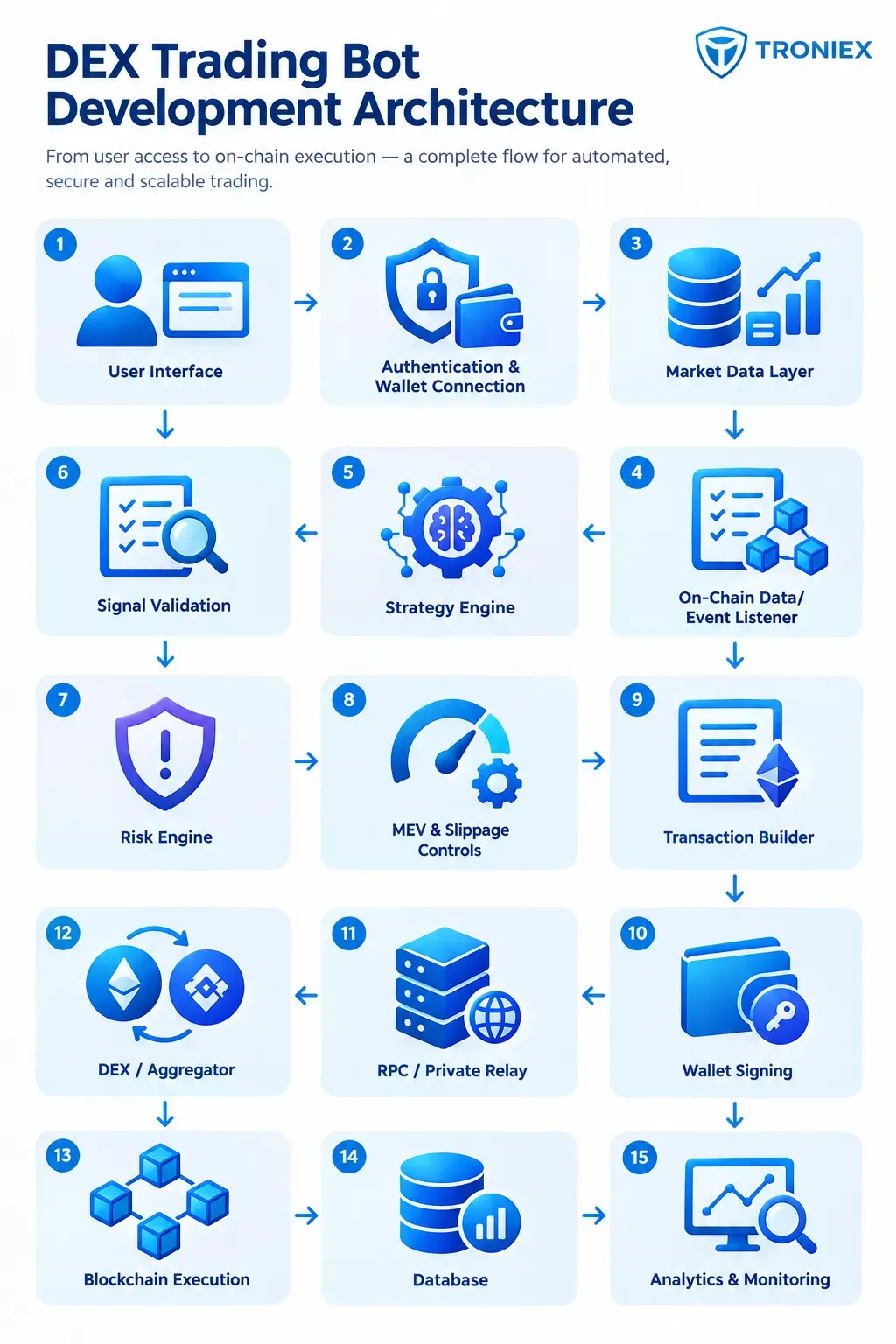
The market data layer collects prices, liquidity, pool activity, gas information, and blockchain events. WebSocket connections, RPC endpoints, indexers, and specialized data providers can be combined depending on latency and reliability requirements.
The strategy engine transforms this information into actionable signals. It should remain modular so that arbitrage, grid, sniper, market-making, or proprietary strategies can be added without rebuilding the entire platform.
The risk engine sits between strategy generation and execution. It can enforce position limits, minimum liquidity, maximum slippage, gas thresholds, exposure limits, token allowlists, cooldown periods, and circuit breakers.
The execution layer constructs transactions and handles nonce management, gas parameters, signing, submission, confirmation, retries, and failure handling. Depending on the use case, the architecture can also incorporate private transaction infrastructure or MEV-aware routing.
Finally, analytics and monitoring provide visibility into execution quality, failed transactions, latency, strategy performance, wallet activity, and infrastructure health.
When the bot needs its own liquidity infrastructure or trading venue, decentralized exchange development can provide the underlying DEX architecture required for pools, swaps, routing, and on-chain execution.
Core Features of a Custom DEX Trading Bot
A custom DEX trading bot can include features based on the selected strategy and operating model:
- Multi-chain DEX connectivity
- DEX and aggregator integration
- Real-time market and liquidity monitoring
- Automated strategy execution
- Wallet connectivity and transaction signing
- Slippage and gas controls
- Transaction simulation
- MEV-aware execution
- Arbitrage opportunity detection
- Configurable trading parameters
- Position and exposure limits
- Circuit breakers and emergency stops
- Trade history and analytics
- Backtesting and strategy validation
- Admin and role-based access controls
- Notifications and operational monitoring
Not every project requires every feature. A focused MVP should prioritize the execution path and risk controls required for the initial strategy before expanding into advanced automation.
Types of DEX Trading Bots We Develop
Different trading objectives require different bot architectures and execution logic.
DEX Arbitrage Bots
These systems identify price discrepancies between DEX pools, chains, or liquidity venues and attempt to execute trades when the expected spread exceeds transaction costs, slippage, and other execution risks.
DEX Market-Making Bots
Market-making systems automate liquidity and inventory management according to predefined pricing, spread, and exposure rules. Their architecture generally requires stronger inventory controls and continuous market monitoring.
DEX Sniper Bots
Sniper bots monitor specific on-chain events and attempt to execute transactions rapidly when predefined conditions occur, such as liquidity creation or token-listing events. Speed must be balanced with token validation and execution-risk controls.
Grid and DCA Bots
Grid bots operate around predefined price ranges, while DCA systems automate purchases according to a schedule or rule set. These strategies generally require configurable position and exposure controls.
MEV and On-Chain Opportunity Bots
MEV-related systems monitor transaction flows and on-chain opportunities. These projects require particularly careful execution design because transaction ordering, gas conditions, competition, and protocol mechanics can materially influence outcomes.
Custom Strategy-Based Bots
Businesses can also implement proprietary strategies combining technical indicators, liquidity conditions, arbitrage logic, event detection, portfolio rules, or external signals.
For businesses targeting price discrepancies across liquidity venues, crypto arbitrage bot development can provide specialized infrastructure for opportunity detection, spread analysis, transaction execution, and risk controls.
DEX Trading Bot Development Services We Offer
DEX trading bot development services can cover the complete lifecycle from strategy discovery to production deployment.
Typical services include strategy engineering, architecture design, DEX integration, wallet integration, smart contract development, blockchain and RPC integration, trading dashboard development, backtesting infrastructure, transaction simulation, security implementation, testing, deployment, and post-launch maintenance.
For businesses with an existing trading system, development may instead focus on adding DEX connectivity, automated execution, multi-chain support, or specialized strategy modules.
The scope should be defined around the actual trading workflow rather than a generic feature checklist. This helps control development cost and ensures that infrastructure decisions support the intended strategy.
Projects that require custom on-chain execution can combine bot infrastructure with smart contract development services to implement programmable transaction logic and blockchain-based controls.
Hire DEX Trading Bot Developers for Your Web3 Project
Work with developers experienced in blockchain integration, smart contracts, trading automation, wallet connectivity, execution systems, risk controls, analytics, and production deployment.
Request A ProposalHow to Build a DEX Trading Bot: Our Development Process
A production DEX trading bot should move through structured technical stages.
Step 1: Strategy and Requirements
Define the trading objective, supported networks, target DEXs, token universe, execution conditions, risk parameters, expected throughput, custody model, and dashboard requirements.
Step 2: Architecture and Technology Selection
Design the bot engine, data pipeline, wallet architecture, blockchain connectivity, database, execution layer, monitoring system, and deployment environment.
Step 3: DEX and Blockchain Integration
Connect the required DEX protocols, aggregators, RPC providers, indexers, wallets, and smart contracts. Integration should account for protocol-specific transaction and liquidity mechanics.
Step 4: Strategy Engine Development
Implement the trading rules and make strategy parameters configurable. Where appropriate, build historical-data pipelines and backtesting functionality before live execution.
Step 5: Risk and Security Engineering
Add transaction simulation, slippage limits, gas controls, token validation, position limits, wallet protections, circuit breakers, and administrative safeguards.
Step 6: Testing and Validation
Run unit, integration, security, performance, stress, and failure-recovery testing. Test reverted transactions, RPC failures, chain congestion, liquidity changes, and unexpected contract responses.
Step 7: Production Deployment
Deploy the bot using monitored infrastructure with logging, alerting, access controls, backups, and operational procedures.
Step 8: Optimization and Maintenance
After launch, monitor execution latency, failed transactions, infrastructure reliability, strategy behavior, and protocol changes. Update integrations as underlying DEXs and blockchain networks evolve.
DEX, Blockchain, Wallet, and API Integrations
DEX bot performance depends heavily on the quality of its integrations.
A multi-chain implementation may connect Ethereum-compatible networks, Solana, BNB Chain, Layer-2 networks, or other supported ecosystems. Each network can introduce different transaction models, confirmation behavior, gas mechanics, RPC requirements, and execution characteristics.
The bot may also integrate DEX protocols, aggregators, price feeds, blockchain indexers, wallet providers, notification systems, analytics platforms, and infrastructure services.
Wallet architecture deserves particular attention because automated trading requires controlled transaction signing. Depending on the business model, the implementation may use dedicated trading wallets, MPC infrastructure, multisignature controls, hardware-backed security, or other key-management mechanisms.
Because automated DEX execution depends on secure transaction signing, businesses may also require crypto wallet development to support controlled key management, wallet connectivity, and transaction authorization.
DEX Trading Bot Security, MEV Protection, and Risk Management
Security should be designed into the bot rather than added after the trading engine is complete.
A robust security framework can include:
- Wallet and Key Security: Private keys and signing credentials should be isolated from unnecessary application components, with appropriate access controls and signing policies.
- Transaction Simulation: Simulate transactions where infrastructure permits to identify unexpected reverts, output changes, or execution conditions before broadcasting.
- Token and Contract Validation: Maintain trusted contract allowlists and validate token addresses, permissions, liquidity, and contract behavior before allowing automated execution.
- Slippage and Gas Controls: Set maximum slippage, minimum expected output, gas thresholds, and transaction-size restrictions.
- MEV and Sandwich Risk Controls: Where relevant, use transaction-ordering protections, private transaction infrastructure, routing controls, or other mechanisms designed to reduce exposure to adverse transaction ordering.
- Circuit Breakers: Automatically pause trading after abnormal losses, repeated failures, extreme slippage, unexpected contract behavior, infrastructure failures, or predefined exposure thresholds.
- Monitoring and Incident Response: Track wallet activity, transactions, errors, RPC health, strategy performance, and security events with real-time alerts.
These controls reduce operational risk but cannot eliminate market, protocol, infrastructure, or smart-contract risk. CoinGecko's 2026 trading-activity research also highlights that smart-contract vulnerabilities, phishing, and price manipulation remain significant sources of losses across the crypto ecosystem.
DEX Trading Bot Development Cost and Timeline in 2026
There is no reliable single market-wide price for DEX trading bot development because project complexity varies substantially.
A basic single-chain bot with one strategy and limited integrations can be significantly less complex than a multi-chain trading platform with multiple DEXs, advanced execution infrastructure, backtesting, custom dashboards, wallet controls, and specialized MEV protection.
|
Development scope |
Typical complexity |
Indicative timeline |
|
Basic single-strategy bot |
Low–Medium |
2–4 weeks |
|
Custom DEX bot with dashboard |
Medium |
4–8 weeks |
|
Multi-DEX / multi-chain bot |
High |
8–16 weeks |
|
Enterprise trading platform |
Very High |
12–20+ months |
These are planning ranges rather than fixed market prices or guarantees. Final pricing depends on strategy complexity, number of chains and DEXs, smart contracts, wallet architecture, infrastructure requirements, testing depth, compliance requirements, and post-launch support.
The most important cost question is therefore not simply "How much does a DEX trading bot cost?" But what execution, security, integration, and operational requirements does the business actually need?
Custom vs White-Label DEX Trading Bot Development
Businesses generally choose between a custom build and a white-label framework.
|
Factor |
Custom Development |
White-Label Development |
|
Launch speed |
Longer |
Faster |
|
Strategy flexibility |
Very high |
Usually limited by framework |
|
Branding |
Fully customizable |
Customizable |
|
Architecture control |
High |
Framework-dependent |
|
Source code control |
Negotiable/project-specific |
Vendor-dependent |
|
Initial development effort |
Higher |
Lower |
|
Differentiation |
Stronger |
More limited |
|
Best suited for |
Proprietary products |
Faster market entry |
White-label development can make sense when launch speed and a proven baseline matter more than deeply differentiated infrastructure. Custom development is more appropriate when the strategy, execution model, security architecture, or long-term product roadmap requires substantial control.
A hybrid approach is also possible: use proven components for non-differentiating infrastructure while custom-building the strategy and execution layers that create product differentiation.
How to Choose a DEX Trading Bot Development Company
Choosing a development partner requires more than checking whether a vendor lists "DEX trading bot" as a service.
Evaluate whether the company can demonstrate experience with:
- DEX and DeFi architecture
- Blockchain and RPC infrastructure
- Trading strategy implementation
- Smart contracts
- Wallet and transaction signing
- Transaction simulation
- MEV and execution risks
- Multi-chain integrations
- Backtesting and testing frameworks
- Security engineering
- Monitoring and incident response
- Source-code ownership and documentation
- Deployment and DevOps
- Post-launch maintenance
Ask potential vendors to explain the proposed execution architecture rather than only presenting a feature list. A credible technical discussion should cover how opportunities are detected, how transactions are constructed, how failures are handled, how keys are protected, how slippage is controlled, and how the system behaves during network congestion.
You should also establish ownership, intellectual-property terms, infrastructure responsibilities, audit requirements, support SLAs, upgrade processes, and documentation before development begins.
For businesses evaluating a broader Web3 engineering partner, the ability to integrate the bot with wallets, exchanges, smart contracts, and decentralized applications can also reduce architectural fragmentation.
If the project extends beyond the trading engine into wallets, smart contracts, DEX infrastructure, and multi-chain applications, choosing an experienced blockchain development company can simplify the overall technical architecture.
Start Your DEX Trading Bot Development Project With Troniex
From strategy definition and architecture to integration, testing, deployment, and post-launch maintenance, build a DEX trading bot around your specific business and technical requirements.
Contact UsBuild Your Custom DEX Trading Bot With Troniex Technologies
Troniex Technologies can approach DEX trading bot development as an end-to-end Web3 engineering project, covering strategy architecture, blockchain connectivity, wallet integration, DEX integration, execution infrastructure, security controls, testing, deployment, and ongoing optimization.
The development approach should start with the business objective and trading strategy rather than a generic bot template. From there, the architecture can be designed around the required chains, liquidity venues, execution model, security requirements, and operating workflow.
For teams building a larger decentralized trading ecosystem, the bot can also be integrated with wallets, DEX infrastructure, smart contracts, analytics, and other Web3 components.
Build a Production-Ready DEX Trading Bot
Whether you are launching an automated trading product, extending an existing DeFi platform, or developing proprietary on-chain trading infrastructure, the right architecture should balance execution speed, strategy flexibility, security, scalability, and operational control.
Start by defining the strategy, supported DEXs, blockchain networks, wallet model, risk parameters, and required execution capabilities. Those decisions provide the foundation for estimating development scope and building a DEX trading bot that can evolve with the market.