Kalshi vs Polymarket: Which Prediction Market Is Right for You in 2026?
Kalshi is open to all US traders today. Polymarket US is still in a limited, invite-only beta rollout. Kalshi is CFTC-regulated, while Polymarket US operates through a CFTC-approved exchange structure after the QCX/QCEX deal, covering sports, politics, and macro markets, and settles binary Yes/No contracts at $1. The real difference is fees, deposit method, and access.
Apr 03, 2026
14 mins read
- Kalshi is open in 42 states plus DC, with some states restricted; Polymarket is still an invite-only beta
- Kalshi uses USD bank deposits; Polymarket runs on USDC crypto wallets
- Polymarket’s global product is cheaper, but the US product no longer uses the 0.1% fee mentioned here; Kalshi's per-contract costs are higher at volume
- Some third-party analyses claim Polymarket performs better in culture and tech markets, but this should be framed as external research, not a settled fact.
- Choose Kalshi for open access and fiat funding; choose Polymarket for lower fees and crypto-native trading
This comparison is for US-based traders deciding between the two biggest prediction markets right now. Kalshi is a fully open, CFTC-regulated platform available across 42+ states. Polymarket is a crypto-native platform that recently re-entered the US market through a controlled beta rollout.
Both let you trade on real-world events, but the right choice depends on how you trade, what you trade, and how you fund your account.
This article gives you a direct, segmented recommendation at the end.
Polymarket vs Kalshi: Quick Comparison
|
Factor |
Kalshi |
Polymarket |
|
Regulation |
CFTC-regulated since November 2020 |
US product launched through acquired CFTC-regulated exchange infrastructure; avoid overstating this as identical to Kalshi’s regulatory status. |
|
US Access |
Open; 42+ states, no invite needed |
invite-only mobile beta; initially sports-heavy, with rollout expanding gradually. |
|
Fees |
Per-contract, tiered (maker/taker) |
Global: low/near-zero depending on market structure; US: 0.30% taker fee on total contract premium. |
|
Market Categories |
Sports, politics, macro, weather, rates |
Sports, politics, culture, tech, global affairs |
|
2025 Trading Volume |
$43.1B |
$33.4B globally |
|
Deposit Method |
USD bank transfer |
USDC (crypto wallet); US app adds bank rails |
|
Best For |
US traders who want open access and bank deposits |
Crypto-native traders who want lower fees and global markets |

Planning to Launch Your Own Prediction Market?
Troniex has helped 50+ clients successfully launch their own prediction market platforms, from Kalshi-style regulated exchanges to Polymarket-style crypto-native marketplaces.
Talk To Our ExpertsWhat Is Kalshi?
Kalshi launched in 2021 as the first CFTC-regulated prediction market exchange in the United States. The Commodity Futures Trading Commission oversees every contract on the platform, which means Kalshi operates inside US financial law with no regulatory ambiguity.
You fund your account with a standard bank transfer, trade binary event contracts (Yes or No), and winning contracts settle at $1.
The platform processed $43.1 billion in 2025 trading volume, making it the highest-volume regulated prediction market in the country.
In early 2026, the CFTC officially classified prediction markets as "swaps," placing them under exclusive federal jurisdiction. That ruling strengthened Kalshi's position significantly, particularly for traders in states where sports betting remains restricted, like California and Texas.
If you are building a platform modeled on Kalshi's regulated event-contract structure, the Kalshi Clone Script from Troniex Technologies covers the trading engine, KYC/AML workflows, and binary contract settlement logic you need to launch faster.
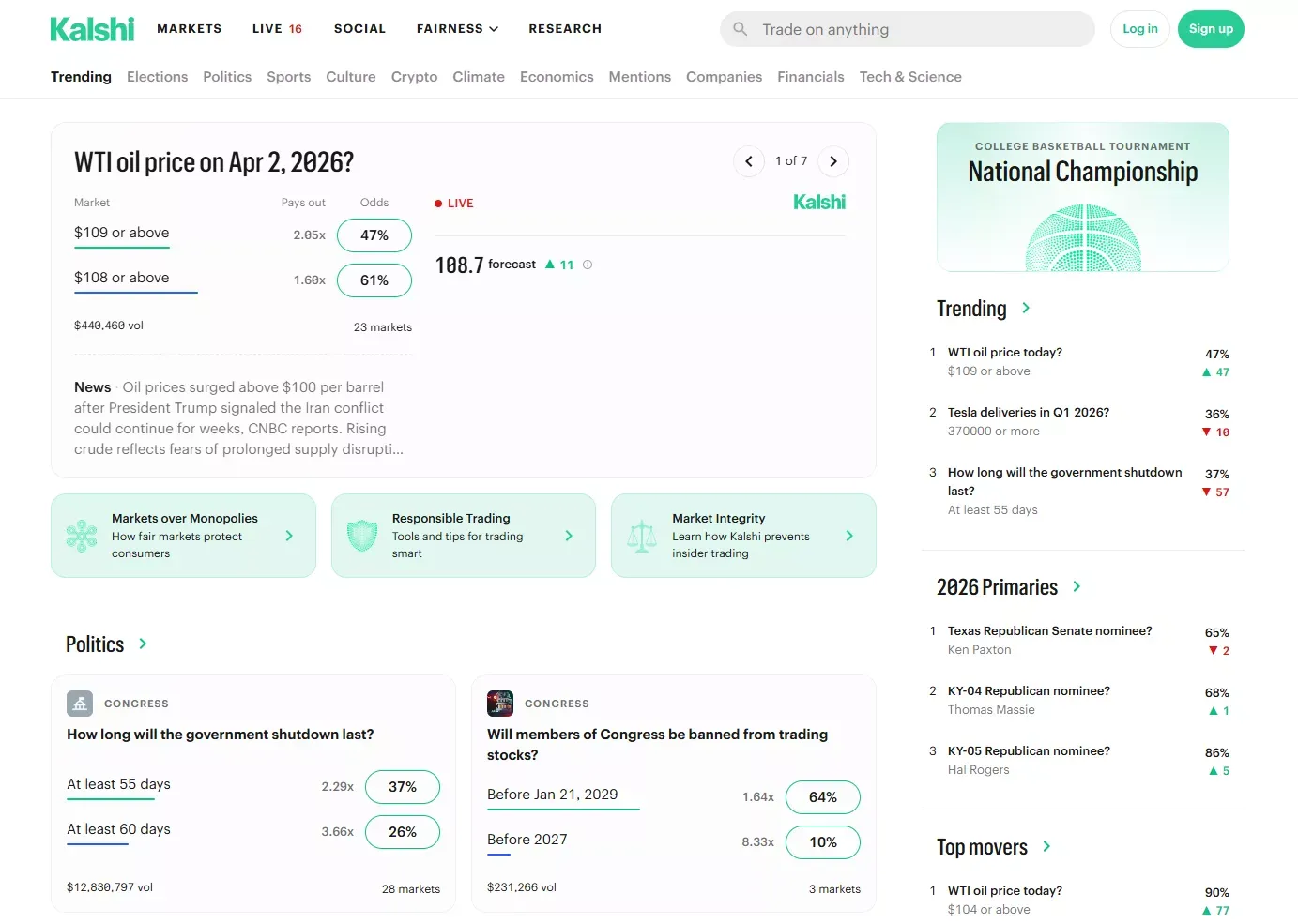
Kalshi at a glance:
- CFTC-regulated since November 2020
- Available in 42+ US states with open sign-up
- $43.1B in 2025 trading volume
Primary limitation: Kalshi's per-contract fee structure is more expensive than Polymarket for active traders, particularly on high-volume positions.
What Is Polymarket?
Polymarket launched in 2020 as a blockchain-based prediction market. The platform built its reputation on crypto-native infrastructure: traders hold USDC on the Polygon network, and every trade settles on-chain, giving full transparency into market activity.
The global platform charged near-zero fees, which attracted high-volume traders and made it the largest prediction market by volume for most of 2024.
In September 2025, Polymarket re-entered the US market through the acquisition of QCEX, a CFTC-licensed exchange.
The US version launched as a mobile beta, invite-only, and initially focused on sports markets. By March 2026, Polymarket crossed $10 billion in monthly trading volume for the first time, driven largely by NCAA tournament activity.
Entrepreneurs interested in replicating Polymarket's decentralized model should review how Polymarket makes money, specifically its fee structure, liquidity incentives, and revenue model, before deciding on a business architecture for their own platform.
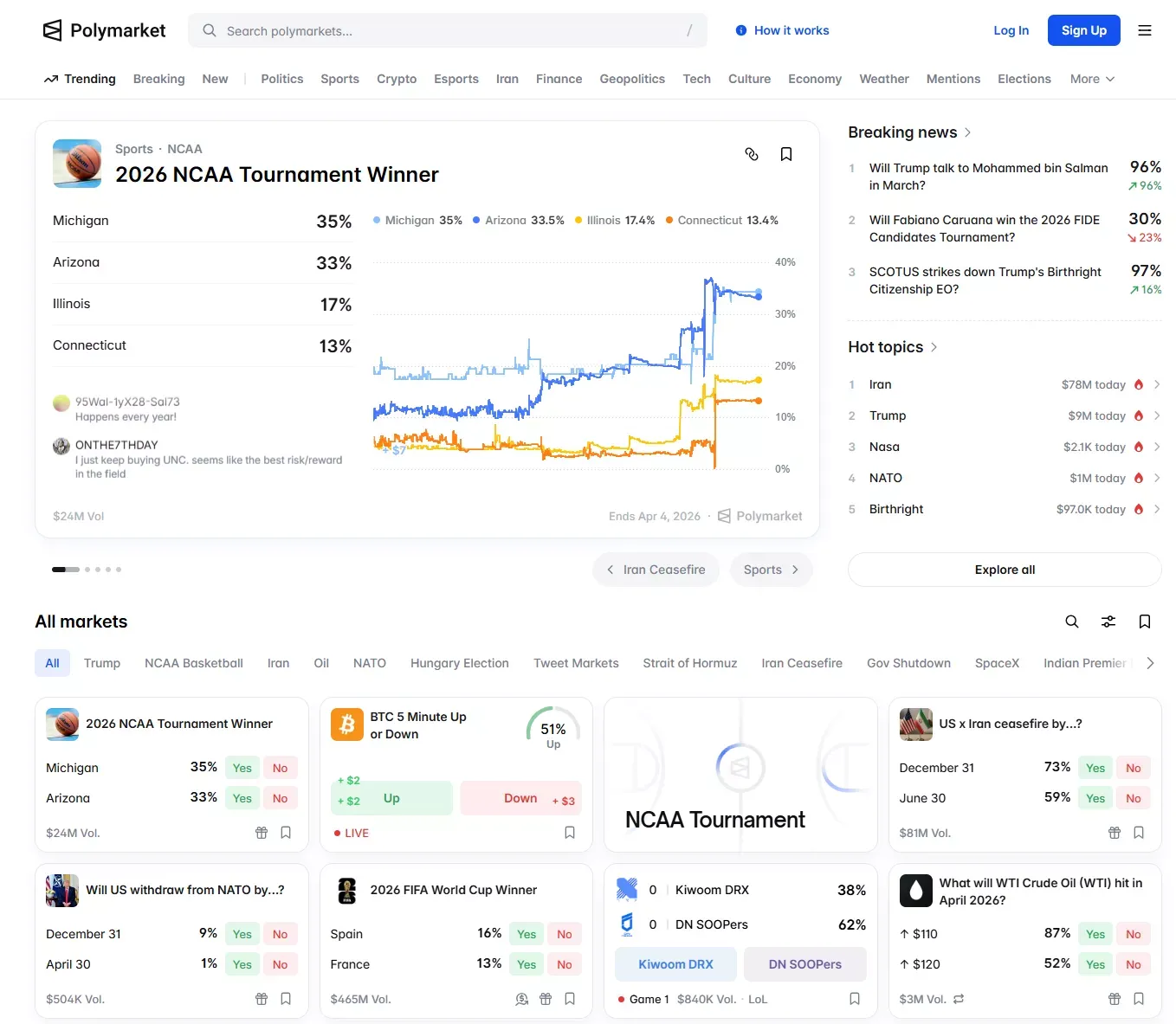
Polymarket at a glance:
- CFTC-approved via QCX LLC acquisition (September 2025)
- $33.4B in global 2025 trading volume; $10B+ in March 2026
- Near-zero fees on the global platform; 0.3% flat taker fee on US
Primary limitation: US access remains controlled. The rollout is invite-only and mobile-only, and the product Americans see today is narrower than the global Polymarket platform.
Regulation and US Access Compared
Kalshi holds the cleanest regulatory record. It received CFTC approval in November 2020 and has operated continuously under federal oversight since then. You sign up, verify your identity, connect a bank account, and trade. No invite codes, no waitlists, no restricted state lists.
Polymarket's path back to the US was more complex. The CFTC fined Polymarket in January 2022 and required it to wind down markets for US users.
The return came through QCX LLC, now doing business as Polymarket US, which the CFTC lists as a designated contract market. The re‑entry is real, but the rollout is still controlled. Access requires an invite code, the product is mobile‑only, and the initial market selection focuses on sports. Users in states not yet included in the beta may still be excluded; check Polymarket’s official waitlist page for current availability.
|
Platform |
US Status |
|
Kalshi |
Open access; 42+ states; no invite required |
|
Polymarket |
Invite-only mobile beta; sports-focused; full rollout pending |
Winner: Kalshi for open, immediate US access.
Fees Compared
Fees are where the Kalshi vs Polymarket comparison becomes most consequential for active traders.
Kalshi uses a per‑contract, tiered fee model based on the price of the contract. For takers, fees are calculated as a percentage of the contract price, with a cap of about $0.035 per contract.
The exact effective rate scales toward the midpoint, typically peaking around 1% for close‑to‑50/50 contracts and lower for more extreme odds. Liquidity providers placing limit orders (makers) receive significantly larger rebates, on the order of 1–2%, depending on price and volume, making Kalshi more attractive for market makers.
Polymarket’s global platform historically charged zero trading fees (0% maker and 0% taker). The US platform introduces a flat 0.3% taker fee on the total contract premium, not per contract, which is often much cheaper than Kalshi’s per‑contract structure for high‑frequency traders.
For a broader look at how prediction market platforms structure their revenue, the breakdown of how crypto exchanges make money applies directly to fee-based prediction market business models.
|
Platform |
Fee Type |
Maker Fee |
Taker Fee |
Notes |
|
Kalshi |
Per‑contract, tiered |
1–2%‑level rebate marketmath+1 |
Scaled by contract price, capped at ~$0.035 |
Higher cost at volume |
|
Polymarket (Global) |
None |
0% |
0% |
USDC/Polygon only |
|
Polymarket (US) |
Flat taker fee on premium covers+1 |
N/A |
0.3% |
Mobile beta; US only |
When Polymarket is cheaper:
- High‑frequency traders placing many contracts per session
- Traders using contracts priced near the $0.50 midpoint, where Kalshi fees scale up
- Traders who are comfortable depositing USDC instead of USD
Winner: Polymarket on cost efficiency for active traders, especially for high‑volume US‑based users.
Market Coverage Compared
Both platforms cover the core prediction market categories. Sports event contracts, political races, macro indicators, culture markets, and global affairs are available on each. The difference shows in depth and speed.
Kalshi leads in macro markets. Interest rate decisions, inflation prints, jobs reports, and weather forecasts all sit on a structured calendar with official data sources. Kalshi’s regulatory structure makes it well‑suited to these timestamp‑anchored events.
Polymarket leads in market breadth and speed of listing. Its global infrastructure allows faster arrival of new events, especially in niche, culture, and technology topics. Its performance in culture and technology categories is measurably stronger in independent analyses.
Categories both platforms cover:
- Sports (NFL, NBA, NHL, college football, golf, tennis)
- Politics (elections, congressional races, policy decisions)
- Macro economics (rate decisions, inflation, GDP)
- Culture and entertainment
- Global affairs
|
Category |
Stronger Platform |
Notes |
|
Macro/Rates |
Kalshi |
Structured calendar events; institutional familiarity covers |
|
Culture |
Polymarket |
Wider niche and faster‑maturing culture markets cover |
|
Technology |
Polymarket |
Faster‑listed tech events and broader coverage |
|
Sports |
Both |
High volume on both platforms in 2026 covers |
|
Politics |
Both |
Both performed well in 2024 US election markets covered |
Winner: Polymarket for breadth and niche coverage; Kalshi for depth in macro and rates.
Accuracy and Predictive Performance Compared
Prediction market accuracy matters if you plan to use prices as genuine probability signals, not just trading instruments.
A third‑party study analyzing markets from Calibration City and brier.fyi found that Polymarket delivered better calibration and lower Brier scores (a measure of prediction accuracy where lower is better) across many durations, especially in culture and technology.
These figures are based on a 2025 analysis of linked markets and may not generalize to every event or market duration.
|
Category |
Polymarket Error Rate |
Kalshi Error Rate |
Gap |
|
Culture |
41.6% |
54.7% |
13.1 percentage points |
|
Technology |
39.2% |
54.7% |
15.5 percentage points |
In the technology category, Polymarket’s markets show a noticeably better accuracy record than Kalshi’s over the studied period, though both platforms perform well in core categories like sports and politics.
Winner: Polymarket for predictive accuracy, particularly in culture and technology, based on third‑party research.
User Experience Compared
The two platforms feel different from the first login.
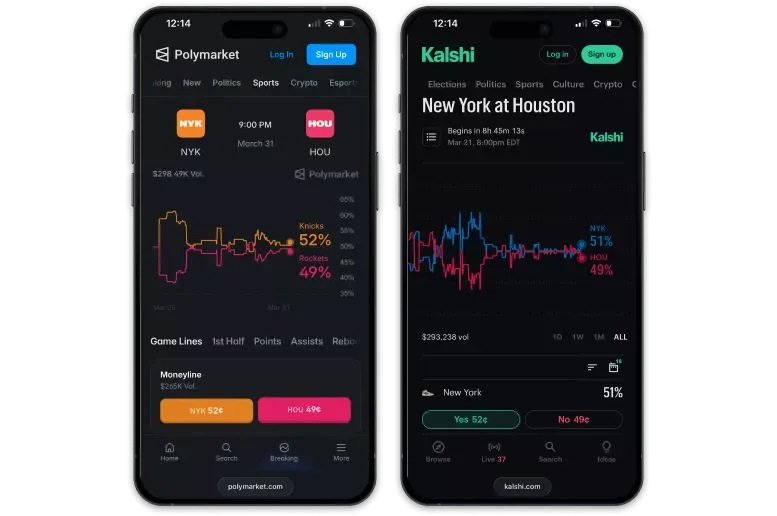
Kalshi runs native iOS and Android apps with a clean, finance-style interface. Price chips, quick Yes/No order tickets, light charting, watchlists, and balance alerts are all built in. Order entry supports both market and limit orders. The onboarding mirrors a standard brokerage: verify your identity, connect a bank, deposit USD, and trade.
For anyone familiar with a stock trading app, Kalshi feels immediate.
Polymarket's global product is web-first and wallet-first. You connect a crypto wallet, hold USDC on the Polygon network, and see full order books with on-chain transaction receipts. The transparency appeals to crypto-native traders who want to verify every trade independently. The US app is now live, but the wallet-based deposit flow remains the primary on-ramp.
|
Factor |
Kalshi |
Polymarket |
|
Deposit method |
USD bank transfer |
USDC (crypto wallet); US app adds bank option |
|
App availability |
Native iOS and Android |
US mobile app live; global product is web-first |
|
Order types |
Market and limit |
Market and limit |
|
On-chain transparency |
No |
Yes (Polygon network) |
|
Onboarding speed |
Fast (bank-style KYC) |
Slower if new to crypto wallets |
Winner: Kalshi for traditional finance users. Polymarket for crypto-native traders who want on-chain records.
Which Prediction Market Platform Should You Choose?
Choose Kalshi if:
- You want to open an account and trade today, with no invite code or waitlist
- You prefer funding with a USD bank transfer
- You trade macro markets: interest rates, inflation, weather, jobs reports
- You need full CFTC regulatory clarity and tax reporting (1099 forms)
Choose Polymarket if:
- You are fee-sensitive and trade at meaningful volume
- You are comfortable depositing and holding USDC
- You want access to a broader global market library once the US rollout expands
- You focus on culture or technology prediction markets, where Polymarket's accuracy record is stronger
Thinking About Building Your Own Prediction Market?
Kalshi and Polymarket together processed over $76 billion in trading volume in 2025. That number tells you where user attention and capital are moving. Both platforms validated the model: binary event contracts, transparent resolution, and fee-based revenue work at scale.
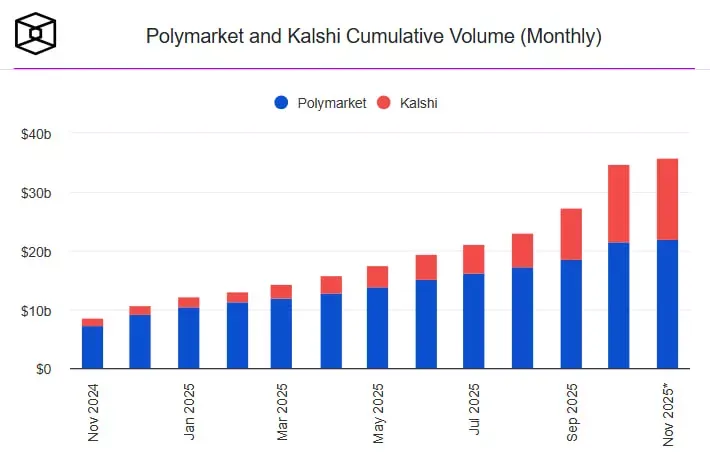
Image Source: coinspot.io
If you are a founder or startup evaluating whether to build in this space, the architecture decisions, order book vs AMM, centralized vs decentralized, fiat vs crypto rails, are the first product decisions that determine whether your market gets used.
The Polymarket Clone Script from Troniex Technologies covers the decentralized, wallet-based route with audited smart contracts and multi-chain support. The Kalshi style script covers the regulated, fiat-native route with KYC/AML, binary contract settlement, and an admin dashboard ready for compliance workflows.
For teams who want to understand what separates platforms that get adoption from those that stay empty, the guide on how to build a prediction market that people actually use walks through the three product decisions: liquidity, question design, and resolution trust that drive real trading volume.
Troniex Technologies builds prediction market platforms for startups, crypto entrepreneurs, and enterprises entering this space. Prediction market Development timelines run 45 to 60 days for clone-based builds and are longer for fully custom prediction market platforms.
Ready to Launch Your Prediction Market?
Get your custom quote and 45-day roadmap today. Start developing your prediction market with Troniex Technologies - proven scripts, audited contracts, and adoption-ready features.
Talk To Our ExpertsThe Decision Comes Down to Two Things
Access and fees are the two factors that separate these platforms right now. If you want to trade today with USD from a bank account, Kalshi is the only fully open option. If you want lower fees and are comfortable with the crypto on-ramp, Polymarket's global product delivers a clear cost advantage.
The fastest way to find your preference: sign up to Kalshi now (it takes under five minutes), and add Polymarket once the US rollout expands to your state.