From Checkout to Settlement: How Crypto Payment Gateways Work for Merchants
Explore crypto payment gateways for merchants, covering supported cryptocurrencies, core components, security, integration, architecture, benefits, and challenges.
Sep 21, 2026
10 mins read
Cryptocurrency is moving beyond trading and becoming a practical payment option for businesses serving customers across borders. But accepting digital assets involves more than adding a crypto button to checkout.
Businesses need reliable blockchain integration, transaction verification, wallet infrastructure, exchange-rate handling, and secure settlement.
At Troniex Technologies, we work on crypto payment solutions involving blockchain connectivity, wallet integration, payment processing, transaction monitoring, and settlement workflows, giving us practical insight into the technical considerations behind merchant crypto payments.
Crypto Payment Gateway Development for Merchants brings these processes together, helping fintech startups, entrepreneurs, and money transfer businesses build streamlined payment infrastructure while understanding the crypto payment gateway development cost involved in planning and launching their solution.
In this guide, we’ll break down how a crypto payment gateway for merchants works, from customer checkout to final settlement.
What Is a Crypto Payment Gateway for Merchants?
Think of a crypto payment gateway for merchants as a bridge between customers paying with cryptocurrency and businesses receiving those payments.
It brings wallet addresses, blockchain confirmations, exchange rates, and transaction tracking into one system, making merchant crypto payments easier to manage for fintech startups, entrepreneurs, and money transfer businesses.
For example, an online software company can accept a crypto payment at checkout while the gateway generates the payment request, monitors the blockchain, verifies the transaction, and updates the order.
Depending on the business model, funds can be retained as crypto, converted into another digital asset, or prepared for settlement.
Core functions include:
- Payment Processing: Handles incoming crypto payments from customers.
- Blockchain Verification: Confirms transactions and blockchain activity.
- Wallet Integration: Connects payments with supported crypto wallets.
- Transaction Monitoring: Tracks payment status and confirmations.
- Settlement Management: Helps merchants receive or convert funds.

Expand Your Merchant Payment Options
Launch flexible crypto payments tailored to your business and customers.
Talk To Our ExpertsWhat Cryptocurrencies Can Merchants Accept?
The right cryptocurrency mix depends on customer preferences, target markets, transaction costs, blockchain performance, and settlement requirements.
Bitcoin and Ethereum are common choices, while USDT and USDC can offer more predictable values during payment processing.
For example, an international e-commerce store may accept Bitcoin and Ethereum alongside stablecoins such as USDT or USDC.
A money transfer business may prioritize stablecoins, while a Web3 business could require additional tokens and networks.
A flexible crypto merchant payment solution allows businesses to start with relevant assets and expand as demand grows.
Popular options include:
- Bitcoin (BTC): Widely recognized for cryptocurrency-based payments.
- Ethereum (ETH): Supports payments across the Ethereum ecosystem.
- USDT: A widely used stablecoin for digital transactions.
- USDC: A stablecoin commonly used for blockchain payments.
- Other Digital Assets: Additional tokens can be supported based on business needs.
What Are the Core Components of a Crypto Payment Gateway for Merchants?
A crypto payment gateway needs several systems working together to make payments simple for merchants and customers. From receiving a payment to confirming it on the blockchain and completing settlement, each component has a specific role. For businesses handling high-volume or cross-border payments, these components help create a smoother, more reliable crypto payment gateway for merchants.
- Payment Processing Engine: Manages payment requests, incoming transactions, and payment status updates.
- Blockchain Integration: Connects the gateway with supported blockchain networks for transaction processing.
- Crypto Wallet Infrastructure: Manages payment addresses, wallet connections, deposits, and asset transfers.
- Transaction Monitoring: Tracks blockchain activity, confirmations, failed payments, and transaction statuses.
- Exchange Rate Engine: Provides real-time cryptocurrency rates for accurate payment calculations.
- Crypto Conversion Module: Converts supported cryptocurrencies into fiat currencies or stablecoins when required.
- Settlement System: Automates merchant payouts based on configured wallet and settlement preferences.
- Security & Compliance Layer: Protects payment operations while supporting applicable security and compliance requirements.
Also read: Get Crypto Payment Gateway Integration Services tailored to your needs.
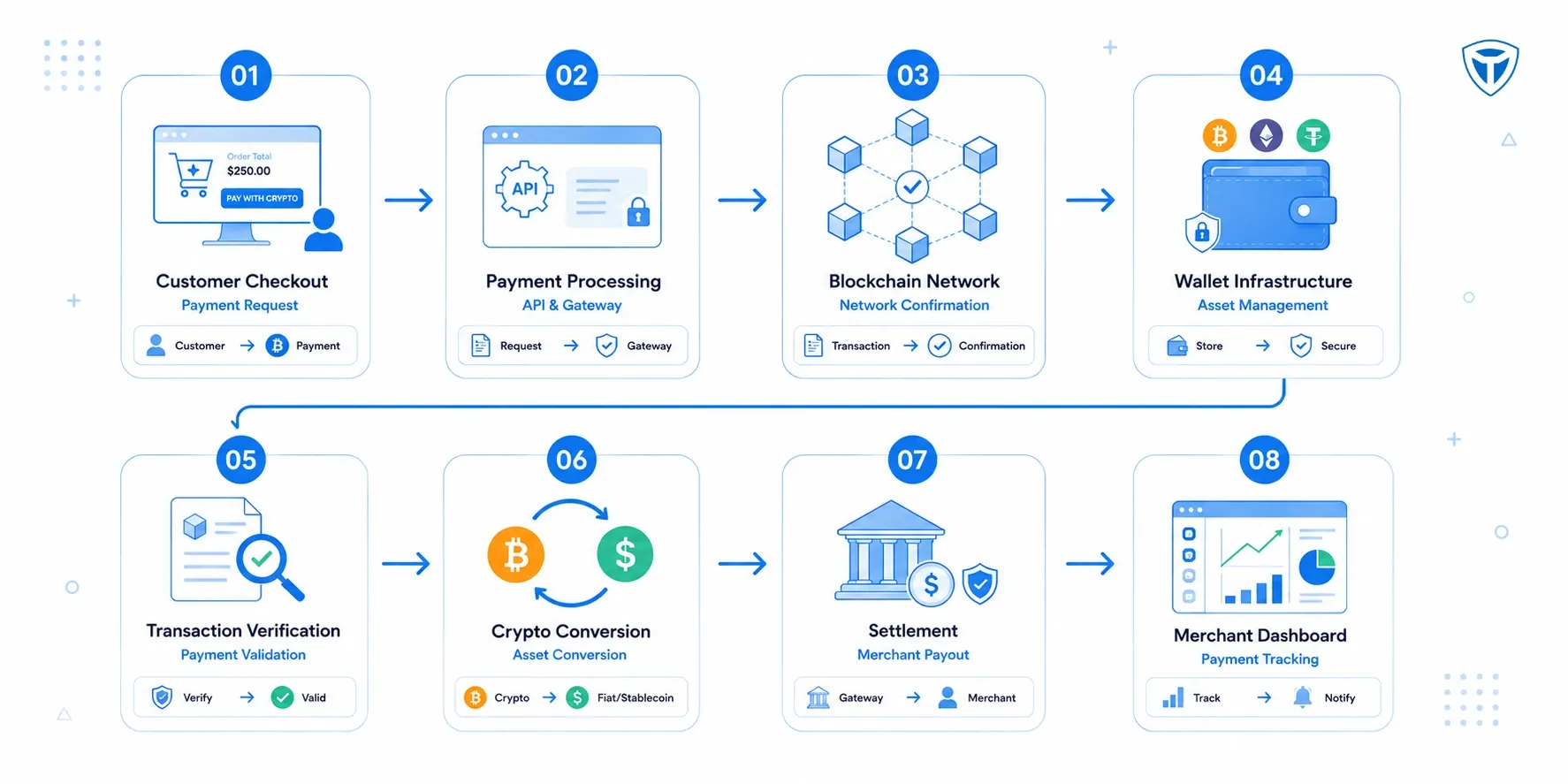
Crypto Payment Gateway Architecture: Key Components at a Glance
A crypto payment gateway brings several systems together to move a customer’s payment from checkout to the merchant’s account.
Each layer has a specific role, from handling the initial payment request and connecting with blockchain networks to verifying transactions, converting assets, and completing settlement.
The infographic below gives a quick look at how these core components work together in a crypto merchant payment solution.
Crypto Payment Gateway Security: What Merchants Should Know
When money is moving through a crypto payment gateway, security cannot be an afterthought. Merchants need confidence that their accounts, wallets, transactions, and payment data are protected throughout the payment process.
For fintech startups, entrepreneurs, and money transfer businesses, combining several security measures can help prevent unauthorized access, reduce payment risks, and create a safer payment experience.
- Data Encryption: Keeps sensitive payment and transaction information protected from unauthorized access.
- Multi-Factor Authentication: Adds another layer of protection when users access merchant accounts.
- Secure Wallet Management: Helps keep merchant funds, wallet credentials, and transactions protected.
- Transaction Monitoring: Helps spot unusual activity and potentially suspicious payment transactions.
- Address Validation: Reduces the risk of sending funds to the wrong wallet address.
- API Security: Protects data exchanged between the gateway and connected merchant platforms.
- Access Controls: Ensures sensitive payment functions are available only to authorized users.
Benefits of Crypto Payment Gateways for Merchants
A crypto payment gateway becomes valuable when it solves real payment challenges rather than simply adding another payment option. For example, an online business can use it to accept payments from international customers, while a money transfer platform can use stablecoins for faster settlement.
Here’s how the main benefits can translate into practical business use cases.
|
Benefit |
How It Helps Merchants |
Practical Example |
|---|---|---|
|
Global Payment Access |
Helps businesses accept payments from customers across supported markets. |
An online store can accept crypto from an overseas customer without relying only on local payment methods. |
|
Faster Transactions |
Enables quicker payment processing across compatible blockchain networks. |
A digital service provider can receive a crypto payment and confirm it without waiting for traditional banking settlement. |
|
Lower Processing Costs |
Can reduce certain intermediary and payment processing expenses. |
A business handling international payments may reduce reliance on multiple payment intermediaries. |
|
Stablecoin Payments |
Offers more predictable-value payment options than volatile crypto assets. |
A money transfer business can accept USDT or USDC when stable-value settlement is preferred. |
|
Multiple Cryptocurrencies |
Gives customers more flexibility when choosing payment assets. |
An e-commerce merchant can accept Bitcoin, Ethereum, USDT, and USDC at checkout. |
|
Automated Settlement |
Reduces manual work through automated payment and payout workflows. |
A merchant can automatically route verified payments to its preferred settlement wallet. |
|
Transparent Transactions |
Provides blockchain records for improved payment visibility. |
A merchant can use transaction hashes to verify and track incoming payments. |
|
Flexible Settlement |
Lets merchants retain crypto or convert funds according to business needs. |
A merchant can receive USDT directly or convert selected crypto into fiat where supported. |
How to Integrate a Crypto Payment Gateway Into a Merchant Website
Adding crypto payments to a website isn’t just about placing a crypto payment button on the checkout page. The gateway needs to work smoothly with your website, wallets, blockchain networks, payment APIs, and settlement system.
These 10 steps give merchants a practical starting point for building a reliable crypto payment gateway for merchants.
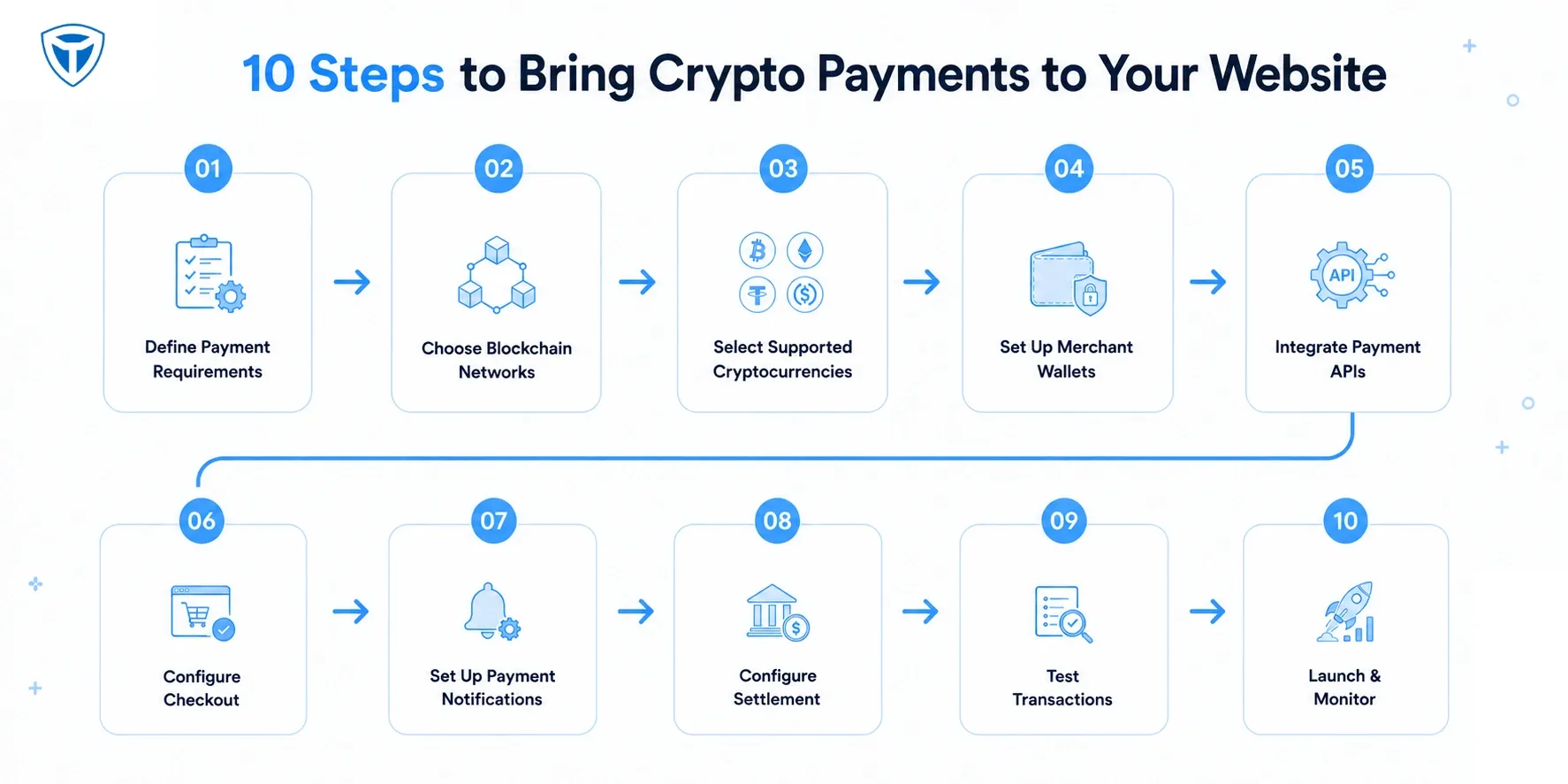
- Define Payment Requirements: Identify your target customers, payment methods, supported currencies, settlement preferences, and business requirements.
- Choose Blockchain Networks: Select reliable blockchain networks based on transaction speed, fees, scalability, and customer demand.
- Select Supported Cryptocurrencies: Decide which cryptocurrencies and stablecoins your customers can use at checkout.
- Set Up Merchant Wallets: Configure secure wallets for receiving, managing, and transferring cryptocurrency payments.
- Integrate Payment APIs: Connect the gateway APIs with your website, backend systems, order management, and payment infrastructure.
- Configure Checkout: Add a simple crypto payment option where customers can select their preferred supported asset.
- Set Up Payment Notifications: Configure real-time notifications to update merchants and customers about payment status.
- Configure Settlement: Define how and where received funds should be settled, retained, or converted.
- Test Transactions: Run test payments to verify wallet connections, transaction confirmation, notifications, conversion, and settlement.
- Launch & Monitor: Deploy the integration and continuously monitor transactions, payment performance, security, and customer activity.
This structured approach helps businesses create a smoother crypto payment gateway for merchants while reducing integration issues and improving the overall payment experience.
Common Mistakes Merchants Make When Adding Crypto Payments
Adding crypto payments can be useful for businesses, but it is important to plan the setup properly. Some merchants make simple mistakes, such as accepting too many cryptocurrencies, overlooking transaction fees, or not planning how they will receive their funds.
Knowing these common mistakes can help businesses create a smoother and safer merchant crypto payments experience.
|
Mistake |
Potential Impact |
Recommended Solution |
|---|---|---|
|
Accepting Too Many Cryptocurrencies |
Managing many assets can make the system harder to handle. |
Start with popular cryptocurrencies your customers actually use. |
|
Ignoring Network Fees |
High fees can increase the cost of each payment. |
Choose blockchain networks with suitable transaction fees. |
|
Ignoring Crypto Price Changes |
The value of crypto can change before settlement. |
Consider stablecoins or quick conversion options. |
|
Poor Wallet Security |
Weak protection can put merchant funds at risk. |
Use secure wallets and strong account protection. |
|
Not Testing Payments |
Payment problems may appear after the website goes live. |
Test different payment and transaction scenarios before launch. |
|
Not Planning Settlement |
Merchants may not know how to manage received crypto. |
Decide whether to keep, convert, or settle the funds. |
|
Ignoring Compliance |
Businesses may face regulatory problems in some markets. |
Check the applicable rules before launching crypto payments. |
|
Making Checkout Complicated |
Customers may leave without completing their payments. |
Keep the crypto checkout simple and easy to understand. |
Start Your Crypto Payment Gateway Development
Discuss your requirements and build a gateway around your business.
Contact UsConclusion
For merchants, crypto payments are no longer just about offering another payment option. They can open the door to global customers, flexible payment methods, faster processing, and more efficient settlement.
However, the real value comes from having the right payment infrastructure behind the checkout experience.
With crypto payment gateway development for merchants, businesses can build a payment system around their specific needs, from supported cryptocurrencies and blockchain networks to wallet management, transaction verification, and settlement.
At Troniex Technologies, we provide Crypto Payment Gateway Development Services to help businesses turn these requirements into practical, scalable crypto payment solutions designed around their business goals and customer needs.
If you’re ready to make crypto payments part of your business, we can help you build a merchant-ready crypto payment gateway that’s secure, flexible, and built for growth.