AI Agent Systems In Gaming: Problems Fixed, Costs To Build
AI agent systems in gaming are software that plans its own steps and acts without approval at each one, unlike scripted NPCs. They fix four problems: static NPCs, reactive LiveOps, slow QA, and support tickets outscaling headcount. The real cost is rarely the AI model. It's low-latency infrastructure and unified data, with builds running 8 weeks to 6 months.
Sep 28, 2026
12 mins read
- "AI agent" and "scripted NPC" aren't the same thing: agents plan their own steps and adapt; scripts don't
- Four problems agent systems fix: static NPCs, reactive LiveOps, slow QA, and support tickets outscaling headcount
- The real cost driver is rarely the AI model. It's low-latency infrastructure, unified data, and integration with what you already run
- Build, buy, or assemble with a partner: the right path depends on your existing data and ML capacity, not on hype
- Don't adopt agentic AI before you've fixed fragmented data, or you'll get an expensive dashboard that does nothing
Every studio conversation about AI right now uses the word "agent" for at least three different things. That's a problem if you're the one deciding where to spend engineering time next quarter.
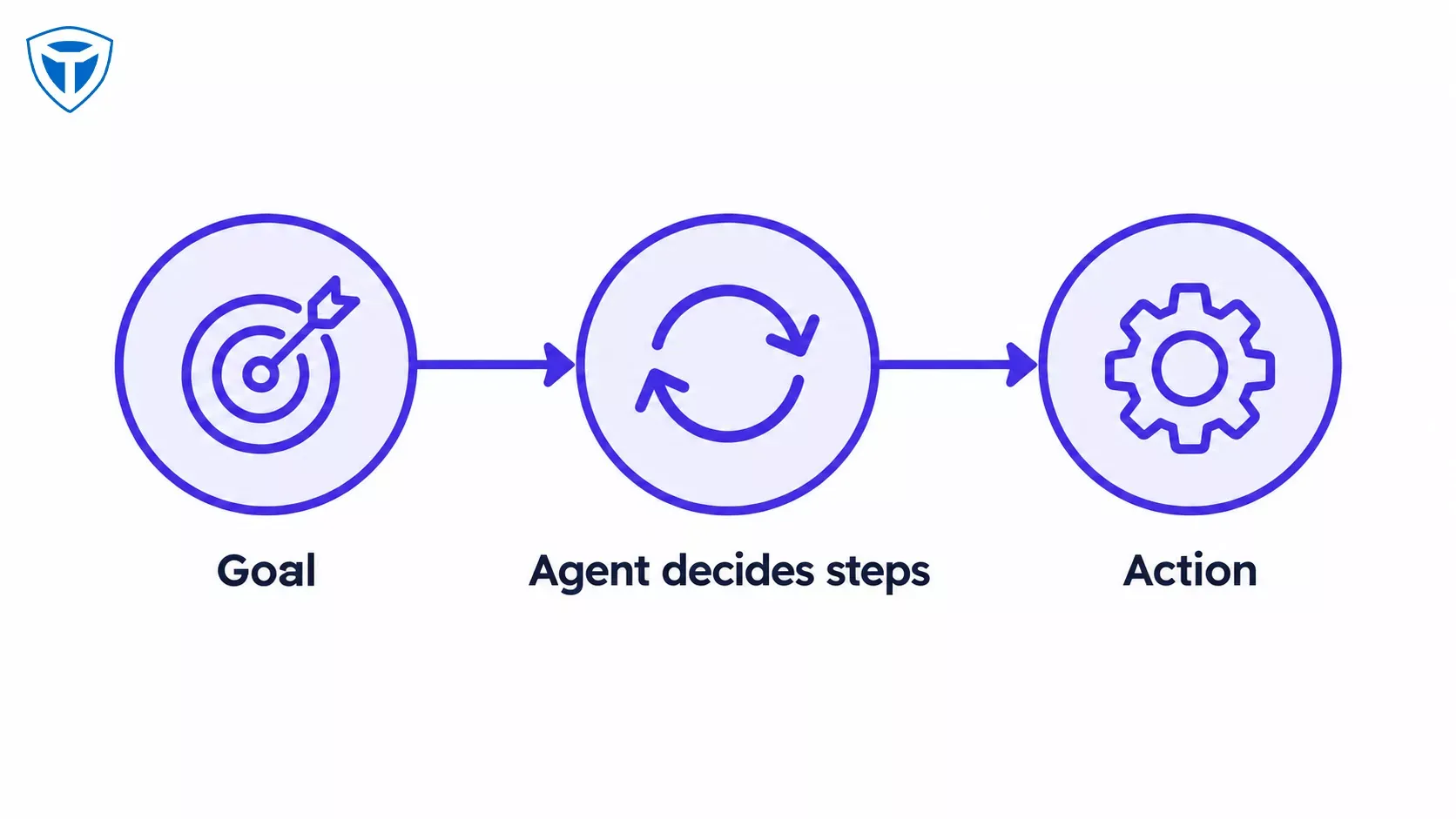
An AI agent in gaming is software that takes a goal, decides its own steps, and acts without a human approving each move. It's different from a scripted NPC, a procedural generation script, or a chatbot that answers one question and forgets you existed. This piece covers four specific problems these systems solve, what building one costs, and where the whole idea doesn't pay off yet.

Not Sure Which Of These Four Problems Applies To Your Game?
Talk to a Troniex AI agent developer and get a straight answer on what's worth building for your studio, and what isn't yet.
Book A Free Consultation →Why "AI Agent" Got Attached To Every Gaming Problem This Year
Scripted NPCs follow a decision tree someone wrote by hand. Procedural generation randomizes content within rules someone wrote by hand. A single-call AI feature answers one prompt and stops. An agent system does none of that. It holds a goal, checks its own progress, calls tools or queries data on its own, and keeps going across multiple steps without a person in the loop for each one.
The confusion isn't accidental. Vendors have spent two years calling anything with an LLM behind it "agentic," and studios without an in-house ML team have no easy way to tell the difference from a product page. Databricks draws the same line between agentic systems and traditional game AI like procedural generation and reinforcement learning. The distinction matters here because the four problems below only get solved by systems that plan and act on their own. A smarter chatbot doesn't touch any of them.
|
System type |
Decides its own steps? |
Adapts in real time? |
Example in gaming |
|---|---|---|---|
|
Scripted NPC |
No, follows a pre-written tree |
No |
Dialogue tree, fixed patrol routes |
|
Procedural generation |
No, randomizes within fixed rules |
No |
Level layout, loot tables |
|
Single-call AI feature |
No, one prompt, one response |
Partially |
In-game chatbot FAQ |
|
Agent system |
Yes |
Yes |
Living NPC memory, real-time LiveOps monitoring |
Problem 1: NPCs That Break Immersion Because They're Static
AI NPC systems are the most visible use case in this list, and the easiest for players to judge for themselves.
Signs this is costing you, players
- Steam and app store reviews call out specific NPCs by name for repeating the same lines
- Players openly compare your NPCs to a competitor's "smarter" ones in community threads
- Playtesters break immersion the moment they realize an NPC "forgot" an earlier choice
Once a player catches the seam, they stop treating the world as real, and that's the thing you were selling.
How an agent system fixes it
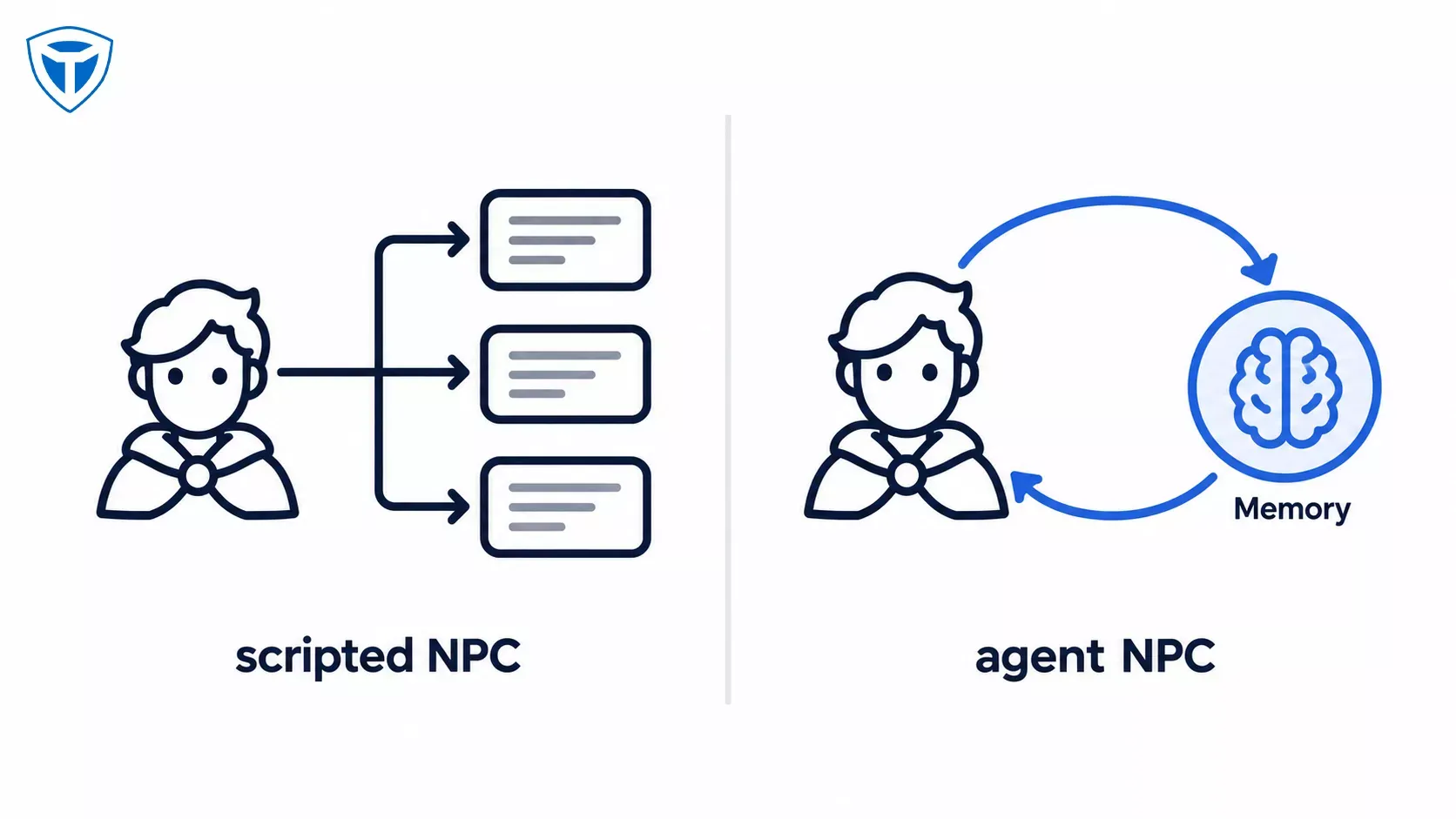
Instead of a dialogue tree, the NPC runs on a compound system: it holds memory of past player interactions, has its own goals independent of the player's actions, and generates responses that account for both. Artificial Agency and Inworld have both shipped commercial versions of this, where an NPC can remember a betrayal three hours earlier and reference it unprompted. The character is doing something instead of retrieving something.
What it costs to build
This is the highest-effort item on this list. You need low-latency inference sitting close to your game servers, because a two-second pause before an NPC responds kills the illusion faster than a bad line would.
You also need memory infrastructure per player, per NPC, which scales with your player count in a way a static dialogue tree never did. Most game development companies haven't had to plan for that kind of build before.
Budget for this as a multi-month integration, not a sprint. Expect ongoing inference cost per active player.
Problem 2: LiveOps Teams Reacting Instead Of Predicting
AI-powered LiveOps is where most of the near-term budget in this space is going, and it's the easiest use case to justify with a number.
Signs this is costing you, players
- Your team finds out an event underperformed only after it's over
- Churn spikes the week after a balance patch, and nobody flagged the pattern beforehand
- Offers get tuned by gut feel because the one person who can read the data runs three other live titles too
How an agent system fixes it
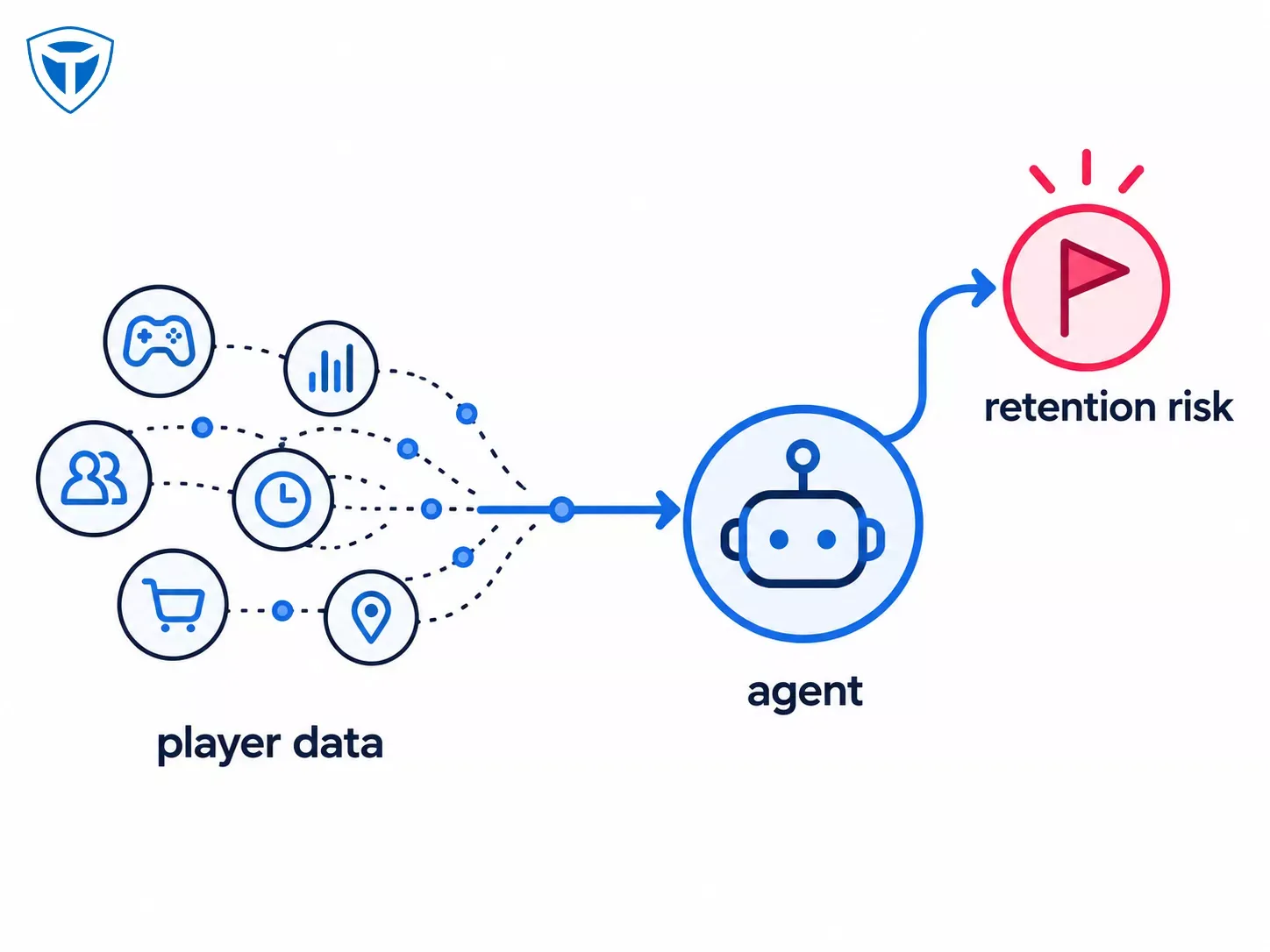
An agent watching player behavior in real time can flag a retention risk while there's still time to act on it, not after the cohort report lands on Monday. It can adjust an offer, trigger a re-engagement message, or surface an anomaly to a human without someone polling a dashboard for it.
The agent takes over the part of the job that's watching numbers and waiting for a threshold to cross, freeing the LiveOps team for the calls a person still has to make.
What it costs to build
The cost here is mostly data plumbing, not the agent itself. If your GA4, in-game telemetry, and CRM data live in three places that don't talk to each other, unifying that pipeline is the actual project. It's a common gap in iGaming platforms built up over multiple releases.
Once the data pipeline exists, the agent layer on top is comparatively cheap. Studios that skip straight to "buy an AI LiveOps tool" without fixing the data layer underneath usually end up with a dashboard that looks smart and does nothing.
Scoping This Against Your Own Stack Before You Commit Budget?
Troniex builds agent systems for live-service and iGaming platforms and can tell you in one call whether your data and infrastructure are ready.
Get A Build Cost EstimateProblem 3: QA Headcount Growing Faster Than The Game
Signs this is costing you, players
- Regression testing takes longer with every content update
- Release dates slip to accommodate manual QA passes
- Bugs still ship to live because no tester can exhaustively click through every content combination
How an agent system fixes it
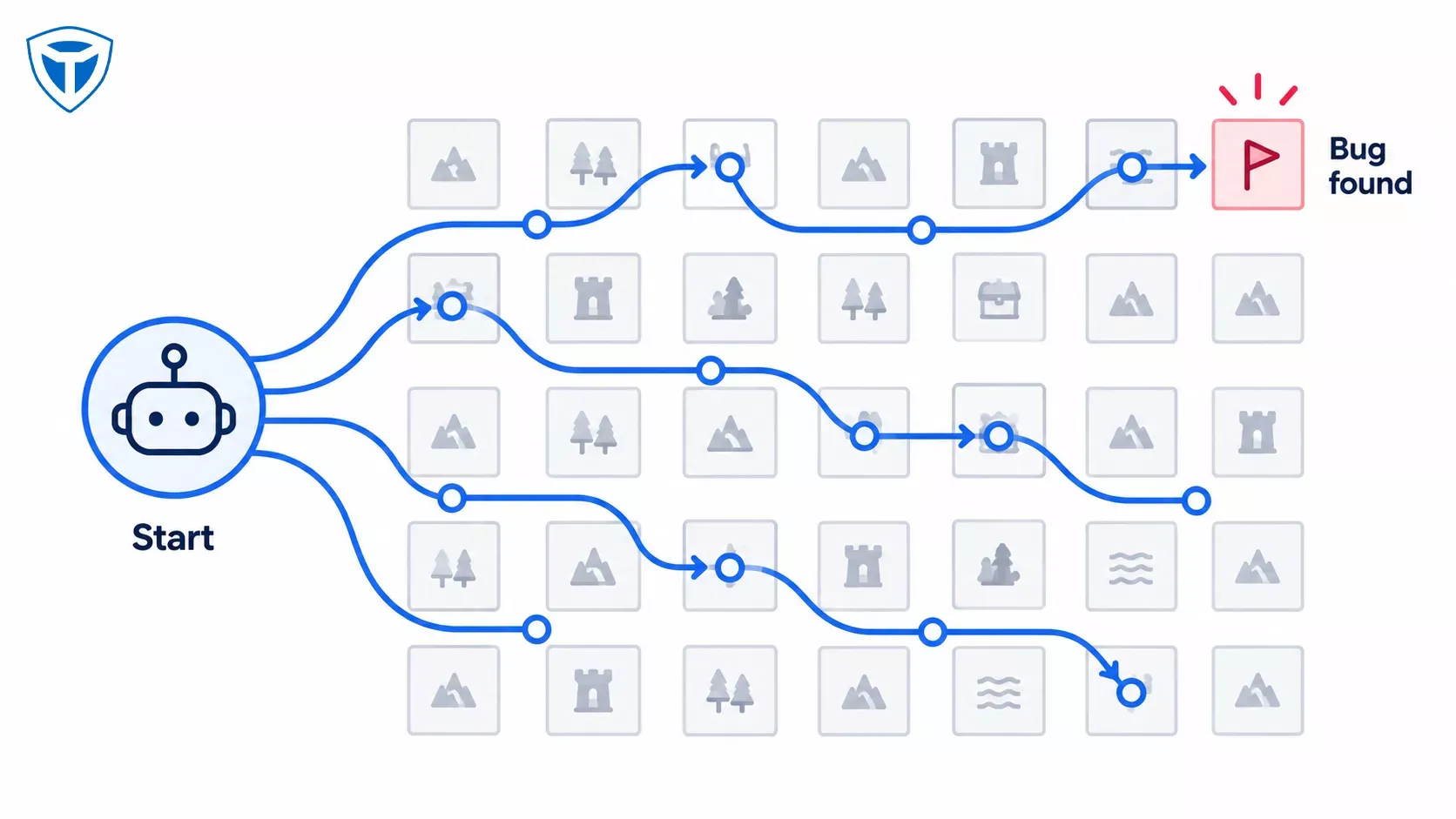
Testing agents explore game content the way a player would, but at a scale and repetition rate no QA team can match. They generate their own play paths, flag anomalies using pattern recognition trained on what "broken" looks like, and run continuously instead of in scheduled passes. Automated scripted testing only checks what someone already anticipated. The agent finds paths nobody wrote a test case for.
What it costs to build
Integration effort here depends entirely on your existing CI setup. If you already have automated test infrastructure, plugging in an agent layer is a matter of weeks, not months. If QA is still mostly manual, you're doing two projects at once: building the automation foundation, then adding the agent on top of it.
This AI agent development guide covers the same sequencing mistake. Don't let a vendor sell you the second project as if it were the first.
Problem 4: Support Tickets Outscaling Your Team
Signs this is costing you, players
- Response times creep up every time you run a promotion or ship a buggy patch
- CSAT drops during exactly the periods when player sentiment matters most
- Headcount can't scale linearly with ticket volume without becoming your biggest line item
How an agent system fixes it
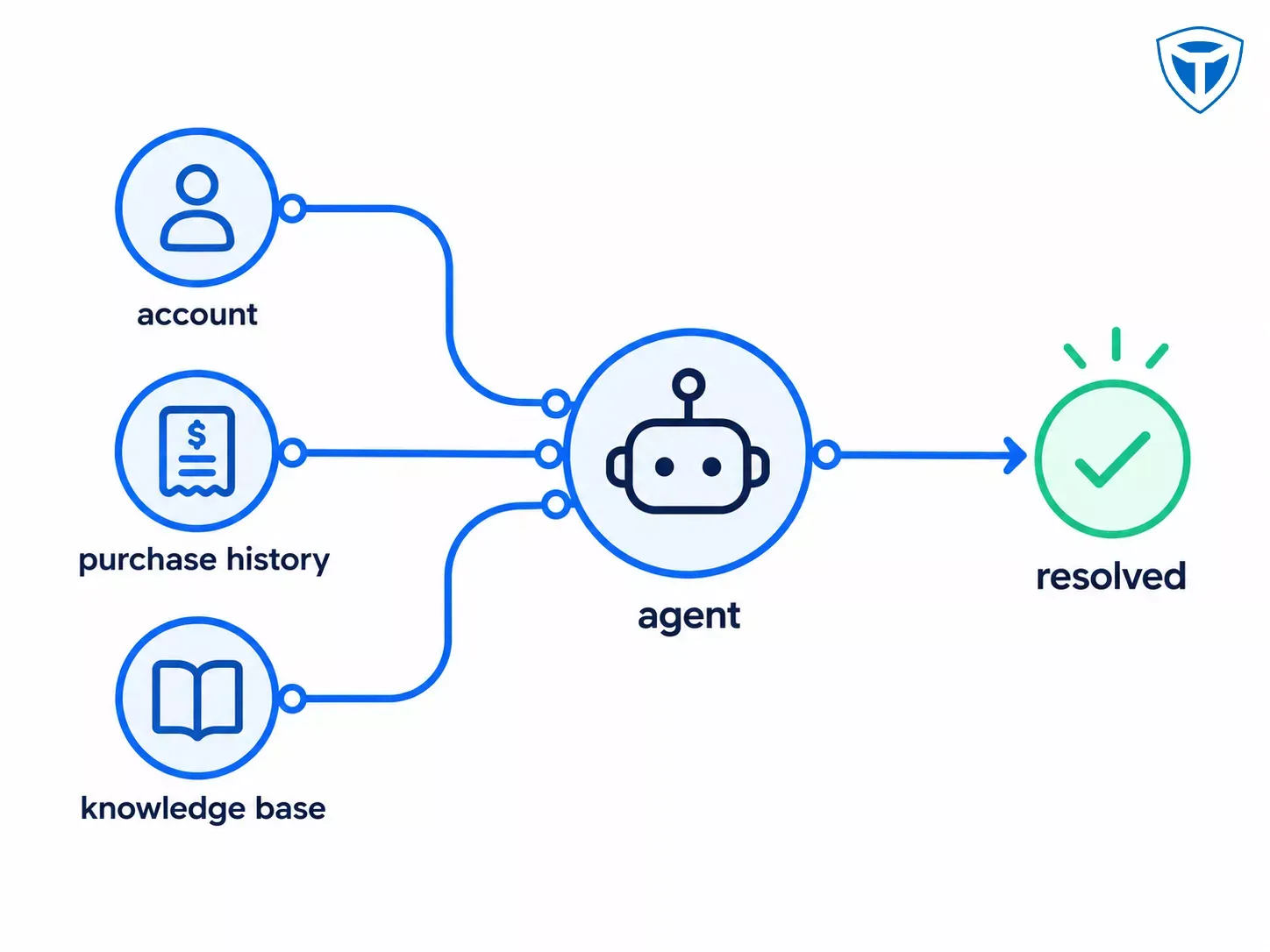
A support agent that can query your knowledge base, pull a player's account and purchase history, and reason through a resolution handles a meaningfully different class of ticket than a rules-based bot. It can say "I see you were charged twice for this bundle on Tuesday; here's the refund" instead of routing the player through five menu options that don't match their problem. Complex or emotionally charged tickets still go to a human. The agent absorbs the volume underneath that.
What it costs to build
The real cost driver is data governance and access-control design: giving an agent access to purchase history, account status, and support history means deciding exactly what it can see and what it can act on without approval.
That work usually takes longer than the model integration itself, and it's the part this breakdown of what custom AI agents cost covers in more depth. Budget time for it accordingly, especially if you operate under GDPR or similar regimes.
What Building An Agent System Takes
Across all four problems, the same three cost drivers show up:
- Low-latency inference near your game servers. Anything player-facing in real time (NPCs, in-session support) needs this. Anything back-office (QA, LiveOps analysis) doesn't need it nearly as badly.
- Centralized, governed data. Every one of these systems is only as good as the data it can reach. If your telemetry, player, and support data are fragmented, that's the project, not a footnote to it.
- Integration with your existing workflow, not a rebuild. The studios that get value fast are plugging agents into pipelines they already have. The ones that stall are trying to replace their whole stack at once.
Build, buy, or assemble with a partner are all reasonable paths depending on where you sit on those three drivers. A studio with strong internal data infrastructure and no ML team benefits most from assembling with an AI agent development company: buying the agent layer and the model access, building the integration in-house. A studio with neither should fix the data problem first, with or without outside help, before spending anything on the agent layer itself.
|
Use case |
Primary cost driver |
Typical timeline |
Latency-sensitive? |
|---|---|---|---|
|
Living NPCs |
Per-player memory infra, low-latency inference |
3–6 months |
Yes, real-time |
|
LiveOps monitoring |
Unified data pipeline |
8–12 weeks (if data is already connected) |
No |
|
Autonomous QA testing |
CI integration effort |
4–10 weeks (if CI automation exists) |
No |
|
Player support agent |
Data governance / access control |
3–6 months |
Partial, session-time |
When Agentic AI In Gaming Isn't Worth It Yet
If your player base is small enough that a human can still watch every metric that matters, you don't need a LiveOps agent yet. If you don't have a support team structure for an agent to hand escalations to, adding one creates a new kind of ticket nobody owns. And if your data lives in spreadsheets and CSV exports instead of a connected pipeline, every problem above gets more expensive to solve with AI than it would with basic data infrastructure work first. Fix that, then revisit this list.
Diagnostic Checklist
- NPCs feel static, and players notice → agent-driven memory and goal systems; budget for latency and per-player memory infrastructure
- LiveOps is reactive, not predictive → real-time monitoring agent, but only after your data pipeline is unified
- QA can't keep pace with content → autonomous testing agent, cheaper if CI automation already exists
- Support tickets outscale headcount → reasoning support agent, with access-control design as the real bottleneck
Start With The Problem, Not The Technology
Pick the one problem from this list costing you the most right now, whether that's churn, QA bandwidth, or support load, and scope that before touching the other three. Studios that try to solve all four at once usually solve none of them well.
Ready To Scope Your First Agent System?
Troniex Technologies builds AI agent systems for gaming and iGaming studios, from NPC memory to LiveOps to player support.
Start Your Project →