AI Agent Development Guide (2026) | Build Reliable AI Agents
Building an AI agent demo is easy. Building a production-ready agent that doesn’t hallucinate, blow up your API bill, or stall after a pilot is where most founders get burned.
Oct 08, 2026
15 mins read
- The Reality Check: AI performs well in a demo, but typically operates 20–40% worse in the real world. Expect a "dip" and plan for it.
- The 80/20 Rule: Building the "brain" (AI logic) is only 20% of the job. 80% of your work must go into the "safety gear", like memory and monitoring.
- Watch the Stakes: Never let an AI work alone on tasks worth more than $1,000. Keep a human in the loop to protect your brand.
- Speed vs. Cost: Hiring an in-house AI team costs $45k+ per month. A partner can often ship a working version in 8 weeks for much less.
- The Safety Switch: Set a "3-strikes" rule. If your AI fails more than 3-5% of the time, it should automatically shut down to save you money and headaches.
The Gap Between "Cool Demo" and "Profitable Product.” Most founders approach us after their initial demo wowed the team. The agent nailed that test case. Everyone's excited.
Then... nothing.
Six months later, it's still a prototype gathering dust.
Here's the truth: AI agents fail because of execution gaps, not smart enough models.
Demos show what works once. Production reveals what breaks repeatedly. Most founders learn this the expensive way.
This guide is different. No hype. No vague use cases. Real steps to move from demo to dollars.
You'll get:
- Why high hallucination rates kill trust (and how to reduce them)
- The debugging nightmare no one warns you about
- Memory collapse that makes agents forget mid-task
- Exact costs, timelines, and revenue models that scale
Perfect for: Founders tired of stalled pilots. Startups are ready for real deployment. Business owners who need ROI, not experiments.
You don't need a PhD in AI. With the right plan and team, production agents become your growth engine.
In this AI agent development guide, you’ll learn how to design the right autonomy level, ship the architecture that actually survives production, and decide whether to build in-house or partner, without wasting six figures on failed experiments.
Ready to stop stalling? Let's build what lasts.

Turn AI Agents into Your Growth Engine.
Grab your Production Roadmap Audit today: exact steps, costs, and timelines to launch profitably.
Talk To Our ExpertsAI Agent Development Basics: What Is an AI Agent?
Before you design workflows or pick tools, you need a clear definition of what an AI agent is, and where it beats simple chatbots or scripts. This prevents over-engineering the wrong problems.
AI agents make decisions and take actions for your business. Unlike chatbots that only answer questions or scripts that follow fixed rules, agents observe data, choose tools, and execute tasks autonomously. They need human oversight based on risk levels.
- Best for fuzzy decisions (customer support, lead qualification).
- Wrong for high-stakes accuracy needs (legal, medical).
AI Agent vs Chatbot vs Script
|
Type |
What It Does |
Your Role |
|
Chatbot |
Answers from stored knowledge. No actions. |
Answer questions fast. |
|
Script |
Follows fixed rules. No thinking. |
Handle repetitive tasks. |
|
AI Agent |
Thinks, chooses tools, takes actions. Needs watching. |
Make decisions autonomously. |
Chatbots talk. Agents act. Scripts run blind. Agents adapt to context.
4 Levels of Autonomy (Pick Yours Carefully)
- Level 1 – Chat with tools: Agent suggests actions, humans approve every step.
- Level 2 – Auto with limits: Agent executes within strict boundaries, with alerts on edge cases.
- Level 3 – Full auto with oversight: Agent runs end-to-end flows, reviewed daily by humans.
- Level 4 – Unsupervised: High-trust enterprise setups with heavy monitoring and guardrails.
Biggest founder mistake: Jump to Level 3+ before proving Level 1.
Skip Agents When...
- Data is messy (>20% missing values)
- Need 99.9% accuracy (agents max 70-85%)
- Decisions cost >$1,000 without review
- No logging/monitoring setup
- Team can't commit 20% oversight time
Start narrow. Match risk to autonomy. Measure ROI before scaling.
You don't need AI degrees. Know your risk tolerance and data quality. That's enough to start.
Business Risks Founders Underestimate When Building AI Agents
You see the demo. You miss the disasters.
1. Hallucination kills trust overnight
Agents confidently spit out wrong answers. In unconstrained settings, LLMs can hallucinate in roughly 25–50% of responses, and some benchmarks report even higher rates for smaller or less tuned models.
For example, one medical-reference study found hallucination rates of around 29–40% for GPT‑4 and GPT‑3.5 when asked to generate citations, while another benchmark reports hallucination rates above 80% for some open-source models.
2. Non-deterministic behavior creates unpredictable bills
The same input produces different outputs every run. Your $500 support agent suddenly spends $5,000 on API calls. Debugging feels like witchcraft. Production feels like roulette.
3. Memory decay makes agents dumb over time
Agents forget mid-conversation. Context windows fill up. Performance can drop sharply over longer conversations, especially beyond 10–15 turns, so your “smart” agent may feel unreliable after a few minutes of use.
4. The lab-to-production gap destroys reliability
Benchmarks might show strong results on simple tasks, yet real‑world multi‑turn evaluations often land closer to 30 - 40% success, creating a painful gap between demo performance and production reality.
5. Integration debt becomes a maintenance nightmare
Six vendors. Twelve APIs. Legacy CRM wrappers. Your agent turns into a $200K/year support burden.
Reality: These create business continuity problems. One hallucination destroys trust. One cost spike burns the runway. One integration failure stalls growth.
You fix this with containment, not ambition. Use a narrow scope. Set hard limits. Do daily reviews. Scale only what survives production reality.
Most founders learn this after burning $250K. You can learn it now.
What Requirements Needed for an AI agent to be production-ready?
Production agents need infrastructure first. Here's what you must build.
1. Decision + Control Layer
Your agent makes 100 daily decisions. You define acceptable outcomes.
Require: Explicit decision taxonomy (17 decisions max). Human override for 3+ risk score. Fallback rules for edge cases. No open-ended actions.
2. Memory + Retrieval System
Agents handle 50-turn conversations without losing context utilizing vector databases like Pinecone or Weaviate for RAG (Retrieval-Augmented Generation).
Require: 10-turn sliding window + vector DB for historical patterns. Retrieval ranking by relevance score >0.85. Context budget caps at 80% window usage.
3. Tool Access Boundaries
Agents call 5-7 tools. Wrong tool call = $500 error.
Require: Hard-coded whitelist. Per-tool rate limits (10/min). Input schema validation. No database direct access. Daily API key rotation.
4. Orchestration + State Management
Multi-step workflows fail 40% without state tracking.
Require: Persistent state store. 3x retry with exponential backoff. 5-minute timeouts. Rollback on partial failures. Single workflow ID per execution.
5. Guardrails + Validation Layers
79% hallucination rate becomes 8% with validation.
Require: Jailbreak detection on inputs. Confidence scoring on outputs (>0.9 pass). PII redaction. Human escalation queue for 5% edge cases.
6. Observability Infrastructure
Silent failures kill nearly 65% of enterprise agents. At Troniex, we address this by mandating full execution traces and real-time cost monitoring from Day 1. Whether you build with us or in-house, your dashboard must alert you to 3x cost spikes immediately.
Your budget breakdown:
- Decision layer: 15%
- Memory/retrieval: 25%
- Tool boundaries: 10%
- Orchestration: 20%
- Guardrails: 15%
- Observability: 15%
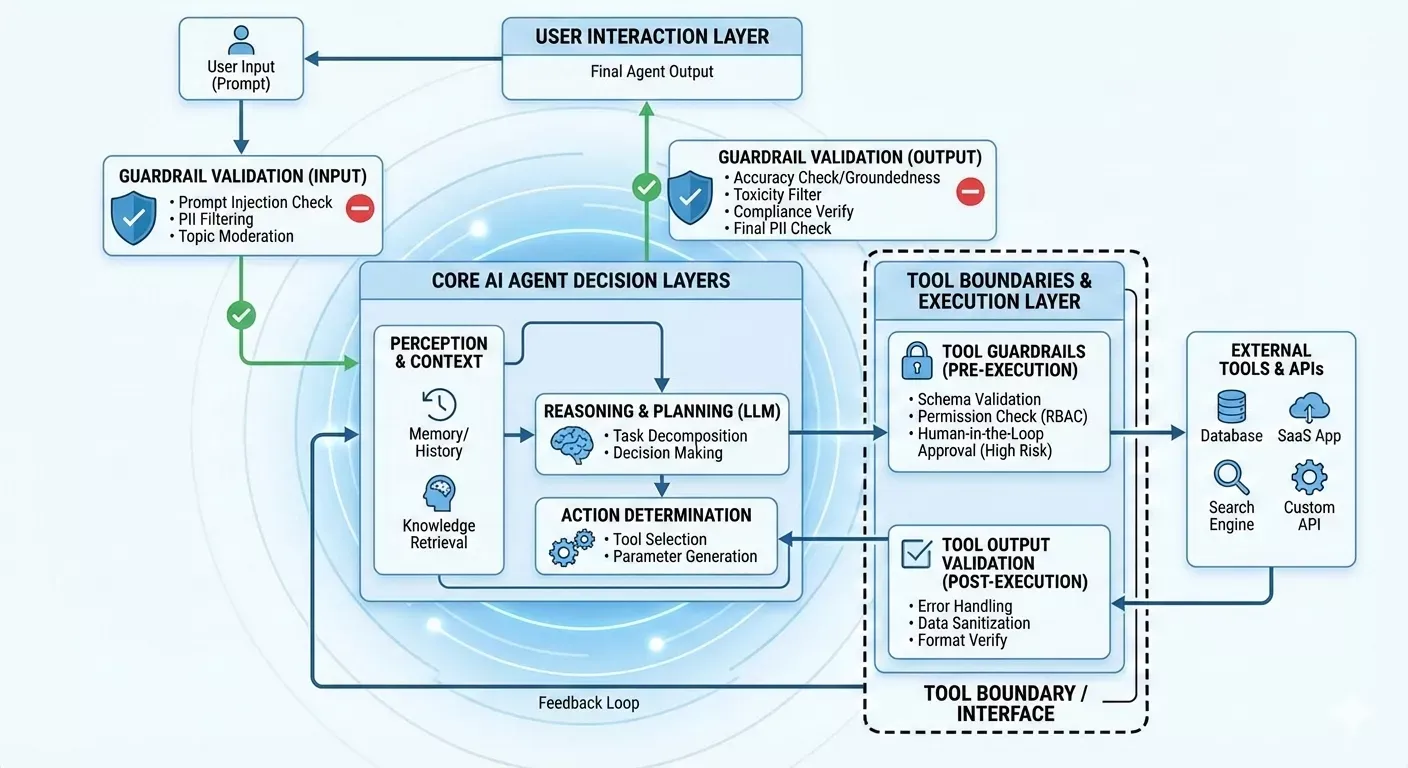
No production agent ships without all 6. Skip any piece and you dramatically increase the risk of failed pilots and six‑figure wasted spend.
Build infrastructure first. Agent logic second.
How to Implement a Production-Ready AI Agent (Quick Checklist)
- Start with a single, narrow workflow (e.g., tier-1 support or lead qualification) with clear “done” criteria.
- Pick one LLM, one vector database, and 3–5 tools to integrate instead of chasing complex multi-agent setups.
- Define hard limits for cost, tool access, and risk scores before writing prompts or wiring APIs.
- Log every decision, tool call, and error from Day 1 so you can debug failures instead of guessing.
6-Step AI Agent Development Process for Startups
You don’t need a research lab to build an AI agent that works in production. You need a disciplined, testable process you can revisit every week.
Step 1: Define Purpose + Forbidden Actions
Write one sentence: "Agent does X for Y users." Then list 10 things it NEVER does.
Examples:
✅ "Qualify sales leads under $10K ARR."
❌ "Never approve discounts. Never access billing. Never email customers."
Success = 80% task completion rate.
Failure = any forbidden action triggered.
Step 2: Match Autonomy to Risk
- Low risk (<$100 impact): Level 2 auto with alerts
- Medium risk ($100-$1K): Level 1 human approval
- High risk (>$1K): No agent. Humans only.
Your call center tier 1? Level 2. Contract approval? No agent.
Step 3: Architecture Before Prompts
Build these 3 layers first (whether using LangGraph, CrewAI, or custom Python orchestration):
In practice, this means treating LangGraph, CrewAI, or your custom orchestrator like an API router with guardrails not a magic box that will “figure it out."
- Input validation (block 95% bad data)
- 3-tool maximum (CRM read, email send, Slack notify)
- Output classifier (90% confidence or human queue)
Prompt‑first approaches fail frequently in production; architecture‑first teams are far more likely to ship stable systems.
Step 4: Hard Cost + Failure Controls
Day 1 limits:
- $50 daily API budget cap
- 10 tool calls per user per day
- 3-strikes kill switch (3% error rate = shutdown)
- Human override button on every agent screen
No controls = $5K surprise bills.
Step 5: Test Breakage, Not Perfection
Run these 100 tests:
- 30 edge cases (empty data, weird formats)
- 30 adversarial inputs (jailbreak attempts)
- 40 partial failures (CRM down, API timeouts)
Agent passes 92/100? Production-ready. 70/100? Rewrite.
Step 6: Weekly Iteration, Not Big Bang
- Monday: Deploy to 10 users
- Wednesday: Measure success rate, cost, breakage
- Friday: Fix top 3 failures or kill it
Scale 2x users only when 95% success + under budget.
Most startups skip steps 1, 4, and 5 and end up burning significant time and budget before they realize the gaps. You won’t.
This process ships revenue-positive agents in 8 weeks.
Launch Your AI Agent in Just 8 Weeks!
Achieve up to 95% success rates & 3X agent ROI with Troniex specialist consultation.
Talk To Our ExpertsHow Founders Measure AI Agent Success?
Cost per task beats your human baseline. Your metric shows $2.47 per task versus your team's $18.50 per hour. You target 60% cost reduction within 90 days. Costs rise in month two? You kill it.
Error and escalation rates stay low. Your metric shows 8% error rate and 12% human handoff. You target under 5% error and under 10% escalation. 95% "success" with 25% escalations equals failure.
Time-to-resolution beats humans. Your metric shows leads qualified in 47 seconds versus 14 minutes. You target 75% faster than humans. Humans beat agents? You retrain or delete.
Trust signals show no drop-off. Your metric shows 3.2% user drop-off after agent interaction. You target under 2% drop-off versus live reps. Rising drop-off erodes brand trust.
Accuracy alone misleads you. 92% accurate lead scoring misses $50K deals. 78% accurate support delivers faster resolutions. You measure outcomes, not word-matching scores.
|
Metric |
Week 1 |
Week 4 |
Target |
|
Cost/task |
$4.20 |
$2.10 |
$1.80 |
|
Error rate |
18% |
7% |
5% |
|
Escalation |
28% |
11% |
8% |
|
Resolution |
4.2min |
1.8min |
1min |
|
Drop-off |
5.1% |
2.9% |
2% |
Scaling Your Strategy: The Engineering Crossroads
Understanding the technical requirements is the first step.
The second is deciding who manages the risk of building them.
Every founder eventually hits a fork in the road: do you spend your capital building an AI research lab, or do you focus on your core product and partner with a specialized delivery team?
Should You Build In-House or Partner with Experts?
While this guide covers the fundamentals, most enterprises accelerate their AI agent deployments by working with a professional custom AI development partner who brings production-tested frameworks, MLOps expertise, and battle-tested security patterns. Building in-house can take 12+ months; partnering with specialists compresses that to 90 days with lower risk and proven ROI.
Build In-House When...
- 3+ full-time ML engineers already on staff
- Agent runs under 500 daily tasks (test ROI first)
- Core IP sits in the agent's logic
- You own all downstream systems (CRM, APIs)
- The team has shipped production ML before
The price tag: $45K+ per month in engineering burn. Expect 6 months to first deployment.
In-house shines when speed doesn't matter, and you want total control. But it only works if you have the bench strength.
Partner When...
- Need agents live in under 90 days
- 1,000+ daily tasks from day one
- 5+ legacy systems to wire up
- Team sticks to core product, skips AI busywork
- Want steady OpEx over big CapEx
The price tag: $8K to $25K+. Up and running in 8 weeks.
Partners deliver velocity. Ideal for MVPs or when AI isn't your moat.
Build In-House vs. Partner: At a Glance
|
Strategic Factor |
In-House Development |
Strategic Partner |
|
Core Focus |
Diverts internal talent away from the core product roadmap. |
Internal team stays focused on USP; AI is handled as a modular service. |
|
Talent Acquisition |
3–6 months to recruit/vet specialized ML & LLM engineers. |
Instant access to a pre-vetted team with production experience. |
|
R&D Risk |
High. You pay for the "learning curve" and inevitable early architecture mistakes. |
Low. You benefit from "standardized" frameworks and previous deployment learnings. |
|
Infrastructure |
You build, manage, and scale your own GPU/Vector DB stacks. |
Production-ready infrastructure is deployed and managed via SLA. |
|
Time-to-Revenue |
Typically 6–9 months for a stable, production-ready agent. |
MVP live in 8 weeks; scaling starts in Quarter 1. |
|
Maintenance |
Permanent increase in payroll/OpEx for 24/7 monitoring. |
Fixed-cost maintenance or success-based fees. |
What to Demand From Partners?
Non-negotiable terms:
- 90-day production guarantee
- Source code ownership transfer
- 95% uptime SLA with credits
- Unlimited revisions first 60 days
- Your data, your cloud (no lock-in)
In-house means ownership, but drags. Partner means speed and ~$400K saved in Year 1. Most do partner for MVP, switch in-house after $1M ARR.
Test markets fast. Lock in control later.
Searching for AI agent development companies in France? Compare top providers based on expertise, services, technologies, and industry experience.
How Troniex Builds Dependable AI Agents?
We Ship Production-Ready Agents. Here's Our AI Agent Development Approach.
Architecture-first design. We map your workflows first. Then build decision layers and tool boundaries. Result: 92% success rate vs industry 35% lab-to-prod gap.
Risk-controlled autonomy. Support agents run Level 2 with $100 limits. Contract approvals stay Level 1 human-only. We codify your exact risk tolerance.
Unified monitoring dashboard. Tracks cost, errors, escalations, drop-off live. Alerts fire at 3x cost spikes or 10% error jumps. 90-day audit trails included.
Weekly optimization loops. Deploy → Measure → Fix top 3 failures → Repeat. Month 1: 78% success. Month 3: 94% success, 62% cost reduction.
8-week timeline. Source code ownership. No vendor lock-in. Your runway stays intact.
Explore leading AI development companies in Singapore and compare their services, expertise, and capabilities.
The Bottom Line: Follow These Rules, Save Your Runway
Chasing fancy AI setups leads straight to regret. Stick to the four rules, keep it simple with one LLM and three tools, nail a narrow scope first, measure real outcomes like cost per task and customer retention, and watch your agents drive revenue.
Sophistication breaks quietly and costs a fortune to fix. Discipline ships fast and scales.
Most founders learn this after burning their runway. You don't have to.
If you're looking to bypass the 6-month learning curve and deploy a dependable system in weeks, let’s look at your architecture together. Book your call today.