Vertical AI Agents: What They Are, Why Most Fail, and How to Build Right
A vertical AI agent is a domain-specific AI system built to handle one narrowly defined business workflow, such as processing insurance claims, reviewing KYC documents, or routing support tickets, with rules, guardrails, and human-in-the-loop supervision built in from the start.
Jun 10, 2026
11 mins read
Vertical AI agents fail because trust erodes early. Workflows mismatch real operations. Teams oversell autonomy before teams earn it.
Founders chase vertical AI as the next SaaS opportunity. Buyers seek fewer manual hours, quicker results, and smoother processes. Operators demand reliability on edge cases. The agent launches. It shines in demos.
Weeks later, it hallucinates policy facts, routes tasks wrong, or picks incorrect actions with confidence. Trust vanishes. Adoption stops. The agent sits unused.
Market views split now. Teams believe agents suit repetitive tasks. Skepticism grows too. Reddit posts, founder chats, ops groups report the same issue. Agents lack production readiness despite sales pitches.
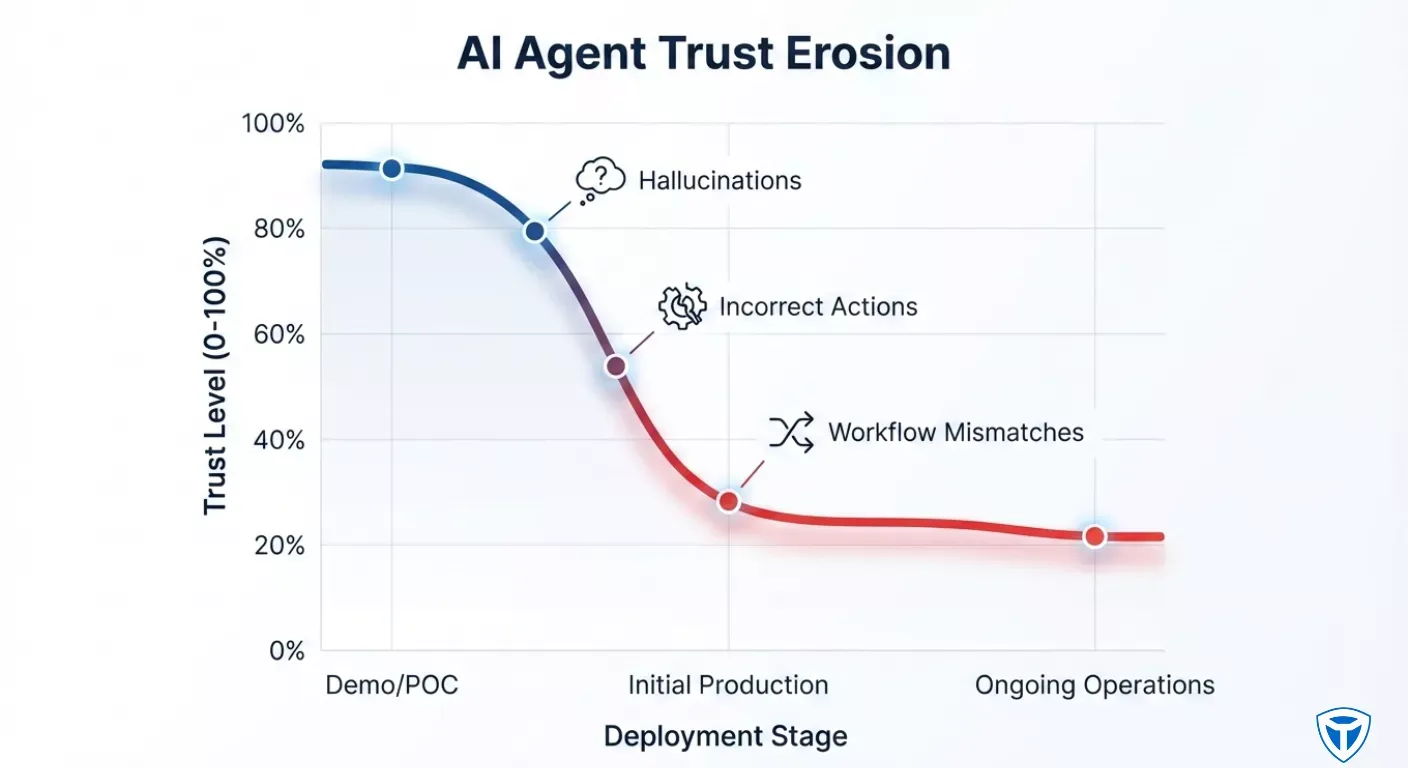
Teams pay for outcomes like 20% faster collections or 15% fewer errors. Deliver narrow wins first.
This guide covers production facts. Agents succeed with maturity, limits, and trust. Model details or agent terms matter less.
What is a Vertical AI Agent?
A vertical AI agent is a domain-specific AI system built to handle one narrowly defined business workflow. Unlike general-purpose AI, it operates within strict industry rules, uses domain-specific data, and includes human approval checkpoints.
The boundaries matter. Every real vertical agent I’ve seen that survives in production is boxed in on purpose:
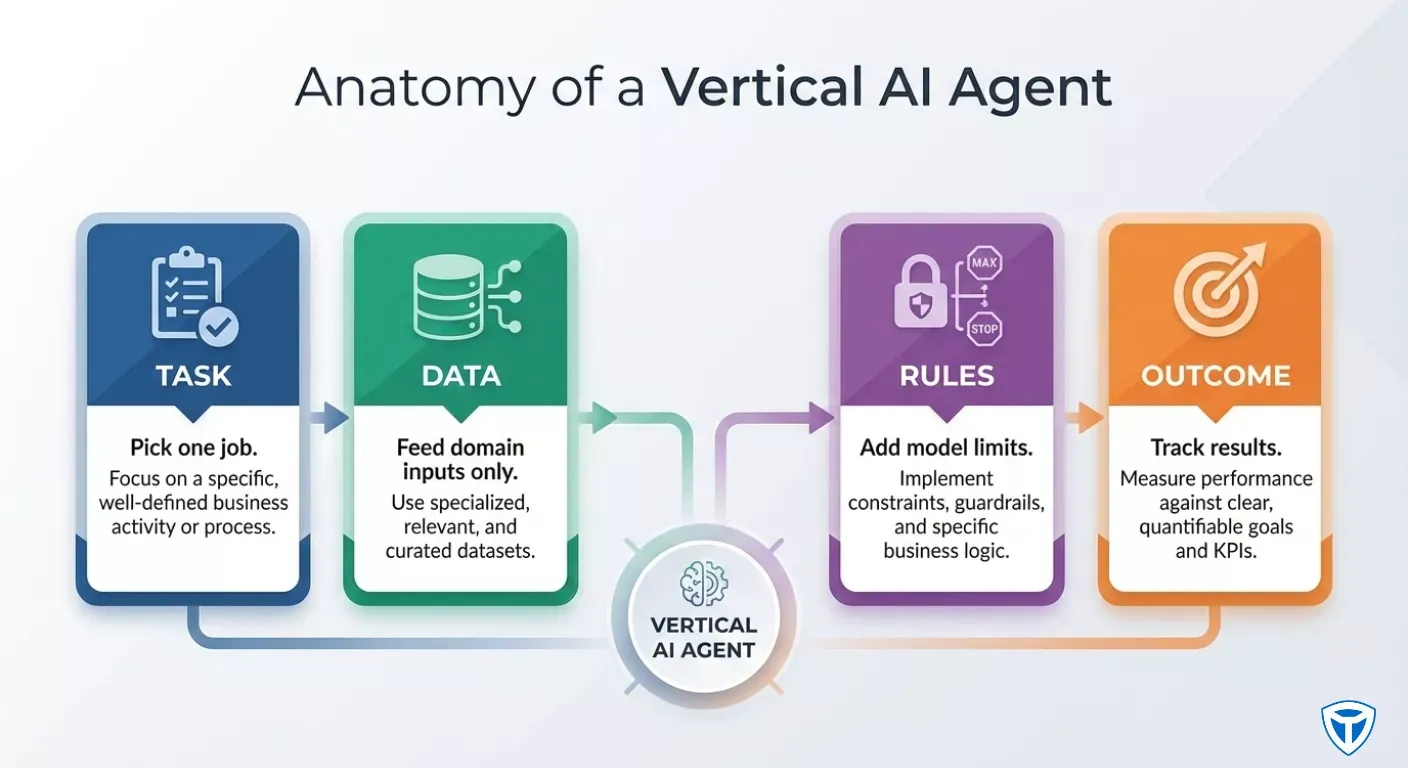
- Task: Pick one job. You review KYC documents and flag exceptions. You skip vague goals like "help with compliance."
- Data: Feed domain inputs only. Use schemas, forms, logs, and past cases. Block open browsing.
- Rules: Add model limits. Set policies, thresholds, and escalation steps.
- Outcome: Track results. Cut time, lower errors, speed approvals, reduce denials.
Agents with edges act like focused employees.
Common fakes confuse buyers. GPT wrappers lack depth. Generic bots span ten workflows. Text generators skip end-to-end ownership. These fail quickly. They promise flexibility but dodge accountability. Hallucinations spread without borders.
Production agents stay narrow, firm, and rigid. Those traits deliver results.
Why Vertical AI Agents Emerged in the First Place?
General agents fail on real tasks. You see the accuracy drop. Edge cases multiply. One wrong call risks legal issues, revenue loss, and customer anger. Teams shut them down.
Scope causes the issue. General agents aim for broad help. They lack precision in key areas. They miss mandatory fields, dangers, and strict rules. They guess outputs.
Vertical agents fix this. You narrow the domain. The agent masters one area. Domain details teach language, forms, flows, risks. Limits block unsafe moves. Rules add fixed logic under the model.
Outcomes improve.
- Errors stay predictable
- Edge cases appear for review
- Humans spot trust points
Vertical agents fill the gap that teams demand.
The market momentum behind vertical AI is significant. Industry analysts estimate the global AI agent market reached approximately $10.9 billion in 2026 and is projected to grow rapidly through the decade as organizations seek workflow-specific automation with stronger governance and accountability.
What Do Users Genuinely Value About Vertical AI Agents?
Users value predictable vertical AI agents. You get dependable automation daily. Agents skip autonomy hype or team replacement claims.
Domain accuracy builds trust first. Your agent grasps industry terms, forms, edge cases. It drops generic replies. It handles tasks like an experienced worker.
Time savings rank second. Organizations deploying workflow-specific AI agents commonly report productivity gains equivalent to 5–10 hours per employee per week, depending on workflow complexity and adoption maturity.
- Summarize tickets
- Process invoices
- Enrich leads
- Draft reports
- Route exceptions
Workflow ownership sets leaders apart. You avoid juggling tools and manual links. Agents cover intake to handoff. Results improve with clear roles.
Compliance drives buys in regulated areas. Agents apply rules steadily. They log decisions. They trace steps. You trust, explain, and defend them.

Ready to Deploy Predictable Vertical AI Agents?
Save 10-20 hours weekly on tickets, invoices, and reports with domain-accurate automation.
Talk To Our ExpertsThe Autonomy MYTH: Where Expectations Diverge From Reality?
Fully autonomous agents shine in pitches. Production shows limits. In 2026, autonomy spans levels. Overclaims burn trust.
Real data beats demos. Support agents escalate 30% or more of tickets. Content agents seek approval on brand, legal, and compliance items. Analysis agents flag insights. Humans review final calls on risks. Workflows demand this check where errors cost high.
Controlled autonomy delivers. You set sliders for actions. Agents act solo on safe tasks. They seek approval from others. They escalate as needed. Supervision stays in the core design. Top agents smooth human loops.
Users accept augmentation. They reject full swaps. Your agent takes 80% of the routine load. It passes 20% risks reliably. Vendors who claim no humans are needed face doubt.
Honest limits drive adoption. Vertical agents own their scope.
Reliability, Hallucinations, and Why Trust Collapses Fast?
Hallucinations kill vertical AI agents fast. One wrong confident reply wipes buy-in.
Regulated workflows amplify risks.
- Sales agents invent pricing. You lose deals
- Compliance agents fake policies. You face legal hits
- Healthcare or finance agents guess. Damage spreads
Operators call unguarded agents confident liars. They sound right until wrong.
Perception hurts most. Users spot errors on the first try. They recall them. You forgive slow tools. You reject certain wrong ones. Trust drops after one or two slips. Agents need oversight or get ignored.
Recent enterprise adoption studies show that explainability, governance, and output verification remain among the top requirements for production AI deployments, reinforcing why reliability matters more than model sophistication.
Surviving agents attack this.
- Run evals on real paths
- Monitor production for drift
- Add guardrails. Use rules, thresholds, and escalations
Reliability shapes architecture.
Data Quality, Integrations, and the Hidden Onboarding Tax
Vertical AI agents fail due to bad data and integrations. Failures hit before agents run.
Domain data fragments across CRMs, EHRs, ERPs, spreadsheets, email threads, legacy systems. Terms lack standards. Fields are filled halfway. Exceptions stay in heads. You clean data heavily before agent input. Raw feeds turn hallucinations into data errors.
Integrations extend timelines and budgets. You connect Salesforce, hospital records, accounting tools, and internal databases. Verticals run unique stacks. Clients add custom workflows. Demos skip this work.
Onboarding burdens non-technical teams. You translate workflows to logic. Edge cases, escalation rules, and break fixes lack docs. DIY platforms demand too much from operators.
Buyers expect managed services. You receive ready digital employees. Services cover onboarding, tuning, integrations, and adjustments. Teams that include these ship-lasting agents.
Human-Agent Fit: UX, Transparency, and Control
Accuracy alone doesn’t save an agent. Even a technically solid agent fails if users feel trapped, confused, or lied to.
UX Error
Hide AI status. Users detect fakes. Mess-ups after a pretense drop trust more. You disclose AI upfront. Users tolerate limits when clear.
Escalation Error
Block human handoffs. Users need quick escapes on off feels. Loops and deflections frustrate even working agents. Add rollback. Undo record updates, messages, and wrong flags without tickets or log hunts.
Operator Controls
Build control panels. Show full logs, reasons, adjustable thresholds, policy toggles, and manual overrides. Control speeds adoption. Users expand agent roles when in charge.
Recent enterprise surveys indicate that organizations moving beyond pilot programs consistently emphasize governance controls, auditability, and human oversight as key factors enabling production deployment.
Security, Privacy, and Compliance Exposure
Vertical AI agents expand risks. Weak governance creates liabilities.
- Prompt leakage threatens data: Sensitive info leaks through prompts, logs, and integrations. Internal system links expose every action and token. Poor log retention or access equals no logs in danger.
- Multi-agent flows worsen traceability: Handoffs and orchestration hide details. You lose who decided what from which data when. Audit trails solve incidents.
- Regulated buyers prioritize governance: Wrong disclosures or acts bring fines and audits. Build security, privacy, and compliance from day one for production agents.
Vertical AI Agents vs Horizontal AI Agents
Vertical AI agents narrow scope. Horizontal AI agents broaden it. Narrow wins in production with real users, data, and risks.
|
Area |
Vertical Agents Advantage |
Horizontal Agents Issue |
|
Reliability |
Tight domain aids detection, fixes. Known data, rules, outcomes. |
Edge cases explode across workflows. Hard to predict or define correctly. |
|
Failure Radius |
Breaks one workflow. Autonomy safe. Downside contained. |
Cascades across teams, systems, customers. |
|
Compliance |
Builds in regs, audits, controls. Logs, escalations ready. |
Adds on later. Traceability weak across domains. |
|
Maintenance |
Low cost. Limited behavior space. Clear monitors, success metrics. |
High cost. Broad evals, complex monitoring, constant fixes. |
Vertical agents trade range for trust. Horizontal promise flexibility. They deliver unpredictability.
Vertical AI Agents vs Vertical SaaS
Vertical AI agents reshape vertical SaaS. Winners mix software with encoded labor.
|
Area |
Vertical SaaS Strength |
Vertical AI Agents Strength |
|
Core Focus |
Structure. Dashboards, forms, workflows, reports. Standardizes processes. |
Execution. Reads fields, applies rules, clears routines, flags exceptions. |
|
Best For |
Determinism. Ledgers, databases, compliance. Rigid flows, user steps. |
Judgment tasks. Handles work inside limits. |
|
Model |
Self-serve tools. |
Hybrid service. Software guardrails, supervision, managed onboarding. |
|
User Feel |
Tools for views. |
Teammates for outcomes in narrow spots. |
Top products act like teammates. They deliver steady value in narrow business spots.
Anatomy of a Production-Grade Vertical AI Agent
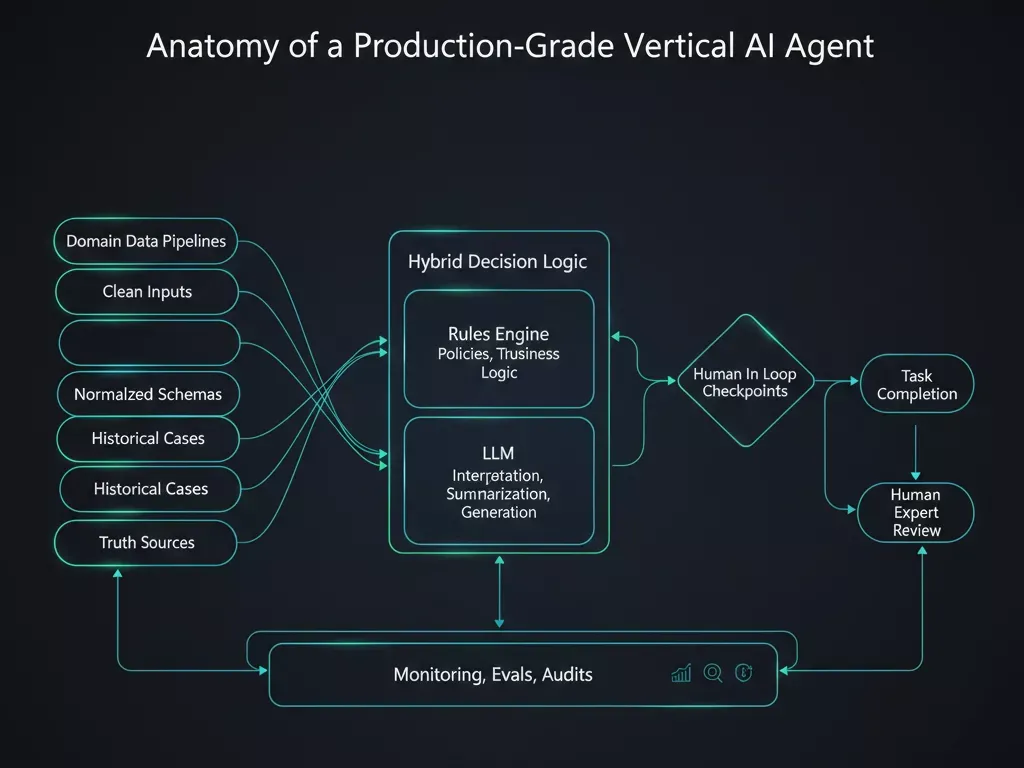
If an “agent” can be described with a single prompt, it’s not production-grade. Real agents are systems, not prompts.
- Domain Data Pipelines: You set clean inputs, normalized schemas, historical cases, and truth sources. Disciplined flows prevent model unpredictability.
- Hybrid Decision Logic: Rules cover policies, thresholds, and compliance. LLMs interpret, summarize, and judge inside rules. Split keeps models from overriding rules.
- Human In Loop Checkpoints: Workflows include approvals and escalations. Agents know act alone limits. Checkpoints preserve trust, grow autonomy.
- Monitoring Evals Audits: Run continuous real path evals. Log actions and reasons. Build audit trails for reviews and regulators. This layer ensures production survival.
Stakeholder Pain Map
Vertical AI agents don’t fail in a vacuum. Each stakeholder feels the risk differently. Adoption depends on addressing all of them, not just one.
- Founders face hype vs reality. Investors seek agent magic. Production requires constraints, guardrails, slow rollout. Vendors commoditize features fast.
- Buyers focus on ROI, uptime, accuracy, SLAs. Integrations and team trust stall unclear deals.
- End users react quickly to bad interactions, hallucinations, and blocks. Transparency and control prevent disengagement.
- Developers manage model unpredictability, tool fragments, glued orchestration, monitoring gaps. They build consistent systems.
The vertical agents that succeed are the ones designed with all four perspectives in mind, not just the demo audience.
How Troniex Technologies Builds Vertical AI Agents?
Troniex starts with one painful workflow at a time. Not “support automation.” Not “sales enablement.” You pick a specific, high-volume, high-friction process where teams feel overloaded, and errors cost money. You map the real flow first, including hacks, workarounds, and tribal knowledge.
Building vertical AI agents requires deep domain expertise and industry-specific training data that goes beyond generic models. Our specialized AI development services combine technical excellence with vertical knowledge in healthcare, fintech, logistics, and manufacturing, delivering agents that understand your industry's unique workflows, compliance requirements, and success metrics from day one. The agent knows what to do alone, what to ask for, and what to avoid. Constraints make deployment safe.
That's why Troniex favors managed AI agent deployment through verticalized agent development, skipping generic self-serve tools. Vertical buyers crave results, not more platforms. You get expert onboarding, data cleanup, seamless integrations, and ongoing tuning as workflows evolve.
This path turns agents from demo toys into operational assets.
Final Insights
Vertical AI agents win when they stay narrow, integrate deeply, and execute under supervision. The magic isn’t that they can do everything; it’s that they do one thing reliably, every day, without drama. A tight scope reduces failure modes. Deep integration makes the agent useful. Supervised execution keeps trust intact.
This is also why most “vertical AI agent” startups won’t survive. Many are thin wrappers chasing a niche label without owning the underlying workflow, data, or risk. As soon as reliability issues surface, or buyers ask hard questions about compliance and accountability, the cracks show.
For buyers, the validation checklist is simple but uncomfortable:
- Does this agent own a real workflow, end-to-end?
- What happens when it’s wrong, and how fast can we recover?
- How is compliance handled in practice, not on slides?
- Who is responsible for production: us or the vendor?
The teams that answer those honestly will build agents that last. The rest will ship impressive demos and quietly disappear.