Decentralized finance (DeFi) is changing how individuals and businesses access financial services.
By combining blockchain technology, smart contracts, and decentralized applications, DeFi enables activities such as lending, trading, payments, and asset management without relying entirely on traditional financial intermediaries.
In 2026, DeFi continues to create opportunities for fintech startups, financial institutions, and blockchain businesses exploring new financial products.
From decentralized exchanges to tokenized real-world assets, these applications demonstrate how programmable financial infrastructure can address practical challenges.
Understanding the leading DeFi use cases helps businesses identify opportunities to develop secure, scalable, and user-focused financial platforms.
What Is Decentralized Finance (DeFi)?
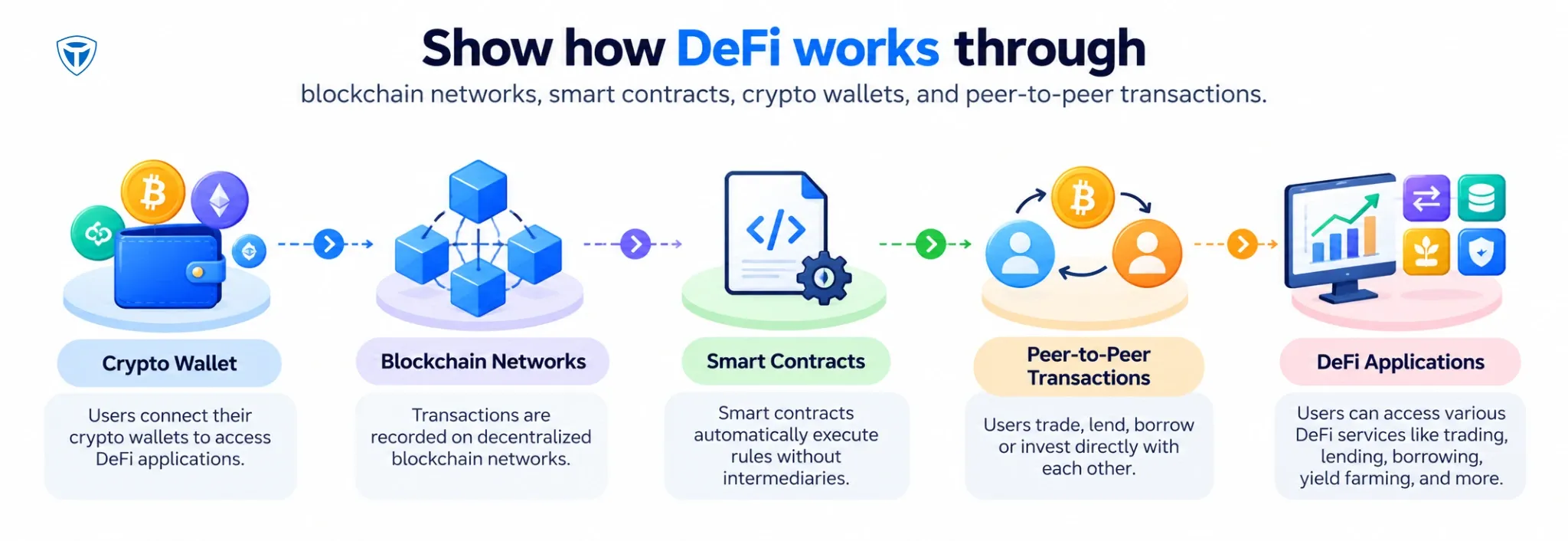
Decentralized finance is an ecosystem of blockchain-based financial applications that use smart contracts to execute transactions and manage financial activities. Unlike conventional financial systems, many DeFi protocols allow users to interact directly through cryptocurrency wallets without opening accounts with a centralized intermediary.
For example, a decentralized lending application can automatically distribute interest to lenders and manage collateral when borrowers take out loans. Similarly, a decentralized exchange can execute token swaps using liquidity pools and predefined smart contract rules.
Businesses exploring this ecosystem can use blockchain development services to establish suitable infrastructure and smart contract development services to implement financial logic, transaction rules, and automated operations.
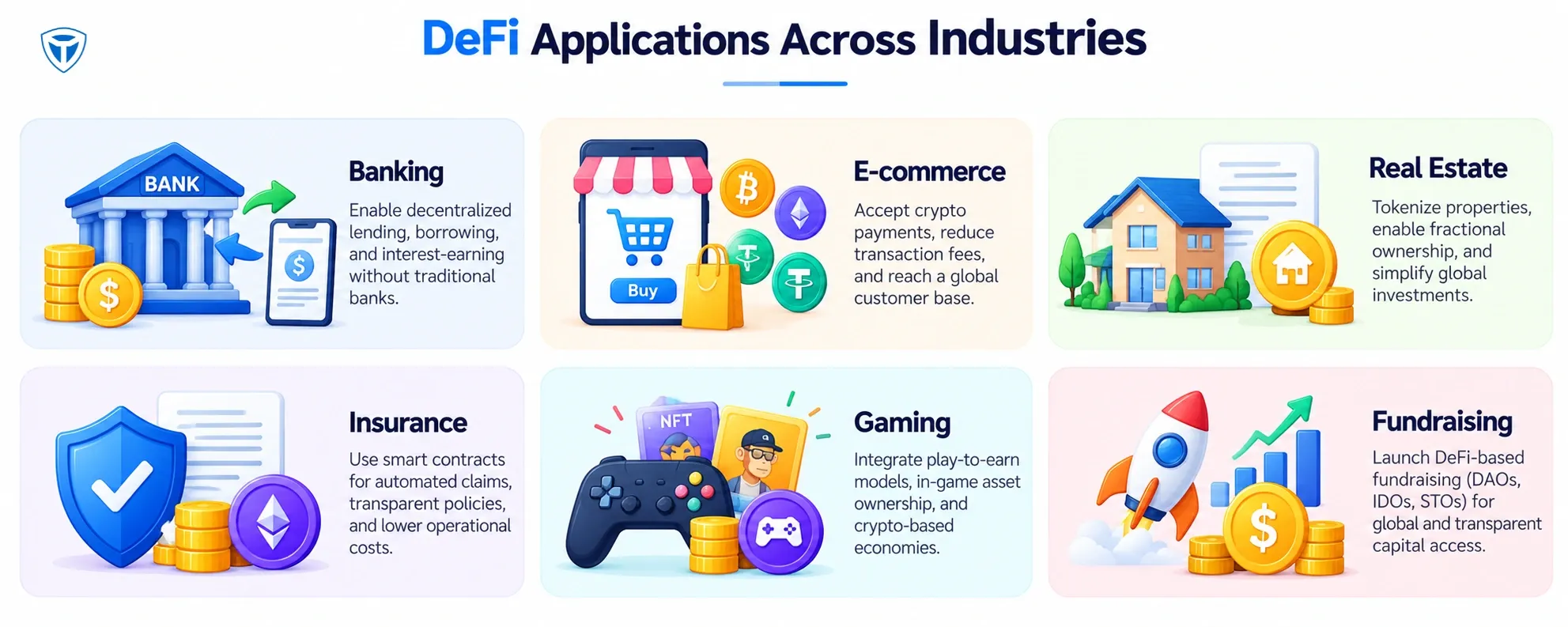
How DeFi Is Transforming Finance Across Industries
Decentralized finance is expanding beyond traditional financial services, helping businesses explore new ways to manage payments, investments, lending, and digital assets.
These industry applications demonstrate how DeFi protocols and smart contracts can support more accessible and transparent financial operations.
|
Industry |
DeFi Application |
Real-World Example |
|---|---|---|
|
Banking and Finance |
Decentralized lending and borrowing without traditional intermediaries |
Aave |
|
E-commerce |
Accepting stablecoin payments and enabling crypto transactions |
USDC payments |
|
Real Estate |
Tokenizing property assets to support fractional ownership |
Tokenized real-world assets (RWAs) |
|
Insurance |
Automating coverage and claims through smart contracts |
Decentralized insurance protocols |
|
Investment |
Providing liquidity and participating in yield farming |
Uniswap liquidity pools |
|
Gaming |
Integrating DeFi-based asset utility and decentralized financial features |
DeFi-enabled blockchain games |
|
Supply Chain |
Exploring tokenized financing and on-chain access to working capital |
Blockchain-based trade finance |
|
Fundraising |
Raising funds through decentralized protocols and community governance |
DAO-based crowdfunding |
Explore DeFi trends shaping the industry to understand emerging innovations, market opportunities, blockchain adoption, and decentralized finance developments that can guide your business strategy.

Explore DeFi Development Opportunities
Choose Troniex Technologies for scalable decentralized finance application development.
Talk To Our ExpertsTop 12 DeFi Use Cases in 2026
DeFi offers practical applications across lending, trading, payments, asset management, and fundraising.
These decentralized finance use cases demonstrate how blockchain technology and smart contracts can improve financial processes, create new business opportunities, and support innovative digital financial services across industries.
1. Decentralized Lending and Borrowing
DeFi lending and borrowing platforms let users deposit digital assets to earn interest or borrow funds against crypto collateral. Smart contracts automate loan processing, interest calculations, and liquidation rules.
Businesses can use DeFi development services to build lending protocols with collateral management, automated repayments, and transparent loan monitoring.
Example: Aave supports decentralized lending through liquidity pools, allowing users to supply supported crypto assets and borrow against eligible collateral.
Key Features:
- Collateral-based borrowing
- Automated interest calculations
- Loan-to-value monitoring
- Liquidation management
2. Decentralized Exchanges (DEXs)
Decentralized exchanges (DEXs) enable peer-to-peer cryptocurrency trading through blockchain-based smart contracts, allowing users to retain control of their wallets.
Businesses exploring DeFi exchange development can build platforms with token swapping, liquidity management, wallet integration, and secure transaction processing.
Example: Uniswap facilitates token swaps using automated market makers and liquidity pools, enabling users to exchange supported tokens without a traditional centralized exchange operator.
Core Trading Capabilities:
- Automated token swaps
- Liquidity pool management
- Wallet-based transactions
- Real-time price calculations
3. Yield Farming and Liquidity Provision
Yield farming allows users to deploy digital assets across DeFi protocols to pursue potential returns through liquidity provision and token rewards.
Businesses developing DeFi platforms can implement liquidity pool management, reward distribution, and performance tracking while helping users understand impermanent loss and market risks.
Example: Liquidity providers on supported Uniswap pools may earn a share of trading fees in exchange for supplying assets, depending on pool activity and protocol rules.
Important Considerations:
- Liquidity pool participation
- Trading fee distribution
- Reward tracking and calculation
- Impermanent loss management
Also read: Build profitable DeFi ecosystems with DeFi yield farming platform development expertise.
4. DeFi Staking and Liquid Staking
DeFi staking enables users to commit eligible crypto assets to proof-of-stake networks and potentially earn rewards.
Liquid staking adds flexibility by issuing tokens representing staked positions.
Businesses can use DeFi staking platform development services to implement validator integration, staking rewards, withdrawal management, and liquid staking token functionality.
Example: Lido offers liquid staking for supported assets, providing users with tokens representing their staked positions that may be used in compatible DeFi applications.
Essential Platform Features:
- Staking and unstaking management
- Reward distribution
- Validator integration
- Liquid staking token support
Also read: Transform blockchain ideas using DeFi staking platform development services.
5. Stablecoin Payments and Transfers
Stablecoin payments enable businesses to transfer digital value using assets designed to maintain a relatively stable price against a reference currency.
A crypto payment gateway development company helps businesses integrate stablecoin payment processing, transaction verification, cross-border transfers, and merchant settlements while addressing network fees, liquidity, and compliance requirements.
Example: USDC and USDT support transfers across compatible blockchain networks, allowing businesses and individuals to send digital value to supported wallets and payment services.
Business Payment Applications:
- Cross-border digital payments
- Stablecoin transaction processing
- Payment verification and tracking
- Merchant settlement management
6. Tokenization of Real-World Assets (RWAs)
Real-world asset tokenization represents interests in assets such as real estate, bonds, and funds through blockchain-based tokens.
Token development services can support asset issuance, transfer restrictions, and ownership records, while legal compliance, custody arrangements, and investor eligibility remain essential considerations.
Example: A property investment platform may issue tokens representing legally defined investment interests, potentially enabling eligible investors to participate in a property investment through a digital platform.
Key Tokenization Capabilities:
- Digital asset issuance
- Fractional ownership structures
- Transfer restriction mechanisms
- Ownership and transaction records
Also read: Get DeFi token development solutions for your next DeFi project.
7. Decentralized Derivatives and Synthetic Assets
DeFi derivatives and synthetic assets provide blockchain-based exposure to selected asset prices through programmable financial contracts.
Businesses can use smart contract development services to implement collateral management, price oracle integration, position tracking, and liquidation mechanisms while addressing leverage and market risks.
Example: A derivatives protocol may allow eligible users to open positions linked to cryptocurrency prices without directly holding the underlying asset, depending on the product's design.
Core Platform Components:
- Derivatives position management
- Collateral monitoring
- Price oracle integration
- Automated liquidation mechanisms
Also read: Choose DeFi smart contract development services for reliable blockchain solutions.
8. Decentralized Insurance
Decentralized insurance uses blockchain protocols to coordinate coverage, manage pooled funds, and automate eligible claims.
DeFi development services can support policy management, contribution tracking, claims workflows, and automated payouts, with clear coverage terms and reliable claims verification.
Example: A DeFi user may purchase coverage against specified smart contract exploits through a protocol offering this protection, subject to policy terms, exclusions, and claims assessment procedures.
Essential Insurance Functions:
- Policy creation and management
- Premium and contribution tracking
- Claims assessment workflows
- Smart contract-based payouts
9. On-Chain Asset Management
On-chain asset management uses smart contracts to organize digital asset portfolios, automate allocation, and execute predefined investment strategies.
DeFi platform development can support portfolio dashboards, asset rebalancing, performance tracking, and strategy management, although returns depend on market conditions and protocol risks.
Example: An automated DeFi vault may allocate deposited tokens according to a published strategy, periodically adjusting positions based on predefined rules and supported protocol integrations.
Portfolio Management Features:
- Automated portfolio allocation
- Strategy-based vaults
- Portfolio performance tracking
- Rebalancing mechanisms
10. Decentralized Identity and Credit
Decentralized identity and credit applications use verifiable credentials and blockchain-based records to support identity checks, reputation systems, and alternative credit assessments.
Blockchain development services can support credential verification and access control while protecting privacy, maintaining data accuracy, and meeting applicable identity verification requirements.
Example: A financial platform may verify a user's eligibility through an authorized digital credential without publicly exposing all the personal information associated with that credential.
Identity and Credit Applications:
- Verifiable digital credentials
- Privacy-conscious identity checks
- Reputation-based assessment
- Access control and verification
11. DAO-Based Treasury and Financial Management
DAO treasury management uses blockchain-based governance to coordinate shared funds, approve spending, and record financial transactions.
Smart contract development services can support treasury tracking, voting mechanisms, spending controls, and transparent fund allocation while reducing risks associated with unauthorized transactions.
Example: A decentralized organization may use governance proposals and a multisignature wallet to authorize ecosystem grants, development budgets, or community initiatives according to its established approval process.
Treasury Management Features:
- On-chain treasury tracking
- Proposal and voting mechanisms
- Multisignature transaction approval
- Transparent fund allocation
12. DeFi Crowdfunding and Fundraising
DeFi crowdfunding allows startups and blockchain projects to collect digital asset contributions through decentralized fundraising platforms.
DeFi development services can support fundraising dashboards, automated fund distribution, refund mechanisms, and project governance, subject to applicable securities and fundraising regulations.
Example: A blockchain startup may use smart contracts to record contributor payments and distribute collected funds according to predefined milestones or fundraising conditions.
Fundraising Platform Features:
- Digital asset contribution tracking
- Automated fund distribution
- Project funding dashboards
- Refund and governance mechanisms
Also read: Launch innovative projects using DeFi crowdfunding platform development solutions.
Real-World Examples of DeFi Applications
Established protocols illustrate how different DeFi models address specific financial needs.
|
Protocol |
Primary application |
Example functionality |
|---|---|---|
|
Aave |
Lending and borrowing |
Supplying assets and borrowing against collateral |
|
Uniswap |
Decentralized exchange |
Token swaps through liquidity pools |
|
Lido |
Liquid staking |
Receiving transferable tokens representing eligible staked positions |
|
MakerDAO (Sky ecosystem) |
Decentralized stablecoin infrastructure |
Collateral-based stablecoin mechanisms |
|
Centrifuge |
Real-world asset financing |
Connecting on-chain finance with tokenized asset structures |
These examples demonstrate different approaches to financial automation, liquidity, and asset representation.
Their features, supported networks, and operating models can change over time, so businesses should verify current protocol documentation before using them as technical benchmarks.
Key Benefits of DeFi for Users and Businesses
DeFi can offer several advantages when applications are designed appropriately:
- Greater accessibility: Supported blockchain applications can be accessed by users who meet their technical and eligibility requirements.
- Automation: Smart contracts can execute predefined financial operations without manual processing at every step.
- Transparency: Public blockchain transactions allow participants to verify many activities and balances.
- Global reach: Blockchain-based services can connect users across markets, subject to local restrictions and infrastructure availability.
- Composability: Compatible protocols can interact to support more complex financial products.
- Programmable settlement: Digital assets can move according to predefined rules, reducing some manual reconciliation steps.
These benefits are not universal guarantees. Network congestion, fees, security vulnerabilities, and regulatory restrictions can affect the overall experience.
Challenges and Risks of Using DeFi
DeFi offers exciting opportunities, but it also comes with risks that businesses shouldn't overlook. From smart contract bugs to changing regulations, identifying these challenges early helps businesses build safer and more reliable platforms.
|
DeFi Challenge |
Description |
Risk Mitigation |
|---|---|---|
|
Smart Contract Vulnerabilities |
Contract bugs and exploits |
Regular security audits |
|
Liquidity Risks |
Limited funds for withdrawals |
Monitor pool liquidity |
|
Market Volatility |
Sudden asset price changes |
Set collateral limits |
|
Oracle Manipulation |
Unreliable external price data |
Use trusted oracles |
|
Cross-Chain Bridge Risks |
Vulnerable asset transfers |
Choose audited bridges |
|
Wallet Security |
Stolen keys and phishing |
Secure wallet integration |
|
Regulatory Uncertainty |
Changing legal requirements |
Follow compliance guidelines |
How Businesses Can Build DeFi Applications in 2026
Businesses planning to launch a DeFi application need a clear strategy that balances user needs, technical requirements, and security. The following steps help turn a DeFi concept into a functional platform.
- Define the Business Model: Identify the target audience, financial problem, and core application requirements.
- Choose the Blockchain Network: Select a suitable network based on transaction fees, scalability, and ecosystem support.
- Develop Smart Contracts: Build and test the logic for transactions, asset management, and platform operations.
- Integrate Wallets and APIs: Enable secure wallet connectivity and connect relevant blockchain data services.
- Prioritize Security and Compliance: Conduct smart contract audits and assess applicable regulatory requirements.
- Test and Deploy the Platform: Validate functionality, monitor performance, and prepare for ongoing maintenance.
Create the Next DeFi Innovation
Troniex Technologies builds secure, scalable platforms for your business.
Contact UsConclusion
DeFi use cases extend far beyond cryptocurrency trading. Lending, decentralized exchanges, staking, stablecoin payments, asset tokenization, and on-chain asset management illustrate how blockchain technology can support new financial services.
For businesses, the opportunity lies in identifying a clear user need and building an application around security, usability, and reliable financial operations.
With appropriate DeFi development, smart contract development, and blockchain development capabilities, organizations can evaluate practical ways to enter this evolving ecosystem while managing its technical and regulatory challenges