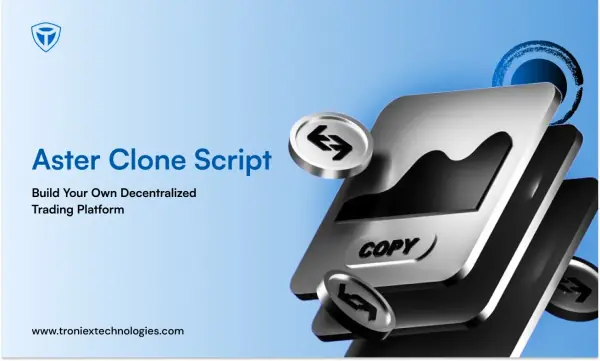
Aster Clone Script: Build Your Own Decentralized Trading Platform
Build your own DEX with an Aster clone script. Explore key features, customization options, development steps, and benefits for your crypto trading business.
Oct 27, 2026
12 mins read
The DeFi market is opening exciting opportunities for businesses ready to build the next generation of crypto trading platforms. But how do you turn your idea into a platform traders actually want to use?
An Aster clone script offers a practical starting point for developing an Aster-inspired decentralized trading platform tailored to your business vision.
With custom Aster clone development, you can create a trading experience with flexible features, seamless wallet integration, and security-focused architecture.
Partnering with a decentralized exchange development company can help you go beyond copying existing functionality and build a platform that delivers real value to traders while supporting your long-term business goals.
What Is an Aster Clone Script?
An Aster clone script is a software solution used to build a decentralized trading platform inspired by Aster’s trading model.
It provides a foundation for developing features such as perpetual futures trading, wallet integration, and trading interfaces.
Through custom Aster clone development, businesses can tailor platform functionality, security controls, and user experiences to their specific requirements while supporting scalability and long-term growth.
Who Can Benefit from Launching an Aster-Like Trading Platform?
The Aster-like trading platform will present new chances for cryptocurrency entrepreneurs, DeFi firms, and even existing exchanges to diversify their offer.
Cryptocurrency entrepreneurs will be able to experiment with new business models, while existing firms will get an opportunity to add decentralized derivatives trading to their portfolio.
Our platform development strategy will allow businesses to create platforms tailored to their goals.
Key Features of an Aster DEX Clone Script
A successful Aster DEX clone script needs practical trading tools, reliable infrastructure, and security-focused functionality.
Here are 10 key features to consider when planning your decentralized trading platform.
- Perpetual Futures Trading: Facilitates the ability of traders to trade on the price of cryptocurrencies without the need to hold any underlying assets.
- Leverage Trading: Offers an opportunity for eligible traders to amplify their market positions with margin and proper liquidation policies.
- Non-Custodial Wallet Support: Enables users to link their wallets and have full custody over their private keys.
- Live Market Information: Shows current prices, trading volume, and other market activities.
- Interactive Trading Interface: Offers an interactive trading interface that includes charts and trading orders.
- Liquidity Handling: Helps facilitate the process of trading by using appropriate liquidity solutions.
- Trading Risk Management: Allows the monitoring of margin levels and other related risk factors.
- Smart Contract Security: Uses security testing and auditing to detect contract vulnerabilities.
- Multi-chain Support: Helps make the platform compatible with selected blockchain platforms.
- Operator Dashboard: Helps in analyzing the platform operations and management.
Also read: Learn how Uniswap clone script development can support your DeFi business goals.

Transform Your Trading Idea with Aster Clone Solutions.
Work with Troniex Technologies to plan your platform’s essential trading features
Talk To Our ExpertsReal-World Use Cases of an Aster-Like Decentralized Trading Platform
The design of an Aster-like decentralized exchange will allow different types of trading to be performed according to how the system is set up.
For example, traders can leverage the perpetual futures feature of the platform to capitalize on cryptocurrency price changes, while professionals can consider employing hedging.
DeFi companies can also incorporate blockchain-powered trading instruments into their financial systems.
- Perpetual Futures Trading
- Crypto Portfolio Hedging
- Leveraged Crypto Trading
- Decentralized Derivatives Trading
- Multi-Asset Trading
- On-Chain Trading and Settlement
- Algorithmic Crypto Trading
- DeFi Trading Integration
- Liquidity Provision and Management
- Cross-Chain Trading Solutions
Advantages of Developing a Decentralized Trading Platform Based on the Aster Exchange Clone Script
Developing an Aster-like decentralized trading platform can present businesses with the ability to personalize trading, test various monetization models, and address a worldwide audience.
Choosing the right development approach is a trade-off between customization, transparency, scalability, and security.
1. More Opportunities for Platform Personalization
An Aster exchange clone script gives you an opportunity to design your platform's features in a way that fits your business and customer specifics. Customization allows personalizing your trading platform without full dependence on existing features.
- Customize trading interface and dashboard.
- Integrate appropriate wallets and blockchain systems.
- Personalize trading tools based on customer requirements.
- Make necessary customizations according to changing business needs.
2. Lower Dependency on Centralized Third Parties
A decentralized trading platform could provide users with the ability to interact with blockchain-based trading infrastructure without using any traditional centralized exchange for custody of users' funds. Custody and transactions depend on the architecture of the platform.
- Integrate non-custodial wallet support.
- Use blockchain technology for transaction processing.
- Give users greater control over their assets.
3. Access to Global Crypto Trading Markets
Decentralized trading platforms can allow access to supported crypto markets for users in various regions. Business organizations should also be mindful of regional laws, supported blockchain systems, liquidity, and geography.
- Reach eligible users from various regions.
- Support selected cryptocurrencies and trading pairs.
- Create accessible trading interfaces.
- Explore integration of multi-chain systems if applicable.
4. Diversified Revenue Generation Models
An Aster-like DEX will have the flexibility of using varied revenue generation models based on its trading system, demand for the platform, and expenses. Use of transparent fees and pricing will make the revenue models sustainable.
- Trading fees: Charging fee on the eligible trades.
- Funding mechanisms: Support the funding mechanisms in the perpetual markets.
- Premium services: Offer additional premium services such as advanced analytics.
- Integration services: Receiving income from platform integrations.
5. Increased Transparency Using Blockchain Systems
Blockchain systems can increase transparency of transactions by documenting all supported activities on an open ledger. However, transparency is dependent on which transactions are recorded on-chain and which off-chain.
- Verify on-chain transactions.
- Provide accessible transaction histories.
- Use auditable smart contract logic.
- Communicate platform fees and rules clearly.
6. Scalable Trading Infrastructure
A well-planned trading architecture helps businesses accommodate changing user activity and evolving feature requirements. Scalability depends on blockchain performance, execution design, liquidity, and infrastructure capacity.
- Optimize transaction processing and system performance.
- Design infrastructure for increasing user demand.
- Integrate additional blockchain networks when suitable.
- Monitor latency, liquidity, and platform reliability.
Essential Technologies for Aster Clone Script Development
The selection of the proper technology stack plays an important role in creating an Aster clone script that is both safe and scalable.
Different technologies have various roles in the process of developing the trading platform. We suggest you choose your technology stack based on your trading strategy, security needs, and demand for users.
|
Technology |
Purpose |
Examples |
|---|---|---|
|
Blockchain Networks |
Process and verify decentralized transactions |
Ethereum, BNB Chain, Arbitrum |
|
Smart Contracts |
Automate trading rules and on-chain operations |
Solidity, OpenZeppelin |
|
Frontend Development |
Build responsive trading interfaces and dashboards |
React.js, Next.js, TypeScript |
|
Backend Development |
Manage APIs, user sessions, and platform services |
Node.js, Python |
|
Wallet Integration |
Enable wallet connectivity and transaction signing |
WalletConnect, MetaMask |
|
Database Systems |
Store user settings, order data, and analytics |
PostgreSQL, Redis |
|
Oracle Services |
Supply external market prices to supported contracts |
Chainlink, Pyth Network |
|
Web3 Libraries |
Connect applications to blockchain networks |
Ethers.js, Viem |
|
Security Tools |
Test contracts and identify potential vulnerabilities. |
Slither, Foundry |
|
Cloud Infrastructure |
Support deployment, monitoring, and scalability |
AWS, Docker, Kubernetes |
Note: These technologies are examples, not mandatory components for every platform. The appropriate stack depends on the target blockchain, trading architecture, security requirements, and expected transaction volume.
Also read: Understand how IDEX clone script development can support a hybrid exchange architecture.
Step-by-Step Process of Custom Aster Clone Development
Developing a trading platform with custom Aster clone development requires careful planning, the right technology stack, and a security-focused approach.
We recommend following a structured process to align platform features with business goals, user expectations, and long-term scalability.
- Business Requirement Analysis: Define your target audience, trading model, and platform objectives.
- Feature Planning: Select trading tools, wallet integrations, and essential platform functionalities.
- Technology Stack Selection: Choose suitable blockchain networks, frameworks, and development tools.
- UI/UX Design: Create intuitive interfaces for seamless navigation and efficient trading.
- Smart Contract Development: Implement trading logic, transaction rules, and security controls.
- Frontend and Backend Development: Build responsive interfaces and reliable platform services.
- Wallet and API Integration: Connect crypto wallets, market data feeds, and blockchain services.
- Security Testing and Auditing: Identify vulnerabilities through testing and independent smart contract audits.
- Platform Deployment: Deploy verified contracts and configure production infrastructure.
- Maintenance and Optimization: Monitor performance, address issues, and improve platform functionality
Revenue Streams for Your Decentralized Trading Platform
An Aster-inspired decentralized trading platform can generate revenue through different monetization models, depending on its features, trading architecture, and target audience.
We recommend choosing transparent, sustainable revenue streams that support platform operations while delivering value to users.
|
Revenue Stream |
Description |
|---|---|
|
Trading Fees |
Charges applied to eligible trades |
|
Funding Fees |
Protocol revenue, where applicable |
|
Liquidation Fees |
Fees from eligible liquidation events |
|
Withdrawal Fees |
Charges for supported withdrawals |
|
Premium Subscriptions |
Paid advanced trading tools |
|
API Access |
Fees for premium API usage |
|
Listing Fees |
Charges for eligible token listings |
|
Integration Services |
Revenue from third-party integrations |
Note: Not every stream is suitable for every DEX. Funding payments often pass between traders rather than generating platform revenue, and liquidation, withdrawal, or listing fees depend on the platform’s design and policies.
Also read: Explore how a DeDust clone script can help you build a TON-based decentralized exchange.
Security Measures for a Decentralized Trading Platform
When users trade crypto assets, they need confidence that their accounts, transactions, and funds are protected. That's why security should be a priority from the beginning of Aster clone script development. By combining reliable security practices with regular testing, we can help build a trading platform that users can trust.
- Smart Contract Audits: Review smart contracts carefully to identify potential vulnerabilities before deployment.
- Multi-Factor Authentication: Add an extra verification step to help prevent unauthorized account access.
- Secure Wallet Integration: Connect compatible wallets using trusted methods and secure transaction-signing processes.
- Data Encryption: Protect sensitive information while it is stored and transmitted.
- Access Control Management: Limit access to administrative tools and critical functions based on user permissions.
- Real-Time Risk Monitoring: Track suspicious activity, margin requirements, and potential liquidation risks.
- Penetration Testing: Test the platform for security weaknesses before launching it to users.
- Regular Security Updates: Keep software dependencies updated and address newly discovered vulnerabilities promptly.
Customization Options for Your Aster-Like Trading Platform
Every trading business has different goals, target users, and technical requirements. With custom Aster clone development, we can tailor an Aster-like trading platform to your business model instead of relying on a fixed set of features.
The right customization choices can improve usability, strengthen security, and support future growth.
|
Customization Option |
How It Helps |
|---|---|
|
Trading Interface |
Create intuitive dashboards, charts, and order placement screens. |
|
Wallet Integration |
Support compatible crypto wallets for convenient transaction signing. |
|
Blockchain Networks |
Select networks based on transaction costs, performance, and requirements. |
|
Trading Features |
Configure perpetual futures, leverage options, and order types. |
|
Security Controls |
Implement access controls, smart contract audits, and risk management measures. |
|
Admin Dashboard |
Monitor platform activity, manage settings, and review performance. |
|
Fee Structure |
Configure transparent trading fees and applicable service charges. |
|
Brand Identity |
Customize logos, colors, and interface elements to reflect your brand. |
Our recommendation: Prioritize features based on your users' needs, the platform's trading architecture, and your security requirements. Test custom integrations thoroughly before launch, and review performance regularly as your platform grows.
Conclusion: Launch Your Decentralized Trading Platform with an Aster Clone Script
For launching a decentralized trading platform, a proper business plan must be in place. Moreover, features should be chosen thoughtfully, and a strong technological foundation is essential.
With DeFi Development Services and custom Aster clone development, businesses can customize functionalities, security, and integrations according to their specific needs. Addressing smart contract audits, risk management, and scalability early helps support the platform’s long-term growth.
Take the Next Step in DEX Development
Contact Troniex Technologies to discuss your Aster clone script requirements.
Contact Us