Decentralized exchanges have established themselves as a vital part of today's cryptocurrency market. They provide users with transparency and control while facilitating direct access to their digital assets.
Orca is one of the most recognized DEX platforms built upon Solana. Orca is known for being a simple-to-use platform with a smooth trading experience and quick execution times.
For entrepreneurs, startup founders, and business executives who want to confidently enter DeFi, developing an Orca-like platform from the ground up can be an overwhelming and elongated process.
This is where an Orca clone script becomes a useful option that helps you get your business up and running quickly by creating a decentralized exchange based on the successful framework of Orca.
With a clone script, you can create a decentralized exchange that is scalable, secure, and ready for market in a matter of weeks instead of months.
By eliminating the need to develop your platform from scratch, you can focus on developing your company's liquidity strategy, growing your business, and building a community of users around your new platform.
What Is an Orca Clone Script?
An Orca clone script is a customizable decentralized exchange (DEX) software solution for launching a Solana-based trading platform with functionality similar to Orca.
It provides a ready foundation for features such as token swaps, AMM, concentrated liquidity, liquidity pools, wallet integration, trading analytics, and admin controls.
Businesses can customize the interface, supported tokens, fee structure, liquidity model, and platform features according to their requirements.
While a clone script can reduce development effort, smart contracts, transaction logic, wallet integrations, and security mechanisms still require proper development, testing, and auditing before deployment.
Rather than simply replicating Orca, businesses can use the software as a foundation for building a differentiated Solana DEX around their target users and DeFi business model.
Also read: Create high-performance DEX platforms with a reliable DeFi exchange development company.
How an Orca-Like DEX Trading Platform Works
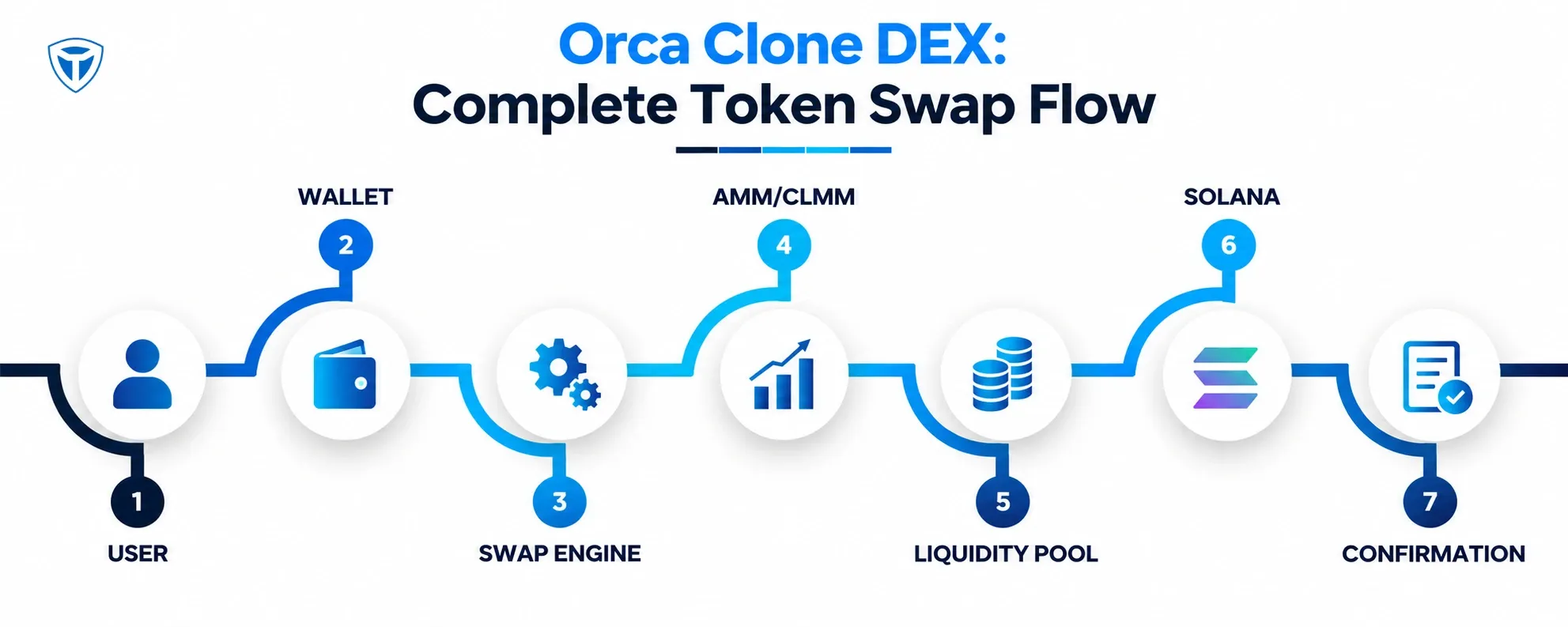
An Orca-like DEX enables users to swap tokens directly through connected crypto wallets without relying on a traditional centralized order book. AMM or CLMM mechanisms use available liquidity to determine swap rates, while Solana processes the transaction on-chain.
The typical process includes:
- Connect Wallet: Users connect a compatible Solana wallet.
- Select Tokens: Traders choose the tokens they want to swap.
- Check Liquidity: The platform identifies available pool liquidity and trading routes.
- Calculate Swap: The system determines the estimated output, fees, slippage, and price impact.
- Sign Transaction: The user reviews and approves the transaction through their wallet.
- Execute On-Chain: The Solana program processes the swap and updates token balances.
- Confirm Transaction: The completed transaction and updated balances are displayed to the user.
Behind this simple trading experience, the DEX requires secure coordination between the frontend, wallets, liquidity pools, Solana programs, and transaction infrastructure.
Key Features of an Orca Clone Script
A reliable Orca clone script should support core trading and liquidity functions while allowing businesses to customize the platform around their DeFi model.
- AMM-Based Token Swaps: Enable users to exchange supported tokens using automated market-making mechanisms.
- CLMM & Concentrated Liquidity: Allow liquidity providers to allocate capital within selected price ranges for more flexible liquidity management.
- Liquidity Pool Management: Support adding and removing liquidity while displaying pool activity, volume, and fee information.
- Solana Wallet Integration: Allow users to connect wallets, manage assets, and sign transactions without transferring custody to the platform.
- Token & Pool Management: Provide tools for configuring supported tokens, trading pairs, pools, and listing parameters.
- Trading Analytics: Display transaction history, trading volume, liquidity, token activity, and other relevant metrics.
- Flexible Fee Management: Configure trading, pool, or platform fees according to the business model.
- Admin & Security Controls: Provide authorized controls for platform management, monitoring, access permissions, and operational settings.
- Governance Features: Support community voting and decentralized decision-making where required.
- Scalable Architecture: Build the platform to accommodate growing users, transactions, liquidity, and future integrations.
The final feature set can be customized based on the target audience, supported assets, liquidity strategy, and long-term business objectives.

Build More Than a DEX—Build DeFi Infrastructure
Leverage an Orca Clone Script to create a scalable, secure, and user-friendly decentralized exchange on Solana.
Talk To Our ExpertsTechnology Stack Used to Build an Orca Clone on Solana
Below is a one-line explanation for each technology component:
- Solana Blockchain: High-performance Layer-1 blockchain for fast and scalable transactions.
- Rust & Anchor Framework: Used to develop secure and efficient Solana smart contracts.
- React / Next.js: Builds a responsive and user-friendly trading interface.
- Solana Web3.js: Connects frontend applications to on-chain programs.
- Node.js Backend: Handles APIs, indexing, and off-chain data management.
- Cloud Infrastructure: Ensures scalability, uptime, and performance optimization.
This stack is specifically chosen to match Orca’s performance standards.
Step-by-Step Process to Launch an Orca Clone Trading Platform
Creating an Orca Clone Trading Platform requires both technical (building the product) and strategic/operational considerations (determining how to run the business). Listed below is a founder-friendly step-by-step guide for the entire process:
- Market & Business Planning – Define Your Target Users, the Tokens You Will Support, The Fee Structure, and The Unique Value Proposition of Your DeFi Project
- Choose an Orca Clone Script – Find a clone script that is scalable and audited for readiness for use on the Solana blockchain.
- Customizing UI/UX, Branding – Design a clean and easy-to-use interface that aligns with your Brand Identity.
- AMM and Liquidity Configuration – Set Up Liquidity Pools, Swap Fees, and How You Will Reward Users
- Development of Smart Contracts – Customize and Deploy Solana Programs in Rust and Anchor
- Wallet Integrations – Connect to Wallets like Phantom and Solflare to allow Users to Use Your Services
- Backend & Admin Panel Setup – Set up dashboards for Analytics, Pool Management, and Governance
- Testing & Security Audits – Conduct Functional Testing, Load Testing, and Audit Smart Contracts
- Mainnet Deployment – Deploy your Orca Clone Platform to the Solana Mainnet Once You Have Validated it
- Liquidity Bootstrapping – Use Incentives and Farming Programs to draw in Early Liquidity Providers
- Launching the Project and Community Onboarding – Go Live and Start Acquiring Users and Engage the Community
- Ongoing Support and Feature Upgrades After Launch – Continue to Monitor and Enhance Your Platform Based Upon the Insights Gained.
Cost to Build an Orca Clone Script
The initial investment required to create an Orca clone is highly dependent on a number of different factors, including the specific feature customization you desire, how thoroughly you want your code audited for security purposes, and how robustly you wish to build out the infrastructure of your new decentralized exchange as well as the level of support you will require to successfully develop your new platform over time.
How Orca Clone Scripts Compare With Custom DEX Development
An Orca clone script provides a ready-made foundation for launching a customized Solana DEX, while custom DEX development builds the platform from scratch.
The main differences are in development time, customization, engineering effort, scalability, and control. Businesses can compare these factors to determine which development approach better fits their platform requirements and long-term goals.
|
Comparison Factor |
Orca Clone Script |
Custom DEX Development |
|---|---|---|
|
Development Approach |
Pre-built foundation |
Built from scratch |
|
Development Time |
Faster |
Longer |
|
Customization |
High |
Full |
|
Engineering Effort |
Lower |
Higher |
|
Technology Stack |
Adaptable |
Fully customized |
|
Scalability |
Architecture-dependent |
Purpose-built |
|
Security |
Testing and auditing are required. |
Custom security architecture |
|
Best Suited For |
Faster DEX launches |
Specialized DEX projects |
Understanding the Architecture of an Orca Clone DEX Platform
An Orca clone DEX platform combines the user interface, Solana wallet integration, swap engine, AMM/CLMM logic, liquidity pools, and Solana programs into a connected trading architecture.
When a user initiates a swap, the platform retrieves liquidity and pricing data, calculates the expected output, and sends the transaction to the relevant Solana program for execution.
Supporting layers such as token management, analytics, security controls, and the admin dashboard help operators manage the platform while maintaining a smooth trading experience.
Revenue Models You Can Implement in an Orca Clone DEX
Each monetization option is explained in one concise line:
- Trading Fees: Earn revenue from every token swap on the platform.
- Liquidity Pool Fees: Share a portion of LP-generated fees with the protocol.
- Token Listing Fees: Charge projects to list new token pairs.
- Yield Farming Fees: Apply performance or withdrawal fees on farming rewards. For platforms focused on sustainable yield incentives, a dedicated DeFi staking platform development approach provides a more structured reward architecture.
- Governance Token Utility: Generate value through staking and fee redistribution.
- Premium Tools: Offer advanced analytics and professional trading features.
An Orca Crypto Trading DEX With Clone Software can support multiple revenue streams simultaneously.
Why Entrepreneurs Choose Orca Clone Software
Orca Clone Software provides startups and entrepreneurs with speed, reliability, and strategic flexibility. It allows for less uncertainty in product development, shorter time-to-market cycles, and allows founders to focus on creating partnerships, building their communities, and growing their businesses, rather than spending time on low-level protocol engineering efforts.
Also read: Build a DeDust-like DEX with secure, scalable decentralized trading features.
How to Choose the Right Orca Clone Script Development Company
Successful decentralized exchange entrepreneurs place greater importance on code quality, security, scalability, and the ability to upgrade their platform than on the actual development costs of their Orca clone, as these four areas directly correlate to their users' trust in their platform and ultimately the longevity of their platforms.
Picking the correct development partner is crucial to the success of your decentralized exchange. The right partner will have an established track record of developing DeFi applications based on Solana, AMM, and Rust, and a firm dedication to security and long-term support after launching your new DEX.
Why Troniex Technologies Is a Trusted Choice
Troniex Technologies is a successfully established blockchain technology company that specializes in developing DeFi products based on the Solana blockchain.
Their development team brings a wealth of knowledge from working with other companies to develop and support scalable, secure, and customizable DEX products with an architecture similar to that of the Orca Platform.
For businesses exploring DeFi development companies in USA, they also assist entrepreneurs with designing and developing sustainable tokenomics, monetization models, and future-proofed architectures, making them an ideal partner when launching or scaling your own Orca Clone-type trading platform.
Future Outlook for Orca-Style DEX Platforms
As DeFi evolves, Orca-like DEXs are integrating concentrated liquidity, cross-chain swaps, DAO governance, and advanced liquidity optimization models.
Aggregation-layer protocols such as a ParaSwap clone script complement these platforms by routing trades across multiple DEX sources for optimal execution. Solana’s rapidly growing ecosystem further strengthens the long-term potential of high-performance decentralized exchanges.
Also read: Explore an expert DeFi development company for custom DeFi solutions.
Conclusion
A pre-built decentralized exchange (DEX) clone script based on the Orca DEX's business model gives entrepreneurs and newer companies everything they need to quickly launch their own profitable DEX on the Solana blockchain using proven technology and reliable DeFi smart contract development practices.
The combination of an established set of features and an experienced partner (Troniex Technologies) allows for the creation of an Orca alternative to be made using a controlled, business-like approach instead of leaving it up to chance or luck.
For founders who are committed to developing their own DeFi solution, the use of this method is one of the most reliable paths to take.
Start Your DeFi Exchange the Smart Way
Use an Orca Clone Script to create a high-performance Solana DEX built for growth and liquidity.
Contact Us