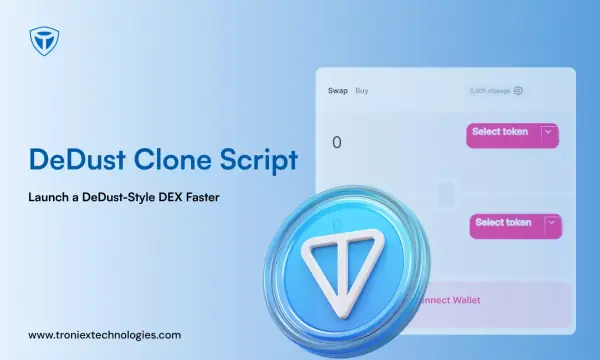
DeDust Clone Script: Build a Powerful Decentralized Exchange Like DeDust
A DeDust clone script is a customizable decentralized exchange (DEX) solution designed to replicate the core trading and liquidity features of DeDust on the TON blockchain. It can include AMM-based token swaps, liquidity pools, wallet integration, multi-hop routing, smart contracts, and admin controls while allowing businesses to customize the platform to their requirements.
Sep 24, 2026
11 mins read
Decentralized exchanges are no longer experimental products, they are now a core part of the global DeFi ecosystem. Users want platforms where they can trade directly from their wallets, maintain custody of their assets, and trust transparent on-chain logic rather than centralized intermediaries.
DeDust has emerged as a strong decentralized exchange within the TON ecosystem by delivering fast swaps, simple liquidity mechanics, and a smooth user experience.
Similar DeFi models, such as those built using a goose finance clone script, have further proven that ready-made frameworks can accelerate the launch of scalable decentralized platforms.
For businesses and Web3 entrepreneurs, building a comparable exchange is now more achievable than ever using a proven development framework rather than starting from zero.
This blog explores how a DeDust-inspired solution works, who it is best suited for, and how you can successfully launch a decentralized exchange with long-term scalability in mind.
What Is a DeDust Clone Platform?
A DeDust Clone Platform is a ready-built decentralized exchange framework that replicates the core mechanics of the original DeDust exchange while allowing full customization for branding, features, and governance.
Rather than having to develop all the necessary components, such as swap logic, liquidity pools, and the various smart contracts, for months before launching their product, a business can leverage a pre-built structure to provide a foundation for their business model and then build on that foundation by modifying it to fit their business model.
This strategy promotes decentralization while also reducing the amount of technical complexity associated with implementing a decentralized exchange.
Therefore, the DeDust Clone Platform is well-suited for groups interested in building a sustainable user base, liquidity pools, and partnership ecosystems, rather than experimentation at the protocol level.
How DeDust Clone Software Operates
Working Model of DeDust Clone Software
DeDust Clone Software follows an Automated Market Maker (AMM) model, where trades occur against liquidity pools rather than traditional order books.
The typical workflow includes:
- Users connect their TON-compatible wallets
- Token pairs are selected for swapping
- Pricing is calculated algorithmically based on pool ratios
- Smart contracts execute the trade on-chain
- Tokens are settled instantly in user wallets
This design ensures continuous liquidity, transparent pricing, and fully non-custodial trading.
Also read: Build high-performance swap platforms with DeFi DEX aggregator development.

Build Your DEX Faster
Turn your decentralized exchange idea into a live platform.
Talk To Our ExpertsHow Liquidity Provision Works in a DeDust Clone
Liquidity provision is a core component of a DeDust-style DEX because it supplies the assets needed for users to swap tokens. In a DeDust clone, smart contracts can manage liquidity deposits, pool balances, liquidity positions, applicable fee distribution, and withdrawals while giving users visibility into their positions.
1. Connect a TON-Compatible Wallet
Users connect their supported wallet to the DEX and select the assets they want to provide as liquidity.
2. Select a Liquidity Pool
Users choose an available token pair based on their preferred assets and the pool model supported by the platform.
3. Deposit the Token Pair
The user deposits the required token amounts into the selected pool. Smart contracts process the transaction according to the pool's predefined rules.
4. Record the Liquidity Position
The platform records the user's contribution and provides the corresponding liquidity position based on the pool's implementation.
5. Earn Applicable Trading Fees
When users trade through the pool, liquidity providers may receive their applicable share of trading fees or other platform incentives, depending on the DEX's configured model.
6. Monitor the Position
A user dashboard can display deposited assets, liquidity position, accumulated fees, and other relevant pool metrics.
7. Withdraw Liquidity
When users decide to exit, they can request a withdrawal through the platform. The smart contract processes the transaction according to the pool's rules and applicable conditions.
Key Features of DeDust DEX Clone Software
Core Functional Capabilities
A complete yet fully functioning Dedust DEX clone software will provide all of the necessary tooling to establish and manage a safe and scalable Decentralized Exchange (DEX).
- Decentralized Token Swaps: Allowing users to swap tokens directly from their wallets without relying on any intermediaries.
- Liquidity Pool Management: Allow users to insert or remove liquidity and receive rewards for supplying liquidity to token pairs.
- Automated Market Maker (AMM): Pricing is set using algorithms to provide continual liquidity and fair price execution.
- Wallet Integration: Supports secure connections to wallets and enables instant authentication when signing transactions.
- Speed of Transaction: Utilizing the TON blockchain, high-speed execution of token swaps occurs without delay.
- Transparency: All trades and liquidity movements are displayed publicly on the blockchain.
These features form the foundation of trust and usability for any decentralized trading platform.
Also read: Explore end-to-end DEX solutions from a specialized DeFi exchange development company.
Technical Architecture Behind the Exchange
The technical infrastructure is modular and designed for future scalability:
- Frontend Layer: Built using modern web technologies such as React or Next.js; providing a fluid and responsive User Experience (UX).
- Backend Services: APIs & Indexers to provide fast access to data and allow for analytics and monitoring of transactions.
- Smart Contracts: Contracts that are compatible with the TON Ecosystem (built on the TON Blockchain) to facilitate the management of swaps, pools, and fees.
- Blockchain Infrastructure: The TON Network provides the features of speed, scalability, & cost savings.
The ability to separate concerns enhances the upgrading of systems as well as carrying out security audits and expanding the features at a later date.
Understanding DeDust Liquidity Pool Types
A DeDust-style DEX can support different liquidity pool models depending on the assets being traded and the market-making mechanism used. Choosing the right pool structure helps businesses design more efficient trading pairs and provide a better experience for liquidity providers and traders.
|
Pool Type |
How It Works |
Best Suited For |
Key Benefit |
|---|---|---|---|
|
CPMM |
Uses a constant-product formula to determine token swap prices based on available liquidity. |
Volatile token pairs |
Provides a straightforward AMM model for token trading. |
|
CPMM v2 |
Builds on the constant-product model with enhanced fee and pool functionality. |
General-purpose token pairs |
Offers greater flexibility for DEX configurations. |
|
Stable-Swap |
Uses a pricing model optimized for assets with relatively similar values. |
Stablecoins and correlated assets |
Can help reduce price impact for suitable asset pairs. |
When developing a DeDust clone, businesses can select and customize suitable pool models based on supported assets, liquidity requirements, fee structures, and overall trading strategy. Each model should be implemented through carefully tested smart contracts to ensure predictable pool behavior.
Use Cases for DeDust Clone App
Real-World Applications of DeDust Clone App
A DeDust clone app can be tailored for multiple real-world DeFi use cases:
- Token Project DEX - Provide Instant Liquidity for Token Projects.
- Startup-owned DEX Platform - An opportunity for startups to build their own customized decentralized exchange.
- Community/DAO DEX - A decentralized exchange that is governed by the community through voting in an on-chain manner.
- Businesses Entering DeFi - Businesses can now enter the DeFi (Decentralized Finance) sector with a scalable, controlled and secure DEX solution.
- Regional or Niche Exchange - Allows the ability to build decentralized exchanges that serve a specific region or community.
While each of these use cases has its own unique advantages associated with decentralization, all provide the ability for business-level control and customization.
Advantages of DeDust Clone App Development
Why Businesses Choose DeDust Clone App Development
Opting for DeDust Clone App Development offers strategic advantages beyond faster deployment:
- Reduced development risk through proven logic
- Flexibility to customize UI, features, and governance
- Faster go-to-market compared to custom-built exchanges
- Scalability to support growing liquidity and users
This approach is particularly attractive for founders who want to validate their DEX idea quickly while keeping room for long-term innovation.
Business Models and Revenue Opportunities
Monetization Strategies for DeDust-Style DEX Platforms
A decentralized exchange built on this model can support multiple revenue streams:
- Transaction Fees: Generates revenue by charging a small fee on every token swap executed on the platform.
- Liquidity Provider Rewards Sharing: Earns platform-level income through configurable LP fee structures.
- Token Listing Opportunities: Allows projects to list new tokens by contributing liquidity or meeting platform criteria.
- Governance Token Utility: Creates long-term value through governance tokens used for voting and incentives.
- Premium Platform Features: Monetizes advanced analytics, priority listings, or enterprise-grade tools.
These models can be combined to create a sustainable and flexible revenue ecosystem.
DeDust Clone Script: From Development to Launch
Building a DeDust-style DEX involves more than replicating a trading interface. The development process needs to cover smart contracts, liquidity mechanisms, TON integration, security, and platform customization.
A structured development approach helps turn the initial concept into a reliable and launch-ready decentralized exchange.
1. Requirement Analysis & Planning
Define the platform's target users, supported tokens, liquidity models, core features, revenue strategy, and technical requirements. This stage establishes the architecture and development roadmap.
2. UI/UX Design
Design intuitive interfaces for token swaps, liquidity management, wallet connections, trading activity, analytics, and administration. The goal is to make complex DeFi functions easy for users to navigate.
3. TON Smart Contract Development
Develop the smart contracts required for token swaps, AMM logic, liquidity pools, fee management, and other platform functions. Contracts should be thoroughly tested before moving toward deployment.
4. Backend & Blockchain Integration
Connect the platform with TON blockchain infrastructure, supported wallets, APIs, indexing services, and backend components. These integrations help retrieve blockchain data and process platform operations efficiently.
5. Feature Development & Customization
Implement the required DEX functionality, such as token swapping, liquidity provision, multi-hop routing, token listings, analytics, and customized fee or reward mechanisms based on business requirements.
6. Testing & Security Audits
Conduct functional, integration, performance, and smart-contract testing to identify potential issues. Security reviews and independent audits can provide an additional layer of assurance before the platform goes live.
7. Deployment & Post-Launch Support
Deploy the completed DEX to the TON network and monitor its performance after launch. Ongoing maintenance can include security updates, feature enhancements, technical monitoring, and platform optimization.
Cost to Develop a DeDust Clone Script
Several factors influence the total cost of development, including depth of features, level of customization, security audit needs, and post-launch support needs.
It is essential that companies do not only think about the initial cost of developing a platform; they should also consider scalability, security, and upgradeability when developing a new product.
Having a well-designed platform reduces technical debt and allows an exchange to adapt to changing market conditions and technology advances.
Common Challenges and Practical Solutions
Launching a decentralized exchange comes with challenges such as liquidity bootstrapping, user education, and smart contract security. These challenges can be addressed through:
- Incentive programs for early liquidity providers
- Clear, intuitive user interfaces
- Thorough testing and third-party audits
- Continuous monitoring and protocol updates
Preparation and the right technical guidance make a significant difference in long-term platform stability.
Why Choose a DeDust Clone Script Development Company?
Decentralized exchange development also requires finding the right partner. Troniex Technologies offers extensive knowledge and experience in blockchain and DeFi development, allowing businesses to transition from concept to a production-ready platform.
Troniex Technologies offers:
- End-to-end decentralized exchange development
- Strong experience with TON-based smart contracts
- Custom UI/UX design and feature enhancements
- Security-focused engineering practices
- Post-launch maintenance and scalability support
Rather than delivering generic software, Troniex Technologies collaborates closely with clients to align technical execution with business objectives and long-term growth plans.
Learn more: Explore end-to-end DeFi development services for your blockchain business needs.
Conclusion
The growth of the TON ecosystem has resulted in an increase in decentralized exchange operations, as evidenced by the success of DeDust's decentralized exchange model. Businesses are able to rely on the DeDust-inspired decentralized exchange development framework to create secure, scalable, and user-friendly decentralized exchanges with minimal technical complexity.
Through thoughtful customization, a well-defined liquidity strategy, and collaboration with a qualified and experienced development partner, businesses can also explore complementary DeFi models such as deFi crowdfunding platform development, and related AMM-based DEX solutions like USwap clone script, enabling them to build a sustainable decentralized exchange business model that is well-prepared to succeed within the rapidly evolving decentralized finance (DeFi) marketplace.
Ready to Launch Your Own DeFi Exchange?
Start building a scalable DeDust-inspired decentralized exchange today.
Contact Us