How to Build an RWA Tokenization Platform in 2026: Architecture, Technology, and Costs
Learn how to build an RWA tokenization platform in 2026. Explore blockchain architecture, token standards, compliance, development costs, and implementation.
Nov 03, 2026
16 mins read
Real-world asset (RWA) tokenization is changing how businesses represent, manage, and distribute interests in physical and financial assets. From commercial real estate and commodities to private credit and treasury instruments, blockchain technology enables organizations to create digital representations of assets and manage related transactions through programmable infrastructure.
For fintech founders, asset managers, financial institutions, and entrepreneurs, building an RWA tokenization platform involves much more than deploying a smart contract.
Businesses must establish the legal structure behind each asset, select an appropriate blockchain, implement investor verification, manage custody, enforce transfer restrictions, and support the asset throughout its lifecycle.
An effective RWA tokenization platform development strategy connects these requirements through an integrated technology architecture.
This guide explains how to build an RWA tokenization platform in 2026, including its business models, essential features, blockchain infrastructure, development process, compliance requirements, and estimated cost factors.
What Is an RWA Tokenization Platform?
An RWA tokenization platform is a blockchain-based software system that enables businesses to represent ownership interests, financial claims, or other legally defined rights associated with real-world assets through digital tokens.
It connects asset issuers, investors, compliance systems, smart contracts, and blockchain infrastructure.
Unlike a conventional investment platform, an RWA platform can combine digital asset issuance with programmable ownership records, permissioned transfers, and automated financial operations.
For example, a commercial property could be held through a special-purpose vehicle (SPV), with investors receiving tokens representing shares or contractual interests in that entity.
The tokens provide a digital representation of the relevant rights, while the legal documents establish the underlying relationship.
An RWA platform typically supports:
- Asset onboarding and documentation.
- Legal and ownership verification workflows.
- Digital token issuance and allocation.
- Investor onboarding and eligibility checks.
- Permissioned transfers and transaction records.
- Distribution, redemption, and reporting.
The important distinction is that token ownership does not automatically establish direct ownership of the underlying physical asset. Legal rights depend on the offering structure, governing documents, and applicable jurisdiction.
How Does Real World Asset Tokenization Work?
RWA tokenization follows a structured process that connects an asset's legal and financial representation with blockchain-based digital tokens. Each stage establishes the information, permissions, and operational controls needed to issue and manage the tokens.
A typical workflow includes:
- Asset identification: The issuer selects an eligible asset, such as property, commodities, bonds, or private credit.
- Asset verification: Supporting ownership documents, valuations, financial records, and other relevant evidence are reviewed.
- Legal structuring: Legal professionals determine whether tokens represent direct ownership, SPV shares, beneficial interests, or contractual claims.
- Token design: The issuer defines token supply, investor rights, transfer restrictions, distribution rules, and redemption conditions.
- Smart contract deployment: Developers implement issuance, allocation, transfer, and other approved operations.
- Investor onboarding: Investors complete identity verification and applicable eligibility checks.
- Token distribution: Eligible investors receive their allocated tokens through the platform.
- Ongoing asset management: The platform supports reporting, distributions, permitted transfers, corporate actions, and redemption.
Consider a business tokenizing interests in a commercial property portfolio. Its platform might issue permissioned digital securities representing shares in an SPV. Investors complete verification, receive allocations, and access relevant financial reports through their accounts.
The blockchain maintains transaction records, while the legal structure and authoritative ownership arrangements determine the rights represented by those tokens.
Which Real-World Assets Can Be Tokenized?
Businesses can explore tokenization across several asset categories, but technical feasibility alone does not establish that an asset can legally or commercially be offered as a tokenized investment.
Common categories include:
- Real estate: Commercial buildings, residential properties, rental portfolios, and development projects.
- Bonds and treasury instruments: Financial instruments representing defined debt or investment interests.
- Private credit: Loan portfolios, receivables, and other structured credit exposures.
- Commodities: Gold, precious metals, and selected agricultural or industrial commodities.
- Infrastructure: Renewable energy projects, transportation infrastructure, and other long-duration assets.
- Alternative assets: Intellectual property, royalties, collectibles, and other assets with suitable valuation and legal frameworks.
Each category requires a different operational model.
A tokenized property investment may involve SPV administration and rental-income distributions. A tokenized credit product may require repayment schedules, interest calculations, and borrower reporting.
A commodity-backed token may need custody verification, reserve reconciliation, and redemption arrangements. Businesses should therefore select their asset category before choosing a blockchain or token standard.
Why Are Businesses Building RWA Tokenization Platforms?
Businesses are investing in RWA infrastructure because tokenization can improve how certain assets are issued, administered, and accessed by eligible investors.
Key potential benefits include:
- Fractional investment structures: An asset can be divided into smaller digital interests where the legal and commercial structure permits, potentially reducing the minimum investment requirement.
- Operational automation: Smart contracts can automate defined activities such as token issuance, permitted transfers, and distribution calculations, subject to appropriate controls.
- Transparent transaction records: Blockchain records can improve transaction traceability and provide a shared reference for authorized participants.
- Settlement efficiency: Programmable settlement can reduce certain manual reconciliation activities and improve transaction coordination.
- Investor administration: Digital onboarding, portfolio dashboards, and reporting tools can centralize investor interactions.
- Secondary-market opportunities: Platforms can integrate approved trading venues or other permitted transfer mechanisms, potentially improving access to liquidity.
However, tokenization does not guarantee investor demand, asset liquidity, reduced costs, or regulatory approval. These outcomes depend on the underlying asset, market structure, legal arrangements, and operational execution.

Looking for an RWA Tokenization Development Partner?
Choose a team that understands smart contracts, blockchain integration, investor-facing applications, security, and asset lifecycle requirements. Discuss your project scope with Troniex Technologies.
Talk To Our ExpertsWhat Are the Different RWA Platform Business Models?
The business model determines how assets are onboarded, how investors participate, and which platform capabilities must be developed.
Common RWA platform models include:
- Asset issuer platforms: Enable asset owners to structure offerings, issue tokens, manage investors, and monitor asset-related transactions.
- Tokenized investment fund platforms: Support fund subscriptions, investor allocations, reporting, distributions, and redemption according to the fund's governing documents.
- Real estate investment platforms: Connect property operators, investment structures, and eligible investors through asset-specific onboarding and administration.
- Private credit platforms: Manage loan-related information, investor participation, repayment events, and financial reporting.
- Commodity-backed platforms: Connect digital tokens with reserve management, custody evidence, verification, and applicable redemption arrangements.
- Institutional and white-label platforms: Provide reusable infrastructure that financial businesses can configure around their own branding, asset categories, and operational requirements.
A startup validating one investment product may need an MVP with limited issuance and investor management capabilities. An institutional operator may require multiple issuer accounts, configurable compliance policies, sophisticated reporting, and integrations with external custodians.
The right model should be selected before development begins because it directly influences architecture, cost, and implementation complexity.
Essential Features of an RWA Tokenization Platform
A successful RWA platform needs more than a token creation interface. It must support the complete operational relationship between issuers, assets, investors, and service providers.
Important features include:
- Issuer and asset management: Allows authorized organizations to register assets, upload supporting documents, manage offerings, and monitor asset information.
- Investor onboarding: Provides registration, identity verification, KYB/KYC workflows, investor categorization, and eligibility management.
- Token issuance and allocation: Supports token creation, supply configuration, investor allocations, issuance records, and approved administrative operations.
- Compliance management: Maintains investor permissions, jurisdictional restrictions, transaction monitoring, and relevant audit records.
- Investor portfolio management: Provides token balances, transaction history, investment information, and relevant financial statements.
- Distributions and redemption: Supports defined income distributions, repayment events, redemption requests, and related calculations.
- Marketplace integrations: Connects with appropriate trading or transfer infrastructure where legally permitted.
- Administrative reporting: Provides operational dashboards, user management, transaction monitoring, and exportable reports.
Feature selection should follow the asset's legal and financial requirements. For example, a property investment platform may prioritize rental distributions and SPV reporting, while a private credit platform may require repayment schedules and borrower performance information.
RWA Tokenization Platform Architecture and Technology Stack
RWA platform architecture connects the user interface, backend services, blockchain infrastructure, compliance providers, and asset-management systems.
Each component must work together without confusing blockchain transaction records with legal ownership records or off-chain asset information.
A practical architecture contains the following layers.
- Frontend and user interfaces: Investor portals, issuer dashboards, and administrator interfaces provide access to platform services. React, Next.js, or comparable frameworks can support responsive web applications.
- Backend and API layer: Business logic manages user accounts, offerings, asset information, permissions, transaction workflows, and third-party integrations. Node.js, Python, Java, or other suitable backend technologies can be selected according to system requirements.
- Blockchain and settlement layer: The selected network handles token-related transactions and smart contract execution. Network selection depends on security, transaction economics, ecosystem support, and compliance requirements.
- Smart contract layer: Contracts implement token issuance, transfers, role permissions, supply controls, and defined financial operations. Upgradeability and administrative privileges require careful design.
- Identity and compliance integrations: KYC/KYB providers, sanctions screening, and eligibility services support investor verification and permission management.
- Oracle infrastructure: External data providers can deliver relevant information such as valuations, reference prices, and financial events. Oracle data requires source validation and appropriate controls.
- Custody and wallet infrastructure: Wallets, institutional custody, MPC, and multisignature arrangements protect digital assets and manage transaction authorization.
- Administration and monitoring: Analytics, audit logs, alerts, access controls, and operational monitoring support platform governance.
A simplified architecture is:
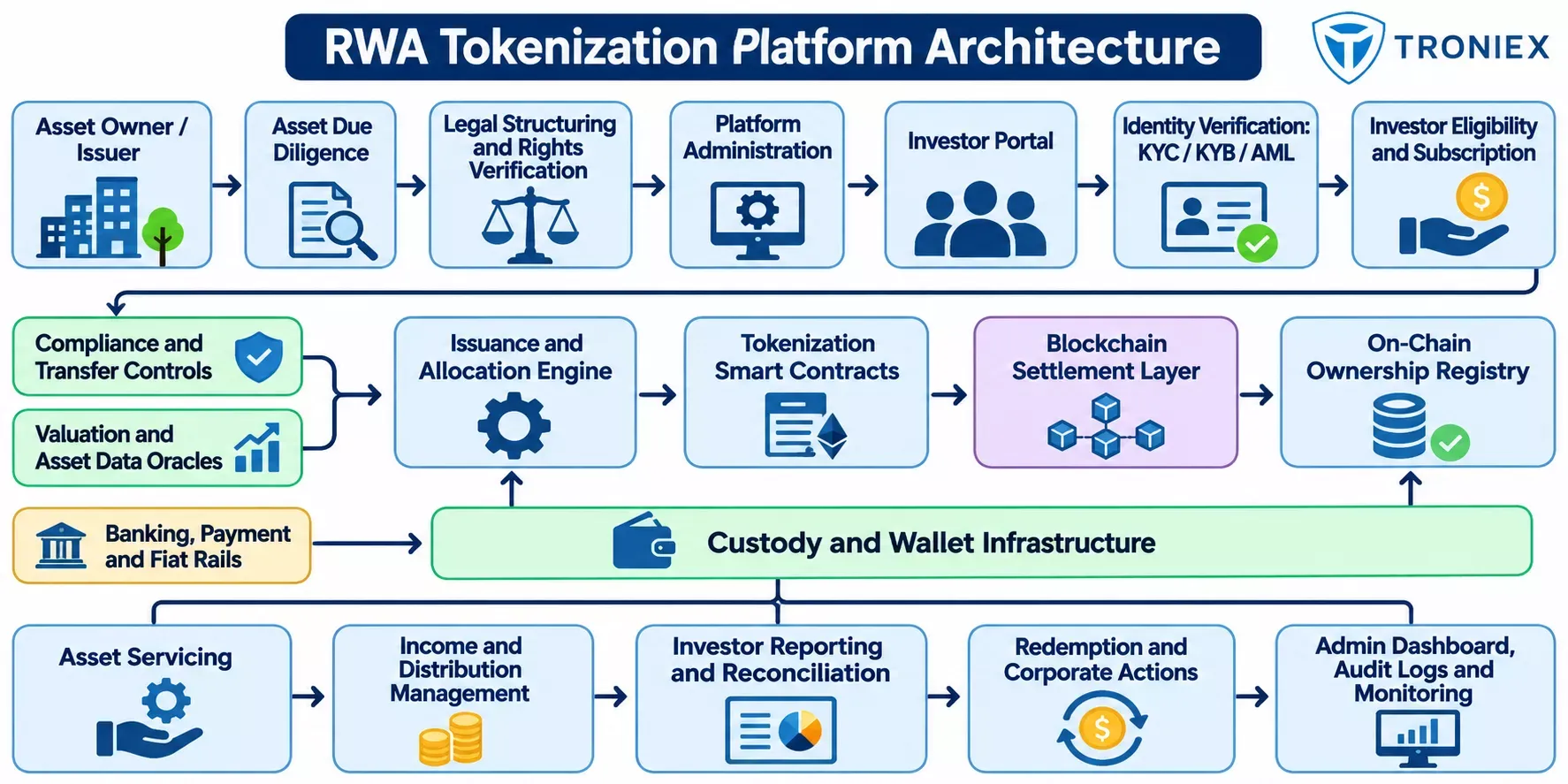
The architecture should also maintain secure connections between on-chain transactions and off-chain records, including asset documents, legal agreements, valuation information, and servicing events.
Which Blockchain and Token Standards Should You Choose?
Blockchain selection should reflect the asset structure, investor requirements, transaction volume, custody arrangements, and regulatory environment. No single network or token standard is appropriate for every RWA project.
- Ethereum: Provides an established smart contract ecosystem and broad infrastructure support. It can be suitable for applications requiring compatibility with institutional wallets, custody providers, and EVM-based services.
- Polygon: Offers EVM compatibility and alternative transaction economics. It may be considered for platforms requiring integration with Ethereum-compatible infrastructure.
- Solana: Provides a high-throughput blockchain environment and a distinct development ecosystem. Businesses should assess their tooling, custody support, and required token controls.
- Avalanche: Offers EVM compatibility and infrastructure options relevant to applications requiring configurable blockchain environments.
- Permissioned networks: Frameworks such as Hyperledger Fabric or enterprise-oriented networks may be appropriate when participants require controlled access and specific governance arrangements.
Token standard comparison
|
Standard |
Main purpose |
RWA application |
|---|---|---|
|
ERC-20 |
Fungible token interface |
Fungible token representations where additional restrictions are implemented separately |
|
ERC-1400 |
Security-token framework |
Security-oriented issuance and transfer controls |
|
ERC-3643 |
Permissioned token standard |
Identity-aware transfers and compliance-controlled token operations |
|
ERC-721 |
Non-fungible tokens |
Unique asset representations or certificates where legally appropriate |
|
ERC-1155 |
Multi-token standard |
Applications managing multiple token types |
ERC-3643 is particularly relevant to permissioned tokenization because its architecture supports identity and compliance-related transfer controls.
However, a standard does not automatically satisfy every regulatory obligation. Legal structuring, investor verification, custody, and ongoing compliance must be addressed independently.
The final technology decision should be based on a documented comparison of security, transaction fees, interoperability, ecosystem maturity, custody integrations, and operational requirements.
Discuss Your RWA Tokenization Platform Project with Our Experts
Have a project in mind? Share your asset category, target jurisdiction, investor model, preferred blockchain, and required functionality. Troniex Technologies can help assess the technical scope and potential development approach.
Request A ProposalHow to Build an RWA Tokenization Platform: 8 Development Steps
Building an RWA platform requires coordinated business, legal, and engineering work. A structured development process reduces architectural rework and helps ensure that technical features reflect the intended investment model.
Step 1: Define business requirements and feasibility.
Identify the asset category, target investors, business model, jurisdictions, and expected transaction volumes. Determine whether the project needs a single-asset MVP or a multi-issuer enterprise platform.
Step 2: Establish the asset and legal structure.
Verify ownership, valuation, asset documentation, and the legal rights investors will receive. Work with qualified legal professionals to establish the appropriate offering structure.
Step 3: Define compliance requirements.
Determine investor eligibility, KYC/KYB procedures, AML controls, transfer restrictions, and reporting requirements. Translate these obligations into software specifications.
Step 4: Select blockchain architecture.
Compare networks, token standards, custody arrangements, and interoperability requirements. Document the technical rationale before development starts.
Step 5: Develop smart contracts.
Implement token issuance, permissions, supply management, transfer rules, and relevant distribution or redemption logic. Include role-based authorization, event logging, and appropriate emergency controls.
Step 6: Build frontend and backend applications.
Develop issuer dashboards, investor interfaces, administrative tools, and backend services. Connect these components through secure APIs and defined transaction workflows.
Step 7: Integrate external services and test the platform.
Integrate identity verification, custody, wallet infrastructure, oracles, and other required providers. Conduct functional, integration, security, and performance testing.
Step 8: Audit, deploy and maintain.
Arrange independent smart contract security reviews, remediate identified issues, and deploy through a controlled release process. Establish monitoring, maintenance, incident response, and upgrade procedures.
A pilot launch should validate the complete asset-to-investor workflow before the platform expands to additional offerings.
RWA Tokenization Compliance and Security Requirements
Compliance and security are foundational components of RWA infrastructure, particularly when tokens represent securities, investment interests, or other regulated financial rights.
- Jurisdiction-specific regulations: Determine which laws govern the asset, issuer, offering, investors, intermediaries, and trading arrangements. Requirements can differ significantly across jurisdictions.
- KYC, KYB and AML: Verify individual and business investors, screen relevant parties, and establish appropriate monitoring and recordkeeping procedures.
- Investor eligibility: Implement accreditation, professional-investor, or other eligibility requirements where applicable.
- Permissioned token transfers: Smart contracts may enforce approved wallet lists, investor restrictions, and transaction permissions.
- Custody and key management: Establish appropriate custody responsibilities, MPC or multisignature arrangements, access controls, and recovery procedures.
- Independent security audits: Review smart contract logic, privileged roles, backend security, API permissions, and infrastructure configuration.
- Data protection: Protect personal and financial information using encryption, access controls, retention policies, and secure integrations.
In the United States, the SEC's January 2026 staff statement on tokenized securities is an important reference for understanding issuer-sponsored and third-party tokenization structures. It should not be interpreted as blanket regulatory approval.
Businesses must obtain jurisdiction-specific legal advice before launching an offering. A technology provider can implement technical controls, but software development alone cannot establish regulatory compliance.
How Much Does RWA Tokenization Platform Development Cost?
RWA tokenization platform development cost depends on the asset category, legal structure, number of user roles, blockchain architecture, integrations, and security requirements.
A white-label solution may reduce initial development effort, while a custom enterprise platform typically requires more engineering, testing, and integration work.
The main cost components include:
|
Development component |
Main cost drivers |
|---|---|
|
Discovery and architecture |
Business model, asset structure, requirements |
|
Legal and compliance design |
Jurisdiction and offering complexity |
|
Smart contract development |
Token standards, permissions, business logic |
|
Frontend and backend |
Dashboards, APIs and user workflows |
|
Blockchain integration |
Network and infrastructure requirements |
|
KYC/KYB and AML |
Provider fees and integration complexity |
|
Custody and wallets |
MPC, multisignature and institutional integrations |
|
Security auditing |
Contract complexity and audit scope |
|
Maintenance |
Infrastructure, monitoring and ongoing support |
An MVP with a limited asset offering, investor onboarding, and basic token management will have a different budget from a multi-issuer enterprise platform supporting several asset categories and jurisdictions.
Businesses should request an itemized estimate covering development, third-party services, legal work, independent audits, deployment, and ongoing maintenance.
Avoid comparing vendors solely on initial development price. Evaluate the total cost of ownership and the quality of the delivered infrastructure.
How Long Does RWA Platform Development Take?
RWA platform development timelines depend on scope, integration complexity, legal readiness, and testing requirements.
A limited MVP may require several months, while a production-grade enterprise platform can take considerably longer.
The major phases include:
- Discovery and architecture planning.
- Legal and compliance design.
- Smart contract and backend development.
- Frontend and integration work.
- Testing and independent security audits.
- Deployment and operational preparation.
External dependencies can affect the schedule. Asset verification, legal documentation, custody-provider onboarding, and regulatory approvals should not be treated as ordinary software development tasks.
A realistic delivery estimate should be prepared after requirements discovery, not based on a universal launch promise.
Common RWA Platform Development Challenges
RWA projects face challenges that extend beyond conventional blockchain application development.
- Legal enforceability: Digital tokens must connect to clearly documented rights and enforceable legal arrangements.
- Asset valuation and verification: Maintaining investor confidence requires reliable documentation, independent appraisals, and up-to-date asset information.
- Liquidity limitations: Tokenization does not automatically create buyers or active secondary markets. Liquidity depends on investor demand, permitted transfers, and market infrastructure.
- Interoperability: Moving assets between networks requires careful consideration of settlement, custody, token representation, and cross-chain security.
- Custody and operational risks: Lost keys, compromised credentials, and privileged contract access can create significant risks.
- Operational complexity: Distributions, corporate actions, redemptions, and ownership reconciliation must remain consistent with the governing legal and financial arrangements.
Businesses should address these challenges during architecture and feasibility planning instead of treating them as post-launch issues.
Accelerate Your RWA Platform Development with Troniex Technologies
From architecture planning and smart contract engineering to investor portal development and blockchain integration, explore technical solutions aligned with your tokenization objectives.
Contact UsHow to Choose an RWA Tokenization Development Partner
Selecting an RWA development partner requires evaluating both blockchain engineering capabilities and an understanding of asset-related business operations.
Before signing a development agreement, assess the following:
- Blockchain expertise: Does the company have experience with relevant networks and smart contract ecosystems?
- Tokenization knowledge: Can it explain token standards, issuance models, and permissioned transfer mechanisms?
- Security capabilities: Does it follow secure development practices and support independent smart contract audits?
- Compliance integrations: Can it integrate KYC/KYB, AML, investor eligibility, and relevant reporting workflows?
- Custody infrastructure: Does it understand MPC, multisignature, and institutional wallet integrations?
- Asset lifecycle experience: Can it implement distributions, redemption, reporting, and ownership reconciliation?
- Post-launch support: Does it offer maintenance, monitoring, upgrades, and technical support?
Troniex Technologies provides blockchain, smart contract, tokenization, and Web3 development capabilities for businesses planning custom digital asset infrastructure.
Through its Asset Tokenization Platform Development services, businesses can explore platform architecture, token issuance, investor management, blockchain integrations, and security-focused development requirements.
The appropriate engagement should begin with a detailed assessment of the asset category, legal structure, target jurisdiction, investor model, and technical requirements.
A clearly scoped implementation plan helps businesses avoid unnecessary features, manage development complexity, and build infrastructure aligned with their operational objectives.