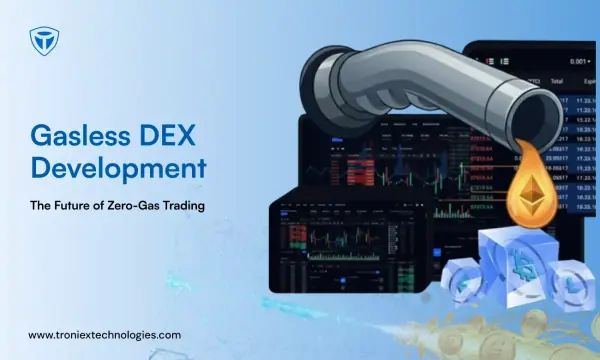
Gasless DEX Development: How to Build a Zero-Gas Trading Experience That Scales
Gasless DEX development eliminates gas friction using account abstraction and intent-based execution. Build scalable, user-friendly DEXs with Troniex Technologies.
Sep 18, 2026
14 mins read
Ever lost half your potential users before they even start?
Most people quit decentralized exchanges before their very first swap.
They leave because funding a wallet with gas tokens is hard. This friction causes a massive 30% to 50% drop-off rate.
Wallet funding is the single biggest roadblock in decentralized finance. New traders get confused and often never come back.
Gasless DEX development breaks this wall to grow your business. It provides a fast experience that works like a regular app.
Troniex Technologies creates gasless, intent-based exchange architectures for you. Our systems focus on scale, security, and sustainable business models. We help you build a trading platform that actually works.
Why Gas Fees are the Biggest Adoption Barrier in DeFi?
Gas fees block your onboarding process. Users must buy native tokens before taking any action. This step creates a wall for new traders. Traders often quit before their very first swap.
Failed trades still cost money
Traders pay for network work but get nothing back. This outcome feels like a betrayal of your customers. It causes people to abandon your platform quickly.
Unpredictable costs
Fees can jump ten times higher in one day. Costs are hard to predict, so business budgeting is hard. Users feel helpless when they cannot see final prices.
Small trades become irrational
Gas often costs more than the actual trade value. The math fails so you lose users. Trades are too expensive so conversion rates drop.
The business impact
Data shows 69% of swaps hit a gas error. These errors hurt your retention and total volume. Getting rid of this friction helps you scale fast.
Removing transaction friction is the fastest way to turn a complex trading platform into a seamless experience that scales for everyone.
-Raja Sekar, CTO of Troniex Technologies
What Gasless DEX Development Really Means?
Think of gasless trading as a hidden engine. It is about abstraction, not making the network work free. A gasless DEX lets users trade without paying fees directly.
You remove the friction of the "insufficient gas" message.
Zero Gas vs. Gas Abstraction
Gas is the fuel every blockchain always needs. Zero gas is the experience you give your users. Gas abstraction is the technology that hides the fuel tank. It turns a complex process into a simple signature.
Who Pays the Fee?
The responsibility to pay shifts to another party (Third-Party). This is usually your platform or a relayer network.
You have three main ways to cover these costs:
- Fee Wrapping
- Platform Subsidisation
- Third-Party Sponsors
UX benefits for your business
New traders do not need native tokens to start. This removes the biggest cause of incomplete trades. Onboarding becomes 50% faster for your new customers. Your DEX feels like a simple Web2 app.
How Do Gasless Decentralized Exchanges Work?
Gasless DEXs shift the technical work from your customers to your platform. You provide a Web2-like experience backed by blockchain transparency. Your users focus on the trade while technology handles the rest.
The power of Meta-transactions
Traditional trading requires users to pay network fees directly. Meta-transactions change this by using signed digital messages.
Users sign an off-chain message expressing their intent to trade. A third-party relayer then submits this to the blockchain.
This relayer pays the fee using their own funds. It removes the requirement for users to hold native tokens.
Account Abstraction and ERC-4337
This technology turns standard crypto wallets into smart contracts. It allows for much more flexible and complex transaction workflows.
You can enable features like account recovery and spending limits. Users can sign in easily without managing complex private keys.
This standard makes your platform feel like a familiar app.
How do Paymasters and Bundlers work?
Paymasters are smart contracts that sponsor your users' network costs. They decide whether to cover a fee based on your logic.
Bundlers group many of these operations into a single transaction. This grouping reduces the overall cost and network load.
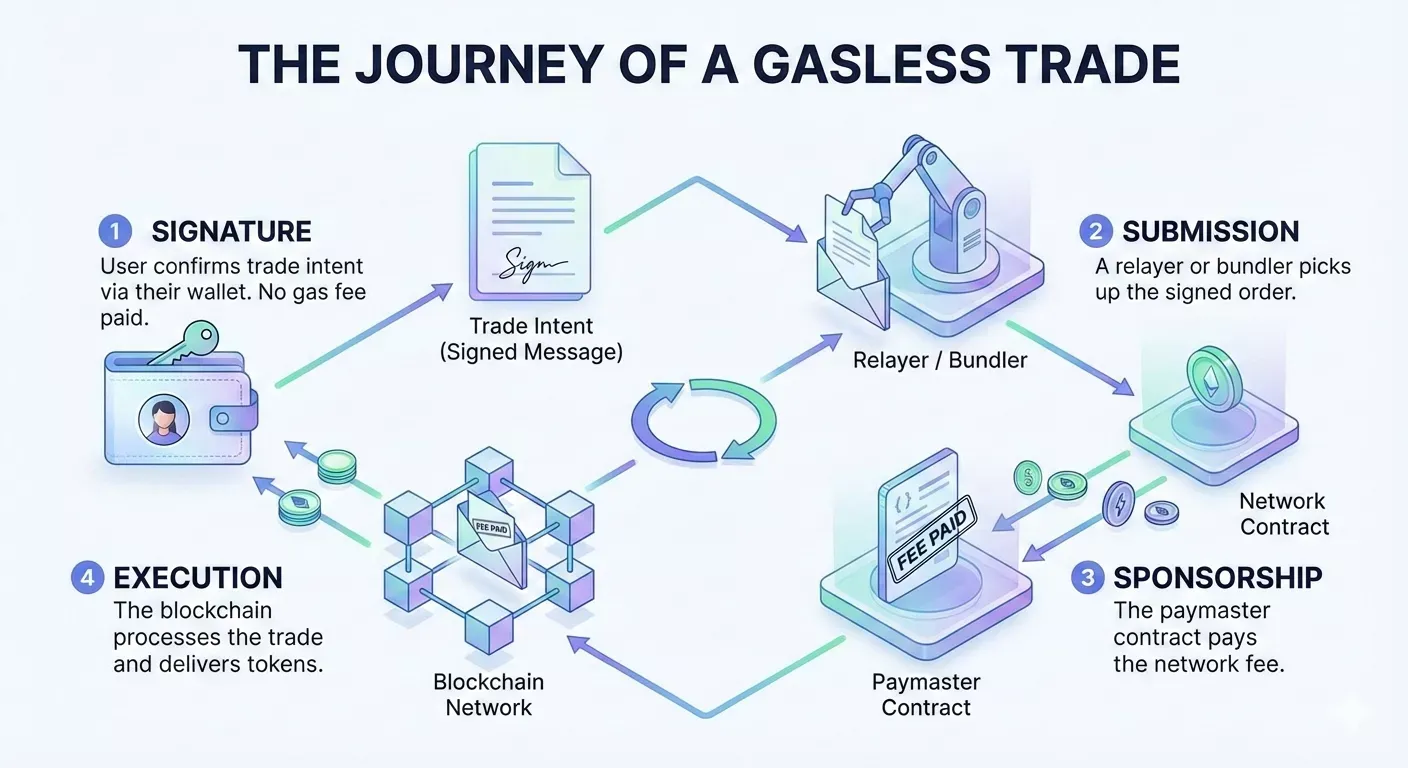
Intent-based vs Direct Execution
Direct swaps require users to manage every technical step manually.
Intent-based swaps let users focus only on the desired outcome. A third-party filler finds the best path to execute that intent.
The filler covers the gas and includes it in the trade price. If a trade happens to fail, your user pays nothing.

Ready to Lead the Next Wave?
Success is simple with the right technical partner. Our team handles the architecture so you can scale.
Schedule A Free ConsulatationGasless DEX vs Traditional AMM DEX
Gasless DEXs and traditional AMMs solve different problems. One demands technical know-how and crypto familiarity.
The other removes friction so anyone can trade, even first-time users. Your choice decides how your platform grows and who it serves.
Gasless vs Traditional DEX Comparison
|
Aspect |
Traditional DEX / AMM |
Gasless DEX |
|
Transaction Flow |
Users submit transactions directly to the blockchain and pay gas in native tokens. |
Users sign an intent (a message). A filler executes and pays the gas for them. |
|
User Onboarding |
New users must first buy native tokens for gas, leading to 30–50% drop-offs. |
No gas needed to start. Users can trade instantly with any token they hold. |
|
Cost Predictability |
Gas fees change constantly. Users never know the final cost until they pay. |
Gas is wrapped into the trade price. Users see the full cost upfront, no surprises. |
|
Failed Trades & Slippage |
Trades can fail if market prices move before confirmation, you still lose gas fees. |
Trades are simulated before execution. Failed trades cost nothing, cutting failed rates by up to 85%. |
|
MEV Protection |
Public mempools expose trades to bots, leading to “sandwich attacks.” |
Encrypted mempools and batch auctions protect prices and user data from MEV bots. |
When Traditional AMMs Still Make Sense?
Traditional models remain useful for simple, direct network interactions. They provide deep liquidity for high-volume, professional trading pairs.
Developers often use them as the base layer for liquidity. However, gasless layers are now the preferred front-end for retail users.
Also Read: AMM vs CLOB: Key Differences Explained
Core Components Required to Build a Gasless DEX
Building a gasless DEX isn’t just about skipping gas fees, it’s about combining the right infrastructure layers so users can trade without friction.
Smart accounts and wallet layer
Account abstraction enables programmable wallets with simpler login, social recovery, and safer key management. Users trade without managing seed phrases or gas tokens.
Paymaster logic and funding strategy
Paymasters sponsors network fees based on your business rules. Gas can be subsidized for onboarding, wrapped into trade pricing, or sponsored by partners to drive volume.
Bundler and relayer infrastructure
Relayers submit user transactions and pay gas on their behalf. Bundlers batch operations to improve speed, reliability, and cost efficiency behind the scenes.
Intent solver and routing engine
Users sign trade intent, not transactions. Solvers compete to find the best execution path across liquidity sources, removing manual gas management.
MEV protection mechanisms
Encrypted mempools and batch auctions prevent front-running and sandwich attacks, ensuring fair trade execution and protecting user value.
Monitoring and analytics stack
Real-time monitoring tracks relayer health, costs, and performance. Alerts and analytics help optimize operations, revenue, and long-term platform stability.
Security, Trust, and Relayer Risks You Must Address
Gasless DEXs improve UX, but they also shift trust to new infrastructure layers. Users now rely on relayers to submit transactions, so relayer reliability and transparency directly affect your platform’s credibility.
If a relayer goes offline or is compromised, trades can be delayed or manipulated. Redundancy and failover systems are essential.
Account abstraction introduces smart wallets that increase flexibility but also expand the attack surface. Even audited contracts can hide risks, making continuous security critical.
Removing gas fees also removes a natural spam filter. Without safeguards, attackers can flood the system and drain gas reserves. Rate limits, circuit breakers, and automated capital controls are required.
Long-term resilience comes from audited code, live monitoring, and transparent operations. These practices protect users, reassure investors, and create the trust foundation every scalable DeFi platform needs.
Cost Recovery and Monetization Models for Gasless DEXs
Gasless trading must be sustainable to support long-term growth. The right monetization model ensures you scale without burning capital while keeping UX friction low.
- Protocol-sponsored gas: Cover gas fees for users as an onboarding incentive. This works like a marketing spend, removing “not enough gas” errors and accelerating early adoption.
- Token-based fee abstraction: Users pay fees with the tokens they already hold. Smart contracts handle gas conversion in the background, so traders never need native gas tokens.
- Spread capture via solver competition: Gas costs are embedded into trade execution. Competing solvers pay the gas and optimize prices, covering costs while improving execution quality.
- Hybrid freemium models: Offer zero-gas trading for selected pairs or early users. Monetize power users through subscriptions, premium tools, or referral-based incentives.
Why Do Most Gasless Models Fail At Scale?
Simple subsidisation models cannot survive massive user growth. Network congestion makes gas costs jump unexpectedly. Platform gas funds drain quickly during high traffic. Success requires a model that stays profitable as you grow.
Gasless DEX Development Process: Step-by-Step Guide
Building the right way from the start saves you time. Architecture-first development stops costly rewrites later. Your users get a smooth experience that keeps them coming back.
Requirement analysis and chain selection
Your chain choice defines your speed and fees forever. Pick a network that supports low costs and fast trades. Arbitrum, Polygon, and Base are top choices for high volume.
Study your target audience to pick the best fit.
UX Flow and Intent Modeling
Traditional gas fees cause a 30% to 50% drop-off rate. Fix this by letting users sign a simple message instead. This model lets them focus on the trade, not technology.
Users sign an intent, and your platform finds the path.
Smart Contract and AA Implementation
Use ERC-4337 to turn wallets into programmable smart software. This setup allows features like easy account recovery.
It removes the requirement for users to manage complex keys. Your contracts handle the execution logic behind the scenes.
Relayer and Paymaster Setup
Relayers act as the bridge to submit trades on-chain. They pay the gas, so your users never have to.
Paymasters decide when to sponsor these costs for you. This setup delivers a zero-gas experience for every customer.
Security Audits and Stress Testing
Code is powerful, but it can also contain hidden flaws. Audit every contract to verify your logic is safe. Test your system under heavy load to find breaking points.
Trust is the single biggest wall for user adoption.
Deployment, Monitoring, and Scaling
Launch on a testnet first to find errors early. Use unified dashboards to track performance and volume. Real-time data helps you manage costs as you grow. Scale your architecture to handle thousands of new traders.
Business Benefits for Founders
- Better Onboarding
- Higher Retention
- Market Lead
Also read: Find suitable DeFi development companies in UAE for building secure decentralized platforms tailored to specific business and financial use cases.
Success Is Simple With The Right Partner!
You do not need to be a technical expert to lead. At Troniex, our team of experts handles the architecture so you can scale.
Talk To Our ExpertsWhen Gasless DEX Development Makes Sense?
Gasless technology can supercharge user growth, but it’s not a fit for every model. The setup you choose must align with your goals; otherwise, you risk wasting capital and slower adoption.
Best-fit use cases
Retail trading apps, mobile platforms, and high-frequency tools like gaming gain the most from gasless systems. Removing fees makes microtransactions and loyalty programs scale smoothly.
Most importantly, new users can start trading instantly without first buying native tokens.
Poor-fit scenarios
For trades above $100,000, direct on-chain transactions may still be cheaper. Simple gas-subsidy models can fail when network traffic pushes costs up.
Teams aiming for full decentralisation without relayers will face added complexity.
L1 vs L2 choices
Running a gasless setup directly on Ethereum L1 is often too costly. Layer 2 chains such as Polygon or Base make sponsorship practical, with fees up to 99% lower, giving you room to scale without breaking your budget.
Retail vs Professional Traders
Retail users quit when faced with “insufficient gas” errors. Gasless tech removes that friction and widens your user base.
Meanwhile, professional traders care more about speed, price stability, and protection from execution risks.
Regulatory and Compliance Checks
If your platform handles fiat-based gas sponsorships, expect stricter KYC and AML requirements.
Cross-border payments follow different banking laws, so clear onboarding and compliance workflows are key to staying safe as you grow.
Why Choose Troniex Technologies for Gasless DEX Development
Concepts are easy, but execution defines your market success. At Troniex Technologies, we focus on production-grade implementation, not experimental prototypes.
Hands-on experience with ERC-4337 and intent-based DEXs
We use ERC-4337 to turn wallets into smart software. This removes the requirement for users to manage complex keys. Your customers simply sign an intent to trade their tokens.
The backend handles the rest, making trading feel instant. This approach removes the barriers that stop 50% of users.
Secure paymaster and relayer architecture
Our paymaster logic acts as a sponsor for network costs. We build secure relayers that submit trades on your behalf.
This architecture protects your users from malicious bot attacks. We implement rate limits and validation to prevent platform abuse. Trust is the foundation of every trade on your platform.
Focus on sustainable economics, not subsidies
Most gasless models fail because they rely on burning capital to sponsor gas. We design cost-recovery mechanisms using fee abstraction, solver competition, and efficient execution paths so your gasless DEX remains viable beyond the launch phase.
End-to-end DEX development support
Troniex provides complete ownership from architecture design to deployment and scaling. This includes smart contracts, frontend UX, relayer infrastructure, analytics, and post-launch optimization. You get a production-ready gasless DEX, not a stitched-together solution.
Final Insights
Gasless DEXs remove the single biggest UX friction in DeFi: forcing users to hold native tokens just to transact. By abstracting gas fees, platforms eliminate wallet funding barriers, reduce failed swaps, and make decentralized trading accessible to a broader audience.
The impact is measurable. Gasless execution improves onboarding speed, increases transaction completion rates, and drives stronger user retention. In competitive DeFi markets, better UX directly translates into higher volume, deeper liquidity, and long-term protocol growth.
As a leading DEX development company,Troniex Technologies works with teams to design, build, and scale gasless DEXs that are secure, economically sustainable, and ready for real-world usage. Our focus is not just removing gas fees, but delivering an architecture that performs under load and earns user trust.
Request a quick, free gasless DEX architecture consultation with Troniex Technologies to evaluate how gas abstraction can accelerate your platform’s growth.