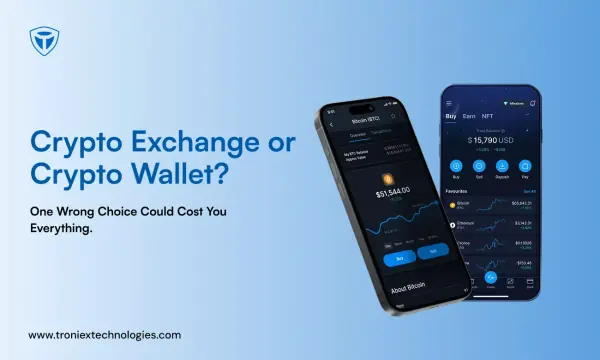
Crypto Exchange vs Crypto Wallet: What’s the Real Difference and Which One Do You Need?
Confused about crypto exchanges vs wallets? Learn the real difference, how custody works, security risks, hot vs cold wallets, and when to use each. A technical, founder-focused guide powered by Troniex Technologies.
Jan 10, 2026
13 mins read
Most crypto losses don’t happen during market crashes; they happen because users misunderstand where their assets actually live and who controls them.
A crypto exchange and a crypto wallet might look similar on the surface, but they operate on completely different trust models.
One prioritizes trading speed and convenience. The other prioritizes sovereignty and security.
In this guide, I’ll break down the exact functional and custody differences between exchanges and wallets, highlight the security risks each one carries, and explain how professionals, institutions, and everyday users should structure their digital asset strategy.
Drawing from our experience building both exchange infrastructures and non-custodial wallet systems at Troniex Technologies, I’ll also share the operational frameworks we recommend to clients who manage high-value crypto portfolios.
By the end, you’ll know precisely when to use an exchange, when to rely on a wallet, and how to minimize risk in a world where custody is everything.

Want To Build A Secure, High-Performance Crypto Platform?
At Troniex Technologies, we help founders design exchanges, non-custodial wallets, and hybrid custody systems built for scale and safety.
Talk To Our ExpertsWhat Crypto Exchanges and Crypto Wallets Actually Do?
The crypto ecosystem revolves around two fundamentally different tools: exchanges and wallets. Both are essential, but they solve entirely different problems. The real distinction comes down to function and custody, what each tool is built for, and who ultimately controls the private keys that govern your digital assets.
Core Functionalities of a Cryptocurrency Exchange
A cryptocurrency exchange is a marketplace, not a storage tool. Its entire architecture is engineered to enable economic activity at speed and scale.
What an exchange actually does
- Facilitates buying, selling, and trading of digital assets.
- Matches orders using order books (CEXs) or AMMs (DEXs).
- Provides liquidity, price discovery, and instant execution.
- Acts as a bridge between crypto and fiat, enabling deposits and withdrawals in USD, EUR, GBP, and more.
- Charges fees through maker–taker models, spreads, or swap fees.
Because the exchange handles rapid off-chain trade execution, users temporarily give up direct control of their private keys. This creates convenience, but it also introduces custodial risk.
💡 In short: an exchange is where you trade crypto, not where you truly own it.
Core Functionalities of a Cryptocurrency Wallet
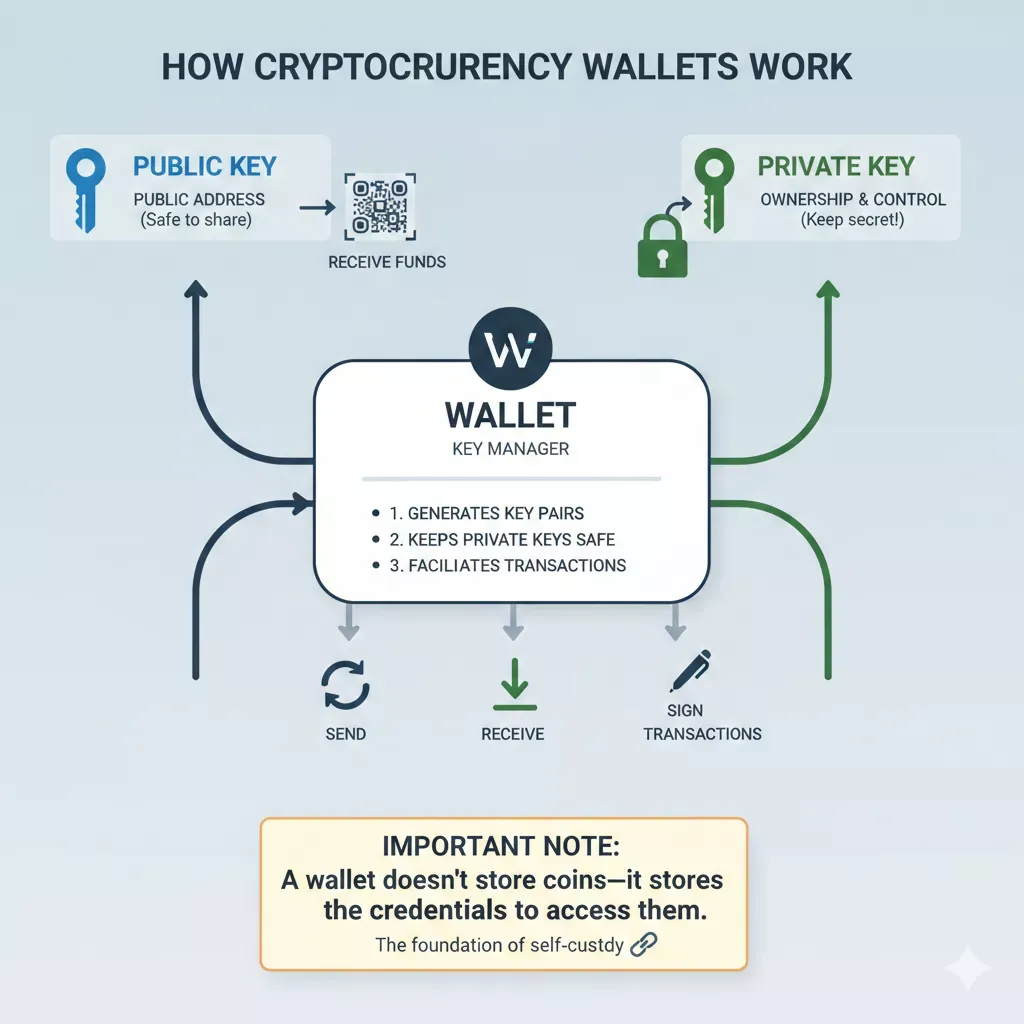
A crypto wallet is not a storage vault for coins. Coins remain permanently recorded on the blockchain. A wallet is simply the tool that manages the private keys, granting access to those coins.
What a wallet actually does
- Generates and stores public and private key pairs.
- Signs and authorizes blockchain transactions.
- Allows users to send, receive, and manage digital assets securely.
- Ensures only the key holder can move funds.
Wallets come in many forms: mobile apps, browser extensions, and hardware devices, but their purpose never changes: to secure private keys and grant the user full control over their blockchain address.
💡 In short: a wallet is where you control crypto, not where you trade it.
Why Custody Defines Everything: “Not your keys, not your coins.”
The most important distinction between an exchange and a wallet is not features, it’s who holds the private keys.
|
Custodial model (exchanges) |
Non-custodial model (wallets) |
|
|
This is the same setup that’s caused every big exchange crash, from Mt. Gox to FTX. Lose your keys, and your assets are gone. There’s no “forgot password” on the blockchain, which is why custody isn’t a small thing; it’s everything.
Deep Breakdown of Cryptocurrency Exchanges
Crypto exchanges power digital asset trading. Their design and custody model decide how users trade, who controls the assets, and how secure the system is.
There are two main types, Centralized (CEXs) and Decentralized (DEXs), with new hybrid models bridging the gap. Each runs on different trust and tech foundations.
Centralized Exchanges (CEXs)
Centralized exchanges operate as regulated intermediaries that manage user accounts, custody assets, and execute trades through proprietary systems.
They resemble traditional financial institutions in structure and compliance.
Operational mechanics
A CEX manages:
- Order books hosted on centralized servers
- Matching engines that pair buy and sell orders in milliseconds
- Internal ledgers that update user balances instantly
- Custodial wallets held by the exchange, not the user
This architecture guarantees:
- Deep liquidity from market makers and institutions
- Tight spreads for high-volume traders
- Ultra-fast execution, often sub-millisecond
- Scalability for margin, futures, and derivatives markets
This model enables sophisticated trading but inherently requires trust in the operator.
Fiat integration
CEXs act as the primary gateway between the traditional banking world and crypto:
- Bank transfers
- Credit and debit cards
- Stablecoin conversions
- Fiat withdrawals
This makes CEXs indispensable for investors entering or exiting the crypto ecosystem.
Regulatory compliance
CEXs must follow strict global financial laws:
- KYC (Know Your Customer) identity verification
- AML (Anti-Money Laundering) procedures
- Transaction monitoring for suspicious activity
- Reporting obligations to regulators
Compliance is mandatory but makes CEXs less private and more control-driven.
User experience
CEX platforms are designed for accessibility:
- Clean UI/UX
- 24/7 support
- Password resets
- Trading dashboards
- Mobile apps
This ease of use is a major reason beginners start with CEXs.
Explore how our team at Troniex Technologies designs secure, high-performance CEX platforms that meet global standards, Learn more about Centralized Exchange Development.
Decentralized Exchanges (DEXs)
Decentralized exchanges remove intermediaries entirely. They run on smart contracts, and users trade directly from non-custodial wallets. No central operator controls funds or private keys.
Operational mechanics
Most DEXs rely on Automated Market Makers (AMMs) rather than traditional order books.
Key components:
- Liquidity pools holding token pairs
- Smart contracts governing swaps and pricing
- LPs (Liquidity Providers) earn fees for supplying assets
- Algorithms setting prices based on token ratios
Everything is executed on-chain, meaning every trade is visible transparently.
User experience
DEXs offer:
- Global, permissionless access
- No KYC requirements
- True self-custody (keys never leave the wallet)
But they demand more user skill:
- Understanding gas fees
- Managing wallets
- Approving smart contract interactions
- Handling failed or pending transactions
DEXs assume users are capable of managing their own security.
Innovation drivers
DEX ecosystems rapidly evolve with:
- Cross-chain swaps via bridges
- On-chain order books on high-speed L2s
- DAO-based governance
- Composable DeFi integrations (yield farms, staking, lending)
DEXs represent the open, programmable leg of Web3.
Building a Decentralized Exchange (DEX) demands precision in smart contract design, liquidity architecture, and security audits. At Troniex Technologies, we develop scalable, transparent DEX platforms that empower users with full control over their assets and on-chain freedom.
Discover how our Decentralized Exchange Development Services can help you launch a secure, high-performance DEX.
Other Notable Crypto Exchange Models
The market has expanded beyond the CEX vs DEX binary. Hybrid and niche exchanges aim to combine the benefits from both worlds.
Hybrid Exchanges
Blend CEX speed with DEX transparency:
- Custody optional models
- Layer-2 processing
- Zero-knowledge proof integrations
- Off-chain order books + on-chain settlement
Examples: DeversiFi, Loopring
Instant Swap Platforms
No accounts. No custody.
Simply aggregate liquidity behind the scenes and execute swaps.
Examples: ChangeHero, Changelly
Peer-to-Peer (P2P) Exchanges
Buyers and sellers transact directly:
- Escrow smart contracts
- Local payment methods
- Strong use-case in restrictive jurisdictions
Examples: LocalBitcoins, Paxful
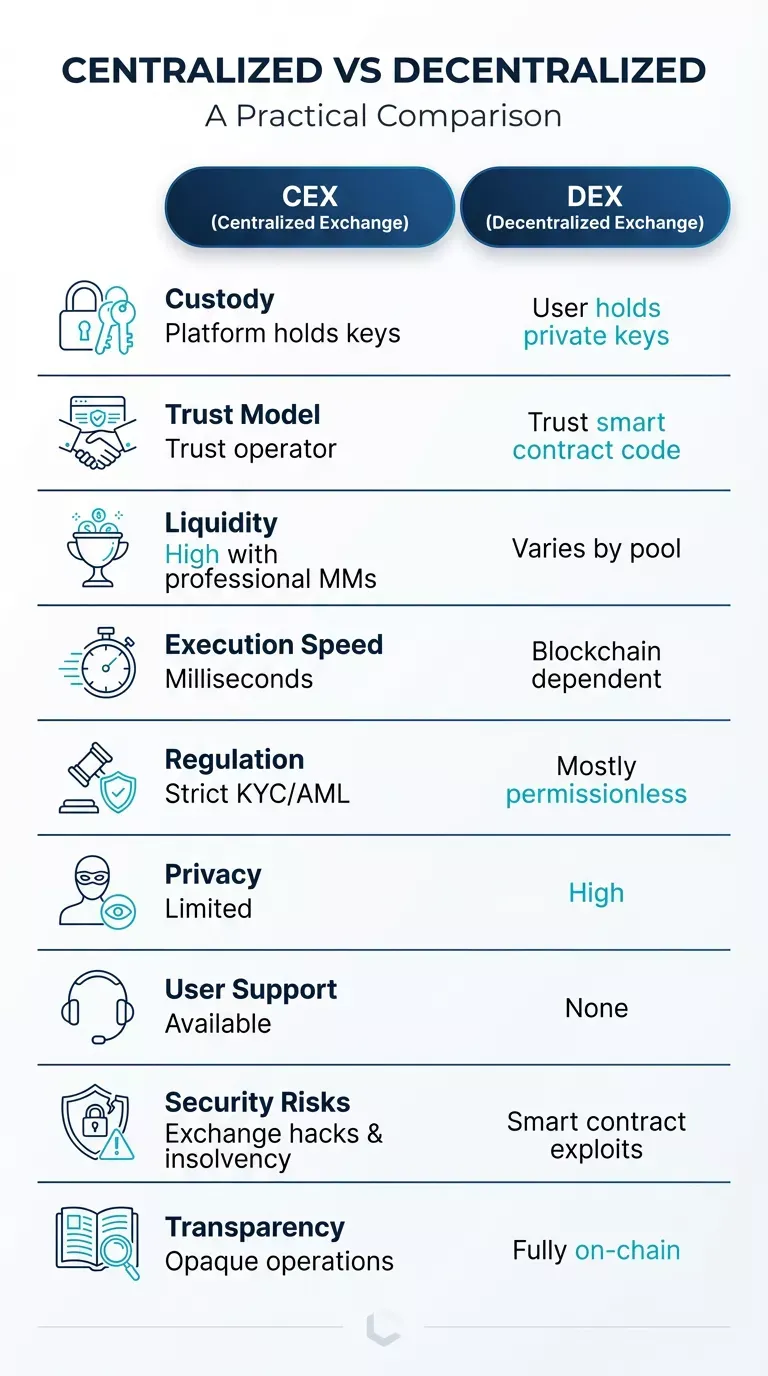
Bottom line:
CEXs optimize for speed, liquidity, and fiat access. DEXs optimize for self-custody, transparency, and decentralization. The right choice depends on whether a user prioritizes convenience or sovereignty.
Complete Taxonomy of Crypto Wallets
Crypto wallets protect private keys, the digital proof of who owns what on the blockchain. Wallets don’t actually hold coins; those always stay on-chain. What changes is who controls the keys and how they’re secured.
Wallets come in two types: hot and cold. Each has different tradeoffs in security, speed, and ease of use.
Hot vs. Cold Wallets: The Most Important Security Divide
The biggest factor in a wallet’s risk profile is whether it touches the internet.
Hot Wallets (Software-Based)
Hot wallets stay connected online, making them ideal for everyday crypto operations.
Key characteristics:
- Mobile apps, desktop apps, and browser extensions
- Private keys stored on internet-connected devices
- Instantly usable for swaps, dApps, games, DeFi, NFT minting, and payments
Pros
Fast and convenient
Easy to install and use
Ideal for small, frequently used balances
Cons
Exposed to malware, phishing attacks, clipboard hijacks, and browser exploits
Higher attack surface due to constant connectivity
Common examples:
- MetaMask, Trust Wallet, Coinbase Wallet, Exodus
- Hot wallets are best treated as operational wallets, not long-term storage.
Cold Wallets (Hardware & Physical)
Cold wallets isolate private keys completely offline, making them the gold standard for long-term protection.
Key characteristics:
- Hardware devices (Ledger, Trezor, KeepKey)
- Paper wallets for extreme minimalism
- External signing: the device signs transactions internally without exposing the key
Pros
Immune to online attacks
Use tamper-resistant Secure Element chips
Best choice for protecting large portfolios
Cons
Requires physical handling
Slower for frequent transactions
Risk of physical loss, theft, or damage
Why are hardware wallets safest?
Inside these devices is a Secure Element (SE), a highly protected chip that:
- Generates private keys
- Stores them isolated from external systems
- Never expose them to the internet
This design makes hardware wallets the preferred solution for institutions, long-term holders, and treasury management.
Advanced models add layers of security:
- Seed phrases help you recover your wallet, but lose it, and your funds are gone.
- Multisig wallets need multiple approvals, great for teams or DAOs.
- MPC wallets split keys across parties for extra protection.
Bottom line:
- Hot wallets offer convenience.
- Cold wallets offer maximum security.
- Advanced models like multisig distribute power and reduce single-key risks.
Understanding these structures is essential before deciding how to protect digital assets, especially in an industry where a misplaced phrase or compromised device can permanently wipe out holdings.
Risk Framework: Choosing the Risk You Can Manage
Choosing between an exchange and a wallet comes down to this: what kind of risk do you want to manage?
- Centralized exchanges carry institutional and custodial risks.
- Wallets bring personal and operational risks.
- Neither option is risk-free; the tradeoff just changes.
Exchange Risks: Trusting the Platform
When you store funds on an exchange, you’re trusting the platform’s solvency, security, and governance. It’s convenient, but history shows how bad this can go.
Main risks:
- Counterparty failure: The exchange could mismanage assets, face liquidity issues, or collapse, like FTX or Mt. Gox. Lose the exchange, lose your funds.
- Hacks: Centralized exchanges are prime targets. In 2024 alone, over $1.7B in crypto was stolen from CEX-related breaches.
- Regulatory clampdowns: Exchanges can freeze accounts, limit withdrawals, or shut down overnight if regulators step in.
- FTX proved the point: billions vanished overnight because users didn’t control their keys. Centralized convenience often comes at the cost of control.
Crypto Wallet Risks: Holding Your Own Keys
Self-custody removes platform risk but adds responsibility. You hold the keys and the consequences.
Main risks:
- Lost seed phrase or key: Lose both, and the funds are gone forever.
- Phishing scams: Fake sites, airdrops, or support chats trick users into revealing keys.
- Device hacks: Hot wallets can be compromised by malware or keyloggers.
- DeFi smart contract bugs: Interacting with risky contracts can drain funds even if keys are safe.
- Physical loss: Cold wallets can be lost, stolen, or damaged.
Self-custody gives total control, but demands total care.
The Hybrid Strategy: Smart Custody for Crypto
The safest way to manage digital assets is a hybrid custody model, a mix of exchange, cold wallet, and hot wallet use. It balances access, security, and efficiency by matching storage type with purpose.
Here’s how it works:
Keep only active funds on exchanges
Use exchanges only for trading, not storage. Holding large balances exposes you to hacks, counterparty failure, and withdrawal freezes. Keep just enough for short-term trading or arbitrage.
Store long-term holdings in cold wallets
Hardware wallets with Secure Element chips are best for treasury reserves, savings, and institutional funds. Offline storage removes internet risk completely.
Use hot wallets for everyday activity
For DeFi, NFTs, or payments, hot wallets give you the speed you need. Keep only small, operational balances here.
This three-tier setup, Exchange for trading, Cold for storage, Hot for utility, reduces risk without slowing you down.
Security Basics Everyone Should Follow
No matter where you keep your crypto, good security habits make all the difference.
Seed phrase protection
- Write it down; never store it digitally or in the cloud.
- Keep backups in two secure, offline places.
- Metal backups survive fire or water damage.
- Lose it, and your funds are gone forever.
Buy hardware wallets safely
- Order directly from the manufacturer.
- Avoid resellers or pre-set-up devices.
- Never trust a wallet that comes with a prewritten seed phrase.
Verify every transaction
- Check the recipient address on your hardware wallet’s screen, not just your browser.
- This prevents address-swapping attacks.
Boost exchange account security
- Use app-based 2FA, not SMS.
- Set withdrawal whitelists.
- Lock devices and monitor logins.
- Limit API keys and update passwords regularly.
Follow these steps, and your crypto stays both accessible and protected, no matter how you trade or store it.
Ready To Strengthen Your Crypto Custody Setup?
Our team at Troniex Technologies designs hybrid custody solutions that blend exchange performance with wallet-level security.
Talk To Our ExpertsConclusion
The difference between a crypto exchange and a wallet is simple but critical: exchanges are for trading, wallets are for ownership.
Exchanges offer speed and liquidity but require trust. Wallets offer full control but demand personal security and discipline.
Smart investors and businesses now use a hybrid setup:
- Exchanges for active trading
- Cold wallets for long-term reserves
- Hot wallets for everyday on-chain use
This approach cuts risk, improves efficiency, and keeps ownership in your hands.
At Troniex Technologies, we’ve built exchanges, wallet systems, and institutional custody frameworks from the ground up. The lesson is clear: security starts with understanding.
If you’re planning to design or scale a crypto platform with secure custody and wallet integrations, our team can help you build a solution that fits your goals in security, compliance, and growth.