Coin Listing Services: Costs, Requirements & Exchange Listing Process in 2026
Explore coin listing services, costs, exchange requirements, timelines, CEX vs DEX options, and the crypto coin listing process for projects in 2026.
Sep 11, 2026
16 mins read
Listing a cryptocurrency on an exchange is much more than submitting a coin name, contract address, and project website. Many exchanges are now considering legal compliance, technical security, tokenomics, liquidity, market demand, project credibility, community activity, and network compatibility to determine if an asset qualifies for trading.
Coin listing services help crypto projects prepare for these requirements, identify suitable exchanges, organize listing documentation, coordinate technical integration, plan liquidity, and manage the path from application to market launch.
The standards vary significantly by exchange. Coinbase states that assets undergo legal, compliance, technical-security, and additional business assessments, while Kraken evaluates factors including market profile, market fit, security robustness, regulatory posture, and community engagement.
For founders, Web3 startups, blockchain businesses, and token issuers, the real question is therefore not simply “How do I list my coin?” It is “Is the project ready, which exchange fits it, what will the complete process require, and how can listing risk be reduced?”
What Are Coin Listing Services?
Coin listing services are specialized advisory, technical, compliance, and launch-support services that help cryptocurrency projects prepare digital currencies for trading on centralized exchanges (CEXs) or decentralized exchanges (DEXs). They may include listing readiness assessment, exchange research, document preparation, technical coordination, liquidity planning, application support, and post-listing preparation.
A legitimate provider will not guarantee acceptance. The exchange decides the final listing, which is based on its internal policies and the criteria for assessment.
Coin Listing Services vs Token Listing Services
During search, the terms are often used interchangeably, but technically a coin is generally a native asset that runs on its own blockchain, while a token usually runs on an existing blockchain protocol or token standard.
In terms of exchange listing, both may have to go through technical validation, project documentation, liquidity planning, regulatory assessment, and integration work. Native coins can involve additional blockchain-node and wallet infrastructure considerations, while standard tokens may benefit from already-supported networks.
Projects issuing blockchain-based tokens can also explore our token listing services for structured support with exchange readiness, documentation, CEX/DEX applications, and launch coordination.
Who Typically Uses Coin Listing Services?
Crypto startups, blockchain foundations, Web3 businesses, DAOs, gaming ecosystems, DeFi, RWA, community-led projects, and established blockchain enterprises may seek professional listing assistance.
The best candidates are usually those with a functional product or ecosystem already in existence, transparent tokenomics, technical documentation, security readiness, clear market demand, and a realistic liquidity strategy, rather than those banking on an exchange listing to generate demand.
How Do Coin Listing Services Work?
Crypto coin listing services normally begin before an exchange application is submitted. A structured engagement evaluates whether the project is ready, determines which exchanges fit its market strategy, addresses documentation or technical gaps, and coordinates the listing workflow.
Project and Listing Readiness Assessment
In the first stage, we will look at the technology, security, tokenomics, legal status, supply distribution, liquidity plan, community, project roadmap, and documentation available for the cryptocurrency.
This stops teams from applying before they have fixed fundamental weaknesses.
Exchange Shortlisting
Not every respectable exchange is right for every project. When you make a selection, you should consider the supported networks, target markets, jurisdictional availability, user demographics, liquidity, integration complexity, business model, and project maturity.
A targeted shortlist is generally more strategic than submitting identical applications indiscriminately.
Application and Due Diligence
Applications commonly require detailed project, team, technical, market, supply, and compliance information. Exchanges may independently evaluate the asset rather than relying exclusively on information supplied by the project.
For example, Kraken explicitly instructs issuers to submit one application per token and warns against encouraging communities to submit duplicate applications.
Technical Integration and Launch Coordination
If approved, additional work may include blockchain integration, wallet or deposit/withdrawal functionality, token configuration, trading-pair preparation, testing, liquidity coordination, market communications, and launch scheduling.
Technical complexity can vary significantly between standardized tokens on supported networks and native or bespoke blockchain integrations.
Why Do Crypto Projects Need Professional Coin Listing Services?
Professional coin listing services can improve preparation and coordination, but their value should be measured by process quality, not promises of guaranteed acceptance or guaranteed price performance.
Reduce Exchange Application Errors
Incomplete documentation, inconsistent supply information, unclear token utility, missing technical details, or poorly organized submissions can make an already demanding review process harder.
Structured preparation improves consistency before the project approaches exchanges.
Improve Regulatory and Technical Readiness
Major exchanges increasingly treat legal, compliance, and technical-security reviews as core listing considerations. Coinbase explicitly states that its listing process evaluates assets against legal, compliance, and technical-security standards.
Projects should therefore identify compliance questions and security weaknesses before, not after submission.
Identify Better-Fit Exchanges
The biggest exchange is not automatically the best first exchange.
A project's ideal venue depends on geography, investor profile, blockchain support, liquidity resources, community strength, regulatory positioning, and maturity. Strategic exchange selection can improve both operational feasibility and market relevance.
Coordinate Listing and Market Launch
Approval is only one milestone. Liquidity preparation, trading-pair strategy, technical availability, communications, community education, and post-launch monitoring also influence whether a listing develops into a sustainable market.
CEX vs DEX Coin Listing: Which Should You Choose?
A CEX coin listing generally offers access to a managed trading environment, established users, order-book infrastructure, and potentially deeper liquidity, but typically involves formal review. A DEX coin listing can provide greater control and faster market access where protocol rules allow it, while requiring the project to manage liquidity and decentralized-market dynamics more directly.
|
Factor |
CEX Listing |
DEX Listing |
|
Approval process |
Usually formal review |
Often permissionless or protocol-based |
|
Liquidity |
Exchange/order-book dependent |
Liquidity-pool dependent |
|
Compliance |
Typically stronger onboarding requirements |
Varies by protocol and interface |
|
Control |
Exchange controls listing environment |
Greater project/protocol flexibility |
|
Costs |
Varies by venue and integration |
Mainly liquidity, gas and launch costs |
|
Speed |
May take substantial review time |
Can be considerably faster |
|
Audience |
Exchange's existing customer base |
On-chain/Web3 users |
When to Choose a Centralized Exchange
A CEX strategy may be suitable when a project needs access to centralized trading audiences, fiat or stablecoin markets, institutional-style infrastructure, or wider exchange discovery.
Projects should nevertheless evaluate each exchange individually rather than treating all CEXs as interchangeable.
When a DEX-First Strategy Makes Sense
A DEX-first approach can work for early on-chain ecosystems that already have compatible wallets, an active blockchain community, transparent token contracts, and sufficient liquidity resources.
DEX accessibility does not eliminate the need for security, responsible tokenomics, or sustainable liquidity.
Hybrid DEX-to-CEX Listing Strategy
Some projects establish initial on-chain trading through a DEX before pursuing suitable centralized venues as their user base, market activity, operational maturity, and compliance preparation develop.
The sequence should reflect business readiness rather than a fixed industry formula.
Is Your Coin Ready for Exchange Listing?
Before paying advisers or approaching exchanges, teams should conduct a Coin listing readiness score. This can turn a vague goal, “get listed” into measurable preparation.
Coin Listing Readiness Score
A practical 100-point internal framework could evaluate five categories:
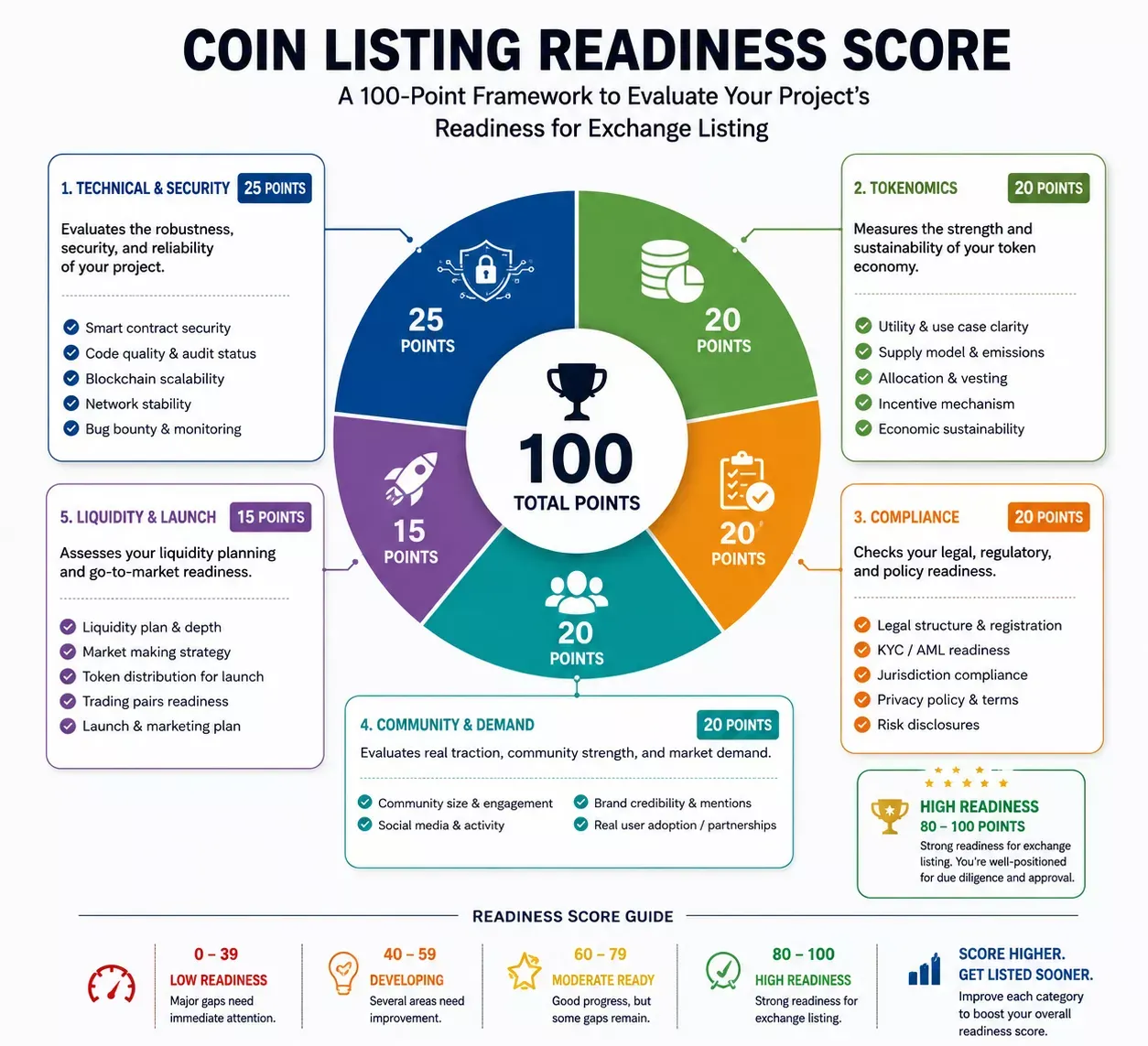
Technical and Security Readiness
Review blockchain stability, contract security where applicable, wallet compatibility, APIs, explorer availability, node requirements, deposit/withdrawal mechanics, audit findings, and incident-response preparation.
Technical integration gaps can delay otherwise promising listings.
Tokenomics and Supply Distribution
Clearly document maximum supply, circulating supply, allocations, vesting, unlock schedules, treasury holdings, insider allocations, emissions, utility, and distribution mechanisms.
Opaque or unsustainable token economics can create both exchange and market risk.
Community and Market Demand
Exchanges can consider business and market signals in addition to technical eligibility. Genuine users, product adoption, developer activity, community engagement, market demand, and credible growth indicators can strengthen a project's case.
Compliance Readiness
Projects should understand the regulatory treatment of the asset and prepare appropriate corporate, legal, identity, jurisdictional, sanctions, and compliance documentation.
Requirements vary across exchanges and jurisdictions, so qualified legal counsel may be necessary.
Documents Required Before Applying to Crypto Exchanges
Crypto exchange listing documents should present a consistent and verifiable account of the project. Missing or contradictory information can create unnecessary questions during review.
Whitepaper and Project Documentation
Draft a current whitepaper or equivalent technical document describing the project’s purpose, architecture, blockchain, token utility, roadmap, ecosystem, governance, economic model, and relevant risks.
Legal & Compliance Documentation
Information may include corporate registration, team identification, legal opinions, regulatory analysis, KYC/AML procedures, jurisdictional restrictions, sanctions controls, and related policies depending on the project and the exchange.
Smart Contract Audit Reports
For smart contract-based assets, independent security audits can demonstrate that the contracts in question have been reviewed by professionals. Projects should also be open about unresolved findings, rather than treating an audit badge as a definitive sign of security.
Projects can engage professional smart contract audit services before approaching exchanges to identify vulnerabilities, confirm contract behavior, and remediate security findings that may impact their listing readiness.
Tokenomics and Supply Information
Total supply & circulating supply allocation; vesting schedules for Treasury holdings; token unlock, minting/burning mechanics. Contract addresses, blockchain info.
Outside of exchanges, supply accuracy matters. CoinMarketCap’s current listing methodology also keeps the criteria around tracked markets, trading activity, and cryptocurrency data.
Projects still refining token architecture can work with a crypto token development company to establish secure token standards, supply mechanisms, utility, vesting logic, and blockchain compatibility before exchange applications.
Team, Community, and Official Project Links
Maintain consistent official websites, documentation, explorers, social channels, repositories where appropriate, team information, and community resources so reviewers can validate project claims efficiently.
Step-by-Step Crypto Coin Listing Process
Every exchange has its own process, but in general, a practical crypto coin listing process can be divided into 7 stages.
- Project Readiness Analysis: Look at technical stability, tokenomics, compliance, community traction, security, documentation, liquidity, and launch goals.
- Choose the right exchanges: Take into account the network they operate on, the target audience, the location, the reputation, the volume of funds they process, the requirements for projects, and whether they are a good business fit.
- Prepare the Listing Application: Gather accurate project, company, team, token, security, market, technical, and compliance information.
- Full Due Diligence: Respond quickly to exchange questions, verification requests, technical reviews, legal queries, and additional information requests.
- Integrate Wallets and Trading Pairs: Coordinate blockchain/token integration, deposits, withdrawals, wallet infrastructure, testing, and proposed markets.
- Prepare Liquidity and Market Making: Establish responsible liquidity plans, trading-pair coverage, treasury allocations, and market-making arrangements where appropriate.
- Coordinate Exchange Launch: Technical activation, official announcements, community communications, monitoring, and post-listing operations
Approval should never be assumed. An exchange may decline an asset even after extensive preparation.
How Much Does Coin Listing Cost in 2026?
There is no universal coin listing cost. Costs depend on the exchange, asset architecture, legal complexity, security requirements, integration work, liquidity strategy, and launch plan.
More importantly:
Total cost of exchange listing ≠ exchange listing fee.
Coinbase, for example, states that its asset-listing application is free and merit-based. Therefore, claims that every major exchange requires a standard paid listing fee are inaccurate.
Exchange Listing and Onboarding Fees
Some venues may have commercial, technical, integration, marketing, deposit, liquidity, or other arrangements, while others do not charge applicants a listing fee. Projects should verify costs directly with the target exchange.
Legal and Compliance Costs
Legal opinions, jurisdictional analysis, corporate structuring, compliance policies, licensing advice, KYC/AML preparation, and specialist counsel can represent meaningful costs.
Smart Contract Audit Costs
Audit expenses depend on contract size, complexity, blockchain environment, number of contracts, testing depth, remediation cycles, and auditing firm.
Liquidity and Market-Making Costs
Teams should budget separately for liquidity. The capital and operational requirements can exceed the direct administrative cost of applying to an exchange.
Projects requiring automated liquidity and trading infrastructure can evaluate crypto market making bot development to support structured order-book operations and post-listing market management.
Marketing and Post-Listing Costs
Launch communications, community management, monitoring, analytics, content, ecosystem campaigns, and ongoing liquidity operations should form part of the total budget.
The responsible way to estimate listing costs is therefore to build a project-specific cost model, not rely on a generic fixed-price claim.
How Long Does Crypto Exchange Listing Take?
A crypto exchange listing timeline can range from relatively quick DEX deployment to weeks or months for centralized-exchange review and integration.
Coinbase states that application-to-listing timelines can vary significantly from hours to months depending on factors such as asset complexity and submission completeness. Kraken says that after internal approval, many EVM-compatible tokens may require roughly two to six weeks before trading, while bespoke or non-EVM integrations can take longer.
Factors That Affect Listing Timelines
Key variables include documentation quality, blockchain compatibility, technical complexity, legal review, security findings, exchange workload, integration requirements, responsiveness, and market readiness.
CEX vs DEX Listing Timelines
Permissionless DEX launches can be technically much faster because they may not require centralized approval. CEX listings typically involve deeper review, operational coordination, and integration.
What Causes Exchange Listing Delays?
Incomplete information, unresolved audit issues, changing tokenomics, unclear supply data, unsupported networks, legal questions, slow project responses, and custom integrations can extend timelines.
How Projects Can Prepare Faster
Maintain a structured data room, complete technical documentation, verified contract information, current tokenomics, security reports, legal materials, and designated technical/compliance contacts before applying.
Why Do Exchanges Reject Coin Listing Applications?
A rejection is not always caused by one fatal flaw. Exchanges may weigh legal, compliance, technical, market, security, and business considerations together.
Coinbase publicly notes several reasons an asset may remain unlisted, including failure to meet listing standards, insufficient information, required technical integration, or unsupported networks/token standards.
|
Rejection reason |
Why exchanges care |
Corrective action |
|
Weak tokenomics |
Concentration or unsustainable incentives increase risk |
Improve transparency, vesting and economic design |
|
Security vulnerabilities |
Exploits can affect users and exchange infrastructure |
Audit, remediate and retest |
|
Incomplete compliance |
Creates legal/regulatory uncertainty |
Complete legal and compliance assessment |
|
Low market traction |
Weak demand can lead to inactive markets |
Build genuine adoption and community activity |
|
Poor liquidity planning |
Thin markets can create poor execution |
Develop sustainable liquidity plans |
|
Wrong exchange fit |
Audience/network/jurisdiction may not align |
Re-score and shortlist appropriate venues |
How to Choose the Right Crypto Exchange for Your Coin
Effective crypto exchange listing services should prioritize exchange fit rather than simply maximizing the number of applications submitted.
Liquidity and Trading Activity
Assess whether the exchange has meaningful activity in relevant trading pairs and whether its user base can support sustainable price discovery.
Geographic and Regulatory Fit
Compare supported jurisdictions, market restrictions, regulatory posture, and the regions where the project's actual users are concentrated.
User Base and Investor Alignment
A DeFi-native project, gaming ecosystem, payments coin, institutional asset, or community token may require very different exchange audiences.
Listing Economics
Evaluate the complete economics: technical preparation, liquidity commitments, integration work, launch marketing, operational resources, and ongoing market support, not simply a quoted fee.
Security and Exchange Reputation
Review exchange security history, transparency, custody model, operational reliability, compliance posture, user reputation, and market integrity.
Exchange Fit Score
Projects can compare shortlisted exchanges using a weighted internal score:
Liquidity quality 25% + target-user fit 20% + geographic fit 15% + regulatory fit 15% + listing economics 10% + security/reputation 10% + ecosystem compatibility 5%.
This framework does not predict acceptance. Its purpose is to prioritize exchanges where project characteristics and business goals align most closely.
DIY Coin Listing vs Professional Coin Listing Services
Projects with experienced legal, compliance, blockchain, liquidity, and exchange-relations teams may be capable of managing applications internally. Others may benefit from specialist assistance when requirements become complex.
When DIY Coin Listing May Be Practical
DIY preparation may work when the team understands target-exchange requirements, has mature documentation, technical resources, legal support, clear tokenomics, and sufficient internal bandwidth.
Where DIY Applications Commonly Fail
Problems often arise when teams apply too early, provide inconsistent information, misunderstand exchange fit, underestimate technical integration, neglect liquidity planning, or assume community hype can compensate for weak fundamentals.
What a Coin Listing Services Company Should Handle
A capable Coin Listing Services Company should help assess readiness, identify gaps, evaluate exchanges, organize documentation, coordinate technical requirements, prepare application information, support due diligence, and plan launch operations.
It should not misrepresent exchange relationships, fabricate approvals, guarantee listings, or promise token-price outcomes.
How to Evaluate a Coin Listing Partner
Ask prospective partners about their assessment methodology, exchange-selection criteria, compliance approach, technical capabilities, documentation process, communication model, security practices, post-listing support, and how they handle projects that are not yet ready to apply.
A provider willing to recommend delaying an application until critical gaps are fixed may ultimately offer more value than one promising immediate acceptance.
How Troniex Technologies Helps Projects Prepare for Exchange Listings
Troniex Technologies approaches coin listing services as a structured readiness and market-entry process rather than treating exchange submission as an isolated task. The objective is to help businesses understand their technical, compliance, documentation, exchange selection, liquidity, and launch requirements before pursuing suitable trading venues.
Listing Readiness and Exchange Assessment
We assess project architecture, tokenomics, technical preparedness, documentation, market positioning, liquidity considerations, and business objectives to identify listing gaps and determine suitable next steps.
Compliance and Technical Preparation
Our team helps projects organize listing-related technical information and coordinate security and compliance preparation while recognizing that legal determinations should be handled by qualified professionals in the relevant jurisdiction.
Exchange Selection and Application Support
Rather than treating every exchange as equally suitable, Troniex Technologies evaluates blockchain compatibility, market audience, geographic fit, project maturity, liquidity requirements, and listing objectives to support a more focused application strategy.
Listing Launch and Post-Listing Planning
Our crypto exchange listing services can extend beyond application preparation to technical coordination, liquidity planning, launch readiness, market communications, and post-listing operational planning.
A successful exchange strategy should not be measured only by whether a coin appears on a trading screen. Projects need sustainable market access, credible liquidity, accurate information, resilient infrastructure, regulatory awareness, and an ecosystem capable of supporting activity after launch.
For businesses preparing their next exchange application, the most useful first step is therefore simple: assess whether the project is genuinely listing-ready before selecting the exchange.