AI-Powered Stablecoin Development: The Future of Intelligent Stablecoins for the AI Economy in 2026
Explore AI-powered stablecoin development in 2026, including architecture, AI agents, peg management, security, compliance, use cases, costs, and risks.
Aug 14, 2026
14 mins read
AI-powered stablecoin development combines blockchain-based stable-value assets with artificial intelligence for functions such as risk monitoring, liquidity forecasting, fraud detection, reserve analytics, oracle validation, and automated decision support. In 2026, the opportunity is not only about making stablecoins smarter but also about stablecoins becoming programmable payment rails for autonomous AI agents.
This distinction matters. AI doesn’t need to run every aspect of a stablecoin. Critical issuance, redemption, reserve, and authorization rules may remain deterministic, while AI augments areas where prediction, anomaly detection, adaptive risk assessment, or large-scale data analysis can add measurable value.
For founders, fintech companies, payment businesses, and Web3 enterprises, the real question is therefore not simply, “Can we add AI to a stablecoin?” It is “Where does AI improve the system enough to justify the additional complexity and risk?”
This guide answers that question from a technical and business perspective.
What Is AI-Powered Stablecoin Creation?
The development of AI-powered stablecoins is the design of a stablecoin infrastructure that integrates blockchain, smart contract technology, data feeds, and artificial intelligence to deliver intelligent monitoring, forecasting, risk management, compliance, liquidity, or autonomous financial operations.
What Is an AI-Powered Stablecoin?
An AI-powered stablecoin is best understood as a stablecoin ecosystem in which AI performs defined operational or analytical functions. Depending on the architecture, AI models can analyze liquidity conditions, detect suspicious behavior, forecast collateral risks, identify abnormal oracle data, or assist treasury decisions.
However, this does not mean that AI itself ensures price stability. A fiat-backed stablecoin, for example, can still rely heavily on reserves, redemption mechanisms, issuer controls, and market liquidity.
Traditional Automation vs Intelligence from AI
Rules-based traditional automation: if X, do Y. Instead, machine learning can detect patterns, calculate probabilities, flag anomalies, or generate predictions from dynamic data.
That distinction is critical. A rules-based rebalancing contract should not automatically be marketed as “AI-powered” simply because it operates without human intervention.
Why Businesses Are Exploring AI-Powered Stablecoins
AI becomes attractive when stablecoin operations generate more data and decisions than manual teams can efficiently process. Potential applications include real-time risk scoring, treasury forecasting, transaction monitoring, liquidity optimization, and machine-to-machine payments.
The objective should be better operational intelligence, not AI adoption for its own sake.
AI-Powered Stablecoins vs Traditional Stablecoins
Both models aim to provide relatively stable digital value, but AI-enhanced infrastructure can introduce an additional intelligence layer around the core blockchain system.
|
Area |
Traditional Stablecoin |
AI-Powered Stablecoin Infrastructure |
|
Peg monitoring |
Rules and manual monitoring |
Predictive and anomaly-based monitoring |
|
Liquidity |
Threshold-based management |
Forecasting and optimization models |
|
Fraud detection |
Rules and blacklists |
Behavioral and anomaly detection |
|
Reserve analytics |
Reporting and reconciliation |
Predictive risk analytics |
|
Oracle monitoring |
Fixed validation rules |
Anomaly and cross-source analysis |
|
Compliance |
Rule-based screening |
AI-assisted risk prioritization |
|
Treasury |
Human/rule-based decisions |
Forecasting and decision support |
|
AI agents |
Possible |
Can be designed for autonomous workflows |
The important architectural principle is separation of responsibilities.
Deterministic smart contracts remain preferable for actions that require transparent, predictable execution. AI is better suited to areas involving uncertainty, prediction, classification, optimization, or abnormal-pattern detection.
This hybrid model reduces the danger of placing opaque AI decisions directly in control of critical monetary functions.
How Do AI-Powered Stablecoins Work?
An AI-powered stablecoin system generally combines on-chain execution with off-chain intelligence. Blockchain infrastructure records ownership and transactions, while data and AI layers analyze conditions and provide signals to authorized operational components.
Real-Time Data Collection
The platform can ingest blockchain transactions, exchange prices, liquidity conditions, reserve information, oracle feeds, wallet behavior, and other authorized data sources.
AI-Based Analysis
Machine-learning models process relevant datasets to identify patterns. A model might forecast liquidity requirements, identify anomalous transfers, estimate collateral stress, or detect unusual deviations between pricing sources.
Smart Contract and Oracle Interaction
Validated data can be delivered through oracle infrastructure or controlled application services. Smart contracts then execute only the actions permitted by their predefined logic and permissions.
Automated Actions With Guardrails
Low-risk actions may be automated, while sensitive activities can require thresholds, multisignature approval, policy checks, or human authorization.
The safest architecture therefore treats AI as an intelligence and decision-support layer rather than an unrestricted controller of token issuance or reserves.
AI-Powered Stablecoin Architecture: From Blockchain to Intelligence Layer
A production-ready architecture requires considerably more than a token contract.
A typical system can be divided into seven layers:
- Blockchain layer: Provides settlement, transaction records, token ownership, and smart-contract execution.
- Issuance and redemption layer: Controls minting, burning, redemption workflows, supply permissions, and administrative functions.
- Oracle and data layer: Connects external market, reserve, pricing, and risk data with blockchain applications.
- AI intelligence layer: Hosts forecasting, anomaly detection, classification, optimization, and risk-scoring models.
- Reserve and treasury layer: Supports reserve reconciliation, collateral monitoring, liquidity planning, and treasury controls.
- Risk and compliance layer: Handles transaction monitoring, wallet screening, policy enforcement, alerts, and audit trails.
- Application layer: Connects wallets, payment applications, exchanges, APIs, enterprise systems, and potentially AI agents.
A strong design keeps these layers modular. An AI model failure should not automatically compromise the stablecoin contract, and an incorrect external signal should not gain unrestricted authority over minting or treasury operations.
Where AI Actually Fits Into Stablecoin Infrastructure
The most valuable AI applications occur where stablecoin operators need to analyze large amounts of dynamic information.
Predictive Peg and Market Monitoring
AI can analyze price movements, liquidity depth, redemption activity, volatility, and market conditions to identify potential instability earlier than static threshold monitoring alone.
Intelligent Liquidity Management
Predictive models can estimate liquidity requirements across exchanges, chains, payment corridors, or redemption channels, helping operators allocate capital more efficiently.
Reserve and Collateral Risk Analysis
For collateralized systems, models can analyze asset volatility, concentration, liquidity, and stress scenarios. AI should complement, not replace auditable reserve policies.
Fraud and Anomaly Detection
Machine learning can identify unusual transaction patterns that rigid rules may miss, helping compliance or security teams prioritize investigations.
Oracle Validation
AI-assisted monitoring can compare multiple feeds and historical patterns to flag abnormal data. Deterministic fallback mechanisms should still exist if models or feeds fail.
Compliance Monitoring
AI can assist with risk classification, behavioral analysis, alert prioritization, and document processing. Final regulated decisions may still require defined policies and human oversight.
AI Agents and Stablecoins: Payment Infrastructure for Agentic Commerce
One of the biggest developments in 2026 is not merely AI inside stablecoins, but stablecoins inside AI systems.
This creates two separate concepts:
- AI for stablecoins uses artificial intelligence to improve stablecoin operations.
- Stablecoins for AI provide programmable money that autonomous software agents can hold and transfer within defined controls.
The latter is becoming tangible infrastructure. Circle announced its Agent Stack in May 2026, including agent wallets, a marketplace, and USDC-based nanopayments designed for autonomous economic activity. Its nanopayment infrastructure supports machine-scale transactions for use cases such as compute, storage, APIs, and other metered services.
Coinbase's x402 protocol similarly enables automatic stablecoin payments over HTTP, allowing software, including AI agents, to pay for APIs or digital resources programmatically.
Potential Agentic Payment Flow
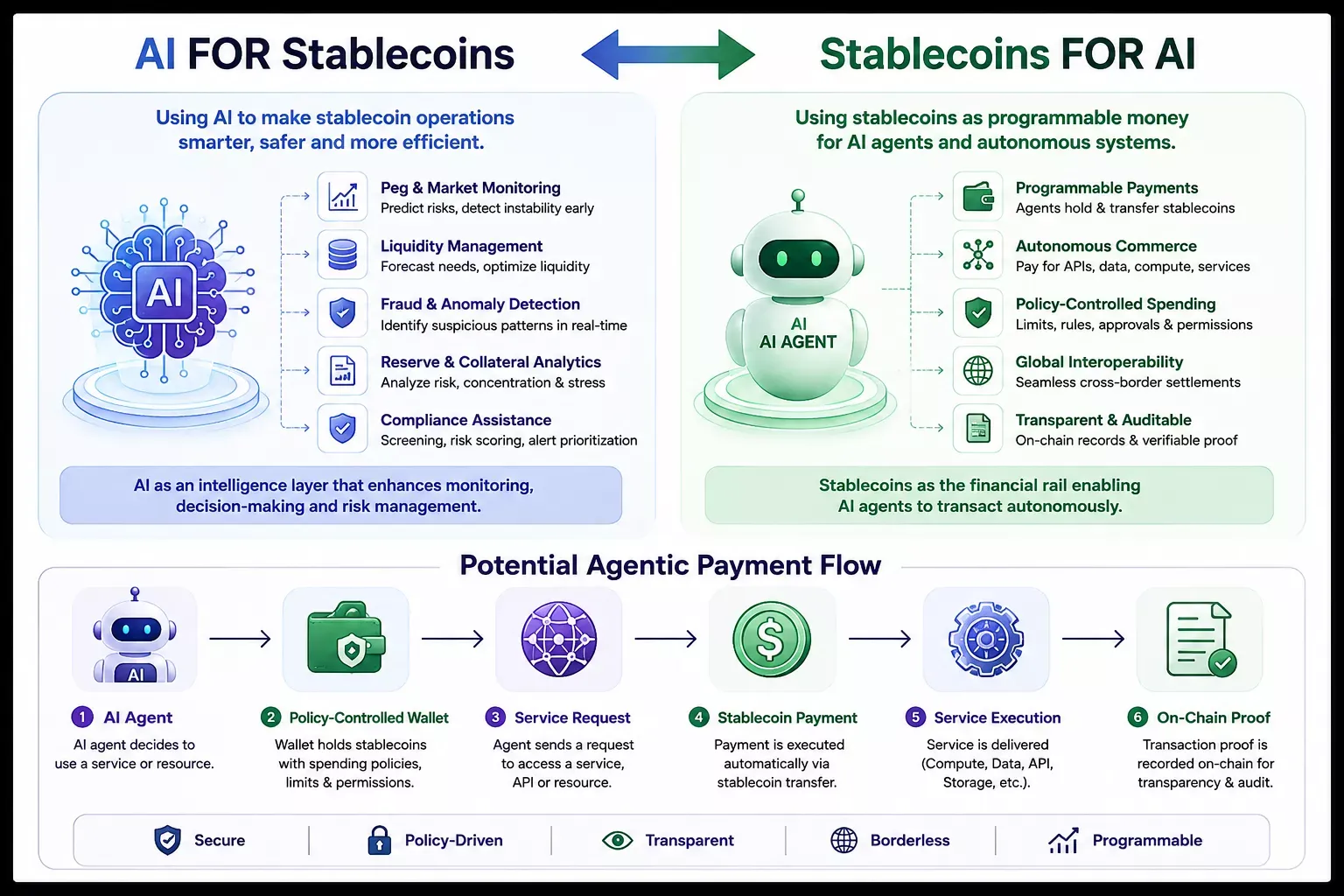
Possible applications include API calls, cloud resources, data access, AI inference, digital content, autonomous procurement, and machine-to-machine commerce.
The key requirement is controlled autonomy. Agent wallets should operate within spending limits, authorization policies, approved counterparties, and auditable rules rather than receiving unrestricted access to enterprise funds.
AI-Powered Stablecoin Development Services
Businesses exploring this technology may require specialized AI-powered stablecoin development services across several technical domains rather than simply token creation.
For broader implementation support beyond the AI layer, explore our stablecoin development services covering token engineering, smart contract engineering, intelligent risk monitoring, oracle integration, reserve analytics, liquidity forecasting, AI-agent payment integration, compliance infrastructure, wallet development, and multi-chain interoperability.
The development strategy should start with the business problem.
For example, an enterprise payments stablecoin might focus on reserve reconciliation, fraud detection, compliance, and transaction monitoring. A DeFi-centric system might be more focused on liquidity and collateral analytics. By contrast, an agentic commerce platform might be about programmable wallets, spending policies, micropayments, APIs, and machine-readable payment protocols.
It’s a use-case-first approach that avoids unnecessary AI components that add complexity without delivering business value.
Important AI Capabilities and Features for Stablecoin Platforms
The nature of the AI capabilities that a smart stablecoin platform can enable is a function of its economic model and operating environment.
- Predictive analytics can forecast liquidity needs, redemption pressure, treasury needs, or changing market conditions.
- Anomaly detection can be done on abnormal transactions, price feeds, wallet behavior, or infrastructure activity.
- Dynamic risk scoring can be used to rank transactions, counterparties, collateral positions, or operational events for review.
- Liquidity forecasting can help predict capital needs across payment channels and trading venues.
- Where appropriate, reserve analytics can track concentration, asset quality, maturity, and liquidity indicators.
- Intelligent alerts enable teams to prioritize operational events by severity instead of being flooded with undifferentiated notifications.
The most robust implementations combine these capabilities with explainability, model monitoring, control of access, fallback procedures, and human escalation paths.
Business Use Cases of AI-Powered Stablecoin
AI-enhanced stablecoin infrastructure can support several emerging business models.
International payment
Stablecoins can enable programmable settlement across borders, while standard artificial intelligence can help with fraud analysis, liquidity forecasting, routing, and operational monitoring.
Enterprise Treasury
Intelligent analytics can help organizations predict inflows and outflows of stablecoins and understand their liquidity needs and treasury exposure.
FinTech and Payments Platforms
FinTech companies have the chance to combine stablecoin settlement with risk management, wallet infrastructure, compliance workflows, and data-driven transaction management.
DeFi
Artificial intelligence can help with collateral analysis, liquidity monitoring, risk alerts, and treasury decision support. Intelligent contracts continue to ensure deterministic execution.
Tokenized Asset Settlement
Stablecoins can function as an on-chain settlement asset for tokenized real-world assets, with AI assisting risk analysis and operational monitoring.
AI-Agent Commerce
Policy-controlled stablecoin wallets would allow autonomous agents to purchase data, software services, compute, or API access. The rapid growth of this payment model is demonstrated by Coinbase’s report in June 2026 that x402 processed more than 160 million agentic payments in the past year.
Security, Oracle, Liquidity, and De-Peg Risks
Adding AI does not automatically make stablecoin infrastructure safer. It can introduce additional attack surfaces.
- Smart contract vulnerabilities can affect minting, burning, access control, collateral, or administrative functions.
- Oracle manipulation can insert false data into applications. The AI models themselves can be fed with poor-quality, manipulated, or adversarial data.
- Model risk arises when AI performs incorrectly under market conditions that differ substantially from its training or historical datasets.
- Liquidity risk can emerge when redemption demand exceeds accessible liquidity, regardless of how sophisticated predictive models are.
- De-peg risk may stem from reserve concerns, collateral deterioration, market panic, liquidity fragmentation, operational failures, and flaws in the economic design.
Production systems should therefore implement independent audits, role-based permissions, multisignature controls, circuit breakers, model monitoring, oracle redundancy, incident response procedures, and deterministic fallback mechanisms.
AI needs to improve risk visibility, not create another uncontrolled systemic risk.
Compliance and Regulatory Considerations
Stablecoin development in 2026 must treat regulation as an architectural requirement rather than a post-launch checklist.
In the United States, the GENIUS Act became law on July 18, 2025, establishing a federal regulatory framework for payment stablecoins. The framework includes permitted-issuer requirements, reserve backing, redemption policies, reserve disclosures, and AML-related obligations.
In the European Union, MiCA distinguishes between asset-referenced tokens and e-money tokens. Relevant issuers face authorization and regulatory requirements, while e-money token rules include issuer authorization and crypto-asset white-paper obligations.
For AI-enhanced platforms, businesses must consider additional operational questions:
- Who is accountable for an AI-assisted decision?
- Can important model outputs be explained and audited?
- What happens when an AI model fails?
- Which actions require human approval?
- How is sensitive user data protected?
- Can automated agents transact only within predefined policies?
Regulatory requirements vary by jurisdiction and business model, so legal and compliance specialists should be involved before architecture is finalized.
AI-Powered Stablecoin Development Process
From the start of a disciplined development lifecycle, economic design, engineering, AI governance, security, and compliance must be integrated.
Step 1: Business & Use Case Assessment
Who is going to use it? What is the payment or settlement problem? Where will it be used? What transaction patterns will be seen? Is there measurable value from AI?
Step 2: Pick a Stablecoin Model
Choose an appropriate fiat-backed, asset-backed, crypto-collateralized, or other legally viable model.
Step 3: Planning for Compliance
Map licensing, issuer, reserve, KYC/AML, reporting, redemption, and operational requirements with qualified advisers
Step 4: Architectural Design
Blockchains, intelligent contracts, wallets, APIs, oracle systems, reserve infrastructure, permissions, and data flows are defined.
Step 5: Creating the Smart Contract
Develop the issuance, redemption, access control, treasury, and other required on-chain components.
Step 6: AI/ML Development
Build only models that are justified by the use case, such as anomaly detection, liquidity forecasting, or risk scoring.
Step 7: Connect to Data and Oracle
Connect validated market, blockchain, reserves, compliance, and operational data.
Step 8: Tests and Security of the Model
Perform smart contract audits, penetration testing, model validation, stress testing, and failure simulations.
Step 9: Deploying
Put in place the appropriate monitoring, control of access, and incident management processes.
Step 10: Ongoing Optimization
Monitoring of intelligent contracts, models, liquidity, regulatory requirements, data quality, and production performance.
AI-Powered Stablecoin Development Cost and Timeline in 2026
There is no credible universal price for an AI-powered stablecoin because the term can describe dramatically different systems.
A relatively focused proof of concept with a token contract and limited AI analytics is fundamentally different from a regulated, multi-chain stablecoin platform with reserve management, enterprise wallets, AI risk models, compliance integrations, agent payments, institutional APIs, and independent audits.
Major cost drivers include:
- Stablecoin economic model;
- Blockchain networks;
- Smart contract complexity;
- AI model requirements;
- Proprietary versus third-party data;
- Oracle infrastructure;
- Wallet and payment integrations;
- Reserve and treasury systems;
- KYC/AML integrations;
- Multi-chain functionality;
- Security audits;
- Regulatory requirements;
- AI-agent functionality;
- Post-launch monitoring.
The timeline follows the same principle. A prototype may be developed substantially faster than an institution-ready system requiring legal structuring, model validation, audits, integrations, liquidity arrangements, and regulatory approvals.
Businesses should therefore request estimates based on a defined technical and regulatory scope, rather than choosing vendors based on an unsupported headline price.
Should Your Business Build an AI-Powered Stablecoin?
The decision should start with a business requirement, not the desire to attach “AI” to a blockchain product.
AI can provide meaningful value when a platform handles complex transaction patterns, large datasets, dynamic liquidity conditions, high-volume risk monitoring, fraud detection, treasury forecasting, or autonomous agent workflows.
Traditional architecture may be better when requirements are simple and deterministic. If the stablecoin only needs straightforward issuance, redemption, reserve backing, and transfers, adding machine learning may create additional infrastructure, governance, data, security, and compliance costs without solving a meaningful problem.
The Future: Stablecoins Meet Agentic Finance
The most consequential trend may ultimately be the convergence of programmable money and autonomous software.
Circle's 2026 infrastructure already allows agents to hold assets and transact programmatically with USDC, while its agent wallet tooling demonstrates workflows in which AI assistants can pay for services and return proof of execution.
This suggests that the next generation of stablecoin infrastructure may need to serve two types of users simultaneously: humans and machines.
For businesses, that creates opportunities around programmable payments, automated procurement, API monetization, AI marketplaces, treasury automation, and machine-to-machine settlement, but only when autonomy is bounded by robust security, compliance, and governance.
Where Troniex Technologies Fits
For organizations evaluating this opportunity, Troniex Technologies can support the technical discovery and engineering required to determine where blockchain, smart contracts, AI, payment infrastructure, and automated controls fit within a proposed stablecoin ecosystem.
Rather than treating AI as a mandatory feature, the stronger development strategy is to identify where intelligence produces measurable operational value and where deterministic blockchain logic remains the safer choice. Businesses evaluating an AI-powered stablecoin development company should prioritize this architecture-first approach alongside security, regulatory readiness, scalability, and long-term maintainability.