AI Signal Bot Development for Crypto: How Profitable Bots Are Actually Built?
Most AI crypto signal bots fail due to trust gaps, overfitting, and poor risk control. Learn how real AI signal bots are actually built and verified.
Aug 12, 2026
11 mins read
Want a crypto signal bot that traders actually trust?
Most AI bots fail because trust breaks down long before the technology matters. In this market, skepticism becomes your best defense.
The reality hits hard: 70-90% of signal services scam users or mislead them badly. Among the survivors, only about 10% deliver consistent profits in live trading with real money. Backtests and screenshots do not count.
Traders dismiss bold claims today. Even superior AI models cannot fix the core issues. Problems arise in verification, risk management, execution, and infrastructure during intense market volatility.
This piece examines how bots perform once real money enters the equation. It reveals what fails, what endures, and why most systems crumble beyond demo mode.
Look away if you seek fast shortcuts. Read on if you aim to grasp how trustworthy AI signal bots get built — and how to prepare your copy trading platform for launch day.

Ready to Test a Bot That Survives Real Markets?
Skip the scams, get instant access to our verified live trading signals with full transparency reports. No backtests, just proven results.
Talk To Our ExpertsWhy AI Crypto Signal Bots Have a Trust Problem?
AI crypto signal bots face an uphill battle from day one. They begin with negative trust levels. Users assume these services are scams until solid proof appears. That mindset makes perfect sense.
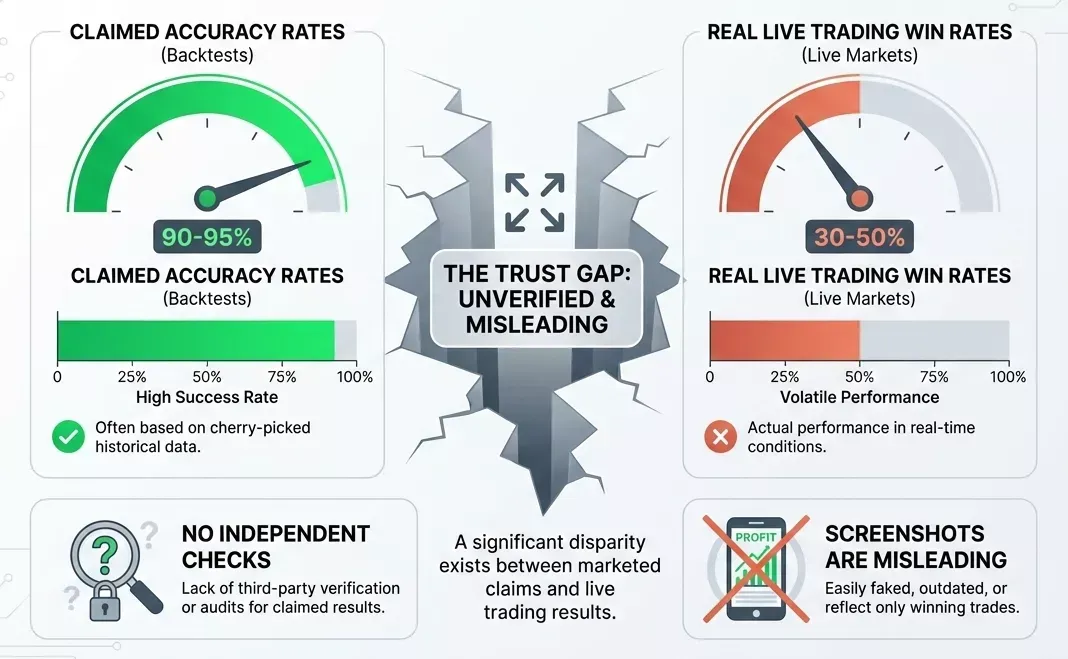
No standard exists for independent checks. Every claim blends together. They all sound great, but prove nothing on their own.
Screenshots and Telegram alerts mean little. A single winning trade or green profit image shows nothing real. Deleted losses or ignored trades stay hidden. Accuracy stats mask the full risk picture.
The market floods users with choices. Over 60 services compete at similar prices. All promise steady wins with matching hype. You cannot test them easily before buying.
Users learn to distrust by default. The flood of unproven options trains them well. Disbelief turns into smart protection.
Also Read: Sniper Bot Development | Build and Launch Your First Crypto Sniper Bot
What an AI Signal Bot Actually Is (and what it is not)
An AI signal bot does not execute trades or guarantee profits. It skips Telegram-style alerts too.
At heart, it generates signals. It gauges probabilities and passes the call to you or another system. Mix-ups start when people ignore that line.
- Signals differ from execution.
- Signals ask if conditions look strong now.
Execution handles size, risk, exchange choice, and protection. Many bots muddle these roles. That kills clear results.
AI bots stand apart from Telegram groups. Groups send tips for humans to act on manually.
Rule-based bots, on the other hand, follow fixed conditions. If X happens, do Y without adapting to changing market behavior.
AI bots land in the middle. They weigh patterns by odds and adjust as markets shift.
Probability drives it all, not sure bets. The bot does not predict prices. It sizes up chances based on data at hand.
Also Read: Vertical AI Agents: Why Domain-Specific Intelligence Beats Generic Automation?
How an AI Signal Bot Really Works?
People imagine an AI signal bot as one smart model cranking out buy and sell calls. That view misses the mark.
The model forms just one piece in a bigger setup. It rarely decides if the bot lasts.
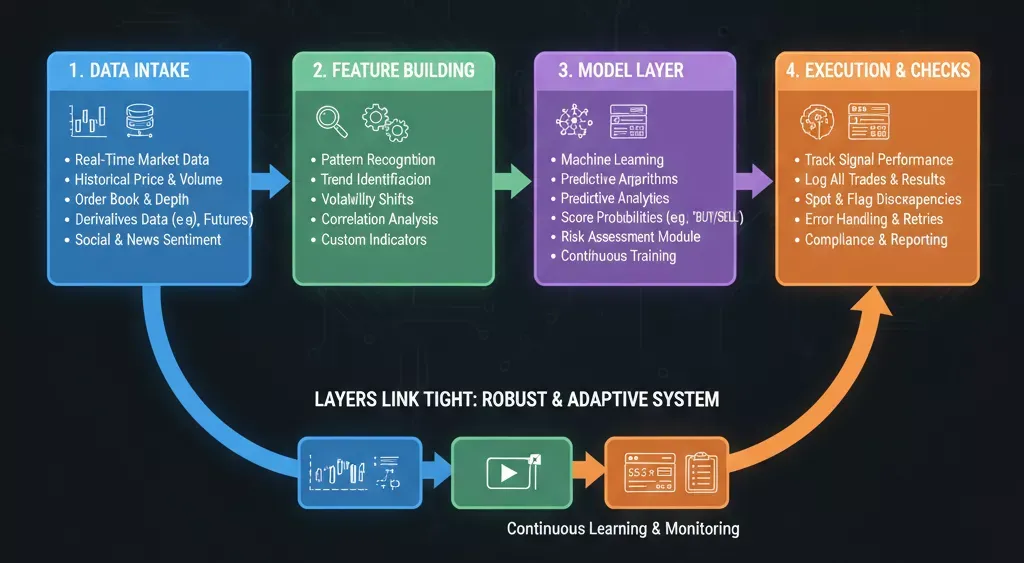
Data intake kicks things off. Prices alone fall short. Strong systems pull in market data, volume, derivatives info, and key signals nonstop. They manage gaps, sync times, and wild jumps. Delays or glitches here ruin everything after.
Feature building does the heavy lift. Raw data confuses. Features pull out key patterns, shifts, and trends from the mess. They shape what the model sees. This step outweighs the model choice every time.
The model layer rides on top. It scores probabilities from past patterns. It skips risk checks, trades, or big-picture sense. Fancy models flop without solid features feeding them.
Execution and checks close the loop. Track signals live, log results, spot issues fast. Watch for drift or breakdowns before losses pile up.
Layers link tight. Poor data breaks features. Bad features fool models. No monitoring masks problems. Top bots build systems first. Models follow.
Why Backtests Lie and Live Trading Humbles Bots?
Backtests shine because they test one easy question. What worked in past data with no hitches?
Live markets pose a tougher one. What holds up when chaos hits all at once?
Real money exposes the gap quickly.
Overfitting causes most pain. The bot memorizes old data quirks instead of true patterns. It chases flukes as signals. Paper results dazzle. Live action breaks it.
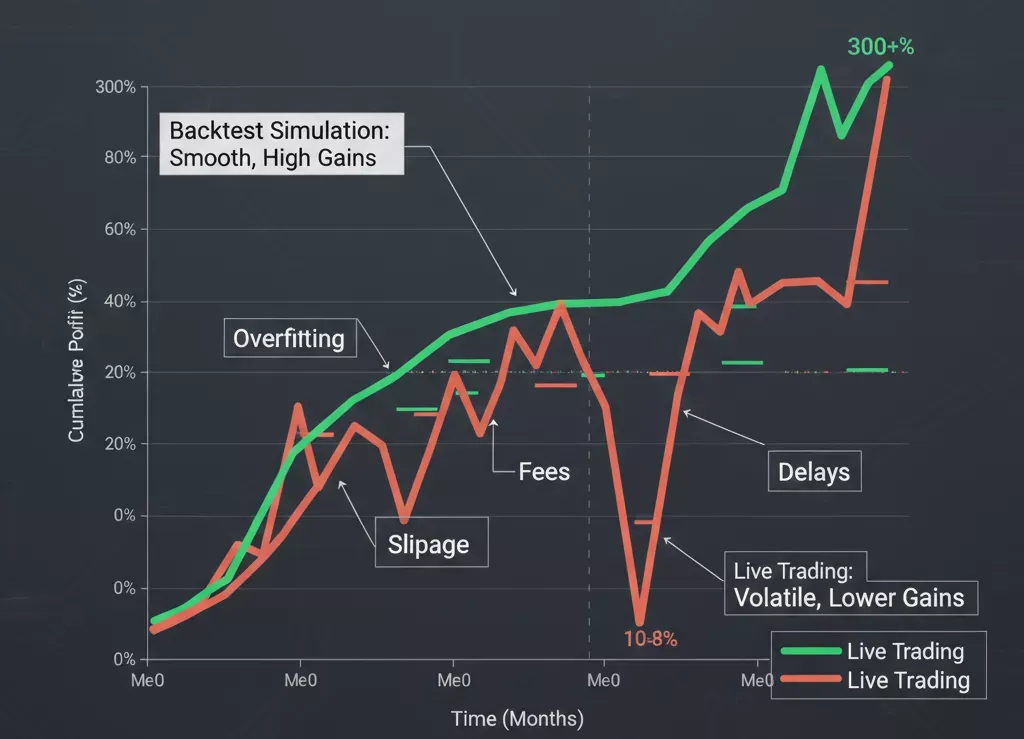
Drops hit hard and fast. Expect 20-40% worse performance live. Fees nibble gains. Slippage muddies entries. Delays kill ideal prices. Dead markets stay hidden from old data.
Backtests fake perfect fills. Reality brings partial orders, slow APIs, and spike volatility. Clean charts hide that mess.
Smart teams use backtests as step one. Walk-forward tests check shifts over time.
Paper trades add live stress sans cash risk. Fail those?
Skip real funds.
Signal Quality Beats Signal Quantity
Too many signals wreck a bot fast. High-speed alerts seem busy. They kill real use. Users drown in dozens daily. Even good ones lose impact.
Humans hit a wall quickly. Endless pings overload the brain. Reacting beats thinking. Entries slip by. Trades lag. Trust fades, not from bad calls, but from chaos.
Execution takes hits too. Volume spikes fees and slippage. Risks bunch up in wild times. Seeming variety hides bets on one move.
Solid bots go low and strong. Few signals pack high odds and clear info. That boosts follow and steady wins. Aim for smart picks, not constant action.
Top bots view the full portfolio. They filter by current holds, market state, and risk caps. No edge? Signal skips.
Risk Management is the Product, Not a Feature
AI signal bots rarely fail on bad entries. Losses build too quickly for recovery. Drawdowns, not weak signals, kill most setups.
Entry wins sell easily. Risk controls do not. Even solid strategies wipe accounts without them. Big bets, loss streaks, or vol spikes do the damage.
Position sizing calls the shots. It asks how badly a wrong trade can hurt. Size limits pain when odds fail. They always do sometimes.
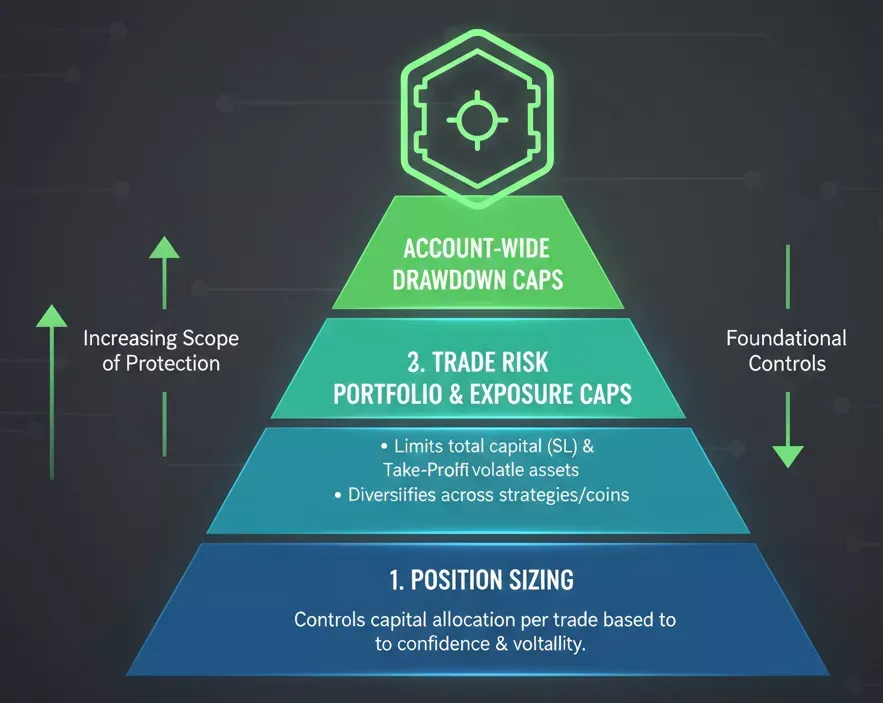
Top systems cap drawdowns account-wide.
Hit the limit? The bot pauses or halts. Kill switches save runs. Markets shift without notice. Exposure caps block stacked risks.
Trade risk guards single plays. Portfolio risk guards the whole. Skip it, and dangers spread across trades and assets until bust.
Risk management defines the product.
Add it last? You lose.
Automation: Where Most Signal Bots Break in Real Markets
Signal bots hold up until timing counts. Automation slams theory into market truth. Many crack right there.
Telegram alerts show it plain. Users read and act late. Prices shift fast. Good signals turn bad. A string of misses warps results.
Manual trades do not scale. People pause, juggle tasks, and skip details. Real setups use APIs for steady action. But APIs bring traps. Fills split. Liquidity vanishes. Vol jumps prices mid-order.
Big swings test hardest. Exchanges slow calls. Gaps widen. Plans shatter. Tiny slips stack into big losses.
Fail-safes fix it. Spot odd conditions and pull back. Pause trades. Cut size. Stop if needed.
Automation skips human flaws. It locks in rules when speed and chaos hit.
Also Read: How Autonomous AI Agents Make Money?
Security Fears That Stop Users From Going All-In
Users fear fund loss more than bad trades. Security doubts quietly kill adoption. They hit hardest with real money on the line.
API keys spark most worry. People dread misuse, leaks, or hidden theft. Legit bots still face pushback. It stems from basic trust needs. Share control, and faith must hold firm.
Trade-only keys change that. They block withdrawals by design. Risk stays small. Users automate with less fear.
Strong bots add logs and checks. Flag odd moves. Keep parts separate. Issues stay contained.
Give users clear oversight and control. Adoption jumps. Strong signals alone won't cut it.
Market Regime Changes: Why Yesterday’s AI Stops Working
Markets shift phases often. Trends turn to ranges or vol spikes. Strategies that win in one flop in the next.
Most bots bank on steady rules. They lock in old patterns and odds. Edges fade as conditions change. Wins turn to random noise.
Adaptive AI sounds great. It sticks to known patterns though. New regimes make old lessons weak.
Tough bots spot shifts and swap plays. Cut action. Tweak bets. Step out when needed.
Businesses that need forecasting beyond signal generation can deploy a crypto prediction bot to estimate potential market movements before execution decisions are made.
Markets keep changing. Static systems chase yesterday's wins.
They pay the price soon.
Infrastructure Realities Nobody Markets
Bots do not just fade. They break at peak chaos. Vol spikes reveal cracks; no test catches. Calm days fool you.
Crashes strike in big moves. Memory leaks grow. Queues clog. Logic freezes when speed counts most. Exchanges tweak APIs too. Params change. Endpoints drop. Unkept bots drift to failure.
Monitoring matches signal strength. Log runs, lags, errors, shifts live. Auto-fixes cut damage fast.
Boring uptime trumps hot edges. Steady, modest wins beat offline brilliance. Infra wins survival. Not headlines.
When It Makes Sense to Build a Custom AI Signal Bot
Custom AI signal bots only make sense under specific conditions. For most users, buying or subscribing is more rational than building.
The key question isn’t ambition, it’s readiness.
Building your own makes sense for exchanges, trading desks, and platforms pursuing crypto trading bot development, especially when you need deep integration, control over execution, and full ownership of data.
These teams typically have historical data at hand, capital to weather drawdowns, and the operational grit to sustain complex systems long-term.
It does not make sense for casual traders or teams chasing differentiation without infrastructure. Custom bots require ongoing maintenance, monitoring, and iteration. Without those, they decay quickly.
A useful framework is simple:
- Capital readiness: Can you survive extended drawdowns?
- Data readiness: Do you control enough clean, relevant data?
- Risk readiness: Are you prepared to halt systems when conditions break?
If any of those are missing, custom development becomes an expensive experiment. Build when control and survivability matter more than speed.
How Troniex Technologies Approaches AI Signal Bot Development?
Troniex Technologies starts with this rule: systems must survive bad markets before you count good market results. Risk comes first. Verification comes first. Models come later.
You skip headline accuracy and flashy dashboards. You build for real conditions. Performance stays observable. Behavior remains auditable. Failures show up clearly.
Transparency integrates into engineering. You avoid guaranteed profit claims. Markets deliver no guarantees. Systems that claim them hide risk until losses hit. You focus on probability, drawdown control, and execution over time.
Development targets custom signal systems. You match them to your data access, execution limits, and risk levels. Models fit your needs. You engineer control amid uncertainty.
Build Your Risk-Proof AI Signal Bot Today
Partner with Troniex for custom systems that prioritize verification, drawdown control, and live performance, not promises. Get a free audit of your trading setup.
Contact UsFinal Insights
AI signal bots head quiet next. Selective beats loud. Proof walls out fakes in a tired market.
Users pair smarts with auto-runs. They seek why's behind calls. Trust grows from clear, steady execution.
Watch consolidation hit. Flashy groups fade. Boring, checked bots rise. They stress uptime, risk guards, true reports. No riches pledged. Just steady sight.
The takeaway is straightforward: realism is back in demand. In a market flooded with noise, the systems that endure will be the ones that respect uncertainty instead of pretending it doesn’t exist.