-
Most multi-chain wallet exploits do not happen in the signing logic, they happen at the bridge integration, where a chain added in Phase 3 shares a key derivation path with another and the audit never covered the interaction.
-
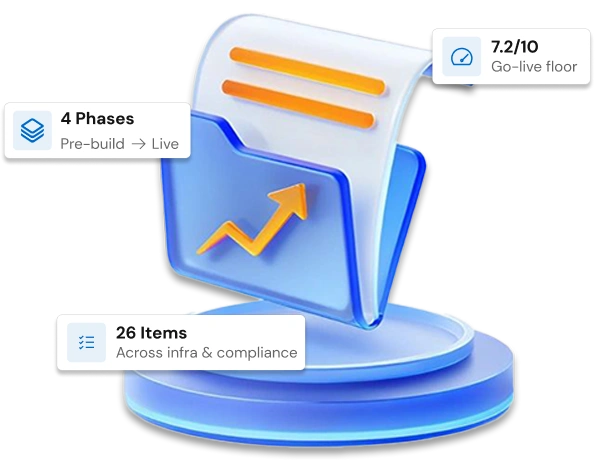
This checklist covers 24 items across four phases: Pre-Build, Build, Validation, and Post-Launch.
-
It includes a self-assessment readiness score, clear 7.5 / 10 before launch.
A multi-chain wallet is not a single-chain wallet with more chains added. Each additional chain adds a new signing surface, a new derivation path, a new bridge integration, and a new set of transaction failure modes. The audit that covers the Ethereum signing logic does not cover the Solana transaction construction. The recovery flow that works on EVM does not work on Cosmos without a separate implementation. The work below treats each chain as an independent security surface and the bridge integrations as the highest-risk seams, because that is where multi-chain wallets lose funds, and it is the part of the build that most teams under-scope when they are moving fast.
| Phase | Timing | Items | What breaks if you skip it |
|---|---|---|---|
| 1Pre-Build Foundation | 12–16 weeks out | 6 | Key derivation architecture selected without multi-chain security review, bridge integrations not in audit scope, recovery flow designed for one chain only |
| 2Infrastructure Build | 4–8 weeks out | 8 | Bridge integration audit excluded, chain-specific signing surfaces unreviewed, recovery path untested across chains |
| 3Pre-Launch Validation | 1–3 weeks out | 7 | Bridge exploit via shared derivation path, transaction failure on new chain with no error recovery, recovery flow fails cross-chain |
| 4Post-Launch Monitoring | Week 1–4 after live | 5 | User fund loss via bridge, transaction failure support load, recovery failure at scale |
Pre-Build Foundation
The single most expensive Multi-chain Wallet mistake is made here — the decisions that are cheapest to fix now and most expensive once build has started.
Pick the jurisdiction before anything else it determines your banking partners, your AML configuration, and which licenses you even need. Get a regulatory counsel opinion in writing for the EU, not a forum thread.
Shortlist two Multi-sig / MPC Systems providers and run a real integration spike against your stack before you commit. Validate latency, failover, and the actual data shape not the sales deck.
Decide your compliance posture now and choose zk-Rollups to match it. Map every flow that touches a user identity or a transaction so the pipeline is designed for AML, not retrofitted.
Model your unit economics at expected volume. Put Multi-sig / MPC Systems cost, compliance cost, and infrastructure cost in one sheet against your fee structure. If the math only works at 10× your launch volume, you do not have a model yet.
Decide custodial vs non-custodial vs MPC, and document the key-management model your auditor will sign off on. This is the most expensive decision to reverse.
Design the key derivation architecture across all target chains in Phase 1, with a security review before implementation begins. The derivation paths must be isolated per chain, shared paths are the most common source of multi-chain wallet exploits and the hardest vulnerability to patch post-launch.
Infrastructure Build
This is where most platforms that fail, fail. Each item below is something that is far harder to add after beta than before it.
The shared derivation path that connected two chains
A multi-chain wallet launched with support for 6 EVM chains and Solana. The key derivation for the Solana implementation reused a BIP-44 path segment already in use on one of the EVM chains, a shortcut taken to accelerate the Solana integration. A researcher identified the shared path 3 weeks after launch and disclosed it privately. Remediation required migrating all Solana keys to a new derivation path and notifying every affected user. 340 users had Solana balances. 12 did not complete the migration within the recommended window.
Stand up Wallet-as-a-Service for scale from day one. Configure auto-scaling, partitioning, and back-pressure handling and load the config into version control so it is reproducible, not tribal knowledge.
Connect Multi-sig / MPC Systems and set per-pair depth targets before beta. Validate each pair independently a healthy BTC book tells you nothing about your thin pairs.
Wire zk-Rollups into live transaction monitoring and run a real suspicious-transaction-report dry run end to end. A configured-but-untested AML stack is not a compliant one.
Build the KYC flow and instrument every step. Run it with real external testers and record the drop-off. The number you get is the number you launch with unless you fix it now.
Commission a separate audit scope for every bridge integration before any cross-chain functionality goes live. Bridge integrations are the highest-risk surface on a multi-chain wallet and the most commonly excluded item in standard wallet audits. Read the exclusions section of every audit report.
Build the reporting pipeline and submit a test file in MiCA's required format before you need to. Format rejections are discovered at the deadline by everyone who skips this.
Implement transaction construction and error recovery for each chain independently, do not abstract across chains if the chains have different fee models, nonce handling, or confirmation semantics. Validate that a failed transaction on one chain does not affect the state of another.
Define circuit breakers, rate limits, and a written incident-response runbook with named owners. Rehearse the first 15 minutes of an incident before you have one.
 From Troniex’s implementation work with Multi-chain Wallet operators
Across multi-chain wallet builds, the transaction failure that generates the most support load is not a signing error, it is a gas estimation failure on a new chain that results in a stuck transaction. The user sees funds debited but not received. The fix is chain-specific gas estimation with a manual override, implemented per chain, not a global gas buffer applied across all chains. A global buffer that works on Ethereum underestimates on Solana and overestimates on Polygon. Build per-chain gas estimation in Phase 2 and save the support queue.
Pre-Launch Validation
The last gate before a real user touches it. Everything here is about discovering the failure in a drill instead of in production.
| What to validate | Pass threshold | Fail signal | Resolution |
|---|---|---|---|
| Key derivation path isolation | Unique path per chain | Shared path identified | Redesign before launch |
| Bridge integration audit coverage | All bridges in scope | SDK excluded from audit | Re-scope to include bridge |
| Recovery flow cross-chain | 100% success all chains | Failure on any chain | Fix per-chain recovery UX |
| Transaction failure isolation | No cross-chain state leak | One chain affects another | Isolate per-chain state |
| Gas estimation per chain | < 5% estimation error | Stuck transactions > 1% | Implement per-chain estimator |
| External recovery test completion | > 80% of external cohort | Drop-off at chain-specific step | Improve per-chain UX |
Run a sustained load test at 3× projected peak, not average. Watch the matching queue, the database, and the auto-scaler under pressure and capture where the first thing bends.
Commission a third-party audit with an explicit scope document, then remediate every critical and high finding before launch. Get the scope in writing before you get the report.
Run your compliance stack against MiCA's published test scenarios and tune thresholds against the results not against defaults shipped by the vendor.
Re-run the onboarding flow with a fresh external cohort and confirm completion clears your benchmark. Fix the friction point you find before, not after, you spend on acquisition.
Confirm depth on every launch pair at peak volume, pair by pair. Add a market maker before go-live for any pair that cannot hold its spread target.
Run a real failover drill: kill the primary, time the recovery, verify data integrity on the other side. An untested BCP is a document, not a plan.
Test the seed phrase and MPC recovery flow on every supported chain, on clean devices, with users who have never used the wallet before. The recovery failure that loses funds is always on the chain the team tested last, with the user who understood the process least.
The bridge audit that was in scope for the contract but not the integration
A multi-chain wallet audited its core signing contracts and received a clean report. The bridge integration, a third-party bridge SDK integrated 6 weeks before launch, was explicitly outside the audit scope. A vulnerability in the bridge SDK's slippage handling allowed a malicious contract to drain funds from cross-chain swaps initiated through the wallet. The wallet's own contracts were never touched. The SDK vendor patched the vulnerability 4 days after disclosure. By then, 7 users had initiated cross-chain transactions through the affected path.
Post-Launch Monitoring
The first 30 days decide whether the launch holds. Item 26 is the retention mechanic unique to this platform.
Review execution quality and per-pair liquidity every day for the first two weeks. The early signal of a failing launch shows here first.
Watch the live onboarding funnel and isolate the real drop-off step within the first 72 hours, while you can still act on it.
Review the AML queue weekly. A false-positive rate creeping up is an early compliance-cost problem you want to catch before it buries the team.
Submit the first regulatory report on time, in the validated format. The first one sets your standing with MiCA.
Turn on the multi-chain retention loop: a unified cross-chain portfolio view and complete transaction history across all chains in a single interface. Users who can see all their assets in one place without switching chains are retained; users who cannot switch to wallets that do.
Is your Multi-chain Wallet ready to launch?
Each category fills in automatically as you tick the checklist above — and the verdict updates live. Drag any slider to model a what-if before you commit.
Score your readiness
Tick the checklist above — categories fill in automatically and the verdict updates live.
Get the Multi-chain Wallet Launch Readiness Report
A documented PDF — your scores, gap analysis, go/no-go decision, and full checklist record.
Where Multi-chain Wallet launches actually fail
1Key derivation paths not reviewed across the full chain set
A per-chain security review does not surface interactions between derivation paths. The shared-path vulnerability is invisible when you look at chains individually and obvious when you look at them together. The cross-chain derivation review is a Phase 1 item.
2Bridge SDK excluded from audit scope
A bridge SDK that is integrated into the wallet is part of the wallet's security surface. The clean audit on the wallet's own contracts does not cover the SDK. Every third-party integration that handles user funds must be in the audit scope, not assumed safe because someone else wrote it.
3The narrative one
The gas estimation used a global buffer calibrated on Ethereum. When the team added Cosmos support in the final week of Phase 2, nobody updated the estimator, Cosmos uses a different fee model entirely. The buffer that worked on Ethereum consistently underestimated on Cosmos by 40–60%. For the first 11 days of Cosmos support, approximately 1 in 8 Cosmos transactions was submitted with insufficient gas and got stuck. The users who noticed opened support tickets. The users who did not notice had funds that looked spent but had not been received. Three of those users found the stuck transactions only when they tried to use the destination wallet weeks later. The gas estimator fix took 4 hours. Identifying all affected users and notifying them took 3 weeks.
4Recovery flow tested only by the implementation team
A team that built the recovery flow knows what the expected output looks like at every step. A user who has never seen the flow before does not. The failures that lose user funds are in the steps that are obvious to the developer and confusing to the user, and they are only found by testing with people who have never seen the flow.
5Single gas estimation model applied across all chains
A global gas buffer is a single number that is wrong for every chain it is applied to, underestimating on some and overestimating on others. Per-chain gas estimation is a Phase 2 infrastructure item. Discovering it post-launch means stuck transactions on every chain added after the global buffer was calibrated.
Frequently asked questions
Let’s Get in Touch.
Unsure whether your Multi-chain Wallet is ready to go live? Our infrastructure team will pressure-test your readiness and map the gaps with honest, practical advice — ABSOLUTELY FREE.
Book Your Free Consultation