Tech Stack to Build a Poker Game, Layer by Layer
Build a poker game on a server-authoritative Node.js and WebSocket game server. Keep live tables in Redis, accounts and the double-entry chip ledger in PostgreSQL, and shuffle with an OS CSPRNG that an independent lab tests. Use Phaser for browser tables or Unity for native mobile. Add fraud controls, KYC and compliance checks from day one.
Nov 03, 2026
10 mins read
- Server decides everything: one authoritative state machine per hand validates every action, and the client holds no game logic.
- Route by table, not by player: the gateway looks up the table ID in Redis and sends every player at that table to the same game server.
- Split live state from money: Redis holds live tables, and PostgreSQL holds the double-entry ledger. Settle each pot in one transaction at hand end.
- Shuffle with a CSPRNG: use the OS source with Fisher-Yates, and get an independent lab such as iTech Labs or GLI to test it before launch.
- Build fraud controls early: the hand log already holds the data for device, IP, seat-sharing, and chip-dumping checks.
- Pick the client by reach: Phaser for browser tables, Unity for native mobile with 3D or heavy effects.
- Plan compliance with the licence: age checks, geolocation and responsible-gaming limits shape the payments layer.
The server decides every action, so it sets table capacity and reconnect speed.
Troniex has delivered 150+ projects, and our poker game development company team builds the layers below for operators launching online poker. Start with the game server. Every other layer depends on it.
What a Poker Game Development Tech Stack Covers
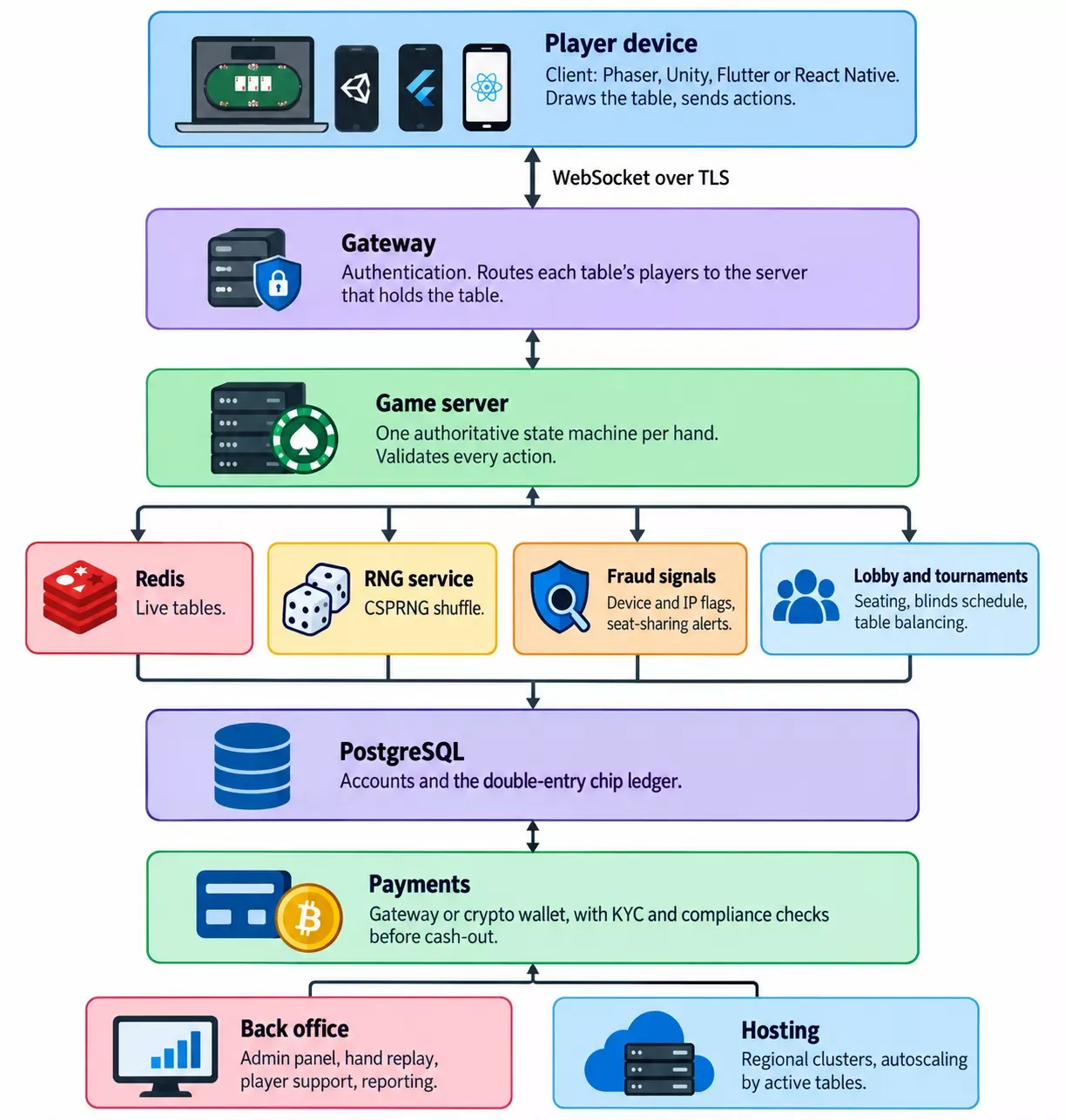
A poker game stack runs from the player's screen to the chip ledger. The client draws the table, and the game server decides every action. Data, RNG, fraud, payment, compliance, and hosting layers sit behind the server.
Real-time Poker Game Server Architecture
Build a server-authoritative game server. It runs one state machine per hand, and clients send actions that the server validates. Node.js with TypeScript and WebSockets is the default pick. Go, or Elixir with Phoenix, suits teams that expect many tables on each machine.
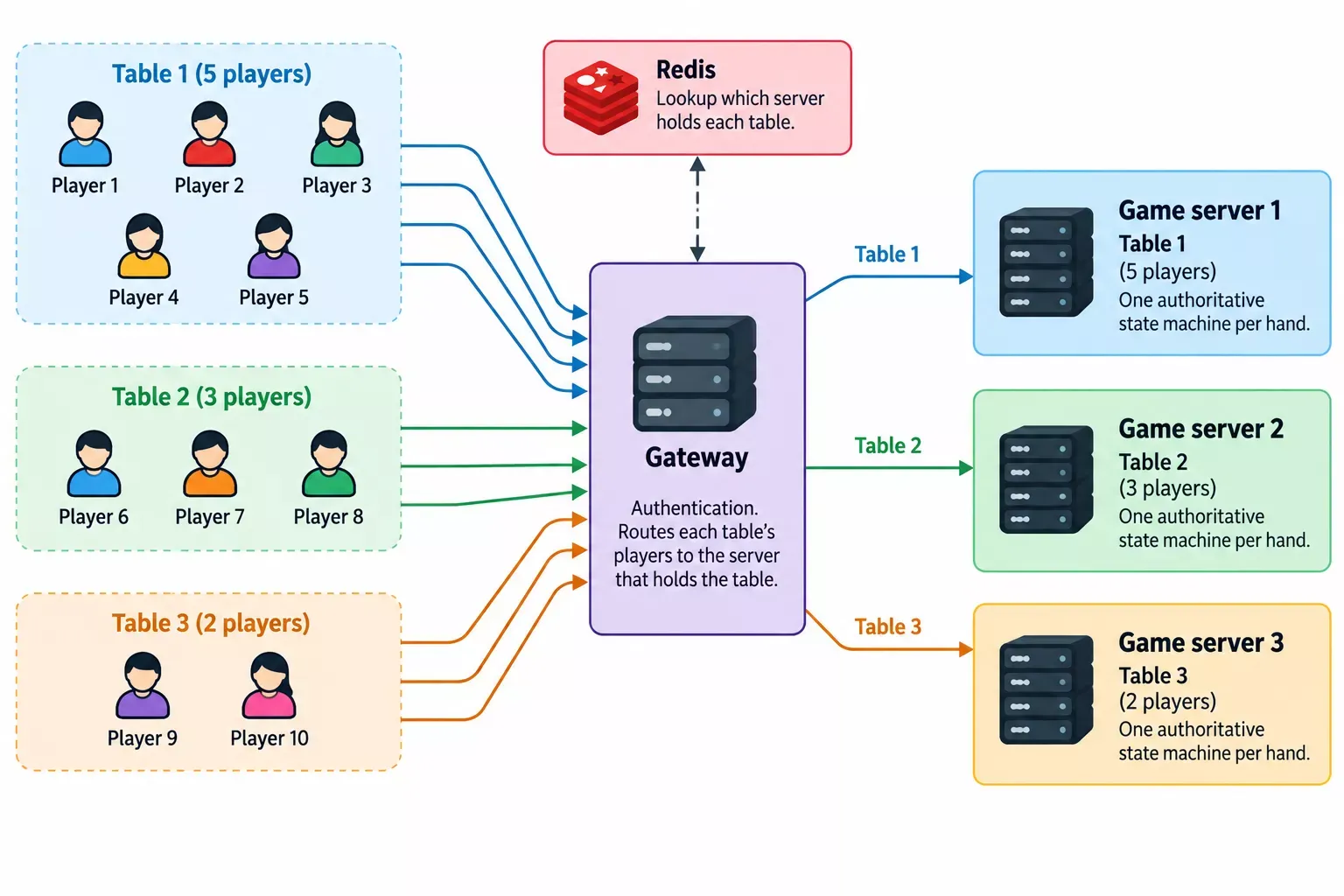
Put a WebSocket gateway in front for authentication and routing. The gateway keeps no table state. It looks up the table ID in Redis and sends the connection to the game server that owns that table, so every player at a table reaches the same server.
Each variant's rules live inside the state machine. See Texas Hold'em game development for the Hold'em rules engine.
Hand state machine and hole-card privacy
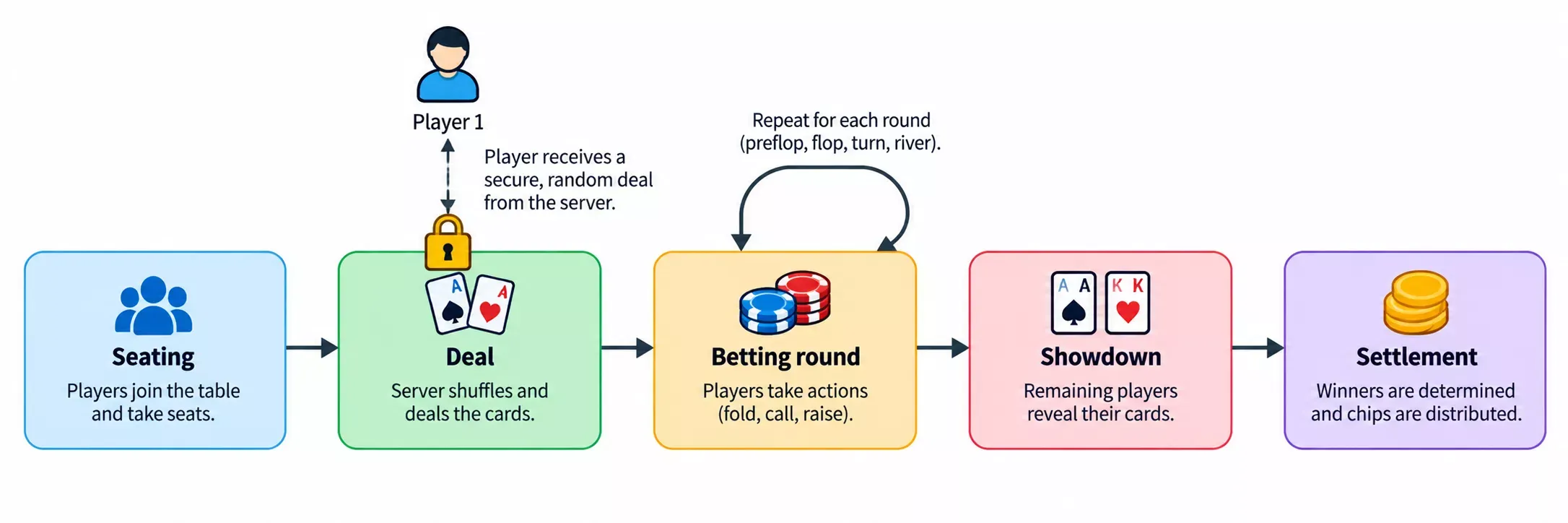
Model each hand as a fixed set of states: seating, deal, betting round, showdown, and settlement. The server accepts an action only when it is that player's turn and the current state allows it.
Hole cards never leave the server except to their owner. Send an opponent's cards only when the showdown rules reveal them.
Write every event to an append-only hand log. Support then replays any disputed hand.
Reconnects and table recovery
A returning player reconnects through the gateway, which looks up the table and routes them to its server. The server sends a snapshot of the table plus the events the player missed.
Save table state in Redis after every action, and run a replica with append-only persistence so a Redis restart does not lose a hand in progress. If a game server crashes, another one loads the snapshot, takes ownership of the table in the lookup, and resumes the hand.
Run the action timer on the server. A dropped player's clock keeps running, and the table's disconnect rule applies when it expires.
Poker Client and Game Engine Choice
Pick HTML5 with Phaser for a browser-first poker table, because a poker table is flat 2D and runs in any modern browser. Pick Unity for a native mobile app with 3D scenes or heavy effects. Flutter and React Native fit a flat 2D table built by a small team.
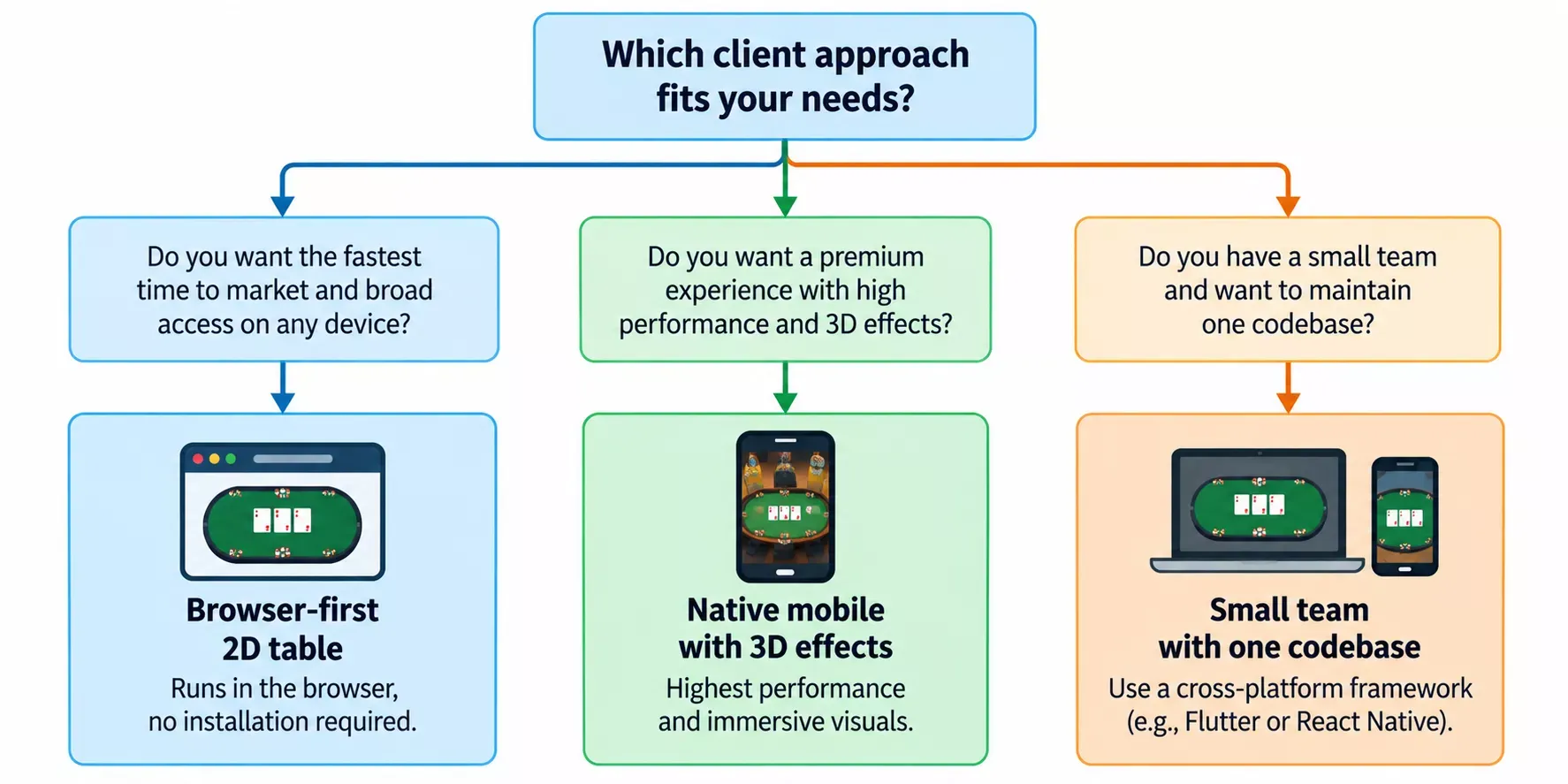
The client draws state and sends actions. It holds no game logic, so a modified client changes nothing about the outcome.
|
Engine |
Best for |
Web reach |
|---|---|---|
|
HTML5 with Phaser |
Browser-first tables, flat 2D |
Runs in any modern browser |
|
Unity |
Native mobile with 3D or heavy effects |
Web export is heavy |
|
Flutter |
One codebase for mobile and web with a custom table UI |
Web build available |
|
React Native |
Teams that already write React |
Mobile first; web needs a separate React build |
Database and Game State for a Poker Game
Use Redis for live table state and PostgreSQL for accounts and the chip ledger. Redis holds state in memory, so every action saves a snapshot. PostgreSQL gives you transactions, so a balance never ends up half-updated.
Move buy-in chips from the player's ledger balance into the table when they sit down. Settle the pot back to the ledger in one PostgreSQL transaction when the hand ends. A Redis failure then never touches a balance at rest.
Store hand history append-only in PostgreSQL or MongoDB. Fraud review and dispute handling then read the same record.
Send reporting queries to a read replica. A report then never slows a live table.
RNG and Shuffle for a Fair Poker Game
Shuffle with a cryptographically secure random number generator (CSPRNG) from the operating system, and run a Fisher-Yates shuffle on the server for every hand. Never seed from the clock or call a general-purpose random function.
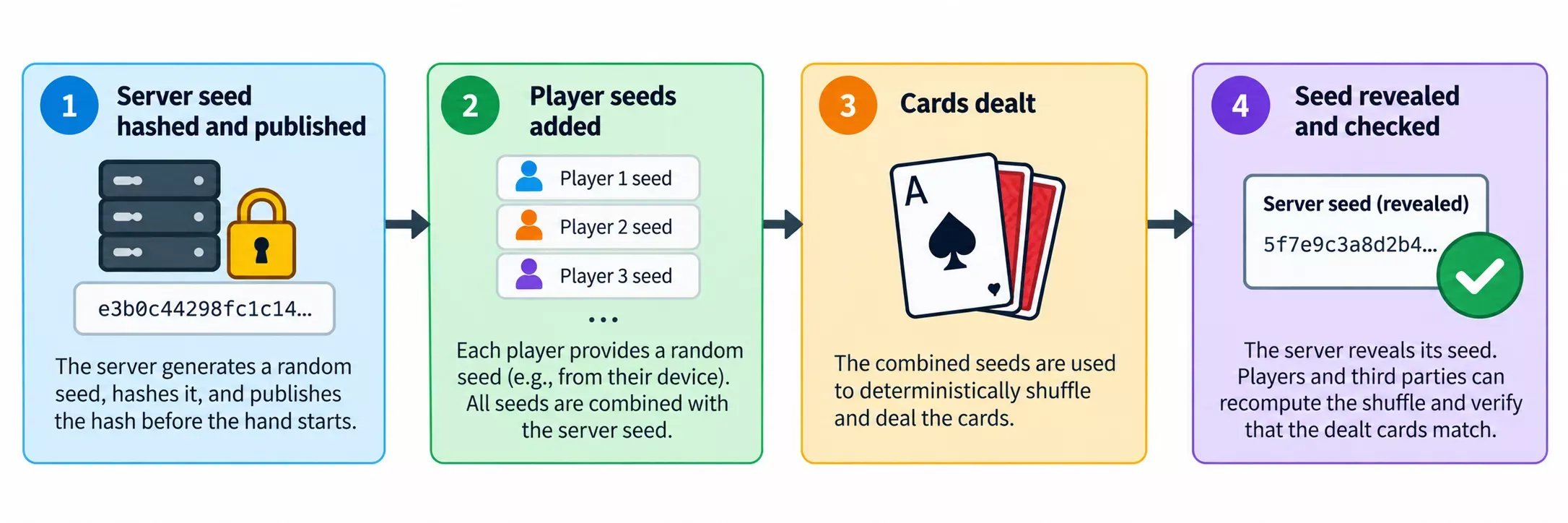
Have an independent test lab such as iTech Labs or GLI test the shuffle before launch.
Crypto tables add a provably fair option. The server publishes a hash of its seed before the deal and reveals the seed after the hand. A server-only seed still asks players to trust the server, so mix in a seed from each player at the table. Players then verify the shuffle themselves.
All builds get 100% QA with code audits and stress testing.
Anti-collusion and Fraud Controls for Online Poker
Build fraud controls into the server from day one, because the hand log already holds the data. Use device and IP signals to flag accounts that share a device fingerprint or network at the same table. Add seat-sharing detection to flag two accounts that act in tandem, and chip-dumping alerts to flag a player who repeatedly loses large pots on weak hands to the same opponent. Send all flagged hands to a human reviewer before any ban.
Replay old hand logs against your detection rules before launch.
Poker Lobby, Tournament Engine and Back Office
Run the lobby, seating and tournament scheduler as their own service beside the game server. A tournament needs a blind schedule, late registration rules, and table balancing as players bust out. None of that belongs inside a hand's state machine.
Build the back office early. It holds the admin panel, hand replay for support, player limits and reporting, and operators use it daily.
Poker Payments, Wallets, KYC and Compliance
Run every chip movement through a double-entry ledger in PostgreSQL, and put identity checks before the first cash-out. Each deposit or cash-out then writes two matching entries, and the books always balance.
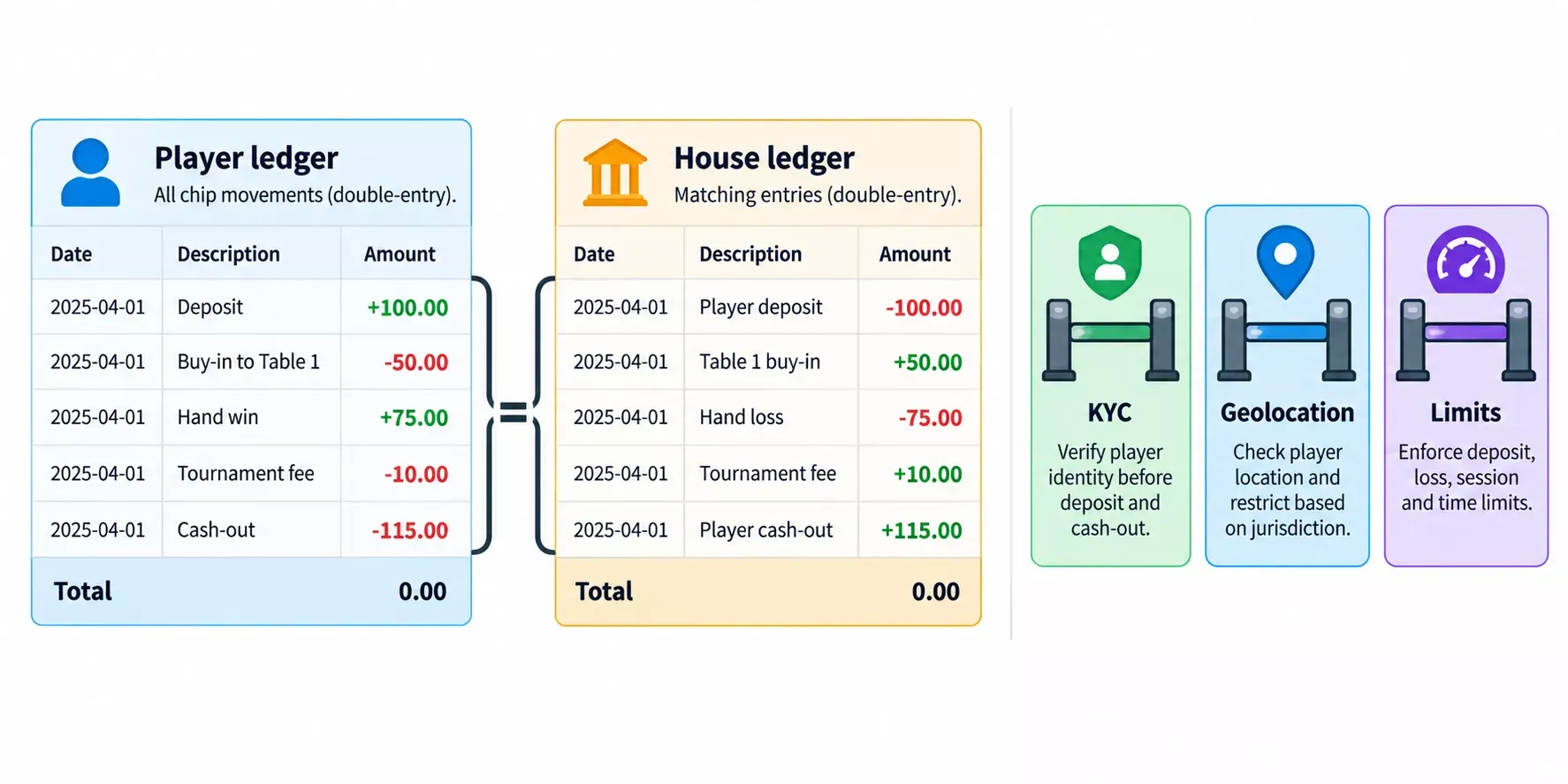
- Chip ledger: write one entry for the player account and one for the house, in a single transaction.
- Deposit and cash-out flows: make each request idempotent, so a retry never pays twice.
- Fiat gateway or crypto wallet: confirm the gateway accepts poker in your target markets before you integrate. Crypto tables need wallet custody and chain monitoring instead.
- KYC gate: verify identity before cash-out, and again when a player's pattern changes.
- Compliance: your licence sets the rest. Plan for age checks, geolocation to block restricted regions, and responsible-gaming limits such as deposit caps and self-exclusion.
Hosting and Infrastructure for a Poker Game
Host game servers in the regions where your players sit, and autoscale by the number of active tables. Network distance adds to every action, so a nearby region keeps the table responsive.
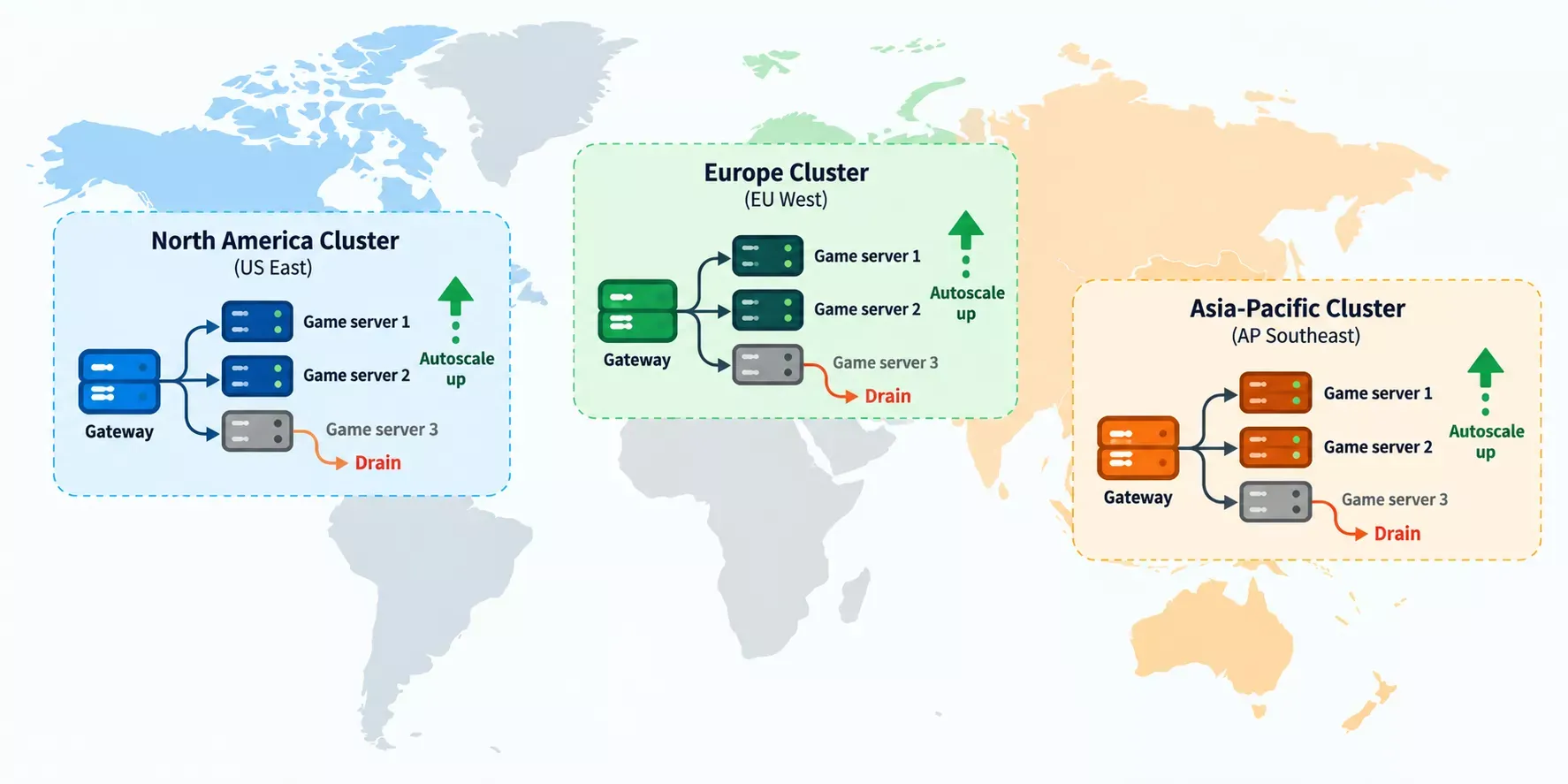
Gateways are stateless and scale out with traffic. Game servers scale by table count.
Drain a server before every deploy. Let running hands finish, then stop it, so no release cuts a hand in half.
Run services in Docker containers on a managed Kubernetes service from a major cloud provider. Scaling and rollouts then repeat the same way each time.
Build from Scratch vs White-label Poker Software
Choose white-label plus custom modules when you want to launch fast with your own features. Choose a custom server when your rules or variants are the product.
|
Option |
Time to launch |
Control over game rules |
Audit and certification scope |
Upgrade freedom |
|---|---|---|---|---|
|
White-label base |
Fastest |
Low: fixed rules and features |
Confirm with the lab what the vendor's certificate covers |
Follows the vendor's roadmap |
|
White-label plus custom modules |
Fast |
Medium: your modules change features |
Base plus your modules |
Moderate |
|
Custom server on a licensed engine |
Slower |
High |
Your server code and RNG, plus the engine as licensed |
High on game logic, tied to the engine licence |
|
Full custom |
Slowest |
Full |
The whole stack |
Full |
Build steps and cost sit in our poker app development guide.
Poker Tech Stack Tools Per Layer
|
Layer |
Default pick |
Alternative |
|---|---|---|
|
Client |
Phaser (HTML5) |
Unity for native mobile with 3D, Flutter or React Native for one codebase |
|
Gateway and game server |
Node.js with TypeScript and WebSockets |
Go, or Elixir with Phoenix |
|
Live table state |
Redis with a replica and append-only persistence |
In-process state with periodic snapshots |
|
Accounts and ledger |
PostgreSQL |
MongoDB for documents |
|
RNG and shuffle |
OS CSPRNG with a Fisher-Yates shuffle |
Hash-committed seed plus player seeds for provably fair crypto tables |
|
Lobby and tournaments |
Separate service on the same stack |
Managed queue for registration events |
|
Fraud controls |
Device fingerprinting plus rules on the hand log |
A learned anomaly model added later |
|
Payments, KYC and compliance |
A licensed gateway, a KYC provider and a geolocation service |
A crypto wallet service for crypto tables |
|
Hosting |
Docker on managed Kubernetes |
A managed container service |
Plan Your Poker Game Development Tech Stack
Bring your target markets and your fiat or crypto plan. Talk to Our Experts for a free 30-minute strategic consultation.
Troniex brings 4+ years in blockchain and AI to custom poker builds, including crypto tables. Our clients rate us at 99.6% satisfaction.