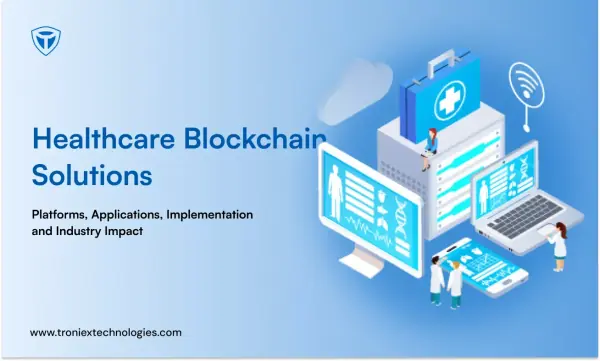
Healthcare Blockchain Solutions: Platforms, Applications, Implementation & Industry Impact
Healthcare blockchain solutions secure medical data, improve interoperability and ensure transparent record sharing through decentralized, tamper-proof systems.
Sep 11, 2026
12 mins read
Solutions using blockchain technology in the health care field have quickly transitioned from an experiment to becoming a necessary part of the infrastructure surrounding health care's digital transformation.
Therefore, the issue at hand is no longer if blockchain has a place in health care; instead, how soon can it be deployed in a responsible, secure, and scalable manner in order to create measurable returns on investment (ROI)?
Solutions are being found through working with a healthcare blockchain development company, one that can assist organizations in developing compliant, tamper-proof systems capable of modernizing health care data management systems, reducing fraud in the industry, and enabling decentralized automation in their operations.
What Is Healthcare Blockchain Technology?
The primary nature of a healthcare blockchain solution is a distributed ledger that captures healthcare transactions or records. These transactions are recorded across multiple nodes (computers or networks). Once a transaction has been recorded, the information cannot be changed or tampered with, unless the entire network of participants agrees to change or tamper with it.
In simple terms:
- It eliminates unauthorized tampering of data.
- It provides for an audit trail that is easy to see.
- It creates a higher level of trust between the participants in the healthcare industry.
Unlike traditional centralized databases used in many healthcare storage solutions, blockchain distributes validation authority across participants.
Blockchain Technology and Healthcare: Core Integration Models
There are generally three types of blockchain models used within the healthcare ecosystem today:
- Public Blockchain: The public blockchains are the most public; however, they are not the most commonly-used for storing and sharing private health information.
- Private Blockchain: The private blockchain systems provide trusted access-controlled environments where only authorized individuals have access to certain data. They are used mostly by hospitals and insurance companies.
- Consortium Blockchain: These blockchains allow various healthcare organizations to work together, but with each one maintaining its own governance of the network.
Most enterprise-grade healthcare blockchain platform deployments use permissioned or consortium models to comply with HIPAA and GDPR.
Healthcare Blockchain Platform Architecture
A serious healthcare blockchain implementation requires more than just a ledger.
Key Components of a Healthcare Blockchain Platform
A robust healthcare blockchain platform typically includes:
- Identity Layer: Decentralized identity (DID) for patients and providers.
- Interoperability Engine: Integration with EHR systems using FHIR APIs.
- Off-Chain Storage: Sensitive files stored securely off-chain, with blockchain hash verification.
- Smart Contracts: Automating claims, billing, and compliance workflows.
This structure strengthens blockchain in healthcare data management by ensuring verifiable access control.
Security, Compliance, and Governance Layers
Healthcare demands strict compliance. Blockchain systems must address:
- Data encryption standards
- Role-based access control
- Immutable audit logs
This transforms traditional healthcare information systems into verifiable and accountable infrastructures.
Blockchain Solutions for Healthcare: Core Revenue-Driving Use Cases
Blockchain solutions for healthcare transform fragmented systems into secure, scalable ecosystems, proving that blockchain in healthcare delivers measurable operational efficiency and revenue growth.
Electronic Health Records Interoperability That Reduces Cost and Risk
Blockchain in healthcare enables secure, shared patient records across providers without duplicating data. Hospitals reduce administrative overhead, prevent costly errors, and accelerate treatment decisions. For investors, interoperable systems mean scalable healthcare software solutions with recurring enterprise revenue potential.
Supply Chain Traceability That Protects Revenue and Brand Trust
Blockchain solutions for healthcare create tamper-proof tracking for pharmaceuticals and medical devices. Companies reduce counterfeit risk, improve recall efficiency, and meet regulatory requirements. The result is stronger brand credibility, lower compliance exposure, and measurable savings across global supply networks.
Credentialing and Provider Verification That Cuts Onboarding Time
Verifying doctors and medical staff is slow and expensive. Blockchain in healthcare records immutable credentials, licenses, and certifications in one trusted ledger. Hospitals shorten hiring cycles, reduce fraud risk, and streamline cross-border staffing in competitive healthcare markets.
Decentralized Health Insurance Blockchain for Automated Claims
Blockchain solutions for healthcare automate insurance verification and claims processing using smart contracts. Insurers reduce fraud, accelerate settlements, and lower administrative costs. Faster payouts improve provider cash flow while creating scalable, data-driven insurance ecosystems ready for global expansion.
Blockchain Medical Applications in Practice
Healthcare blockchain applications move beyond theory, delivering secure automation, regulatory confidence, and scalable healthcare blockchain solutions that drive measurable enterprise growth.
Patient Data Ownership & Consent Management for Secure, Compliant Access
Healthcare blockchain applications enable self-sovereign identity models where patients control record access through smart contract development. Providers gain verifiable consent trails, regulators gain transparency, and enterprises reduce breach liability while strengthening trust across digital healthcare blockchain solution ecosystems.
Clinical Trial Transparency That Protects Data Integrity and Investor Confidence
Blockchain timestamps clinical trial data, preventing post-study manipulation and ensuring protocol transparency. Sponsors strengthen regulatory compliance, reduce disputes, and increase investor confidence. These healthcare blockchain solutions create trustworthy research environments that accelerate approvals and global collaboration.
Remote Monitoring & IoT Integration for Scalable Digital Care
Wearables and remote devices generate sensitive health data daily. Blockchain in healthcare secures device authentication, validates telemetry integrity, and supports cross-border telemedicine. Enterprises reduce fraud risk while scaling chronic care programs through a reliable healthcare blockchain application infrastructure.

Start Your Blockchain Healthcare Journey Today
Book a consultation, request a demo, or join our newsletter for insights on healthcare blockchain applications and global digital health trends.
Talk To Our ExpertsBlockchain Impact on Healthcare Systems
Blockchain technology in healthcare transforms fragmented operations into secure, revenue-protecting ecosystems, enabling healthcare software solutions that reduce waste, strengthen compliance, and create a sustainable competitive advantage.
Cost Reduction & Operational Efficiency
Administrative waste accounts for billions in healthcare losses annually, and inefficiency is no longer affordable.
Blockchain technology in healthcare automates verification, reconciliation, and data exchange across healthcare software solutions, replacing manual processes with trusted digital workflows.
- Lower claims processing costs
- Reduced duplicate testing and billing errors
- Automated settlements through smart contracts
- Faster cross-organization data sharing without expensive intermediaries
Improved Patient Outcomes
In healthcare, speed and accuracy directly influence outcomes, and outcomes define reputation.
Blockchain technology in healthcare enables real-time access to verified patient data across healthcare software solutions, ensuring clinicians make decisions based on complete, tamper-proof records.
- Fewer medical errors from incomplete histories
- Faster diagnoses through interoperable systems
- Secure cross-border data exchange for global care
- Higher patient satisfaction is driving long-term brand loyalty
Enhanced Transparency & Trust
In healthcare, trust equals brand value, and trust is measurable.
By embedding auditability into healthcare software solutions, blockchain technology in healthcare creates immutable records that regulators, insurers, and patients can independently verify.
- Stronger HIPAA and GDPR compliance posture
- Reduced fraud and billing manipulation
- Transparent clinical and insurance audit trails
- Increased investor and stakeholder confidence in operational integrity
How to Implement Healthcare Blockchain Solutions: A Practical, ROI-Driven Roadmap
A step-by-step roadmap showing how healthcare blockchain solutions integrate with existing healthcare software solutions to reduce risk and accelerate enterprise growth.
Step 1: Feasibility Assessment: Is Blockchain the Right Strategic Fit?
Start with clarity and validate business value, technical readiness, and regulatory alignment before investing capital.
- Business case validation
- Regulatory impact analysis (HIPAA, GDPR, regional laws)
- Infrastructure readiness review
- ROI and risk modelling
A feasibility assessment evaluates operational bottlenecks such as claims fraud, data silos, or supply chain inefficiencies. It also reviews how existing healthcare software solutions are structured and whether integration is realistic without major disruption.
Step 2: Pilot Deployment: Prove Value Before Scaling
Launch a controlled pilot to demonstrate measurable ROI and operational improvement.
- Limited-scope use case selection
- Smart contract configuration
- Performance benchmarking
- Stakeholder feedback loop
A pilot program transforms strategy into proof. Instead of overhauling entire healthcare information systems, organizations begin with focused use cases such as insurance claims automation, provider credential verification, or secure patient identity management.
Step 3: Integration with Existing Healthcare Software Solutions
Ensure seamless interoperability between blockchain infrastructure and current healthcare software solutions to protect operational continuity.
- API-driven architecture
- Data migration strategy
- Interoperability testing
- Cybersecurity reinforcement
The biggest fear among hospital networks and insurers is disruption. Integration must be smooth, secure, and scalable. Healthcare blockchain solutions should not replace existing systems overnight; instead, they enhance them.
Step 4: Governance & Compliance: Build Trust at Enterprise Scale
Design governance frameworks that ensure regulatory compliance, auditability, and long-term scalability.
- Permissioned access controls
- Data residency compliance mapping
- Third-party security audits
- Ongoing regulatory monitoring
Governance frameworks define who can access data, how consent is managed, and how disputes are resolved. Permissioned blockchain models allow healthcare blockchain solutions to maintain transparency without exposing sensitive patient data publicly.
Challenges of Blockchain in Healthcare
Healthcare blockchain solutions promise efficiency, but integration with existing healthcare software solutions exposes scalability, regulatory, and adoption barriers that demand strategic execution.
Scalability Limitations
Healthcare generates massive data volumes, and public blockchains struggle with transaction speed and storage limits. Enterprises must adopt permissioned networks and hybrid architectures to maintain performance while protecting long-term scalability and cost control.
Regulatory Complexity
Blockchain immutability can conflict with “right to erasure” laws under GDPR and similar regulations. Organizations mitigate risk through off-chain storage, encryption key destruction, and governance frameworks aligned with evolving healthcare compliance standards.
Organizational Resistance
Healthcare institutions are risk-averse and cautious with infrastructure change. Training costs, workflow disruption, and cultural resistance slow adoption, requiring phased rollouts, executive sponsorship, and measurable ROI to justify healthcare blockchain solutions investment decisions.
Blockchain in Healthcare Applications: Research, Challenges, and Opportunities
Research-backed insights show that healthcare blockchain solutions strengthen healthcare software while unlocking scalable revenue, compliance confidence, and competitive global growth.
Research-Backed Validation of Healthcare Blockchain Solutions
Peer-reviewed studies confirm measurable security, transparency, and efficiency gains across real healthcare deployments.
Academic and industry research shows blockchain in healthcare improves data integrity, reduces fraud, and increases interoperability across fragmented systems. Pilot programs in the US and UK demonstrate faster claims processing and stronger auditability. However, studies also highlight scalability and governance gaps, reinforcing why carefully designed healthcare blockchain solutions outperform rushed implementations within existing healthcare software solution environments.
- Up to 30% reduction in administrative reconciliation costs in pilot insurance models
- Improved clinical data traceability across multi-site research environments
- Stronger HIPAA/GDPR audit readiness through immutable logs
- Clear evidence that hybrid architectures outperform fully on-chain storage models
Emerging Revenue Opportunities for Growth-Focused Founders
New verticals are forming where blockchain in healthcare creates defensible, high-margin infrastructure businesses.
For founders and enterprises, the opportunity extends beyond compliance. Healthcare blockchain solutions are powering decentralized identity networks, automated insurance platforms, secure health data exchanges, and cross-border telemedicine verification layers. As healthcare software solutions modernize globally, blockchain becomes the trust backbone enabling premium enterprise services and recurring SaaS revenue.
- Tokenized patient consent platforms enabling data monetization partnerships
- Fraud-resistant insurance automation is reducing billions in annual leakage
- Enterprise-grade blockchain APIs integrated into existing healthcare software solutions
Organizations that invest early position themselves not just as technology adopters but as infrastructure leaders in the next generation of global digital healthcare.
ROI Analysis & Business Case in Healthcare Blockchain Solutions
Discover measurable ROI from healthcare blockchain solutions that reduce fraud, automate compliance, and modernize healthcare software solutions for scalable enterprise growth.
Healthcare organizations do not invest in innovation for headlines. You invest for margin protection, operational control, and competitive advantage. Administrative waste, fraud leakage, compliance penalties, and inefficient reconciliation processes silently erode profitability every year.
- Reduced Claims Processing Costs
- Lower Fraud Rates and Revenue Leakage
- Faster Compliance Audits and Regulatory Confidence
- Improved Operational Efficiency Across Departments
- Long-Term Enterprise Savings Through Intelligent Automation
Industry Best Practices for Blockchain Solutions for Healthcare
Proven governance, security, and interoperability frameworks ensure that blockchain technology in healthcare delivers scalable, compliant, high-trust blockchain in healthcare deployments globally.
Healthcare leaders exploring blockchain technology in healthcare must move beyond experimentation and focus on disciplined execution. Strong best practices reduce risk, accelerate ROI, and transform blockchain in healthcare from pilot projects into enterprise-grade infrastructure.
Consortium-Based Governance Models
Shared governance ensures accountability across hospitals, insurers, and technology partners while reducing single-point control risks in blockchain networks.
Consortium governance distributes decision-making across trusted stakeholders, preventing centralization risks while aligning incentives. For enterprises, this model strengthens compliance oversight, improves dispute resolution, and builds investor confidence in blockchain in healthcare deployments.
Interoperability Standards Adoption
Standardized data frameworks allow blockchain networks to integrate seamlessly with existing healthcare systems and third-party platforms.
Adopting FHIR and API-based architectures ensures that blockchain technology in healthcare integrates with legacy systems without disruption. Interoperability reduces vendor lock-in, accelerates onboarding, and enables scalable healthcare partnerships across the global markets.
Cybersecurity Risk Mitigation Frameworks
Blockchain is secure, but endpoints are not, making layered security strategies essential for enterprise healthcare environments.
Strong encryption, identity management, and third-party audits protect healthcare data beyond the blockchain layer. Enterprises implementing healthcare blockchain solutions reduce breach exposure, satisfy regulators, and create measurable trust advantages in competitive markets.
Future Outlook: The Evolution of Blockchain Technology in Healthcare
Healthcare leaders face rising data breaches, fragmented records, and costly compliance delays. Healthcare blockchain solutions are rapidly becoming the secure trust layer powering next-generation healthcare software solutions and modern healthcare information systems.
As healthcare blockchain applications mature, enterprises gain real-time interoperability, automated claims validation, and audit-ready transparency. Founders and investors who act now can capture market share, reduce operational risk, and build scalable digital infrastructure.
The future belongs to organizations deploying blockchain strategically, not experimentally.
Why Choose Troniex for the Right Healthcare Blockchain Platform
Troniex helps you modernize complex healthcare information systems with secure, scalable healthcare blockchain solutions built for enterprise growth.
We design interoperable healthcare software solutions that reduce compliance risk, strengthen data security, and streamline operations without disrupting existing infrastructure.
Our expertise in deploying production-ready healthcare blockchain applications enables faster audits, lower fraud exposure, and measurable ROI. If you are ready to transform compliance burdens into a competitive advantage, Troniex delivers the strategic foundation to scale confidently and profitably.
Talk to Our Healthcare Blockchain Experts
Get a customized roadmap tailored to your market, compliance requirements, and scalability goals.
Contact